
In the dynamic landscape of modern digital interaction, the journey a user takes from discovery to engagement is paramount. We navigate a world where information resides not just on websites, but increasingly within specialized mobile applications designed to offer richer, more focused experiences. Bridging the gap between these disparate environments is a critical technical challenge, and at the heart of its solution lies a concept often referred to as an “app linker,” more formally known as deep linking or app linking. This technology serves as the digital connective tissue, allowing users to seamlessly transition from a web browser, an email, or another application directly into specific content within a native mobile app, transforming what could be a cumbersome detour into a fluid, intuitive experience.
The Core Concept: Seamless Navigation Across Digital Experiences
Imagine clicking a link for a specific product review on a website, only to be redirected to the home screen of the corresponding e-commerce app, forcing you to navigate through several steps to find that very product again. This common friction point highlights the fundamental problem that app linking seeks to resolve. In an era where mobile apps are the preferred mode of interaction for countless services and content providers, the ability to direct users precisely where they intend to go within an app is no longer a luxury but a necessity for an optimal user experience.
Beyond Simple URLs: The Need for Deep Linking
Traditional web links, or Uniform Resource Locators (URLs), are designed to point to specific pages or resources on the internet. They operate within a browser environment, directing users to web content. However, mobile applications, while often connected to web services, are distinct ecosystems. They reside on a device, offering native performance, specialized interfaces, and often offline capabilities that a browser cannot replicate. The challenge arises when a user discovers content on the web – perhaps through a search engine, a social media post, or an advertisement – and that content also exists within a related mobile app. Without a mechanism to intelligently “link” these two worlds, users are often left with a disjointed experience: either opening a mobile web version (if available) or being dumped onto an app’s generic launch screen.
This problem of user experience is magnified by the expectation of instant gratification. Every extra tap, every moment of confusion, increases the likelihood of user abandonment. App linking provides the solution, acting as a sophisticated router that understands not just where to go (the app itself), but what to present upon arrival (specific content or functionality within that app).
Defining App Linker (Deep Linking)
At its essence, an app linker, or deep link, is a specialized type of URL that points directly to content inside a mobile application. Instead of directing a user to a website (e.g., https://www.example.com/products/item123), a deep link can direct them to a specific product page within an installed application (e.g., exampleapp://products/item123). When a user clicks such a link, the operating system (iOS or Android) intercepts it, determines which app is registered to handle that particular link structure, and then opens the app to the designated content.
The primary goal is to bypass the app’s default home screen and take the user straight to the desired view, whether it’s a product detail page, a user profile, a specific article, or a checkout flow. This direct access significantly streamlines the user journey, making interactions more efficient and satisfying. For example, if a user clicks a link for a specific song in an email, an app linker would open the music streaming app directly to that song’s playback page, rather than to the app’s general music library.
Types and Technologies of App Linking
The evolution of app linking has seen several generations of technology, each addressing limitations of its predecessors, enhancing reliability, and improving the overall user experience.
Traditional Deep Links (URI Schemes)
The earliest and most straightforward form of deep linking involves custom Uniform Resource Identifier (URI) schemes. Developers define a unique scheme for their app (e.g., myapp://, facebook://, spotify://), which is then registered with the mobile operating system. When a link with this scheme is tapped (e.g., myapp://product/123), the OS checks if an installed app has registered to handle myapp:// and, if so, passes the rest of the URI (product/123) to the app for processing.
Pros: Simple to implement and widely supported across older OS versions.
Cons: If the app is not installed, the link typically fails silently, does nothing, or produces an error. There’s also a risk of scheme conflicts if multiple apps try to register the same common scheme. They also lack a graceful fallback mechanism.
Android App Links and iOS Universal Links
To address the shortcomings of traditional URI schemes, both Google and Apple introduced more robust, web-based deep linking mechanisms: Android App Links (for Android 6.0+) and iOS Universal Links (for iOS 9+). These technologies represent a significant advancement because they use standard HTTP/HTTPS URLs (e.g., https://www.example.com/products/item123) that are also valid web links.
The key innovation here is verification. Developers establish a secure association between their web domain and their mobile app.
- Android App Links utilize a
digital_asset_links.jsonfile hosted on the web server, which contains cryptographic signatures of the app. - iOS Universal Links use an
apple-app-site-associationfile, also hosted on the web server, to declare which paths on the domain correspond to specific app content.
When a user taps an HTTP/HTTPS URL that has been configured as an App Link or Universal Link, the operating system first checks if the corresponding app is installed and if the domain-app association is verified. If both conditions are met, the app opens directly to the specified content. If the app is not installed, or if the association fails, the link gracefully falls back to opening the URL in the mobile web browser. This ensures a consistent and reliable user experience, regardless of app installation status.
Deferred Deep Linking
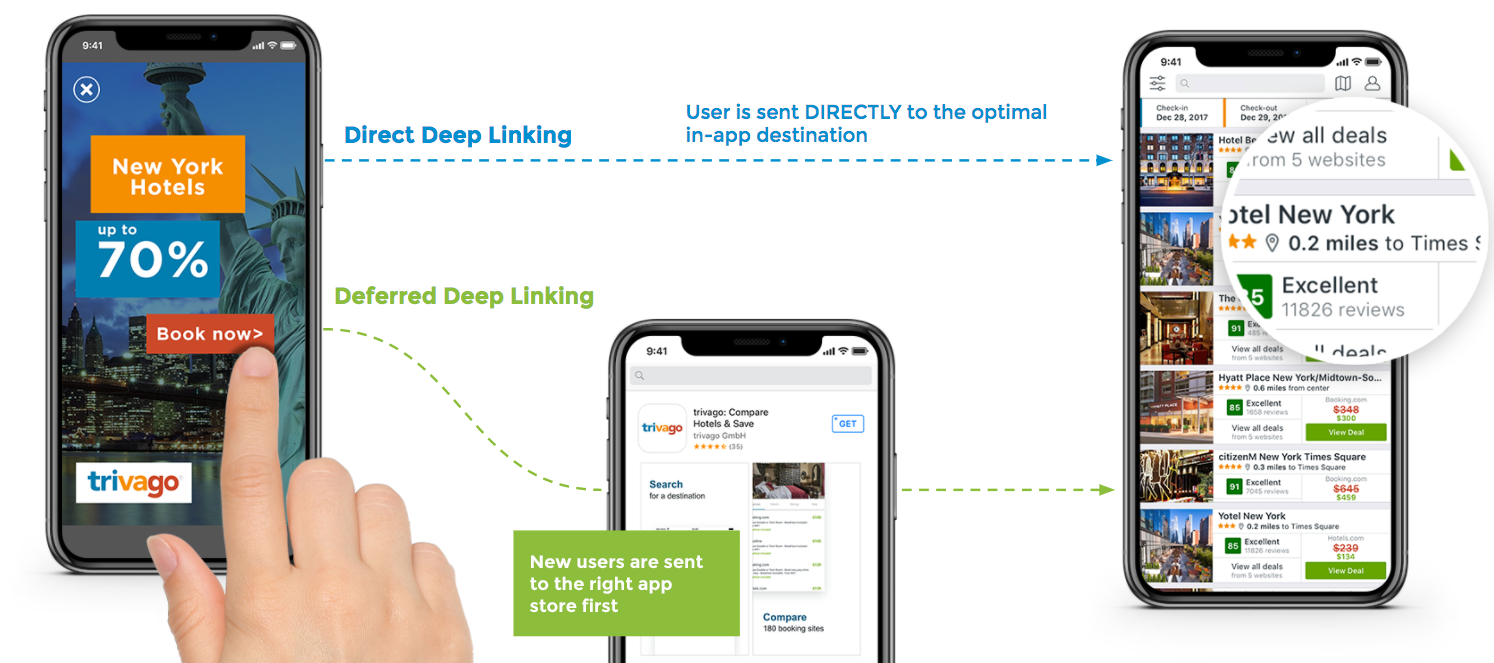
Deferred deep linking addresses the scenario where a user clicks a deep link but does not yet have the app installed. Instead of failing or simply opening the mobile website, a deferred deep link first redirects the user to the appropriate app store (Google Play Store or Apple App Store). After the user downloads and installs the app, the app can then retrieve the original deep link parameters and navigate the user to the intended content after the first launch.
This requires a sophisticated tracking mechanism, often managed by third-party deep linking services (like Branch, AppsFlyer, Adjust). These services employ device fingerprinting or other identifiers to “remember” the user’s initial intent across the app store download/install process. Deferred deep linking is crucial for marketing campaigns, allowing for a seamless transition from an ad click to an in-app experience, even for new users.
Contextual Deep Linking
Contextual deep linking extends the concept further by not only directing users to specific content but also passing additional data and context along with the link. This data can include referrer information (e.g., which user shared the link), A/B testing parameters, discount codes, or personalized onboarding instructions.
For instance, if a user shares an app link with a friend, the contextual deep link could not only take the friend to the specific content but also automatically apply a referral bonus to both users’ accounts upon the friend’s first interaction with the app. This adds a layer of personalization and functionality that goes beyond mere navigation, enabling richer, more dynamic user journeys.
The Benefits of Implementing App Linkers
The strategic implementation of app linkers yields a multitude of benefits for both users and businesses, touching upon user experience, marketing effectiveness, and data analytics.
Enhanced User Experience
The most immediate benefit is a significantly improved user experience. By removing friction points, app linkers create a smooth and intuitive flow from discovery to engagement. Users are no longer forced to manually search for content they’ve already identified, leading to greater satisfaction, reduced frustration, and a higher likelihood of continued app usage. This seamless navigation fosters a sense of efficiency and sophistication in digital interactions.
Improved Marketing and Conversion Rates
For marketers, app linkers are an indispensable tool. They allow campaigns to direct users precisely to the most relevant in-app content, maximizing the chances of conversion. Whether it’s a social media ad promoting a specific product, an email announcing a new feature, or a push notification leading to a limited-time offer, deep links ensure that every click leads directly to the desired action. This precision translates into higher conversion rates for e-commerce, subscriptions, content consumption, and user sign-ups, effectively shortening the conversion funnel.
Advanced Analytics and Attribution
App linking provides invaluable data for analytics and attribution. By tracking which deep links are clicked, from what sources, and what actions users take post-click, businesses gain deep insights into the effectiveness of their marketing channels and content strategies. This granular data allows for accurate ROI measurement, enabling optimization of marketing spend and a clearer understanding of the customer journey across web and app touchpoints. Tools that manage app links often integrate with analytics platforms, providing a comprehensive view of user behavior.
SEO for Apps (App Indexing)
App linkers play a crucial role in “app indexing,” allowing search engines like Google to crawl and index content within mobile apps. When app content is indexed, it can appear in Google search results, often alongside web results, with options to open the content directly in the app. This drives organic traffic to apps, enhancing discoverability and increasing user acquisition without direct advertising spend. For businesses with rich app content, app indexing via deep links is a powerful SEO strategy.
Challenges and Best Practices
While the benefits are clear, implementing and managing app linkers effectively comes with its own set of technical complexities and considerations.
Implementation Complexity
Setting up Android App Links and iOS Universal Links involves configuring server-side files (like digital_asset_links.json and apple-app-site-association), modifying app manifest files, handling different operating system versions, and writing robust in-app logic to parse and navigate based on incoming link data. This can be intricate, requiring coordination between front-end, back-end, and mobile development teams.
Ensuring Reliability and Fallbacks
A critical challenge is ensuring that deep links work reliably across all scenarios. This includes testing on various devices, OS versions, and network conditions. Robust error handling is essential, as is implementing thoughtful fallback mechanisms. If the app isn’t installed, or if there’s an issue with the link, users should be gracefully redirected to the app store, a relevant mobile web page, or a clear explanation, rather than encountering a broken experience.
Security Considerations
As deep links can launch applications with specific content, security is paramount. Malicious actors could potentially craft deep links to exploit vulnerabilities or redirect users to unintended content. Developers must validate incoming link parameters, sanitize any user-provided input, and ensure that only authorized domains can trigger app links, especially for Universal and App Links which rely on domain verification.
Best Practices for Developers and Marketers
- Plan Your Structure: Design a logical and scalable deep link URI structure that mirrors your app’s navigation and content hierarchy.
- Test Thoroughly: Test deep links exhaustively across all supported devices, OS versions, installation states, and originating sources (email, social media, web).
- Utilize Third-Party Tools: For complex scenarios, especially involving deferred deep linking, attribution, and cross-platform management, consider leveraging specialized deep linking platforms that abstract away much of the underlying complexity.
- Provide Clear User Journeys: Ensure that the user experience after clicking a deep link is intuitive and meets expectations.
- Monitor and Analyze: Continuously monitor deep link performance and integrate with analytics to track engagement and conversion.
The Future of App Linking
The trajectory of app linking points towards even greater sophistication and seamlessness. As digital ecosystems become more interconnected, we can expect further integration between web, native apps, and emerging platforms like voice assistants, augmented reality interfaces, and wearable technology. Contextual understanding will deepen, allowing for hyper-personalized experiences driven by a user’s history, preferences, and real-time environment. App linking will continue to be a foundational technology for driving user acquisition, engagement, and retention, evolving to support ever more complex and intuitive digital interactions. The goal remains constant: to make the digital journey as direct, efficient, and delightful as possible.
aViewFromTheCave is a participant in the Amazon Services LLC Associates Program, an affiliate advertising program designed to provide a means for sites to earn advertising fees by advertising and linking to Amazon.com. Amazon, the Amazon logo, AmazonSupply, and the AmazonSupply logo are trademarks of Amazon.com, Inc. or its affiliates. As an Amazon Associate we earn affiliate commissions from qualifying purchases.