
In the intricate world of brand communication, every word, phrase, and sentence contributes to the overarching narrative and perception of a company or individual. While creative flair and compelling storytelling often take center stage, the foundational elements of language — specifically, proper sentence structure — are the unsung heroes that build credibility, clarity, and authority. An incomplete sentence, often overlooked or dismissed as a minor grammatical slip, can silently erode a brand’s professionalism, confuse its audience, and dilute its message. Understanding what constitutes an incomplete sentence and, more importantly, why it matters for your brand is critical for anyone looking to build a robust, respected, and effective communication strategy.
The Anatomy of a Complete Sentence in Branding
At its core, a complete sentence is a self-sufficient unit of thought. It conveys a full idea and can stand alone as grammatically sound. This self-sufficiency is paramount for brands aiming for crystal-clear communication.
Subject-Verb Agreement: The Core
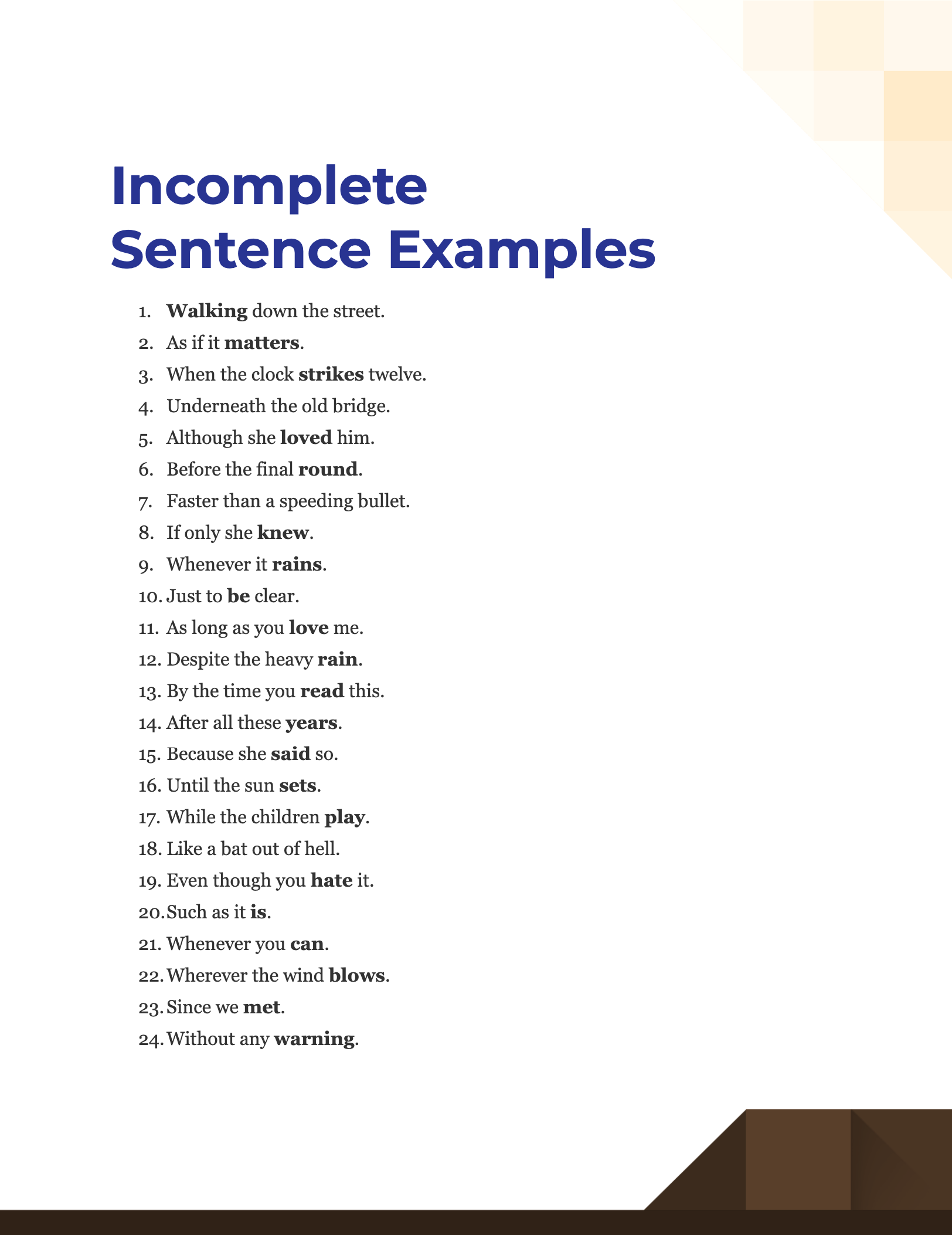
Every complete sentence requires at least two fundamental components: a subject and a predicate (which typically contains a verb). The subject is who or what the sentence is about, and the predicate tells us what the subject is doing or what is being said about the subject. For example, in “Our brand innovates,” “Our brand” is the subject, and “innovates” is the verb. Both are present, forming a complete thought. An incomplete sentence, or fragment, often lacks one or both of these essential parts. Consider “Innovating for tomorrow.” This phrase lacks a clear subject; who is innovating? Without this, the thought remains unfinished, leaving the audience to fill in the gaps.
Independent Clause: The Self-Sufficiency Test
Beyond just a subject and a verb, a complete sentence must be an independent clause. This means it expresses a complete thought and can stand alone. Dependent clauses, while containing a subject and a verb, cannot stand alone because they are introduced by a subordinating conjunction (like “because,” “although,” “while,” “if”) and require an independent clause to complete their meaning. For instance, “Because we prioritize customer experience” is a dependent clause. It has a subject (“we”) and a verb (“prioritize”), but the word “because” makes it reliant on further information. “Because we prioritize customer experience, our customer loyalty is unmatched” provides the necessary independent clause, completing the thought and delivering a full message that resonates with brand values.
Why Incomplete Sentences Undermine Your Brand
The occasional sentence fragment might seem harmless, but its cumulative effect on a brand’s communication can be significant and detrimental. In the competitive landscape of branding, precision and clarity are not just preferences; they are necessities.
Eroding Credibility and Professionalism
When a brand consistently uses incomplete sentences, it inadvertently signals a lack of attention to detail or even a lack of respect for its audience. This can severely damage credibility. Imagine a luxury brand’s website filled with fragments, or a financial institution’s marketing materials riddled with grammatical errors. The impression conveyed is one of sloppiness, unprofessionalism, and unreliability. Customers expect brands, especially those they trust with their money, data, or personal image, to communicate with precision and polish. Grammar, in this context, is a subtle yet powerful indicator of a brand’s overall commitment to excellence.
Creating Ambiguity and Confusion
Incomplete sentences inherently leave gaps in meaning. When a brand’s message is fragmented, the audience is forced to interpret or guess the intended meaning, leading to ambiguity and potential confusion. For example, a social media post that reads, “Innovative new features. Coming soon!” might generate initial interest but lacks the full context of what these features are for, who they benefit, or even which product they belong to. While some intentional ambiguity can be used for suspense, persistent vagueness due to incomplete sentences hinders clear understanding of product benefits, service offerings, or brand values, ultimately frustrating the audience and weakening the message’s impact.
Diminishing Impact and Persuasion
Effective branding is about telling a compelling story and persuading an audience. Complete sentences, with their inherent structure and flow, allow for a clear articulation of ideas, arguments, and calls to action. Incomplete sentences, by breaking this flow, can diminish the persuasive power of content. A powerful marketing slogan, a well-structured argument in a thought leadership piece, or a clear directive in a call-to-action all rely on complete, coherent sentences to convey their full weight. When messages are fragmented, their punch is lost, and the brand’s ability to influence decisions and build lasting connections is compromised.
Common Pitfalls: Where Brands Often Go Astray

Even well-intentioned brands can fall victim to using incomplete sentences, often in specific contexts where speed or conciseness is prioritized.
The Social Media Snippet Trap
Social media platforms, with their character limits and fast-paced nature, often encourage brevity. This can lead to the overuse of fragments. While a short, punchy phrase might seem impactful, consistently sacrificing grammatical completeness for conciseness can backfire. “Best quality. Ever.” lacks the authoritative voice of “We consistently deliver the best quality products, setting a new standard for excellence.” Brands must find a balance, ensuring that even short-form content conveys complete thoughts, perhaps through strategic sentence construction or by pairing fragments with strong visuals that provide context.
Over-reliance on Bullet Points and Fragments
Bullet points are excellent for readability and breaking down complex information. However, content within bullet points should still strive for completeness, or at least be clearly understood within the context of the main sentence introducing the list. A list of features that are just single words or disjointed phrases without a clear grammatical connection to a preceding statement can leave readers feeling like they’ve received a list of keywords rather than meaningful benefits. For example, instead of just “Innovation. Efficiency. Reliability.”, consider “Our solutions are characterized by: Innovation that drives progress, Efficiency that saves resources, and Reliability that builds trust.”
Neglecting Proofreading in Marketing Copy
In the rush to launch campaigns or publish content, proofreading is sometimes minimized or skipped entirely. This is a critical error for brand communication. Marketing copy, website content, email newsletters, and press releases are often the first, and sometimes only, interactions a potential customer has with a brand. Errors, including incomplete sentences, can undermine the professionalism of these crucial touchpoints, creating a negative first impression that is hard to overcome.
Crafting Clearer Brand Messages: Strategies for Completeness
Ensuring your brand’s communication is grammatically sound, particularly in avoiding incomplete sentences, is an ongoing commitment to excellence. Several strategies can help brands maintain this high standard.
Intentional Sentence Construction
Consciously constructing complete sentences involves identifying the subject and verb of each thought and ensuring it expresses a full idea. When drafting content, especially for key marketing materials, take a moment to pause and ask: “Who or what is doing what?” If the answer isn’t immediately clear within the sentence, it likely needs adjustment. This intentional approach helps to build a habit of clearer, more precise writing.
The Power of the Pause: Reading Aloud
One of the most effective techniques for identifying incomplete sentences and other grammatical issues is to read your content aloud. When spoken, incomplete thoughts or awkward phrasing become much more apparent. Your ear often catches what your eye might miss, helping you identify sentences that don’t flow naturally or don’t convey a full idea. This simple practice can significantly enhance the clarity and impact of your brand’s message.
Leveraging Editorial Tools and Expertise
While understanding grammar is essential, modern brands can also benefit from technological assistance. Grammar checking software can highlight potential sentence fragments and suggest improvements. However, these tools are not infallible. The ultimate safeguard against incomplete sentences and other errors is human expertise. Investing in professional copywriters and editors who specialize in brand voice and grammatical precision ensures that your message is not only accurate but also strategically impactful and aligned with your brand identity. Their nuanced understanding can refine your content beyond what automated tools can achieve.

The ROI of Grammatical Precision for Your Brand
In an age where digital noise makes it harder for brands to cut through, clarity, credibility, and professionalism are invaluable assets. Avoiding incomplete sentences is not merely about adhering to arbitrary rules; it’s about safeguarding your brand’s reputation, enhancing its message’s effectiveness, and fostering trust with your audience.
Every complete, well-constructed sentence contributes to a coherent brand narrative, builds confidence, and reinforces the brand’s authority. This precision translates directly into tangible returns: higher engagement rates, improved conversion rates, stronger customer loyalty, and ultimately, a more influential and respected brand presence. By mastering the fundamental elements of language, brands can ensure their voice is not just heard, but understood, trusted, and remembered.
aViewFromTheCave is a participant in the Amazon Services LLC Associates Program, an affiliate advertising program designed to provide a means for sites to earn advertising fees by advertising and linking to Amazon.com. Amazon, the Amazon logo, AmazonSupply, and the AmazonSupply logo are trademarks of Amazon.com, Inc. or its affiliates. As an Amazon Associate we earn affiliate commissions from qualifying purchases.