
The financial landscape for employees and employers in the United States is intrinsically linked through a series of mandated tax documents, with the Form W-2, Wage and Tax Statement, being paramount. However, human error, changes in circumstances, or administrative oversights can necessitate revisions to this critical document. This is where the Form W-2C, or Corrected Wage and Tax Statement, comes into play, serving as an indispensable tool for maintaining accuracy in financial reporting and compliance with the Internal Revenue Service (IRS). Understanding the nuances of the W-2C is crucial for both individuals managing their personal finances and businesses fulfilling their tax obligations.
Understanding the W-2 Form’s Foundation
Before delving into the specifics of a W-2C, it’s essential to grasp the foundational role of the original W-2 form. This document is a cornerstone of American personal finance and tax compliance, issued annually by employers to their employees and to the Social Security Administration (SSA).
The Original W-2: A Core Document for Employees
Form W-2 summarizes an employee’s annual wages and the amount of taxes withheld from their paycheck for federal income tax, state income tax, Social Security, and Medicare. Employers are legally required to provide a W-2 to each employee by January 31st of the following calendar year, detailing earnings and withholdings for the prior year. This form is then used by employees to file their individual income tax returns, serving as primary evidence of their income and taxes paid throughout the year. Without an accurate W-2, an individual cannot correctly report their income, claim applicable refunds, or determine their tax liability.
Employer Responsibilities and Employee Expectations
Employers bear the significant responsibility of accurately reporting wages and tax withholdings to both their employees and the SSA. This involves meticulous payroll management, accurate calculations, and timely submission of W-2 forms. Errors on the employer’s part can lead to discrepancies that impact an employee’s tax filing, potential IRS audits, or even penalties for non-compliance. Employees, in turn, are expected to review their W-2 forms carefully upon receipt, comparing the reported figures against their pay stubs and personal records to identify any potential inaccuracies. This initial review is the first line of defense against future tax complications.
The Purpose and Necessity of a W-2C Form
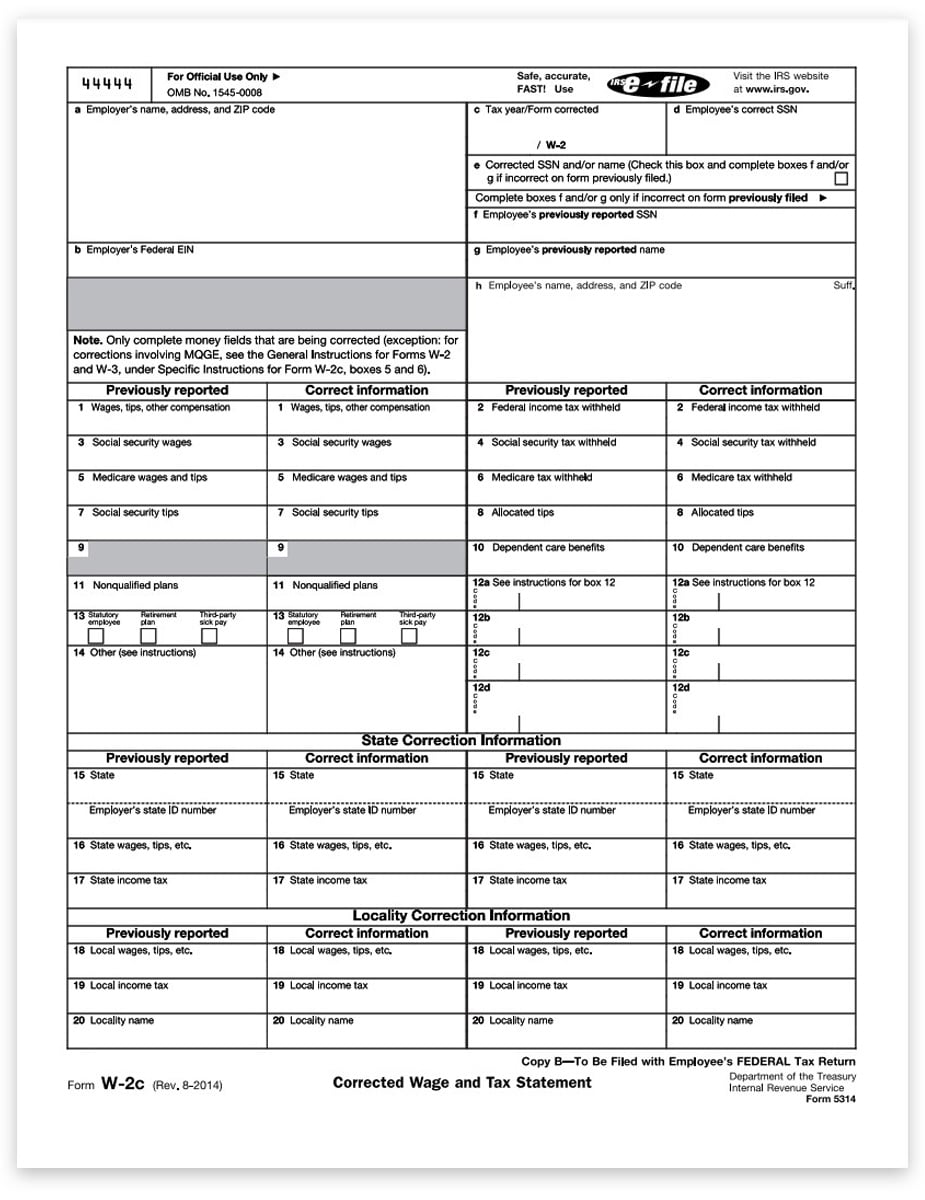
Despite best efforts, mistakes can happen. When an error is identified on an already issued W-2 form, the employer must correct it. This is the precise purpose of the Form W-2C. It is not an entirely new W-2 but rather a specific document designed to amend previously submitted information, ensuring that both the employee and the SSA have the correct financial records.
When and Why a Correction is Needed
A W-2C becomes necessary for various reasons, all stemming from an inaccuracy on the original W-2. Identifying these common discrepancies can help both parties understand when to expect or initiate a correction.
Incorrect Wages or Tax Withholdings
Perhaps the most common reason for a W-2C is an error in the reported wages (Box 1) or in the amounts withheld for federal income tax (Box 2), Social Security tax (Box 4), or Medicare tax (Box 6). These errors can arise from payroll calculation mistakes, incorrect year-end adjustments, or misclassification of certain types of compensation (e.g., bonuses, fringe benefits). An underreporting of wages could lead to an employee owing more tax, while over-reporting might result in an unjustified refund. Similarly, incorrect tax withholdings directly impact an employee’s tax liability or refund entitlement.
Mismatched Social Security Number or Name
Errors in an employee’s Social Security Number (SSN) or name are critical. The IRS and SSA rely on accurate SSN-name combinations to match income to individuals. A mismatch can flag the tax return, delay processing, or even lead to issues with future Social Security benefits. This type of error must be corrected promptly to avoid significant administrative hurdles.
Wrong Employer Identification Number (EIN)
Just as an employee’s SSN is crucial, an employer’s EIN (Box b) is vital for proper reporting. If the EIN on a W-2 is incorrect, it means the wages and taxes are being attributed to the wrong entity, potentially causing problems for both the employer and the employee in demonstrating compliance and income sources.
Other Discrepancies (e.g., Box 12 Codes)
Form W-2 includes various boxes (e.g., Box 12 with codes like ‘D’ for 401(k) contributions, ‘W’ for HSA contributions) that report other types of compensation or benefits. Errors in these boxes, such as miscoded retirement contributions or incorrect amounts for health savings accounts, can impact an employee’s deductions, adjusted gross income, and overall tax strategy. A W-2C ensures these specific details are accurately reflected.
Impact on Tax Filings and Financial Obligations
An incorrect W-2 can have significant ramifications for an individual’s tax filing. If an employee files their tax return using an erroneous W-2, their return will be based on inaccurate information. This can lead to the IRS sending a notice requiring clarification, an underpayment of taxes (leading to penalties and interest), or an overpayment that delays a rightful refund. For employers, failing to correct W-2 errors can result in penalties from the IRS and SSA, and can damage employee trust and morale. The W-2C is therefore a corrective mechanism designed to avert these negative outcomes, ensuring that all parties are operating with correct financial data.
Distinguishing W-2C from Amended Returns
It’s crucial to understand that a W-2C is issued by the employer to correct their original reporting to the SSA and the employee. It is not an amended tax return. If an employee has already filed their personal income tax return (Form 1040) using an incorrect W-2, and then receives a W-2C, they will likely need to file an amended tax return (Form 1040-X, Amended U.S. Individual Income Tax Return) to reflect the corrected information. The W-2C is the basis for the amendment, but it does not, by itself, amend the employee’s previously filed tax forms.
The Process of Issuing and Receiving a W-2C
The issuance and handling of a W-2C involve specific procedures for both employers and employees to ensure proper correction and compliance.
Employer’s Role in Correcting W-2s
When an employer identifies an error on a W-2, they must act diligently to correct it.
Using Form W-2C (Corrected Wage and Tax Statement)
The employer prepares Form W-2C to correct errors on a previously filed W-2. This form will show the previously reported amounts, the corrected amounts, and the difference. The employer must issue a copy of the W-2C to the employee and also send a copy to the SSA.
Using Form W-3C (Transmittal of Corrected Wage and Tax Statements)

If an employer is correcting multiple W-2 forms for different employees, or even multiple errors on a single employee’s W-2, they will typically need to file Form W-3C, Transmittal of Corrected Wage and Tax Statements, along with the W-2Cs. The W-3C is the summary form that aggregates the corrections, similar to how a W-3 summarizes original W-2s.
Timelines and Deadlines for Issuance
While there isn’t a strict deadline for issuing a W-2C after an error is discovered, employers are encouraged to do so as soon as possible. The sooner the correction is made, the less likely it is to impact an employee’s tax filing or create issues with the IRS. For errors that affect the tax year for which an employee is preparing their return, an employer should ideally issue the W-2C before April 15th to give the employee ample time to amend their return if needed.
Employee’s Responsibilities Upon Receipt
Receiving a W-2C means an employee has an important action item on their financial to-do list.
Reviewing the Corrected Information
Upon receiving a W-2C, an employee should carefully compare it against their original W-2 and their own records (pay stubs, bank statements). Verify that the corrected amounts resolve the identified error and that no new errors have been introduced. If there’s still a discrepancy, contact the employer immediately.
Amending Previously Filed Tax Returns (Form 1040-X)
If an employee has already filed their federal income tax return using the incorrect W-2, they must file Form 1040-X, Amended U.S. Individual Income Tax Return. This form allows the taxpayer to report the corrected income and tax withholding information. The W-2C is an essential document to attach or reference when filing a 1040-X. The IRS typically processes amended returns within 3-4 months, and a refund from an amended return can take even longer.
Impact on State and Local Tax Filings
It’s important to remember that state and local tax authorities often mirror federal tax requirements. If a W-2C impacts federal wages or withholdings, it’s highly probable that state and local tax returns will also need to be amended. Employees should check with their state’s tax agency for specific guidance on amending state income tax returns.
Implications for Personal Finance and Tax Planning
The accuracy of W-2 information, and the timely correction via a W-2C, has direct and indirect implications for an individual’s personal finance and tax planning strategy.
Avoiding Penalties and Interest
Filing a tax return with incorrect information, especially if it leads to an underpayment of taxes, can result in IRS penalties and interest charges. Receiving a W-2C and promptly filing an amended return helps an individual avoid or mitigate these additional costs, ensuring they meet their full tax obligation without incurring punitive fees.
Adjusting Tax Liabilities and Refunds
A corrected W-2 can significantly alter an individual’s tax liability. An increase in reported wages or a decrease in reported withholdings could mean an unexpected tax bill. Conversely, a decrease in wages or an increase in withholdings might result in a larger refund or a reduced balance due. Understanding this potential shift is crucial for cash flow management and financial planning.
Record Keeping Best Practices
Maintaining meticulous financial records is always a sound practice, but it becomes even more critical when a W-2C is involved. Employees should keep all versions of their W-2 (original and corrected), along with their filed tax returns and any correspondence with the IRS or their employer, for at least three to seven years. These records serve as proof of income and tax payments, which can be invaluable in case of an audit or discrepancies.
What to Do if You Don’t Receive a Corrected Form
If an employee identifies an error on their W-2 but their employer is unresponsive or fails to issue a W-2C, they should take action. First, follow up with the employer in writing, clearly stating the error and requesting a W-2C. If the issue persists, the employee can contact the IRS directly. The IRS can intervene to help obtain the corrected form, or in some cases, advise the employee on how to proceed with filing their return using their best available information.
Scenarios and Advanced Considerations
The intricacies of W-2C forms can extend to various unique situations, requiring careful attention to detail.
Correcting Multiple Years
It’s possible for W-2 errors to go undetected for more than one tax year. In such cases, an employer would need to issue a W-2C for each affected year. Consequently, the employee would need to file a separate Form 1040-X for each year requiring an amendment. This underscores the importance of annual review of financial documents.
Impact on Social Security Benefits and Medicare
The wages reported on a W-2 (and subsequently corrected by a W-2C) are vital for calculating an individual’s Social Security and Medicare benefits later in life. Inaccurate wage reporting could potentially lead to discrepancies in benefit calculations. The SSA uses the information from W-2s to track an individual’s earnings history, which determines eligibility and benefit amounts. Thus, a W-2C ensures the integrity of this long-term financial record.
Special Cases: Deceased Employees or Business Closures
The process for W-2C issuance can become more complex in special circumstances. If an employee is deceased, the W-2C would be issued to their estate or designated beneficiary. If a business ceases operations, it is still responsible for issuing W-2Cs for any prior errors. In cases where the original employer no longer exists, employees may need to work directly with the IRS to resolve issues, as the responsibility for reporting wages often falls to successor entities or the IRS itself maintains records.

Seeking Professional Tax Assistance
Given the potential complexities and the financial implications of W-2C forms, especially when dealing with amended returns or significant discrepancies, seeking advice from a qualified tax professional is often advisable. A certified public accountant (CPA) or enrolled agent can provide expert guidance, ensure proper filing procedures, and help navigate potential interactions with the IRS, offering peace of mind and optimizing financial outcomes.
aViewFromTheCave is a participant in the Amazon Services LLC Associates Program, an affiliate advertising program designed to provide a means for sites to earn advertising fees by advertising and linking to Amazon.com. Amazon, the Amazon logo, AmazonSupply, and the AmazonSupply logo are trademarks of Amazon.com, Inc. or its affiliates. As an Amazon Associate we earn affiliate commissions from qualifying purchases.