
In the intricate world of modern industrial operations, efficiency, precision, and reliability are paramount. At the heart of achieving these critical objectives lies a technology that has revolutionized manufacturing and process control: the Programmable Logic Controller, or PLC. Often unseen by the general public, PLCs are the silent workhorses behind automated systems, orchestrating complex sequences of events with unwavering consistency. Understanding what a PLC is and what it does is fundamental to grasping the backbone of contemporary industrial automation.
The Core of Industrial Automation: Defining the PLC
A Programmable Logic Controller (PLC) is a ruggedized industrial computer that continuously monitors the state of input devices and makes decisions based on a custom program to control the state of output devices. Designed to withstand harsh industrial environments, PLCs are distinct from typical desktop computers; they lack a keyboard, mouse, or screen (though they can connect to human-machine interfaces, or HMIs). Instead, their interface is primarily through electrical connections to sensors, switches, motors, valves, and other actuators that perform specific tasks on a factory floor or in a process plant.
The genesis of the PLC dates back to the late 1960s, driven by the automotive industry’s need for a more flexible and easily reprogrammable control system than the then-prevalent hard-wired relay systems. Traditional relay control panels were cumbersome to modify, required extensive rewiring for any change in logic, and were prone to mechanical wear. The advent of the PLC offered a solid-state, software-driven alternative that brought unprecedented flexibility and diagnostic capabilities to industrial control.
A Modern Relay Replacement
To fully appreciate the PLC, it’s helpful to compare it to its predecessor. Before PLCs, industrial control systems relied heavily on electromechanical relays. A relay is essentially an electrical switch operated by an electromagnet. To create a sequence of operations (e.g., “if button A is pressed AND sensor B detects something, THEN turn on motor C”), engineers would wire dozens or even hundreds of these relays together in complex arrays. This was known as “relay logic.”
While effective, relay logic panels were massive, consumed significant power, generated heat, and were notoriously difficult to troubleshoot or modify. A single change in operation might require hours or days of physical rewiring. The PLC emerged as a direct, solid-state replacement, virtualizing this relay logic into software. Instead of physically wiring components, engineers could now program the desired control logic using a computer, dramatically simplifying modifications, reducing space requirements, and enhancing reliability.
Key Components of a PLC System
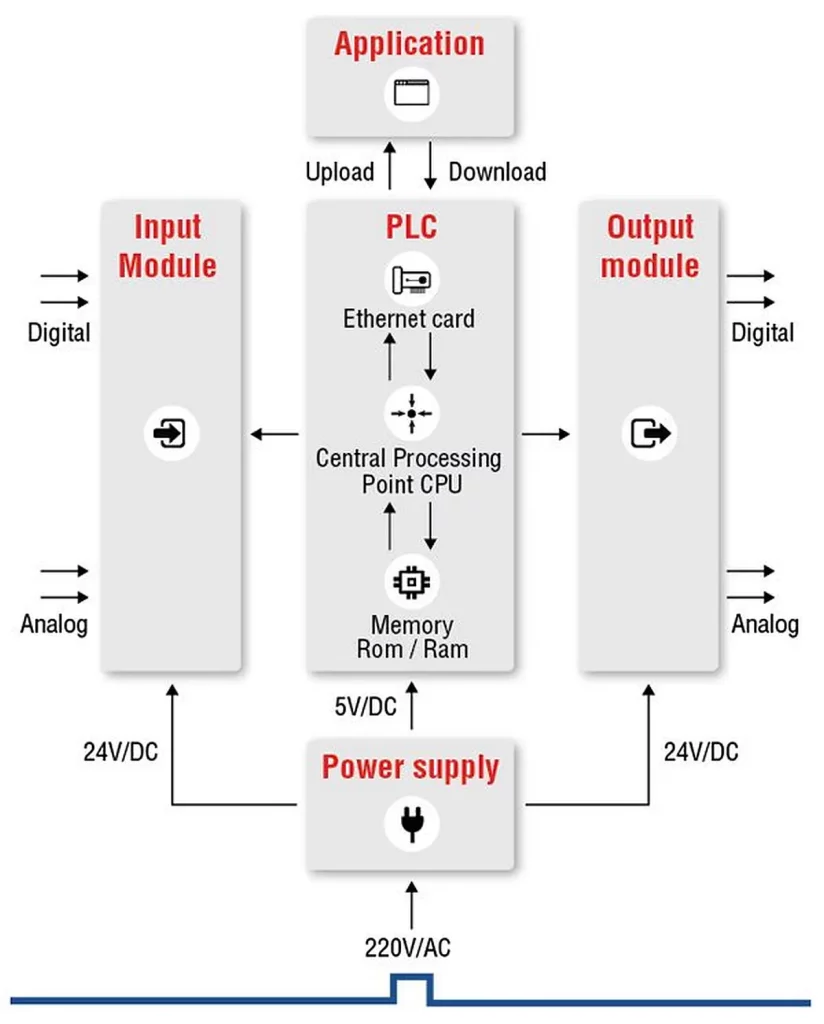
A typical PLC system is comprised of several essential components working in concert:
- Processor (CPU): This is the “brain” of the PLC. It executes the control program, performs logic operations, handles communications, and manages memory. The CPU continuously reads inputs, executes the programmed logic, and updates outputs.
- Memory: PLCs contain different types of memory. Program memory stores the user-created control logic, while data memory stores values for timers, counters, internal relays, and the status of inputs and outputs.
- Input/Output (I/O) Modules: These are the interfaces that connect the PLC to the real world.
- Input Modules: Receive signals from external devices such as pushbuttons, limit switches, proximity sensors, temperature sensors, and level sensors. These signals are converted into digital data that the CPU can process.
- Output Modules: Send control signals to external devices such as motor starters, solenoid valves, indicator lights, and alarm sirens. These signals are typically used to turn devices on or off, or to control their speed/position.
- Power Supply: Provides the necessary electrical power to the CPU and I/O modules, often converting higher AC voltages to lower DC voltages used by the internal electronics.
- Programming Device: While not part of the operational PLC hardware, a programming device (typically a personal computer) is used to develop, download, monitor, and troubleshoot the PLC program. Software specifically designed for PLC programming is installed on this device.
- Communication Modules: Many modern PLCs include communication ports (e.g., Ethernet, Profibus, Modbus) that allow them to communicate with other PLCs, HMIs, supervisory control and data acquisition (SCADA) systems, and enterprise resource planning (ERP) systems, enabling data exchange and remote monitoring.
How PLCs Operate: From Input to Output
The operational cycle of a PLC is a continuous, repetitive process known as the “scan cycle.” This cycle is fundamental to how the PLC monitors inputs, executes logic, and updates outputs in real-time.
The Scan Cycle Explained
Every PLC performs a scan cycle repeatedly, typically hundreds or thousands of times per second, depending on the complexity of the program and the speed of the processor. The scan cycle generally consists of three main steps:
- Read Inputs: The PLC first reads the status of all its input devices. It takes a snapshot of the current state (on/off, analog value) of every connected sensor, switch, and other input. This input data is then stored in the PLC’s input image table in memory.
- Execute Program Logic: Next, the PLC executes the user-programmed logic instruction by instruction. It uses the input data from the input image table to evaluate the logic conditions (e.g., IF A is ON AND B is OFF). Based on these evaluations, it determines the new status for the output devices. The results of this logic are stored in the PLC’s output image table.
- Update Outputs: Finally, the PLC updates the physical output devices based on the data in the output image table. It sends signals to turn motors on/off, open/close valves, illuminate lights, etc.
After updating the outputs, the PLC immediately restarts the cycle, continuously monitoring and controlling the industrial process. This rapid, repetitive cycle ensures that the system responds to changes in inputs almost instantaneously, providing robust real-time control.
Programming Languages for PLCs
The logic inside a PLC is created using specialized programming languages, standardized by IEC 61131-3. The most common languages include:
- Ladder Diagram (LD): This is the most popular and visually intuitive language, heavily influenced by the relay logic diagrams it replaced. It uses graphical “rungs” that resemble electrical schematics, with contacts representing inputs and coils representing outputs. It’s easy for electricians and technicians to understand due to its familiarity with relay logic.
- Structured Text (ST): A high-level, text-based language similar to Pascal or C. It is powerful for complex algorithms, mathematical operations, and data manipulation.
- Function Block Diagram (FBD): A graphical language that represents control logic as interconnected function blocks, each performing a specific task (e.g., timer, counter, PID controller). It’s useful for visualizing signal flow.
- Instruction List (IL): A low-level, assembly-like text-based language that uses mnemonic codes for instructions. While less common for new programming, it can be efficient for highly optimized code segments.
- Sequential Function Chart (SFC): A graphical language used to structure and organize the control program into a series of steps and transitions. It’s ideal for sequential processes and state machines, providing a clear overview of the process flow.
The choice of programming language often depends on the complexity of the task, the programmer’s familiarity, and the specific PLC platform being used. Many modern PLC programming environments allow for a combination of these languages within a single project.
The Indispensable Role of PLCs Across Industries
PLCs are ubiquitous in virtually every sector that involves automation, process control, and repetitive tasks. Their robustness, flexibility, and reliability make them an ideal choice for a vast array of applications.
Manufacturing and Assembly Lines
This is perhaps the most well-known application of PLCs. In manufacturing, PLCs control everything from individual machines to entire production lines. They manage:
- Material Handling: Controlling conveyor belts, robotic arms for pick-and-place operations, automated guided vehicles (AGVs).
- Machining Operations: Managing CNC machines, presses, drills, and welding robots.
- Assembly: Orchestrating sequences of automated assembly stations, ensuring parts are correctly placed and joined.
- Quality Control: Interfacing with vision systems and sensors to detect defects, sort products, and trigger rejection mechanisms.
- Packaging: Controlling filling machines, cappers, labelers, and palletizers.
By synchronizing various machines and processes, PLCs ensure high throughput, consistent product quality, and minimized human error on the factory floor.
Process Control in Critical Sectors
Beyond discrete manufacturing, PLCs are fundamental to continuous process control in industries where raw materials are transformed into finished products through chemical, physical, or biological processes.
- Chemical Plants: Managing temperature, pressure, flow rates, and levels in reactors, distillation columns, and mixing tanks.
- Oil and Gas: Controlling pumps, valves, compressors, and safety systems in refineries, pipelines, and offshore platforms.
- Water Treatment: Automating filtration, purification, pumping, and chemical dosing processes in municipal water and wastewater facilities.
- Power Generation: Controlling turbine startup/shutdown, generator synchronization, fuel delivery, and safety systems in power plants (thermal, hydro, nuclear).
- Food and Beverage: Overseeing blending, cooking, pasteurization, bottling, and clean-in-place (CIP) systems, ensuring hygienic and consistent production.
In these sectors, PLCs are often integrated into larger Distributed Control Systems (DCS) or SCADA systems to provide supervisory control, data logging, and alarm management for entire facilities.
Infrastructure and Building Automation
PLCs also play a significant role in managing essential infrastructure and complex building systems, contributing to safety, energy efficiency, and operational convenience.
- Traffic Management: Controlling traffic lights, variable message signs, and tunnel ventilation systems.
- Elevator Control: Managing the movement of elevators, door operations, and safety interlocks in multi-story buildings.
- HVAC Systems: Automating heating, ventilation, and air conditioning in commercial buildings, ensuring optimal climate control and energy consumption.
- Security Systems: Integrating access control, CCTV, and alarm systems.
- Pumping Stations: Managing water distribution networks, sewage systems, and flood control.
Their ability to handle multiple inputs and outputs, execute complex logic, and operate reliably in diverse environments makes them indispensable for critical infrastructure.
Advantages and Future of PLC Technology
The enduring success and widespread adoption of PLCs are due to a compelling set of advantages they offer over alternative control methods.
Benefits of PLC Implementation
- Reliability and Durability: Designed for industrial environments, PLCs are built to withstand extreme temperatures, vibrations, electrical noise, and dust, leading to high operational uptime.
- Flexibility and Re-programmability: Unlike hard-wired relay systems, PLC logic can be easily modified or completely changed through software updates, adapting to new processes or product variations without extensive hardware changes.
- Cost-Effectiveness: While initial setup costs might vary, the long-term benefits of PLCs often outweigh traditional methods, especially for complex systems. Reduced troubleshooting time, less wiring, and fewer maintenance needs contribute to lower operational expenditures.
- Compact Size: PLCs are significantly smaller than equivalent relay panels, saving valuable floor space in industrial facilities.
- Diagnostic Capabilities: Modern PLCs offer extensive diagnostic features, including error codes, status indicators, and remote monitoring tools, which greatly simplify troubleshooting and reduce downtime.
- Speed of Operation: The rapid scan cycle of PLCs allows for near real-time control, essential for fast-moving production lines and time-critical processes.
- Enhanced Safety: PLCs can be programmed with safety interlocks and emergency shutdown sequences, improving overall operational safety for personnel and equipment.

Evolution and Integration with Modern Tech
The PLC landscape is continuously evolving. While core functionality remains, advancements are bringing PLCs closer to IT environments and the broader Industry 4.0 paradigm.
- Connectivity and IIoT: Modern PLCs come equipped with advanced communication protocols (Ethernet/IP, PROFINET, OPC UA) that facilitate seamless integration with the Industrial Internet of Things (IIoT). This enables data acquisition, cloud connectivity, predictive maintenance, and remote diagnostics on an unprecedented scale.
- Edge Computing: Many PLCs are gaining capabilities to perform local data processing and analytics at the “edge” of the network, reducing reliance on centralized cloud resources and enabling faster decision-making.
- Cybersecurity: As PLCs become more connected, cybersecurity for industrial control systems (ICS) is a growing focus, with manufacturers implementing features to protect against unauthorized access and cyber threats.
- Open Architectures: There’s a trend towards more open and standardized PLC architectures, promoting interoperability between different vendors’ equipment.
- Integration with Advanced Analytics and AI: Data collected by PLCs is increasingly being fed into advanced analytics platforms and AI models to optimize processes, predict failures, and drive continuous improvement.
In essence, the PLC has transitioned from a simple relay replacement to a sophisticated, networked industrial controller that forms the bedrock of automation, driving efficiency, innovation, and competitiveness across global industries. Its ability to bridge the gap between physical processes and digital control makes it an indispensable technology for the present and future of industrial operations.
aViewFromTheCave is a participant in the Amazon Services LLC Associates Program, an affiliate advertising program designed to provide a means for sites to earn advertising fees by advertising and linking to Amazon.com. Amazon, the Amazon logo, AmazonSupply, and the AmazonSupply logo are trademarks of Amazon.com, Inc. or its affiliates. As an Amazon Associate we earn affiliate commissions from qualifying purchases.