
In the intricate world of technology, where complex algorithms drive everything from artificial intelligence to secure digital transactions, fundamental mathematical concepts serve as the unseen bedrock. While often overshadowed by discussions of neural networks, blockchain, or quantum computing, the very basic building blocks of arithmetic remain indispensable. One such fundamental element, often taken for granted, is the “minuend.” Understanding what a minuend is, and its role in the elementary operation of subtraction, provides crucial insight into how computers process numerical data, execute instructions, and ultimately, power the digital age. Far from being a mere scholastic term, the minuend represents a critical component in the computational logic that underpins virtually all software, data analysis, and technological innovation.
The Foundational Role of Arithmetic in Computing
At its heart, a computer is an incredibly sophisticated calculator, performing billions of arithmetic operations per second. Every line of code, every data manipulation, and every graphical rendering boils down to a series of logical and mathematical computations. Subtraction, along with addition, multiplication, and division, forms the elementary set of operations upon which all higher-level computational tasks are built. Without a precise understanding and implementation of these basics, the elaborate structures of modern software would crumble. The concept of a minuend, therefore, isn’t just about basic math; it’s about the very language computers speak.
Deconstructing Subtraction: Minuend, Subtrahend, and Difference
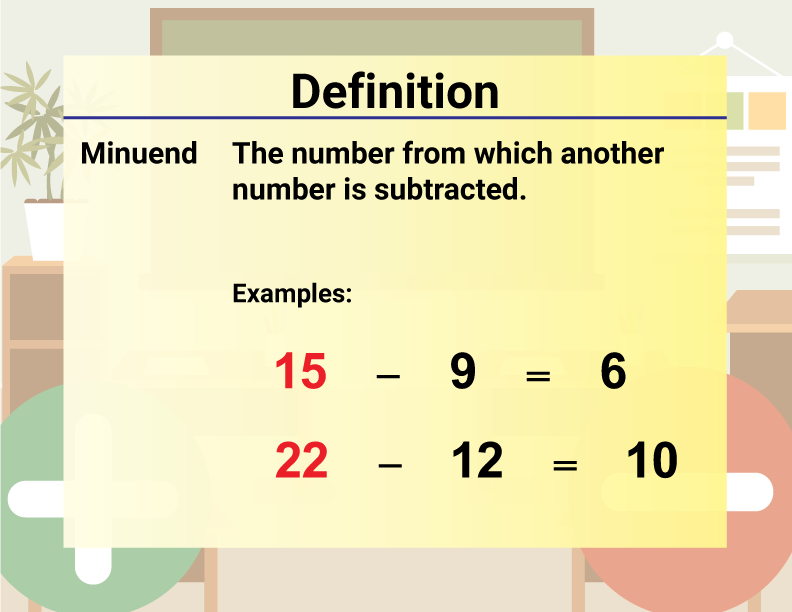
To fully appreciate the minuend, it’s essential to first grasp its position within the subtraction operation. Subtraction is an arithmetic operation that represents the operation of removing objects from a collection. The result of a subtraction is called the difference. In any subtraction problem, there are three primary components:
- Minuend: This is the number from which another number is subtracted. It is the initial quantity or value.
- Subtrahend: This is the number that is being subtracted from the minuend. It represents the quantity being removed.
- Difference: This is the result of the subtraction, indicating how much remains after the subtrahend has been taken away from the minuend.
Consider the simple expression: 10 – 3 = 7.
Here, 10 is the minuend, 3 is the subtrahend, and 7 is the difference. The minuend sets the initial state, providing the value that will be modified by the subtraction. In a computational context, accurately identifying and representing the minuend is the first step in performing any subtraction operation, whether it’s calculating remaining inventory, adjusting a financial balance, or determining pixel differences on a screen.
From Basic Operations to Complex Algorithms
While individually simple, the precise execution of operations involving minuends, subtrahends, and differences scales dramatically within computational systems. Every algorithm, no matter how complex – from sorting arrays to simulating physical phenomena – breaks down into atomic operations like subtraction. Whether a program is calculating the trajectory of a rocket, determining the optimal route for a delivery truck, or rendering a 3D model, it’s constantly performing comparisons and modifications that inherently involve these basic arithmetic components. For instance, determining the “change” or “delta” between two states (e.g., current value minus previous value) fundamentally uses subtraction, where the current value acts as the minuend. This foundational understanding allows developers to write efficient and error-free code, directly impacting the performance and reliability of technological solutions.
Minuends in Software Development and Programming
For software developers, understanding the role of the minuend transcends a mere definition; it becomes integral to the logical construction and reliable execution of code. Every programming language, from Python to C++, provides operators for subtraction, and the underlying concept of a minuend governs how these operations are processed and applied to data.
Numerical Precision and Data Types
In software, numbers are not just abstract concepts; they are stored as specific data types (e.g., integers, floats, doubles), each with defined ranges and precision limitations. The choice of data type for a minuend can have significant implications, especially in applications requiring high accuracy, such as scientific computing or financial software. If a minuend exceeds the capacity of its assigned data type, an overflow error can occur, leading to incorrect results or program crashes. Conversely, if a minuend involves fractional numbers (floating-point numbers), accumulated precision errors from repeated subtractions can lead to subtle but critical inaccuracies, a common challenge in numerical analysis and scientific simulations. Developers must carefully consider the nature of their minuends to choose appropriate data types and implement robust error handling.
Debugging and Logical Operations
When debugging software, developers often trace the values of variables as they change throughout a program’s execution. Understanding which variable is acting as the minuend in a particular calculation is crucial for identifying logic errors. For example, if an inventory system incorrectly subtracts items, tracing the minuend (the initial stock) and the subtrahend (items sold) can pinpoint where the calculation went awry.
Furthermore, subtraction is often implicitly used in logical operations. For instance, determining if a value has decreased from a previous state (e.g., if (current_value - previous_value < 0)) relies on the result of a subtraction where current_value is the minuend. These comparisons are fundamental to control flow, decision-making, and state management within software applications. The correctness of these logical branches depends entirely on the correct identification and processing of the minuend.
AI, Data Science, and the Arithmetic Underpinning
The seemingly abstract and complex fields of artificial intelligence and data science are, at their core, heavily reliant on numerical computation. While machine learning models perform sophisticated pattern recognition and prediction, the underlying mechanisms involve vast numbers of arithmetic operations, including subtraction.
Machine Learning Algorithms and Loss Functions
In machine learning, algorithms learn by minimizing “loss functions,” which quantify the difference between predicted outputs and actual target values. This “difference” is often calculated using subtraction. For example, in a simple linear regression model, the error for a data point might be (predicted_value - actual_value). Here, predicted_value acts as a minuend (or subtrahend, depending on the convention) in calculating the error term. The optimization process then involves iteratively adjusting model parameters to reduce these differences. Gradient descent, a common optimization algorithm, relies on calculating the gradient (rate of change) of the loss function, which involves computing differences between current and previous states, thus leveraging the minuend concept repeatedly. The accuracy and convergence of AI models directly depend on the correct and efficient computation of these differences.
Data Analysis and Transformation
Data scientists constantly manipulate and transform datasets. Operations like calculating percentage changes, finding deviations from a mean, or normalizing data often involve subtraction. For instance, feature scaling techniques like “min-max scaling” involve subtracting the minimum value from each data point (where the data point is the minuend) and then dividing by the range. Similarly, when performing time-series analysis, calculating the “change” or “growth” between two periods involves subtracting an earlier value from a later one. Even sophisticated statistical tests and hypothesis testing rely on calculating differences and deviations from expected values, making the minuend an ever-present component in the numerical machinery of data science.
Digital Security and Cryptography’s Numerical Backbone
Even in the realm of digital security and cryptography, where the focus is on protecting information, the fundamental arithmetic operations, including subtraction, play a vital, if sometimes less obvious, role. Cryptographic algorithms are built upon robust mathematical principles, often involving modular arithmetic and large number operations.

Ensuring Accuracy in Computational Transactions
While direct subtraction operations might not always be explicitly labeled with “minuend” in cryptographic discussions, the underlying concept is ever-present. For instance, in integrity checks and hash functions, even subtle changes in data will result in drastically different hash outputs. These differences are detected through complex calculations that indirectly rely on the precise management of numerical values, where any deviation, however small, can be conceptualized as a “difference” derived from some initial value (minuend) and its altered state (subtrahend).
Furthermore, in distributed ledger technologies like blockchain, transactions involve updating balances. When funds are transferred, an amount is subtracted from one account and added to another. The original account balance acts as the minuend, and the transferred amount as the subtrahend. The integrity and immutability of these ledgers depend on the absolute precision of these arithmetic operations, ensuring that every minuend, subtrahend, and difference is processed correctly and without error, thereby maintaining the trust and security of the entire system. Without this foundational accuracy in basic math operations, the security guarantees offered by modern cryptography and secure transaction systems would simply not hold.
aViewFromTheCave is a participant in the Amazon Services LLC Associates Program, an affiliate advertising program designed to provide a means for sites to earn advertising fees by advertising and linking to Amazon.com. Amazon, the Amazon logo, AmazonSupply, and the AmazonSupply logo are trademarks of Amazon.com, Inc. or its affiliates. As an Amazon Associate we earn affiliate commissions from qualifying purchases.