
A married put is a foundational options trading strategy employed by investors seeking to protect profits or limit potential losses on a stock they already own. Often likened to purchasing an insurance policy for a stock holding, it involves simultaneously buying a put option for shares of a stock while owning an equal number of shares of that same underlying stock. This strategy is particularly appealing to investors who are bullish on a company’s long-term prospects but wish to hedge against short-to-medium-term market volatility or specific event risk without selling their shares.
Understanding the Core Concept
At its heart, the married put strategy is a risk management tool designed to provide a floor for potential losses. It blends the direct ownership of shares with the protective power of an option contract.

Definition and Mechanics
A married put is established by an investor who owns 100 shares of a particular stock and then buys one put option contract on the same stock. Each standard put option contract typically represents 100 shares of the underlying asset. The key elements are:
- Underlying Stock: The investor must already own the shares they wish to protect. This isn’t a speculative play but a defensive one for an existing portfolio position.
- Put Option: A put option gives the holder the right, but not the obligation, to sell 100 shares of the underlying stock at a specified price (the strike price) on or before a certain date (the expiration date).
- Simultaneous Action (or near-simultaneous): While not strictly required to be executed at the exact same second, the intent is for the put purchase to occur while the investor holds the stock, effectively “marrying” the put to the stock.
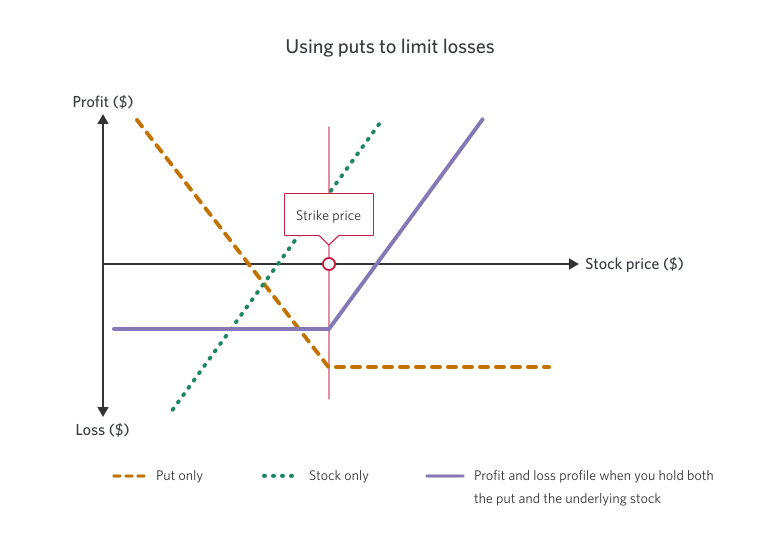
The premium paid for the put option is the cost of this insurance. If the stock price falls below the strike price of the put option, the investor can exercise their put option, selling their shares at the higher strike price, thereby limiting their loss. If the stock price rises, the investor benefits from the appreciation, minus the cost of the put premium.
The Protective Power of a Put
To grasp the full utility of a married put, it’s crucial to understand how a put option functions as a protective instrument. Imagine you own 100 shares of XYZ Corp at $100 per share. You’re concerned about an upcoming earnings report or broader market uncertainty. By buying a put option with a strike price of, say, $95 and an expiration three months out, you effectively cap your potential loss at $5 per share (plus the put premium) below your purchase price if the stock plummets.
If XYZ Corp shares fall to $80, your put option, with a $95 strike price, becomes in-the-money. You can exercise the option, selling your 100 shares at $95 each, even though the market price is $80. This prevents further depreciation below $95. Your maximum loss on the stock’s price movement is limited to the difference between your initial purchase price and the put’s strike price, plus the premium paid for the put.
Conversely, if XYZ Corp’s shares climb to $110, you simply let the put option expire worthless. You lose the premium paid for the put, but you fully participate in the stock’s $10 per share appreciation. This dynamic highlights the “insurance policy” analogy: you pay a premium for protection, and if the “disaster” (stock price drop) doesn’t occur, you “lose” the premium, but you gain peace of mind and the upside.
Strategic Rationale for Employing a Married Put
Investors choose a married put for several compelling reasons, primarily centered around risk mitigation and strategic portfolio management.
Hedging Against Downside Risk
The primary motivation for executing a married put is to hedge against potential declines in a stock’s value. This is particularly relevant for:
- Highly Appreciated Stocks: An investor might have significant unrealized gains in a stock and wants to protect those gains without triggering a taxable event by selling the shares. The put option acts as a temporary safeguard.
- Event Risk: Ahead of significant company announcements (e.g., earnings reports, FDA approvals, litigation outcomes) or major economic events, a stock’s price can be highly volatile. A married put provides a buffer against adverse outcomes.
- Broader Market Uncertainty: During periods of general market instability or anticipated corrections, investors may use married puts on their core holdings to defend against systemic risk without liquidating positions.
By limiting the maximum potential loss, the married put strategy provides a defined risk profile, offering investors a clearer understanding of their worst-case scenario.
Maintaining Upside Potential
Unlike simply selling the stock to lock in gains, a married put allows the investor to retain full exposure to any upward movement in the stock price (minus the cost of the premium). This is a critical distinction. If the stock performs well, the put option will likely expire worthless, but the investor captures all the appreciation in their shares. This “have your cake and eat it too” aspect, albeit with a premium cost, is what makes the married put a flexible and attractive strategy. It supports a bullish long-term outlook while mitigating short-term uncertainty.
Ideal Scenarios for Implementation
A married put is best utilized when an investor has:
- A strong conviction in the long-term value of a stock but anticipates short-term volatility.
- Significant unrealized gains in a stock and wants to protect those gains from erosion.
- Large, concentrated positions in a single stock that could severely impact their overall portfolio if it declines.
- A desire to avoid selling shares for tax reasons (e.g., to defer capital gains) or to maintain voting rights or dividend eligibility.
- A need for psychological comfort by knowing their downside risk is capped, allowing them to ride out market corrections without panic selling.
It’s particularly useful for growth stocks or those in volatile sectors where price swings can be dramatic but the long-term outlook remains positive.
Building a Married Put Position
Implementing a married put involves careful selection of the put option to align with the investor’s risk tolerance and market outlook.
Step-by-Step Execution
- Own the Underlying Stock: Ensure you own at least 100 shares of the stock for each put option contract you intend to buy.
- Select the Strike Price: This is arguably the most crucial decision.
- In-the-money (ITM) Puts: A strike price above the current market price offers more protection but costs more.
- At-the-money (ATM) Puts: A strike price near the current market price offers balanced protection and cost.
- Out-of-the-money (OTM) Puts: A strike price below the current market price offers less protection but is cheaper. This is often chosen when an investor wants to protect against extreme downside moves rather than minor corrections. The choice depends on how much downside protection the investor wants and how much they are willing to pay for it.
- Choose the Expiration Date:
- Short-term Puts (e.g., 1-3 months): Cheaper premiums, but protection expires quickly. Good for hedging specific, near-term events.
- Long-term Puts (e.g., 6 months to 1 year or LEAPs): More expensive premiums but offer protection for an extended period, allowing more time for the stock to recover or continue its upward trend.
- Buy the Put Option: Place a buy order for the put option. It’s often recommended to place this order immediately after confirming stock ownership to establish the “married” position quickly.
Key Considerations: Strike Price and Expiration
The selection of strike price and expiration date directly impacts the cost of the premium and the level of protection.
- Strike Price: A higher strike price provides a higher floor for the stock, meaning less potential loss, but it comes with a higher premium. A lower strike price means less protection but a lower premium. Investors must balance their desired risk tolerance against the cost. For instance, protecting a stock currently at $100 with a $95 strike offers a $5 cushion before the put activates its protection (disregarding premium). A $90 strike offers a larger $10 buffer, but the put is cheaper.
- Expiration Date: Longer-dated puts (more time until expiration) are more expensive because they cover a longer period of uncertainty and have more time value. Short-dated puts are cheaper but require more frequent re-evaluation and potentially rolling the position if protection is still needed. The expiration should align with the anticipated period of risk.
Cost Analysis and Break-Even Point
The cost of the married put is the premium paid for the put option. This premium reduces the overall profitability of the stock position if the stock rises, and it adds to the total loss if the stock falls (up to the strike price).
The break-even point for a married put strategy is generally the original purchase price of the stock plus the premium paid for the put option.
- Formula: Break-Even Price = Stock Purchase Price + Put Premium
- Example: If you bought 100 shares at $100 and paid $300 ($3 per share) for a put option, your break-even point is $103 per share. The stock needs to rise above $103 for you to begin making a profit on the entire married put position.
Understanding the break-even point helps investors gauge the impact of the hedging cost on their potential returns.
Advantages and Disadvantages
Like all financial strategies, the married put comes with a distinct set of pros and cons that investors must weigh.
Benefits: Risk Mitigation, Psychological Comfort
- Defined Maximum Loss: This is the most significant advantage. Investors know the absolute maximum they can lose on their stock position (stock purchase price – put strike price + put premium) regardless of how far the stock falls.
- Retained Upside Potential: Unlike selling the stock, the investor benefits from unlimited upside if the stock price rises, minus the put premium.
- Flexibility: It allows investors to stay invested in a stock they believe in long-term, avoiding the tax implications or regret of selling prematurely due to short-term fears.
- Psychological Comfort: Knowing that downside risk is capped can prevent impulsive decisions during market downturns and allow investors to maintain a long-term perspective.
- Tax Efficiency: Allows investors to defer capital gains by not selling the appreciated stock, while still protecting its value.
Drawbacks: Premium Cost, Limited Upside (Relative to Unhedged)
- Cost of Premium: The primary disadvantage is the non-recoverable cost of the put option premium. If the stock does not fall, the put expires worthless, and the premium is a direct reduction in the overall return of the stock position.
- Reduced Profitability: Even if the stock rises significantly, the profit will always be less than if the put option had not been purchased, due to the premium paid.
- Time Decay (Theta): Put options lose value as they approach expiration, a phenomenon known as time decay or theta. This works against the put buyer, especially if the stock price remains stable.
- Complex for Novices: While relatively straightforward among options strategies, it still requires understanding options mechanics, strike prices, and expiration dates, which can be daunting for new investors.
- Opportunity Cost: The capital used to purchase the put option could have been invested elsewhere or used to buy more shares of the underlying stock.
Real-World Applications and Advanced Considerations
Beyond the basic mechanics, married puts can be integrated into broader portfolio strategies and compared with alternative hedging methods.
When to Leg In or Leg Out
“Legging in” refers to establishing one part of a multi-leg strategy (like the put in a married put) at a different time than the other. Typically, the stock is already owned, so the investor “legs in” by adding the put. “Legging out” refers to exiting one component of the strategy.
- Legging In: Investors often leg into a married put when they acquire a stock and immediately decide they want protection, or when an existing stock position starts showing signs of increased risk.
- Legging Out: This usually involves selling the put option before expiration if the risk has passed (e.g., a strong earnings report has been released, or market uncertainty has subsided). This allows the investor to recover some of the put’s remaining value, rather than letting it expire worthless. Alternatively, if the stock has risen significantly, the investor might simply let the put expire and continue holding the unhedged stock.
Comparing with Other Hedging Strategies
The married put is one of several ways to hedge a stock position:
- Stop-Loss Order: A stop-loss order automatically sells the stock if it drops to a predetermined price. While it’s free, there’s no guarantee the order will execute at the exact stop price in fast-moving markets (market orders), and a limit stop can result in not being filled. Unlike a married put, a stop-loss order gives up all upside potential once triggered.
- Covered Call: This involves selling call options against an owned stock. It generates income (premium) but limits upside potential beyond the call’s strike price. It’s an income-generating strategy that also offers a slight downside buffer, but it’s fundamentally different from the pure protection of a married put. A married put is best for a bullish investor concerned about a temporary dip, while a covered call is for a mildly bullish or neutral investor looking to generate income.
- Collar Strategy: A collar combines elements of both. It involves buying a protective put and simultaneously selling an out-of-the-money call option. The premium received from selling the call helps offset the cost of buying the put, making it a “zero-cost” or “low-cost” collar. However, selling the call caps the stock’s upside potential, which a standalone married put does not.

Tax Implications and Account Types
The tax treatment of options can be complex. Profits from exercising a put or selling it for a gain may be treated as short-term or long-term capital gains, depending on the holding period of the option itself. The premium paid for a put that expires worthless is generally considered a short-term capital loss. Investors should consult with a tax professional regarding their specific situation.
Married puts are typically executed in standard brokerage accounts. Margin accounts may offer more flexibility but also carry increased risks. It’s important to understand the specific rules and requirements of your brokerage for options trading.
In conclusion, the married put is a powerful and flexible risk management strategy for investors who wish to protect their stock holdings from downside risk while retaining full exposure to potential upward price movements. While it comes with the cost of the option premium, this expense is often viewed as a worthwhile insurance policy for peace of mind and strategic portfolio defense.
aViewFromTheCave is a participant in the Amazon Services LLC Associates Program, an affiliate advertising program designed to provide a means for sites to earn advertising fees by advertising and linking to Amazon.com. Amazon, the Amazon logo, AmazonSupply, and the AmazonSupply logo are trademarks of Amazon.com, Inc. or its affiliates. As an Amazon Associate we earn affiliate commissions from qualifying purchases.