
The term “Cinemascope” evokes a golden era of filmmaking, synonymous with grandeur, spectacle, and the sweeping vistas that pulled audiences into the magic of the silver screen. Far more than just a name, Cinemascope represents a groundbreaking technological innovation that fundamentally reshaped the visual language of cinema, propelling the industry into the widescreen era and establishing a new standard for cinematic immersion. At its core, Cinemascope is an anamorphic lens system used during the shooting and projection of films, designed to capture a much wider image on standard 35mm film stock than was previously possible, thereby creating a panoramic viewing experience.
The Dawn of Widescreen: Genesis and Purpose
The mid-20th century presented a significant challenge to the dominance of motion pictures. The advent and rapid popularization of television threatened to keep audiences at home, siphoning viewers away from movie theaters. Hollywood, ever resourceful, recognized the need for a differentiating factor—something television, with its small, square screens, could not replicate. The answer lay in spectacle, an experience that transcended the living room. This imperative gave birth to a race for widescreen formats, each promising a more immersive and captivating experience.
20th Century Fox, under the leadership of Spyros Skouras, made a bold move by acquiring the rights to an anamorphic lens system developed by French inventor Henri Chrétien. Chrétien’s “Hypergonar” lens, originally conceived in the 1920s, had never found widespread commercial application. Fox saw its potential, adapting and refining it for mass cinematic production and projection. The studio rebranded this technology as “Cinemascope,” unveiling it with great fanfare in 1953 with the biblical epic The Robe.
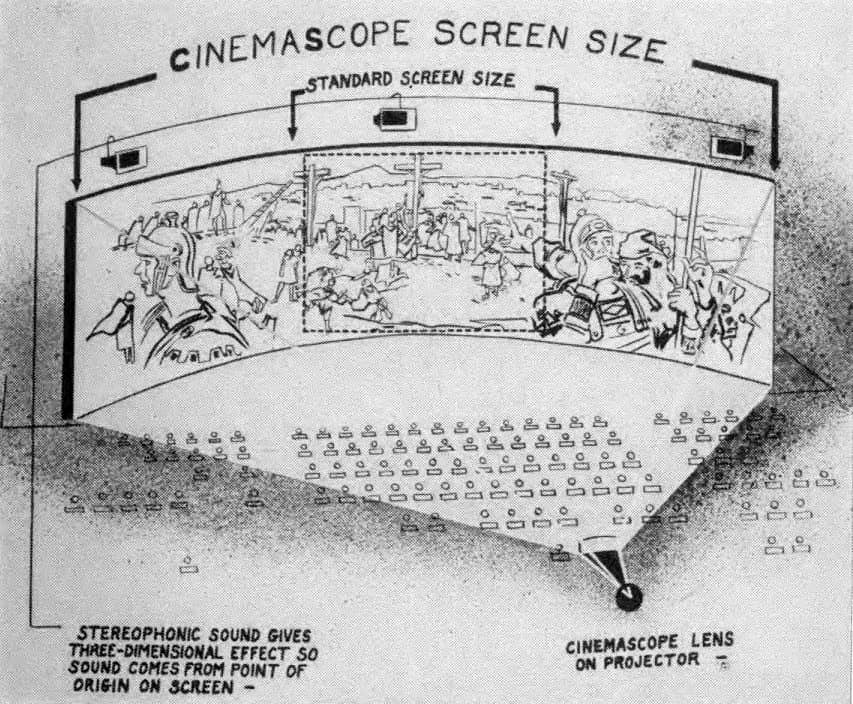
Prior to Cinemascope, the standard aspect ratio for films was the Academy Ratio of 1.37:1, a nearly square frame. Cinemascope dramatically expanded this canvas to an initial aspect ratio of 2.55:1 (later standardized to 2.35:1 and then 2.39:1), offering a much broader horizontal field of view. This wasn’t merely a cosmetic change; it was a strategic technological deployment aimed at creating a larger-than-life presentation that would lure audiences back to the cinemas, providing an experience utterly distinct from anything available at home. It was a technological gamble that paid off, ushering in an era where widescreen became synonymous with prestige and cinematic spectacle.
Technical Marvels: The Anamorphic Process
The ingenuity of Cinemascope lies in its “anamorphic” nature, a term derived from Greek meaning “to reshape” or “to form again.” Unlike other early widescreen processes that used larger film stock (like 70mm Todd-AO) or multiple projectors (like Cinerama), Cinemascope achieved its wide aspect ratio using conventional 35mm film. This was a critical advantage, as it allowed theaters to adapt their existing projection equipment with relatively minor modifications, rather than requiring entirely new, expensive setups.
The Lens System
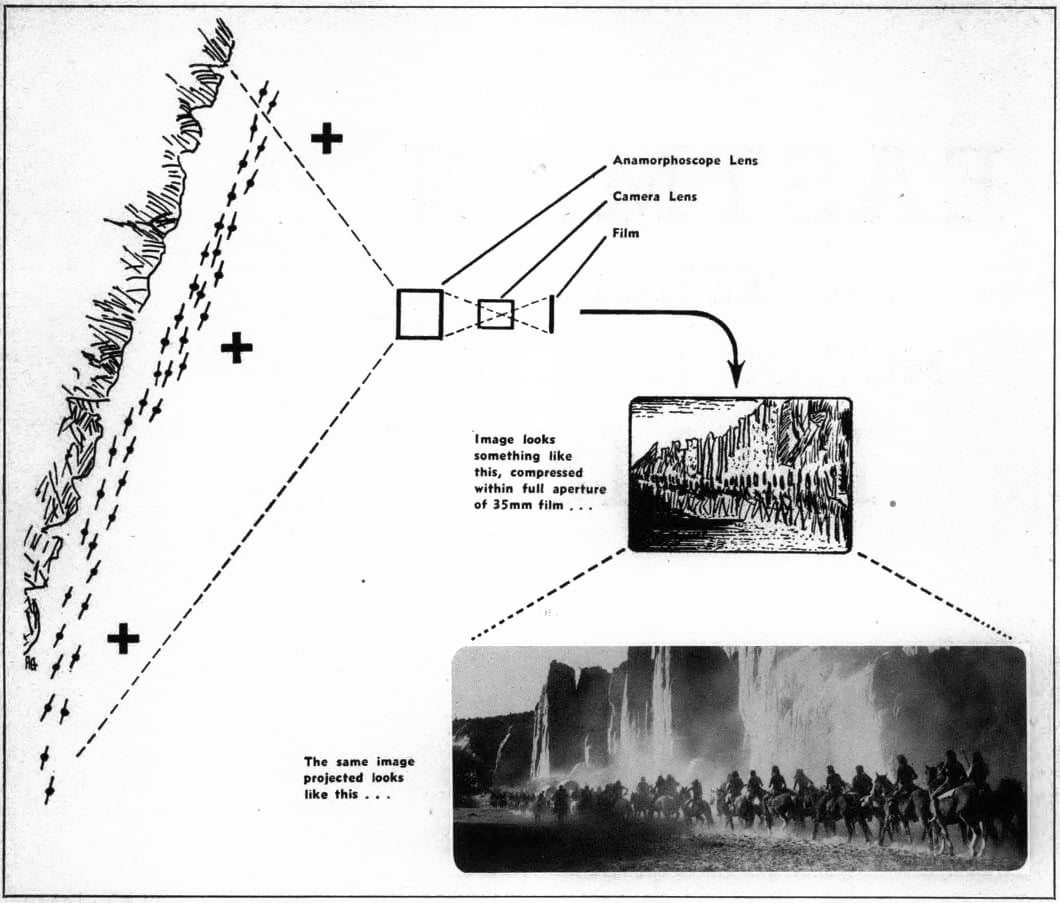
The core of Cinemascope technology resides in its specialized anamorphic lenses. During the filming process, a unique anamorphic lens is attached to a standard 35mm motion picture camera. This lens contains cylindrical elements that effectively squeeze or compress a wide field of view horizontally onto the narrower 35mm film frame, typically by a factor of 2x. Imagine taking a wide image and optically squashing it horizontally into half its width while maintaining its original height. The resulting image on the film negative appears distorted, with people looking tall and thin, and circles appearing as ovals. This compression is the magic trick—it allows twice the horizontal information to be stored on a standard frame.
The technical brilliance of this system meant that filmmakers could use existing cameras and standard film stock, streamlining the production process compared to more radical formats. However, these early anamorphic lenses presented their own challenges, including potential distortions at the edges of the frame and a tendency for specific types of lens flares and unique bokeh characteristics, which have since become desirable aesthetic qualities.
Projection and Exhibition
The second part of the anamorphic equation occurs during projection. When the Cinemascope film print, with its squeezed image, is run through a projector, a corresponding anamorphic lens is attached to the projector’s standard lens. This projection lens performs the inverse operation: it unsqueezes or expands the image horizontally by the same 2x factor, restoring the picture to its original, wide aspect ratio on the large cinema screen.
This dual-lens system—squeezing at capture, unsqueezing at projection—was a cost-effective solution for theaters. Instead of investing in entirely new projectors, many cinemas could adapt their existing equipment by adding the anamorphic attachment and installing a larger, curved screen. The curved screen was particularly important in early Cinemascope installations, as it helped mitigate some of the inherent optical distortions of the anamorphic process and created a more immersive, peripheral viewing experience, wrapping the image around the audience.
In addition to the visual breakthrough, Cinemascope was often coupled with another significant technological advancement: four-track magnetic stereo sound. Standard optical sound tracks on 35mm film were monaural. By placing four magnetic sound tracks along the edges of the film, separate from the sprocket holes and picture area, Cinemascope films could deliver a much richer, multi-channel audio experience. This combination of widescreen visuals and immersive stereo sound created an unparalleled sensory assault that truly differentiated the theatrical experience from television.
Impact and Legacy in Filmmaking
Cinemascope’s technological introduction was not merely an incremental improvement; it was a paradigm shift that profoundly influenced the art and craft of filmmaking. It forced directors, cinematographers, and production designers to rethink composition, blocking, and storytelling within a much wider frame.
Aesthetic and Narrative Implications
The expansive canvas of Cinemascope transformed visual storytelling. No longer confined to the relatively square Academy Ratio, filmmakers could now compose shots with a breadth that captured sprawling landscapes, epic battle scenes, and crowded urban environments with unprecedented scale. Directors like Nicholas Ray (Rebel Without a Cause), Otto Preminger (River of No Return), and Stanley Kubrick (Paths of Glory) explored the compositional possibilities, often placing multiple characters side-by-side within a single frame, allowing for complex visual narratives without needing rapid cuts. This encouraged longer takes and more deliberate camera movements, providing a more immersive, contemplative viewing experience.
The wider frame also had a psychological impact. It pulled the audience into the scene, creating a sense of being present within the film’s world. The grandiosity of the image was perfectly suited for genres like historical epics, Westerns, and musicals, reinforcing the idea of cinema as a spectacular event. The distinct characteristics of anamorphic lenses—the characteristic oval bokeh (out-of-focus background elements appearing as ovals instead of circles), unique lens flares, and subtle distortions at the edges—became part of the cinematic lexicon, contributing to a distinctive “Cinemascope look” that filmmakers often sought to achieve.
Enduring Influence and Modern Adaptations
While Cinemascope itself eventually gave way to other widescreen formats, notably Panavision, its technological principles and aesthetic legacy endure. Panavision, initially compatible with Cinemascope lenses and then developing its own superior anamorphic optics, became the dominant player in anamorphic widescreen cinematography. However, the aspect ratio established by Cinemascope (approximately 2.39:1, often referred to as “scope”) remains one of the most popular and revered formats in contemporary cinema.
In the digital age, anamorphic cinematography continues to thrive. Modern digital cinema cameras, while capable of capturing high-resolution images in various aspect ratios, frequently employ anamorphic lenses to replicate the distinct optical qualities and widescreen aesthetic pioneered by Cinemascope. Filmmakers today consciously choose anamorphic lenses for their unique characteristics—the wider field of view, the specific compression/expansion process, the oval bokeh, the elongated lens flares, and a subtly different sense of depth—to achieve a particular “film look” that harkens back to the classic Hollywood era. This demonstrates that the core technological idea of anamorphic lensing is not just a historical footnote but a vital and creatively powerful tool in the modern cinematographer’s arsenal.
Challenges and Evolution
Like any revolutionary technology, Cinemascope faced its share of technical hurdles and market competition, which ultimately led to its evolution and eventual replacement by more refined systems based on its own foundational principles.
Early Hurdles and Competition
The initial rollout of Cinemascope was not without its difficulties. The cost of adapting projection equipment and installing new, larger screens was a significant investment for theater owners. Technically, early Cinemascope lenses could suffer from optical aberrations, leading to “anamorphic mumps” where faces would appear unnaturally stretched or distorted, particularly when close to the edge of the frame. Maintaining perfect focus across the entire wide frame also presented challenges.
Furthermore, Cinemascope was just one of several widescreen formats competing for Hollywood’s attention. Cinerama, with its three-projector system and highly curved screen, offered an even more immersive, though logistically complex and expensive, experience. VistaVision by Paramount used standard 35mm film run horizontally through the camera, capturing a much larger negative area without anamorphic squeezing, resulting in superior image quality that could then be reduced to a conventional vertical print for projection. Todd-AO, developed by American Optical and Mike Todd, used 70mm film at 30 frames per second, offering immense clarity and a wider aspect ratio directly. These rival technologies pushed each other, stimulating innovation and ensuring that only the most robust and adaptable systems would survive.
Cinemascope’s proprietary nature also presented a barrier. 20th Century Fox controlled the technology, licensing it to other studios. This created friction and encouraged competitors to develop their own systems. Panavision, initially producing compatible anamorphic lenses for use with Cinemascope, eventually developed its own superior lenses and camera systems that offered greater flexibility and optical performance. Panavision’s business model of renting, rather than selling, equipment, coupled with its continuous innovation, allowed it to become the industry standard for anamorphic cinematography, effectively superseding Cinemascope by the late 1960s.
The Digital Age and Beyond
While the “Cinemascope” brand faded, the fundamental technology it championed—anamorphic widescreen cinematography—has not. In the digital age, the principles of Cinemascope are alive and well. High-resolution digital cinema cameras can capture images in incredibly wide aspect ratios natively. However, many cinematographers still opt for anamorphic lenses, even on digital cameras, precisely for the distinct optical characteristics that these lenses impart: the unique bokeh, the organic lens flares, and the subtle perspective changes that differentiate an anamorphic image from a spherically captured one.
Post-production workflows have also embraced and streamlined the handling of anamorphic footage. Digital unsqueezing and aspect ratio conversions are now routine, offering filmmakers precise control over the final presentation. The most common “scope” aspect ratio today, 2.39:1, is a direct descendant of the Cinemascope standard, a testament to its enduring influence on how stories are told visually.
From its origins as a revolutionary technical answer to the threat of television, Cinemascope etched itself into the very fabric of cinematic technology and artistry. It democratized widescreen for the masses, forced a fundamental rethink of visual composition, and established an aesthetic that continues to shape the look and feel of major motion pictures to this day, proving itself to be one of the most influential technological developments in the history of film.
aViewFromTheCave is a participant in the Amazon Services LLC Associates Program, an affiliate advertising program designed to provide a means for sites to earn advertising fees by advertising and linking to Amazon.com. Amazon, the Amazon logo, AmazonSupply, and the AmazonSupply logo are trademarks of Amazon.com, Inc. or its affiliates. As an Amazon Associate we earn affiliate commissions from qualifying purchases.