
The mood ring, a fascinating relic of late 20th-century pop culture, continues to pique curiosity with its enigmatic color shifts. Far from being a mere decorative trinket, the mood ring represents an early foray into accessible, albeit rudimentary, wearable technology. Its perceived ability to reflect inner emotional states through a spectrum of hues cemented its place in public imagination, transforming it from a simple piece of jewelry into a personal emotional barometer. To truly understand “what the colors mean,” one must delve into the clever thermochromic technology at its core, explore the conventional interpretations ascribed to its color changes, and ultimately position it within the broader landscape of personal gadgets and emotional sensing.
The Engineering Behind the Enigma: Thermochromic Technology
At the heart of every mood ring lies a sophisticated yet simple piece of engineering: thermochromic liquid crystals. This specialized material, housed beneath a protective dome or quartz stone, is the unsung hero responsible for the ring’s captivating displays. The perceived “magic” of the mood ring is, in fact, a testament to the intriguing physics of liquid crystal technology.
The Science Behind the Shimmer
Thermochromism is the property of substances to change color in response to a change in temperature. While various materials exhibit this property, mood rings specifically utilize chiral nematic liquid crystals. These unique organic compounds exist in a state between a conventional liquid and a solid crystal. Their molecules are arranged in helical layers, and the pitch (the distance over which the helix completes one full turn) of these helices is highly sensitive to temperature fluctuations.
As the temperature changes, the molecular structure of the liquid crystals subtly reorients, altering the wavelength of light they reflect. When white light, which contains all colors of the visible spectrum, strikes the liquid crystals, certain wavelengths are absorbed, and others are reflected. A specific molecular arrangement reflects blue light, while a slightly different arrangement reflects red light. This continuous shift in the reflected wavelength across the visible spectrum is what gives the mood ring its dynamic, iridescent display. The technology is remarkably similar to that used in early liquid crystal displays (LCDs), albeit applied in a different context for a different visual effect.
How Liquid Crystals Respond to Temperature
The human body’s surface temperature, particularly on the fingers, is not constant. It fluctuates based on numerous physiological factors, including blood flow, environmental conditions, and indeed, emotional states. When a person is relaxed or warm, blood flow to the extremities increases, raising finger temperature. Conversely, stress, anxiety, or cold environments constrict blood vessels, leading to a drop in finger temperature.
The liquid crystals in a mood ring are calibrated to react within a specific temperature range, typically between 82°F and 92°F (28°C to 33°C).
- Higher temperatures cause the liquid crystals to reflect light at the blue/violet end of the spectrum.
- Lower temperatures shift the reflection towards the red/brown end.
- Intermediate temperatures produce greens, yellows, and oranges.
This direct correlation between temperature and color is the sole mechanism of the mood ring’s operation. It doesn’t “read” emotions directly, but rather, it responds to the subtle physiological changes—primarily peripheral blood flow—that can accompany emotional shifts.
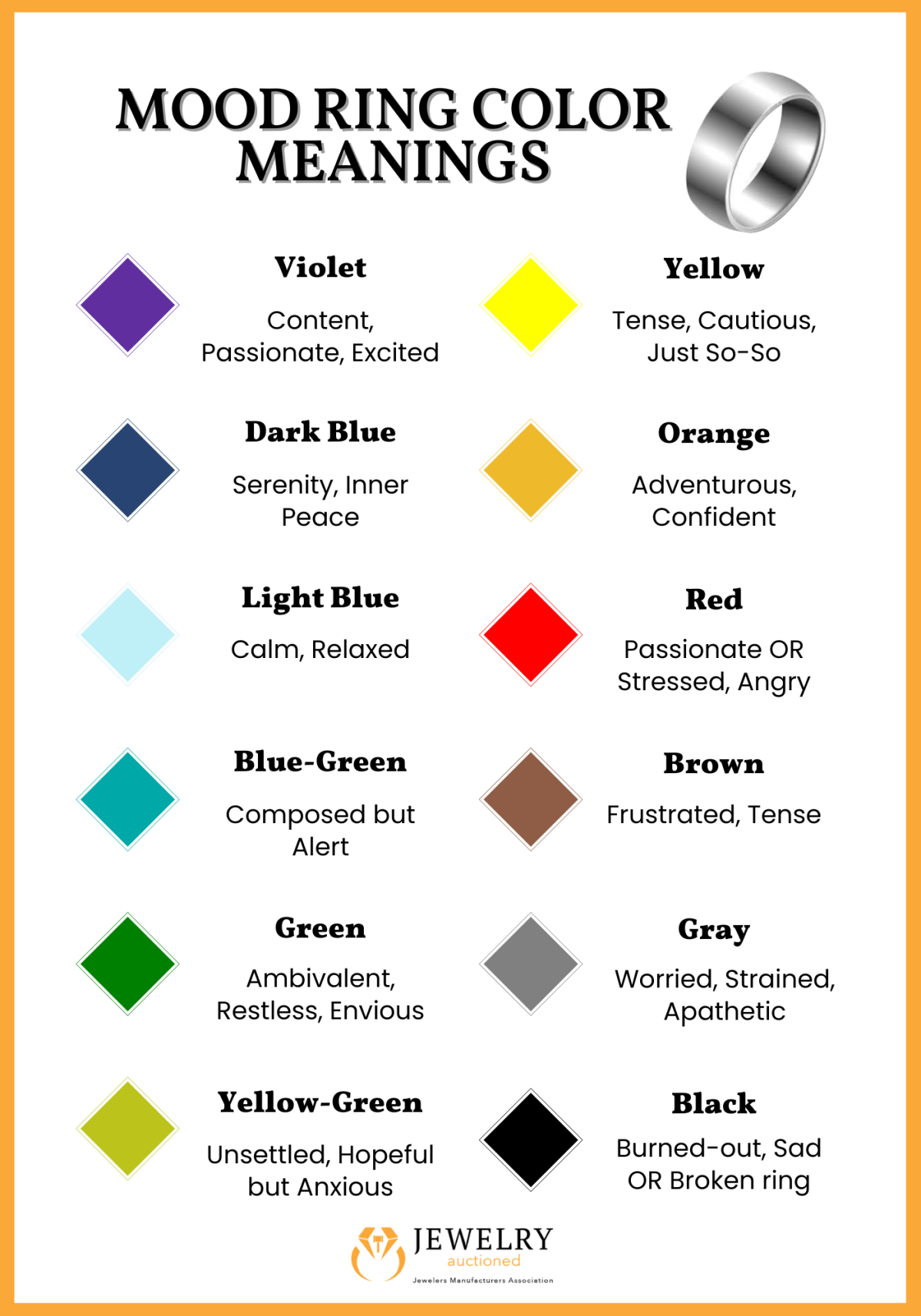
Decoding the Classic Color Chart: A Narrative of Interpretation
While the science behind the mood ring’s color changes is purely thermochromic, its enduring appeal stems from the rich narrative of emotional interpretation that has been culturally assigned to each hue. These interpretations are not scientific facts but rather a widely accepted, almost mystical, language developed around the gadget, enhancing its perceived value as a personal indicator.
Warm Colors: Energy and Excitement
- Dark Blue/Violet (High Temperature: ~90-92°F / 32-33°C): Often associated with feelings of joy, love, passion, and excitement. This is typically the warmest color a mood ring displays, suggesting an energized and perhaps outwardly expressive emotional state. From a physiological standpoint, this would correlate with increased peripheral blood flow, possibly due to excitement or physical activity.
- Blue (Warm-Normal Temperature: ~86-89°F / 30-31°C): Signifies happiness, calm, relaxation, and contentment. This is often considered the “ideal” state for a mood ring, suggesting a balanced and serene demeanor.
- Green (Normal Temperature: ~82-85°F / 28-29°C): Represents calmness, balance, curiosity, and often a stable or “average” emotional state. Many rings naturally settle on green when worn by someone in a neutral, relaxed state.
These warmer tones suggest an active, engaged, or content physiological state, with good circulation to the extremities.
Cool Colors: Calmness and Reflection
- Amber/Yellow (Slightly Below Normal Temperature: ~78-81°F / 25-27°C): Indicates a range of emotions from mixed feelings and apprehension to thoughtful contemplation. It suggests a slight cooling of the finger, perhaps due to a subtle reduction in peripheral blood flow.
- Orange (Cooler Temperature: ~75-77°F / 24-25°C): Can signify stress, confusion, or a feeling of being unsettled. This color often appears when one is experiencing mild anxiety or uncertainty.
These cooler tones suggest a decrease in peripheral circulation, often associated with slight internal tension or external cold.
Darker Hues: Stress and Mystery
- Gray (Cool Temperature: ~70-74°F / 21-23°C): Points to anxiety, nervousness, or being guarded. It often appears when one is feeling uncertain or experiencing internal conflict.
- Black/Brown (Coldest Temperature: Below ~70°F / 21°C): The darkest colors often indicate significant stress, tension, anger, or feeling overwhelmed. Physiologically, this correlates with significant vasoconstriction, where blood flow is drawn away from the extremities towards the core, resulting in significantly colder fingers. This can also simply mean the ring is too cold, either from the environment or prolonged lack of contact with the body.
The interpretations, while compelling, are largely cultural constructs. The true technological output is merely a temperature reading, which users then translate into an emotional narrative based on a widely disseminated chart.
Beyond the Hype: The (Lack of) True Biofeedback

While charming and culturally significant, it’s crucial to distinguish the mood ring’s function from genuine biofeedback or advanced emotional sensing technologies. The mood ring operates on a single parameter—temperature—which only indirectly correlates with complex emotional states.
Body Temperature vs. Emotional State
The link between core body temperature and emotion is well-established; however, peripheral skin temperature (especially of the finger) is far more susceptible to external factors and varies greatly between individuals. A person might have cold hands due to environmental temperature, poor circulation, or simply individual physiology, regardless of their emotional state. Conversely, someone could be extremely stressed but have warm hands if they’re in a warm environment or just naturally have warmer extremities.
The mood ring’s “reading” is a simplified, non-diagnostic response to localized temperature. It cannot differentiate between a relaxed warmth from being happy and a relaxed warmth from simply being in a warm room. Nor can it distinguish between cold hands from anxiety and cold hands from being outdoors on a chilly day. This fundamental limitation prevents it from being a truly accurate emotional barometer.
The Psychological Effect: Suggestion and Self-Perception
The real “magic” of the mood ring often lies in its psychological effect. Wearing a mood ring encourages self-reflection and introspection. When a color appears, the wearer subconsciously or consciously tries to align it with their current feelings. This act of seeking meaning can influence one’s perception of their own emotional state. For instance, if a ring turns blue (calm), the wearer might genuinely feel calmer, even if they were anxious moments before. This phenomenon, similar to a placebo effect, contributes significantly to the mood ring’s enduring allure and perceived accuracy. It becomes a prompt for self-assessment rather than a direct readout of internal states.
Mood Rings in the Modern Tech Landscape
Despite its simplistic mechanics, the mood ring holds a fascinating place in the history of personal technology. It can be viewed as a precursor, however distant, to the sophisticated wearable tech we see today, attempting to bring internal physiological data to external display.
From Novelty to Niche Gadget
In its heyday, the mood ring was a groundbreaking novelty gadget. It was an accessible, affordable piece of tech that brought a sense of wonder and personalization to everyday wear. Its immediate visual feedback, even if based on a simple principle, was revolutionary for its time. It tapped into a universal human desire to understand oneself and one’s emotions better, a desire that continues to drive innovation in wearables and biofeedback.
Today, mood rings are largely considered retro novelties or collectible items, but the underlying thermochromic technology continues to find applications in various fields, from temperature indicators on baby bottles and battery gauges to sophisticated thermal sensors and artistic displays.
Precursors to Wearable Tech and Health Monitors
The concept embodied by the mood ring—a wearable device that monitors a physiological parameter (temperature) and attempts to translate it into meaningful data (mood)—directly foreshadows modern wearable technology. Today’s smartwatches and fitness trackers are packed with sensors that monitor heart rate, skin temperature, galvanic skin response, sleep patterns, and even blood oxygen levels. These devices use algorithms to interpret this raw physiological data, often providing insights into stress levels, recovery status, and overall well-being.
While the mood ring’s interpretation was based on a simple, fixed chart, modern wearables utilize complex data fusion and machine learning to offer more nuanced and personalized insights. The mood ring, in its own way, laid some conceptual groundwork for the public’s acceptance and desire for personal, data-driven insights into their own bodies and minds.
The Future of Emotional Sensing Technology
The quest to accurately sense and interpret human emotion continues to be a frontier in tech. Advances in artificial intelligence, multimodal sensing (combining visual cues, vocal analysis, physiological signals), and neuroscience are pushing the boundaries of what’s possible. From AI-driven mental health apps that track vocal tone and language patterns to smart clothing embedded with sophisticated sensors, the goal is to move beyond mere temperature readings to truly understand the intricate tapestry of human emotion. The mood ring, with its charmingly simple color changes, serves as a whimsical reminder of how this journey began—with a direct, immediate, and captivating visual representation of our inner (or at least, skin-deep) states.
Maintaining Your Mood Ring’s “Tech”
As a gadget, albeit a low-tech one, a mood ring requires some basic care to ensure its thermochromic properties remain functional and vibrant. Understanding its limitations also helps manage expectations regarding its longevity and accuracy.
Care for Liquid Crystal Longevity
The liquid crystals within a mood ring are delicate. Exposure to extreme temperatures, particularly prolonged high heat, can damage their molecular structure, causing them to lose their ability to change color effectively. Similarly, water can seep into the ring’s casing, compromising the crystals or causing permanent discoloration. Owners are often advised to:
- Avoid prolonged exposure to direct sunlight.
- Remove the ring before showering, swimming, or washing hands vigorously.
- Store it at room temperature to prevent unnecessary stress on the crystals.
Proper care ensures the internal “tech” remains intact, allowing the ring to continue its captivating display for years.

Limitations and Degradation
Over time, even with careful maintenance, a mood ring’s liquid crystals can degrade. This degradation can manifest as:
- Fading: The colors may become less vibrant or distinct.
- Sticking: The ring may get “stuck” on a particular color, or its range of color changes may diminish.
- Permanent discoloration: The crystals might take on a dull, uniform color, indicating irreversible damage.
This natural degradation is a common characteristic of many early material technologies. While modern thermochromic materials are more robust, the mood rings of yesteryear remind us that even simple gadgets have a lifespan, and their “meaning” can fade as their functional technology deteriorates.
aViewFromTheCave is a participant in the Amazon Services LLC Associates Program, an affiliate advertising program designed to provide a means for sites to earn advertising fees by advertising and linking to Amazon.com. Amazon, the Amazon logo, AmazonSupply, and the AmazonSupply logo are trademarks of Amazon.com, Inc. or its affiliates. As an Amazon Associate we earn affiliate commissions from qualifying purchases.