
Navigating the landscape of homeownership often presents a choice between condominiums (condos) and cooperatives (coops). While both offer the promise of urban living or reduced maintenance compared to single-family homes, their fundamental structures—and, crucially, their financial implications—differ significantly. Understanding these distinctions is paramount for anyone making one of the most substantial financial commitments of their life. From ownership type to financing, monthly costs, and resale potential, the financial journey with a condo contrasts sharply with that of a coop.
Unpacking the Fundamentals of Ownership
The core difference between a condo and a coop lies in what you actually own, which has cascading effects on your financial responsibilities and rights.

Condominium: Direct Ownership and Real Property
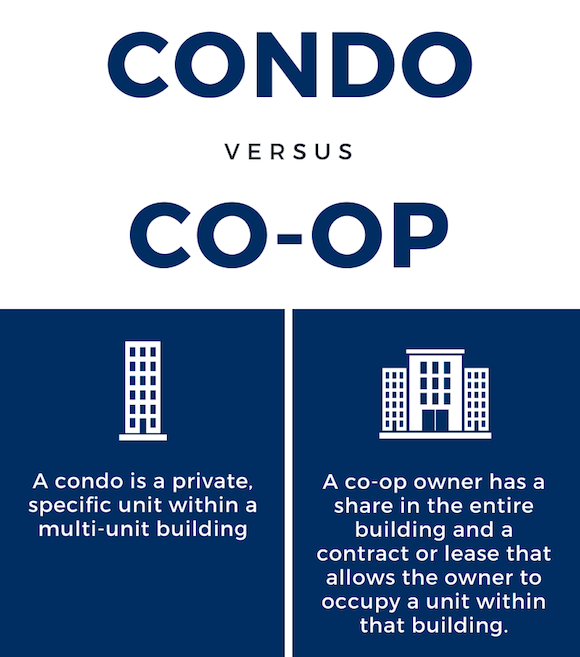
When you purchase a condominium, you are acquiring direct ownership of a specific physical unit within a larger building or complex. This is akin to owning a detached house, but within shared walls. Your ownership extends to the interior space of your unit, often defined by the “paint on the walls in.” Beyond your private domain, you also own an undivided proportional interest in the building’s common elements. These common elements can include the roof, foundation, hallways, elevators, lobbies, shared amenities like gyms and pools, and the land itself.
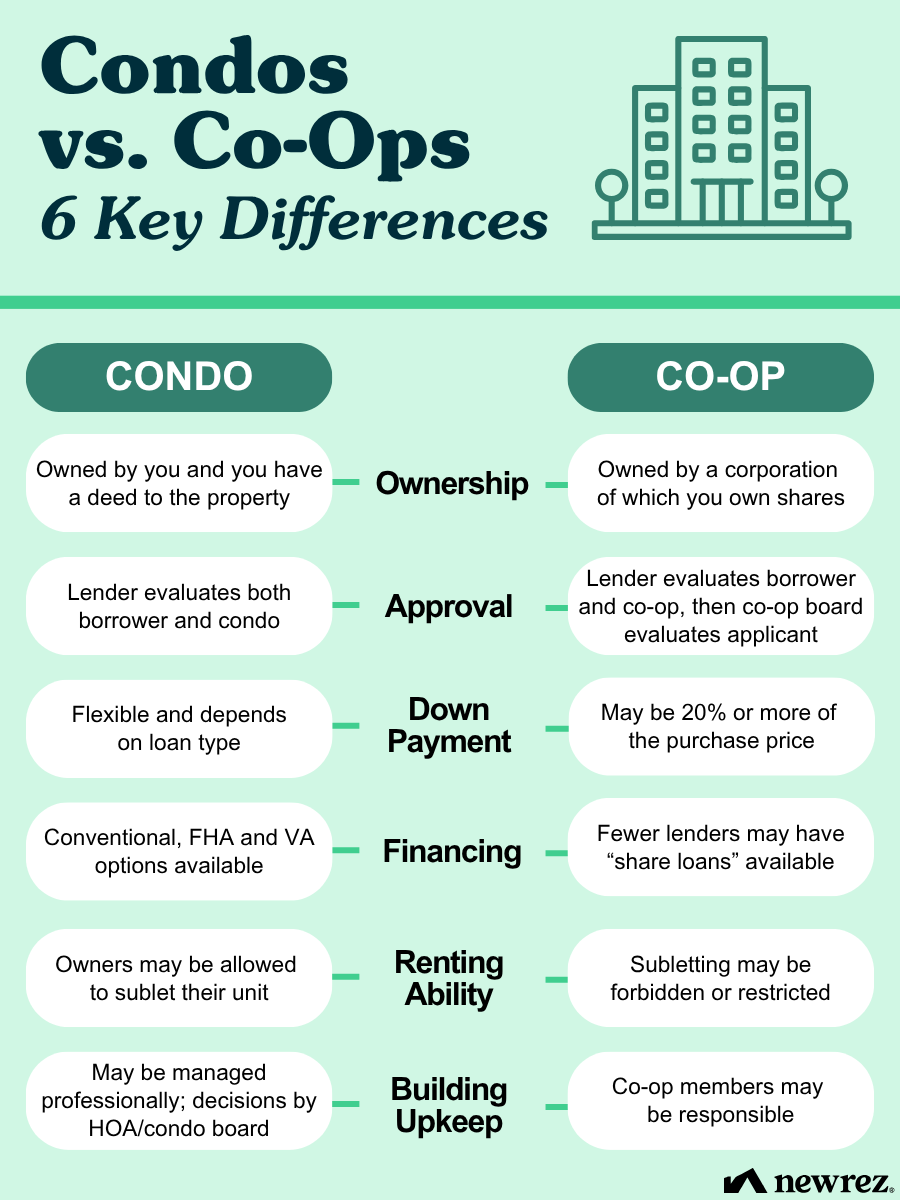
Financially, this means you receive a deed to your specific unit, making it real property. This direct ownership allows for conventional mortgages, with lenders providing financing secured directly against your unit. As an owner, you are responsible for paying your own property taxes directly to the municipality. Additionally, you pay monthly Homeowners Association (HOA) fees. These fees are designed to cover the costs associated with maintaining the common areas, building insurance (for the structure, not your interior contents), and funding any shared amenities. Any significant repairs or improvements to common areas may result in special assessments, where owners contribute additional funds based on their proportional interest. From an investment perspective, this direct ownership typically means that the appreciation or depreciation of your asset is tied to the local real estate market for similar direct-ownership properties.
Cooperative: Shares in a Corporation, Proprietary Lease
A cooperative operates on an entirely different financial and legal model. When you “buy” a coop, you are not purchasing real property in the traditional sense. Instead, you are buying shares in a private corporation that owns the entire building, including all the individual units and common areas. These shares, in turn, grant you a proprietary lease for a specific unit within that building.
Financially, this means your “ownership” is actually an equity stake in a business entity. The shares are considered personal property, not real property. Financing for coops involves what’s often called a “share loan” rather than a traditional mortgage. These loans can have different terms, require higher down payments, and are offered by a more limited pool of lenders. Monthly expenses in a coop are referred to as “maintenance fees,” and they are generally more comprehensive than HOA fees. These fees typically cover a proportion of the entire building’s underlying mortgage, property taxes for the entire building, building insurance, utilities (like heat, hot water, and sometimes electricity), and the upkeep of common areas. The financial health of the corporation directly impacts all shareholders, meaning you are financially interdependent with your neighbors. This structure often comes with potential tax advantages, as a portion of the maintenance fees, representing your share of the corporation’s property tax and mortgage interest payments, may be deductible.
Financial Requirements and Ongoing Costs
The financial outlay for purchasing and maintaining a condo versus a coop presents a critical decision point for potential homeowners and investors.
Down Payment and Financing
The initial capital required varies significantly. For condos, conventional mortgages typically demand down payments ranging from 5% to 20% of the purchase price. FHA loans, for approved condo projects, can offer even lower down payment options. Lenders primarily assess the individual buyer’s financial stability and the financial health of the HOA.
Coops, by contrast, frequently require substantially higher down payments, often ranging from 20% to 50%, and in some luxury markets, 100% cash purchases are not uncommon. This higher barrier to entry is a deliberate financial strategy by cooperative boards to ensure the financial robustness of their shareholder base. Lenders for share loans often impose stricter financial requirements on borrowers, given that the loan is secured by personal property (shares) rather than real property, and the borrower’s financial health is intrinsically linked to the financial stability of the entire cooperative.
Monthly Expenses: HOA vs. Maintenance Fees
Understanding the composition of monthly fees is crucial for budgeting. Condo HOA fees primarily cover common area maintenance, amenities, and the building’s master insurance policy. Property taxes are paid separately by the individual unit owner, as is insurance for the unit’s interior and personal belongings.
Coop maintenance fees are typically more extensive. They encompass a pro-rata share of the building’s underlying mortgage, the entire building’s property taxes, master insurance, most utilities (often including heat, hot water, and gas), and common area upkeep. Because these fees include a portion of the building’s property taxes and mortgage interest, shareholders can often deduct these amounts on their personal income taxes, offering a potential financial advantage. However, this also means that coop maintenance fees are generally higher than condo HOA fees. Moreover, the collective nature of a coop means that if the underlying mortgage rate adjusts or property taxes increase for the entire building, your maintenance fees will likely reflect these changes.
Closing Costs and Deductions
Closing costs differ in nature and amount. Condo closing costs are standard for real estate transactions: loan origination fees, title insurance, appraisal fees, legal fees, and recording fees. Property tax and mortgage interest deductions are straightforward for the individual owner.
Coop closing costs can include unique items such as a “stock transfer tax,” attorney fees for the cooperative corporation, and sometimes a “flip tax” or transfer fee imposed by the co-op board on the seller. These additional fees can impact the net proceeds for sellers and increase the initial cash outlay for buyers. While the financial structure is more complex, the ability to deduct a proportionate share of the coop’s property tax and mortgage interest can be a significant financial benefit, effectively reducing the net cost of ownership for tax-savvy buyers.
Approval Process, Financial Scrutiny, and Restrictions
The level of scrutiny and control exerted by the governing body represents another significant financial and lifestyle differentiator.
The Board Approval Gauntlet
For condos, while there is a Homeowners Association (HOA) with bylaws and rules, the buyer approval process is generally less rigorous. The HOA typically focuses on ensuring the buyer will adhere to community standards and that the unit will not be used for purposes inconsistent with the bylaws. The primary financial scrutiny comes from the mortgage lender, who assesses the buyer’s creditworthiness.
Coops, however, are renowned for their stringent board interview process. The cooperative board, acting on behalf of all shareholders, has a vested interest in the financial stability and compatibility of new residents. They will often conduct a thorough review of a buyer’s entire financial profile, including income, assets, debt-to-income ratio, and liquidity, frequently requiring proof of substantial post-closing cash reserves. The rationale is purely financial: each shareholder’s financial health directly affects the stability of the corporation and, by extension, every other shareholder. A financially weak shareholder could potentially default on maintenance fees, thereby increasing the financial burden on others. This rigorous financial gatekeeping serves as a protective measure for the collective asset.
Financial Flexibility and Rules
The rules governing usage, renovations, and rental income also vary considerably, impacting an owner’s financial flexibility. Condos generally offer more latitude. While HOAs have rules, they are typically less restrictive regarding subletting, renting units, and interior renovations. This greater flexibility can be a significant financial advantage for owners who wish to generate rental income, convert their unit into an investment property, or undertake extensive personal renovations to enhance value.
Coops, conversely, often impose strict rules that can significantly curtail financial flexibility. Subletting might be prohibited entirely, restricted to specific durations, or subject to a lengthy waiting period and repeated board approval, making it difficult to generate rental income. Renovations often require detailed plans and extensive board approval. These restrictions, while designed to protect the financial and aesthetic integrity of the building, can limit an owner’s ability to monetize their property or make changes that might enhance its market value without board consent.
Investment Potential and Liquidity
Evaluating a property purely as a financial asset, the differences between condos and coops become stark in terms of appreciation potential, ease of resale, and associated risks.
Appreciation and Market Dynamics
Condos generally tend to appreciate in value in line with the broader local real estate market for directly owned properties. Their value is typically driven by factors such as location, amenities, condition, and market demand for physical real estate. In a rising market, condos can offer a clear path to equity growth.
Coops can present a more nuanced picture regarding appreciation. In certain competitive markets, such as New York City, coops can offer a more affordable entry point into desirable neighborhoods due to their higher down payment requirements and restrictive purchase process, which can limit the pool of eligible buyers. However, their appreciation might be slower or less predictable than condos due to the inherent restrictions on resale and the stringent financial vetting of new buyers. Their value is tied to the underlying corporation’s financial health and the demand for shares in that specific entity, not just the physical unit.
Resale and Exit Strategy
Liquidity, or the ease with which an asset can be converted to cash, is a key financial consideration. Condos are generally easier and quicker to sell. The larger pool of potential buyers (due to easier financing and less restrictive approval processes) contributes to greater market liquidity. This means a condo owner can typically expect a more straightforward and faster exit from their investment.
Coops often present a more challenging resale environment. The demanding board approval process, higher down payment requirements, and restrictions (like subletting limitations) significantly reduce the pool of eligible buyers. This can lead to longer selling times and potentially affect the selling price, as sellers might need to appeal to a more niche market. Furthermore, some coops levy a “flip tax” or transfer fee upon sale, which is paid by the seller to the cooperative, impacting the seller’s net proceeds. These factors collectively indicate lower liquidity for coop shares compared to condo units.
Risk Assessment
Both property types carry financial risks. For condos, risks include significant increases in HOA fees, special assessments for major building repairs (e.g., roof replacement, structural issues), and overall market downturns. The financial burden of a special assessment falls directly and individually on the unit owner.
Coops carry unique risks tied to the collective ownership model. The financial health of the entire cooperative corporation is paramount. If the building has a large underlying mortgage and reserves are low, shareholders could face substantial increases in maintenance fees or special assessments to cover unforeseen expenses or capital improvements. Mismanagement by the coop board or significant financial distress within the shareholder base can also negatively impact the value and marketability of shares. Because shareholders are interdependent, the financial decisions and stability of the entire entity directly affect each individual’s investment.
Choosing the Right Financial Path
The decision between a condo and a coop ultimately hinges on an individual’s financial capacity, investment goals, risk tolerance, and desired lifestyle.
For the Investor
Condos typically appeal more to traditional real estate investors due to their greater financial flexibility. Easier financing, fewer restrictions on renting out units, and generally higher liquidity make them more attractive for generating rental income and facilitating quicker exits. The straightforward ownership structure and clearer market value also simplify investment analysis.
Coops are generally less suitable for investors looking for traditional rental income or quick turnover due to the stringent subletting rules, board approval processes for tenants, and lower liquidity. While some investors might find value in specific coop markets where purchase prices are lower relative to condos, the operational complexities and restrictions often outweigh the benefits for a purely financial investment strategy focused on cash flow or rapid appreciation.
For the Homeowner
For those primarily seeking a primary residence, both options offer distinct advantages. Condos provide direct ownership, more personal autonomy (within HOA rules), and often a clearer path to financing and equity build-up. They can be an excellent choice for individuals who value independence and a more straightforward financial model.
Coops can offer a strong sense of community, potentially lower purchase prices in prime locations (offset by higher down payment requirements), and often better financial stability for the building due to rigorous vetting of shareholders. They can appeal to individuals who value a collective approach to property management and are comfortable with the increased scrutiny and rules in exchange for potential tax benefits and a stable living environment. However, homeowners must be prepared for less personal control over their property and a shared financial destiny with their neighbors.
Weighing Financial Goals and Lifestyle
Ultimately, the choice demands thorough financial due diligence. Prospective buyers should meticulously review the financial statements of both the HOA or cooperative corporation, understand their reserve funds, scrutinize the bylaws and house rules, and consult with a financial advisor specializing in real estate. Consider your available cash for down payments and closing costs, your comfort with higher or more variable monthly fees, your long-term investment horizon, and your desire for financial autonomy over your property. Whether it’s the direct ownership and flexibility of a condo or the shared financial responsibility and community control of a coop, the decision is a profound financial one that shapes your asset portfolio and future financial commitments.
aViewFromTheCave is a participant in the Amazon Services LLC Associates Program, an affiliate advertising program designed to provide a means for sites to earn advertising fees by advertising and linking to Amazon.com. Amazon, the Amazon logo, AmazonSupply, and the AmazonSupply logo are trademarks of Amazon.com, Inc. or its affiliates. As an Amazon Associate we earn affiliate commissions from qualifying purchases.