
Digital advertising, in its omnipresent form across websites, applications, and connected devices, relies on a sophisticated technological ecosystem operating largely behind the scenes. At the core of this infrastructure lies the ad server – a specialized computer server responsible for storing advertisements, making decisions about which ads to display, and delivering them to users’ web browsers or applications. Far from being a simple storage unit, an ad server is a complex piece of software and hardware designed for real-time processing, data analysis, and intelligent delivery, forming the technical backbone that enables targeted and measurable advertising campaigns.
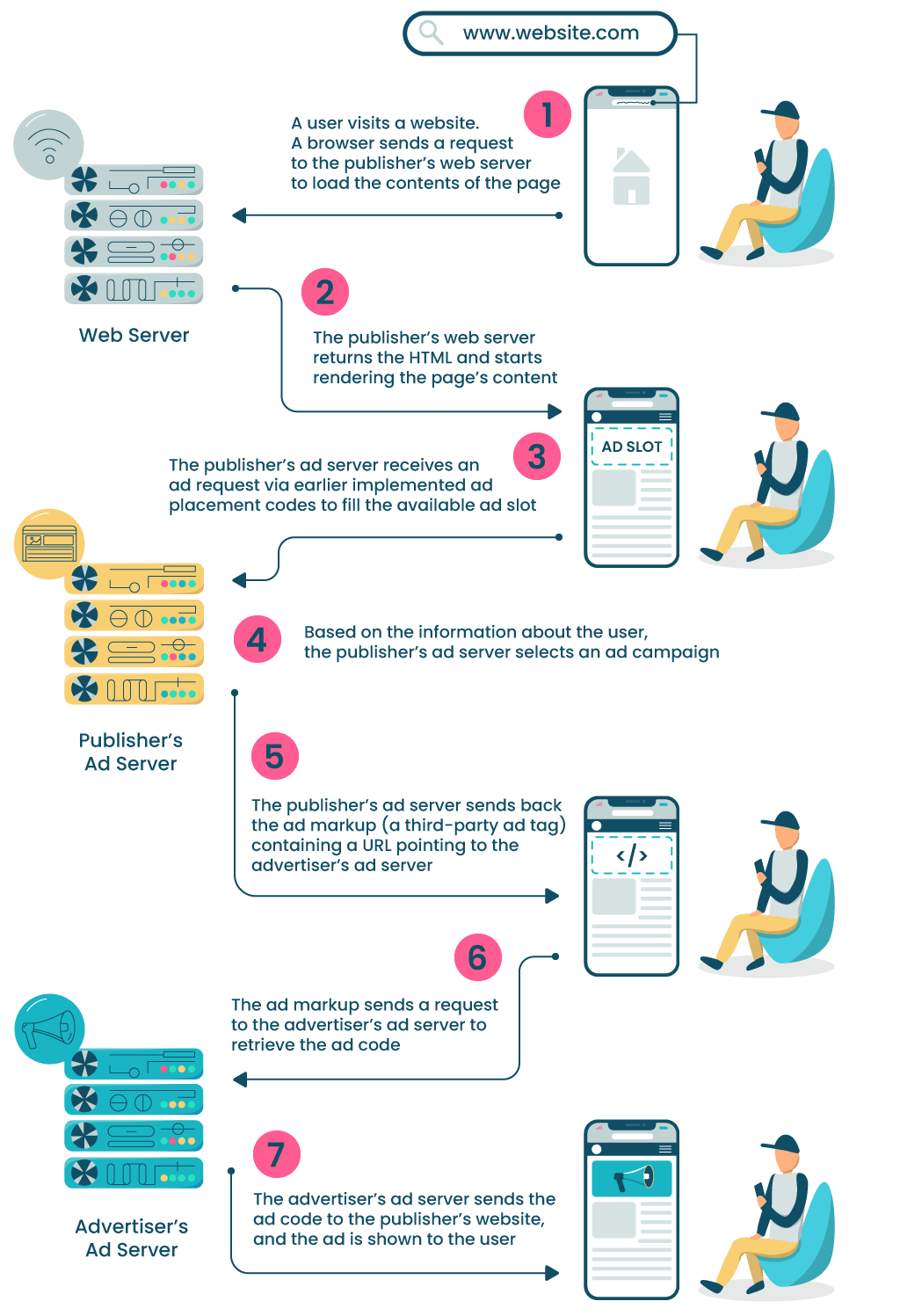
The Technical Backbone of Digital Advertising
At its most fundamental level, an ad server is a system that responds to a request for an ad by selecting an appropriate creative from its database and serving it. This seemingly simple action masks a highly intricate process involving multiple decision points and data exchanges occurring in milliseconds. When a user visits a webpage or opens an app, an “ad request” is sent. This request carries various pieces of technical information about the user (e.g., IP address, device type, browser, location) and the context (e.g., URL of the page, content category). The ad server then takes this data, cross-references it with campaign parameters, targeting criteria, and available inventory, and determines the most relevant ad to deliver.
The server’s role extends beyond mere delivery. It meticulously logs every impression, click, and conversion, providing the critical data points necessary for campaign optimization and performance reporting. Without ad servers, the digital advertising landscape would be chaotic, untargeted, and impossible to measure with precision. They centralize ad management, automate campaign execution, and provide the programmatic logic essential for modern digital marketing.
Anatomy of an Ad Server System
An ad server is not a monolithic entity but rather a distributed system comprising several interacting modules, each dedicated to specific technical functions. Its architecture is designed for high availability, low latency, and massive data processing capabilities.
Core Components
- Database: This is the central repository for all critical information. It stores ad creatives (images, videos, HTML5 bundles), campaign parameters (start/end dates, budget, targeting rules, frequency caps), publisher inventory details, and historical performance data. The database must be highly optimized for rapid querying and large-scale data storage.
- Ad Selection Engine (Decisioning Engine): This is the “brain” of the ad server. It houses sophisticated algorithms that make real-time decisions about which ad to serve for each incoming request. Factors considered include user demographics, browsing history, geographic location, time of day, ad placement availability, budget pacing, campaign priority, and various optimization goals (e.g., click-through rate, conversion rate). Machine learning models are increasingly integrated here to predict optimal ad delivery.
- Ad Delivery Mechanism: Once an ad is selected, it must be delivered efficiently. This typically involves leveraging Content Delivery Networks (CDNs) to cache ad creatives closer to the end-user, minimizing latency. Ad delivery can be client-side (JavaScript tags instruct the browser to fetch the ad) or server-side (the ad server directly inserts the ad into the content stream, common in video).
- Reporting and Analytics Module: This component collects, processes, and aggregates vast amounts of interaction data (impressions, clicks, conversions). It then translates this raw data into actionable insights through dashboards and reports, allowing advertisers and publishers to monitor campaign performance, identify trends, and make data-driven decisions. This module often employs big data technologies for efficient storage and analysis.
- APIs and Integrations: Modern ad servers do not operate in isolation. They feature robust Application Programming Interfaces (APIs) that allow seamless integration with other ad tech platforms such as Data Management Platforms (DMPs), Supply-Side Platforms (SSPs), Demand-Side Platforms (DSPs), Customer Relationship Management (CRM) systems, and analytics tools. These integrations are crucial for enriching targeting data, participating in programmatic bidding, and providing a holistic view of the advertising ecosystem.
Architectural Considerations
The technical demands on ad server architecture are immense. Scalability is paramount, as systems must handle billions of ad requests daily without performance degradation. Low latency is critical; ad selection and delivery must occur within milliseconds to ensure a smooth user experience. Redundancy and fault tolerance are built-in to prevent service interruptions, often involving geographically distributed data centers and load balancing. Finally, robust security measures are essential to protect sensitive user data, prevent ad fraud, and ensure compliance with privacy regulations.
Diverse Ad Server Implementations
The term “ad server” can refer to several distinct types of technology, each designed to serve different stakeholders within the digital advertising ecosystem.
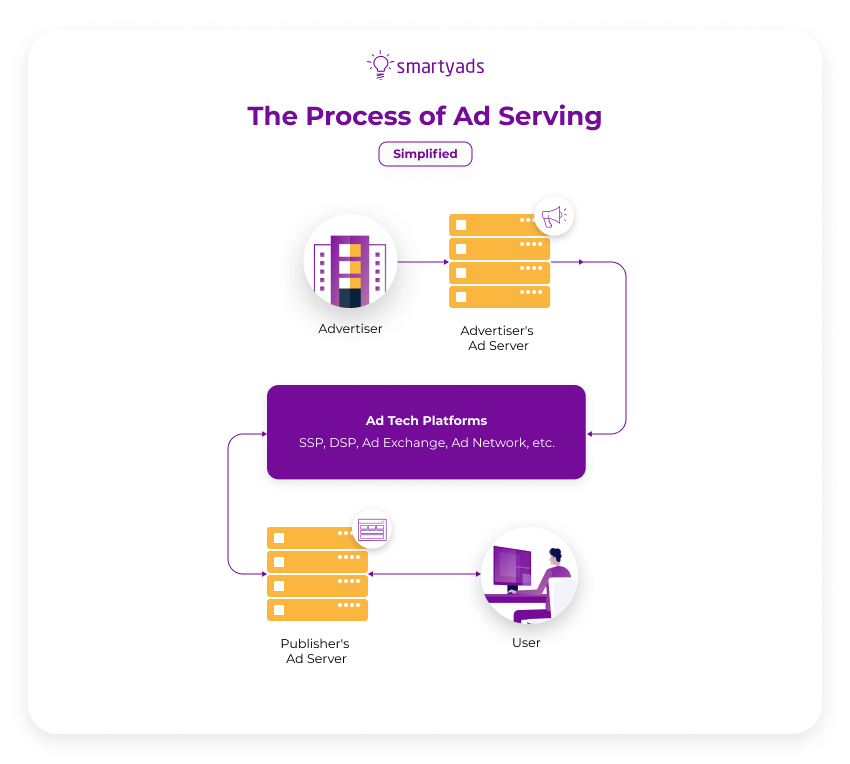
First-Party Ad Servers (Publisher Ad Servers)
These ad servers are primarily used by publishers (website owners, app developers) to manage their own ad inventory and display direct-sold campaigns.
- Functionality: They enable publishers to set up, manage, and track advertising campaigns sold directly to advertisers. Key features include inventory forecasting, yield optimization across various ad units, frequency capping for user experience, and robust reporting on impressions and clicks.
- Technical Focus: These servers integrate deeply with a publisher’s Content Management System (CMS) and often interact with header bidding wrappers or other programmatic integrations to maximize revenue from unsold inventory. They prioritize delivering the right ad to the right placement on the publisher’s property. A prominent example is Google Ad Manager (GAM), widely adopted by publishers.
Third-Party Ad Servers (Advertiser Ad Servers)
In contrast, third-party ad servers are utilized by advertisers and their agencies to manage, serve, and track their campaigns across multiple publishers and platforms.
- Functionality: They provide a centralized platform for advertisers to upload ad creatives, set targeting parameters, monitor campaign performance, and attribute conversions across an entire media plan. This allows for unified reporting and consistent measurement, regardless of where the ads are displayed.
- Technical Focus: A critical technical aspect is their ability to track user interactions (impressions, clicks, conversions) across different websites using technologies like third-party cookies or tracking pixels. This cross-site tracking is fundamental for audience segmentation, retargeting, and robust attribution modeling. Examples include Campaign Manager 360 (formerly DoubleClick Campaign Manager) and Sizmek.
Programmatic Ad Servers (SSP/DSP/Ad Exchange)
While not always explicitly called “ad servers,” the underlying technology powering Supply-Side Platforms (SSPs), Demand-Side Platforms (DSPs), and Ad Exchanges perform specialized ad serving functions within the programmatic advertising ecosystem.
- Functionality: These systems facilitate automated, real-time bidding (RTB) processes. SSPs connect publishers’ inventory to multiple ad exchanges and DSPs, ensuring publishers get the best price for their impressions. DSPs allow advertisers to bid on impressions across various ad exchanges based on their targeting criteria and budget. Ad exchanges are marketplaces where impressions are bought and sold in real-time.
- Technical Focus: The technology here is incredibly complex, involving ultra-low latency bid requests and responses exchanged between numerous platforms in milliseconds. Sophisticated algorithms manage supply and demand, optimize bid strategies, and ensure efficient matching between buyers and sellers, all while processing massive volumes of data in real-time.
The Technical Mechanisms of Ad Targeting and Tracking
The ability of an ad server to deliver a “relevant” ad hinges on its capacity to identify users and track their online behavior. This involves a suite of interconnected technologies.
- Cookies: HTTP cookies remain a foundational technology. First-party cookies are set by the domain a user is visiting (e.g., a publisher’s site) and are used by publisher ad servers for frequency capping or basic targeting. Third-party cookies are set by domains other than the one in the address bar (e.g., an advertiser’s ad server) and are crucial for cross-site tracking, retargeting, and enabling unified campaign measurement across the internet.
- Pixels and Tags: These are small snippets of code (often JavaScript) embedded on webpages. Tracking pixels (1×1 transparent images) and conversion tags fire when specific events occur (e.g., page view, product added to cart, purchase completion). They send data back to the ad server, enabling detailed event tracking, audience segmentation, and performance measurement.
- Server-Side Tracking: As privacy concerns and browser restrictions on third-party cookies grow, server-side tracking is gaining traction. Instead of browser-side pixels directly sending data to third parties, all event data is first sent to the publisher’s own server. The publisher’s server then forwards this data to various ad tech vendors, potentially cleaning or anonymizing it in the process. This offers greater control, improved data accuracy, and can bypass some ad blockers.
- Device IDs and Fingerprinting: For mobile apps, device identifiers (like IDFA on iOS or GAID on Android) serve a similar function to cookies for tracking and targeting. Browser fingerprinting involves collecting various technical attributes of a user’s device and browser (e.g., plugins, fonts, screen resolution) to create a unique identifier, although its accuracy and privacy implications are subjects of ongoing debate.
- Data Management Platforms (DMPs): DMPs collect, store, and organize vast amounts of user data from various sources (online, offline, first-party, third-party). Ad servers integrate with DMPs via APIs to access enriched audience segments, allowing for highly granular targeting based on behavioral patterns, demographics, and interests.

Emerging Technologies and Future Directions
The ad server landscape is continuously evolving, driven by advancements in technology and increasing demands for privacy, transparency, and efficiency.
- AI and Machine Learning: The integration of AI and ML is transforming ad selection engines. These technologies enable predictive analytics to identify optimal ad placements, dynamically adjust bidding strategies, personalize ad creatives, and detect fraudulent activities with greater accuracy. They can optimize campaigns in real-time by learning from past performance data and predicting future user behavior.
- Privacy-Enhancing Technologies (PETs): With the deprecation of third-party cookies and stricter privacy regulations (like GDPR and CCPA), ad servers are adapting to cookieless environments. Solutions like Google’s Privacy Sandbox initiatives (e.g., Topics API, FLEDGE), universal ID solutions, and privacy-preserving data collaboration methods (e.g., data clean rooms, federated learning) are being developed to enable targeted advertising while respecting user privacy. This shift necessitates significant technical re-architecture for ad servers.
- Server-Side Ad Insertion (SSAI): Especially relevant for video content and Connected TV (CTV), SSAI involves stitching ads directly into the video stream on the server side before it reaches the user. This creates a seamless viewing experience, reduces buffering, and bypasses many ad blockers, offering a more robust ad delivery mechanism for premium video inventory.
- Blockchain for Transparency: While still nascent, blockchain technology holds potential for the ad tech ecosystem. Its distributed ledger capabilities could enhance transparency in the ad supply chain, reduce ad fraud by providing an immutable record of impressions, and give advertisers clearer visibility into where their budgets are being spent.
- Edge Computing: To further reduce latency and enhance real-time decision-making, ad server logic could increasingly leverage edge computing. By processing ad requests closer to the user, particularly in geographic regions with high ad density, edge computing could dramatically improve response times and optimize content delivery for specific local contexts.
In summary, an ad server is a sophisticated technological system, constantly adapting to new challenges and opportunities. It remains an indispensable component of the digital advertising infrastructure, facilitating the complex interplay between publishers, advertisers, and users while driving the engine of the digital economy.
aViewFromTheCave is a participant in the Amazon Services LLC Associates Program, an affiliate advertising program designed to provide a means for sites to earn advertising fees by advertising and linking to Amazon.com. Amazon, the Amazon logo, AmazonSupply, and the AmazonSupply logo are trademarks of Amazon.com, Inc. or its affiliates. As an Amazon Associate we earn affiliate commissions from qualifying purchases.