
Choosing the right horsepower (HP) for your garage door opener is a critical decision that impacts not only the system’s performance and longevity but also the safety and convenience of your daily routine. While it might seem like a simple choice, selecting an opener with insufficient power can lead to premature wear, motor strain, and operational failures, while excessive power might be an unnecessary expense. Understanding the nuances of garage door opener technology and how various factors influence HP requirements is key to making an informed decision.
Understanding Garage Door Opener Horsepower (HP)
Horsepower, in the context of a garage door opener, quantifies the motor’s capability to lift and lower the garage door. It’s a measure of the work the motor can perform. Unlike a car engine where higher HP often equates to faster speeds, for garage door openers, adequate HP ensures the door operates smoothly, reliably, and without undue strain on the motor.
What HP Represents
At its core, HP reflects the motor’s strength. A higher HP rating means the motor can exert more force, making it suitable for heavier or larger doors. However, it’s crucial to understand that the spring system of your garage door carries the vast majority of the door’s weight. The opener primarily manages the initial lift and controls the door’s movement, not the full dead weight. Properly balanced garage doors should feel relatively light when lifted manually. If your door feels excessively heavy, it’s an indication that the springs are worn or improperly tensioned, a problem that even the most powerful opener cannot rectify and which should be addressed by a professional.
Common HP Ratings
Garage door openers typically come in several standard horsepower ratings:
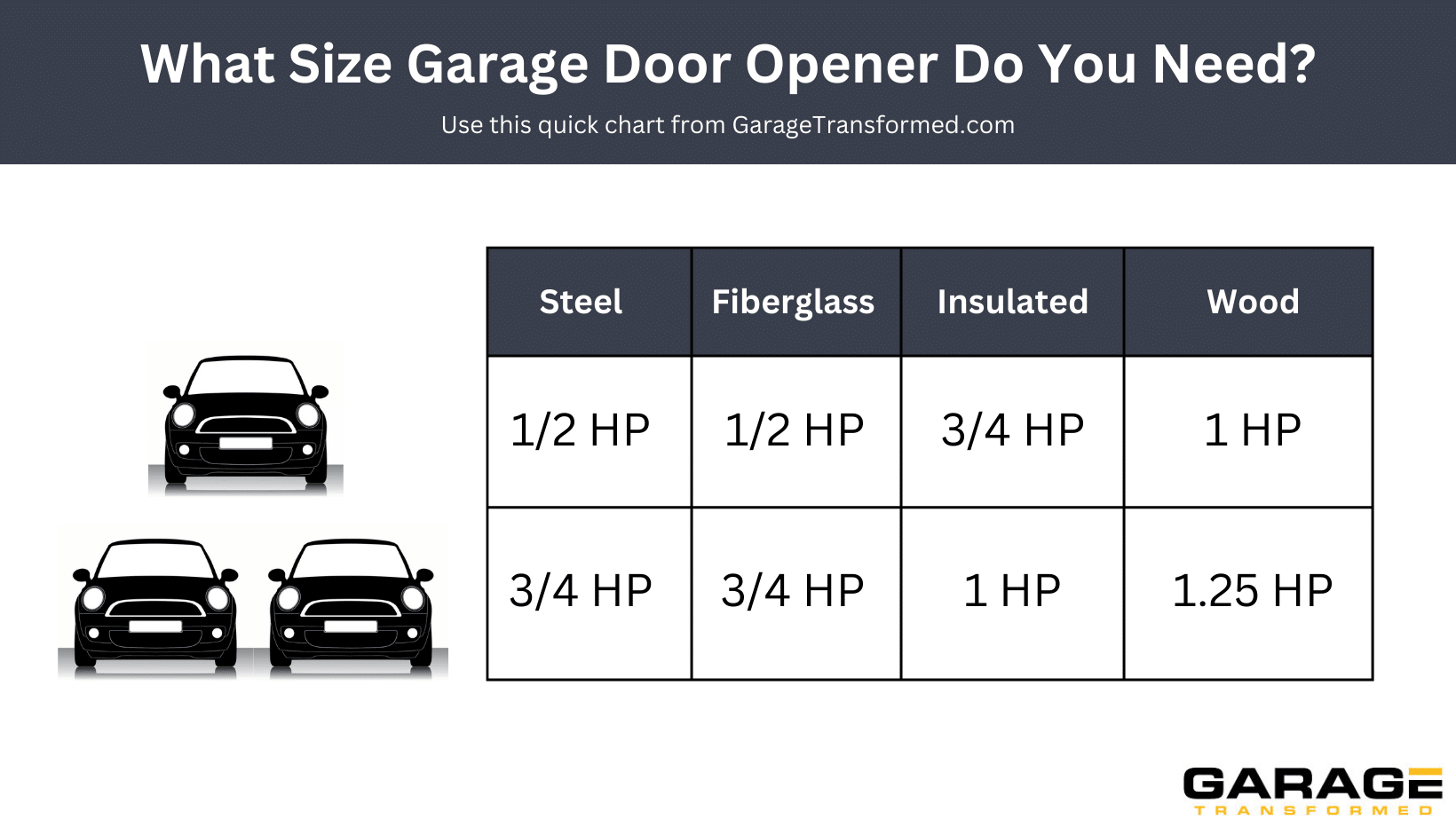
- 1/2 HP: This is the most common rating, suitable for most standard single or double garage doors that are well-balanced and made from common materials like steel or aluminum.
- 3/4 HP: Often recommended for heavier double garage doors, particularly those made from wood or reinforced steel, or for homes with high-cycle usage.
- 1 HP and higher: Reserved for exceptionally large, heavy, or custom-built garage doors, such as those made from solid wood, oversized commercial doors, or those with unique insulation properties that add significant weight. Some manufacturers also offer DC motors with “equivalent HP” ratings that reflect their lifting power rather than a direct comparison to traditional AC motor HP.
Factors Influencing Your HP Requirement
Several key factors contribute to determining the appropriate horsepower for your garage door opener. Evaluating these aspects will help narrow down your options and ensure you select a system capable of handling your specific needs.
Garage Door Size and Weight
This is arguably the most significant factor. Larger doors, by nature, are heavier. A standard single-car garage door (around 8×7 or 9×7 feet) is significantly lighter than a standard double-car garage door (typically 16×7 or 18×7 feet). Custom-sized or oversized doors will, of course, increase the weight further. Materials also play a crucial role; a standard aluminum door will weigh less than a steel door of the same size, which in turn will weigh less than a solid wood door.
Door Material and Construction
The material composition of your garage door directly impacts its total weight.
- Aluminum and Lightweight Steel: These are typically the lightest options, often compatible with 1/2 HP openers.
- Heavy Gauge Steel or Insulated Doors: The added layers of steel or insulation increase weight, making 3/4 HP or even 1 HP a more suitable choice for double doors.
- Wood or Composite Wood Doors: These are generally the heaviest doors. Solid wood doors, especially larger ones, almost always require 3/4 HP or 1 HP openers to ensure reliable operation and prevent motor strain.
Type of Spring System
Garage doors utilize either torsion springs (mounted horizontally above the door opening) or extension springs (mounted vertically along the side tracks). Both systems are designed to counterbalance the door’s weight, making it feel lighter. However, the condition and proper tensioning of these springs are paramount. If the springs are old, broken, or improperly adjusted, even a high-HP opener will struggle, and its motor will wear out quickly. The opener’s HP rating assumes a properly balanced door.
Frequency of Use
Consider how often your garage door will be opened and closed daily. A garage door that serves as the primary entrance to your home, being used multiple times a day by a busy family, experiences significantly more cycles than one used only on weekends. Higher frequency usage can benefit from a more robust motor, potentially a 3/4 HP over a 1/2 HP, as it implies greater durability and less strain over time.
Desired Speed and Smoothness
While HP primarily relates to lifting power, a motor with adequate power for its load will generally operate more smoothly and quietly. While speed is not directly proportional to HP, an opener that is not straining will perform its function more efficiently. DC motors, regardless of their HP equivalent, are often praised for smoother, quieter operation with soft start and stop features.
Additional Features (e.g., smart tech integration, battery backup)
While not directly related to HP, features like battery backup add a small amount of weight to the head unit and may draw slightly more power. Smart home integration, while convenient, doesn’t impact the core HP requirement, but it’s often found on higher-end units that may also boast more robust motors.
Matching HP to Your Garage Door Type
Once you’ve considered the various factors, matching them to common garage door types provides a clear pathway to selecting the correct HP.
Single-Car Garage Doors (Lightweight)
- Size: Typically 8×7 ft to 10×8 ft.
- Material: Most commonly aluminum, light-gauge steel, or single-layer composite.
- Recommendation: A 1/2 HP garage door opener is usually sufficient for these doors, provided they are well-balanced and the springs are in good condition.
Double-Car Garage Doors (Standard Weight)

- Size: Typically 14×7 ft to 18×8 ft.
- Material: Steel (often insulated), some lighter wood composites.
- Recommendation: For standard double doors, especially insulated steel ones, a 3/4 HP opener is generally the preferred choice. While a 1/2 HP might work for lighter double doors, 3/4 HP offers a better margin of safety, reduces motor strain, and extends the life of the unit, particularly with moderate to high usage.
Oversized or Heavy Custom Doors
- Size: Anything larger than standard double doors, or doors with unusual height/width.
- Material: Solid wood, heavy custom designs, multi-layer insulated steel, or specialty commercial doors.
- Recommendation: These doors almost always require a 1 HP or higher garage door opener. For exceptionally large or heavy doors, consulting with a professional garage door technician is highly recommended to ensure you select an opener that can handle the load safely and efficiently. Some specialized openers for commercial applications can even exceed 1 HP.
Beyond Horsepower: Other Key Considerations
While HP is fundamental, a modern garage door opener is a complex piece of technology with several other features that contribute to its overall performance, safety, and user experience.
Drive System Types
The drive system is how the motor physically moves the garage door.
- Chain Drive: The most common and robust system, using a metal chain to pull the door. It’s durable and affordable but can be noisy. Good for heavy doors.
- Belt Drive: Similar to chain drive but uses a steel-reinforced rubber belt. Significantly quieter than chain drive, making it ideal for garages attached to living spaces. Slightly more expensive but offers smooth operation.
- Screw Drive: Employs a threaded steel rod that rotates, moving a trolley that lifts the door. Fewer moving parts, making it generally reliable and low-maintenance. Can be noisier than belt drives and less common for very heavy doors.
- Direct Drive (Wall Mount): These openers mount directly to the torsion bar beside the door. They free up ceiling space, are very quiet, and are often the most powerful and technologically advanced, making them excellent for large, heavy doors and homes where ceiling space is at a premium.
Motor Type (AC vs. DC)
- AC (Alternating Current) Motors: Traditional motors that operate at a fixed speed. They are reliable and often found in 1/2 HP and 3/4 HP openers.
- DC (Direct Current) Motors: Offer variable speed operation, allowing for soft start and stop functionality. This reduces wear and tear on the door and opener, provides quieter operation, and often comes with battery backup capabilities. Many modern openers use DC motors, with their lifting power often equated to traditional AC HP ratings (e.g., “1/2 HP equivalent DC motor”).
Safety Features
All modern garage door openers are required to have certain safety features:
- Photo-Eye Sensors: These infrared beams detect obstructions in the door’s path. If the beam is broken while the door is closing, it automatically reverses. Essential for preventing accidents.
- Auto-Reverse Mechanism: If the door encounters an obstruction while closing and the photo-eye sensors fail, the door must reverse its direction upon contact.
- Manual Release: A cord (usually red) allows you to disengage the opener and manually open or close the door during a power outage or malfunction.
Noise Level
For garages attached to living spaces, especially bedrooms, noise level is a significant concern. Belt-drive and direct-drive openers are the quietest options, with DC motors also contributing to quieter operation due to soft start/stop. Chain-drive openers are generally the noisiest.
Smart Home Integration
Many contemporary openers offer Wi-Fi connectivity, allowing control and monitoring via a smartphone app. Features include remote operation, status alerts (door open/closed), scheduling, and integration with other smart home platforms (e.g., Google Assistant, Amazon Alexa).
Security Features
Look for openers with rolling code technology, which changes the access code after each use, preventing code duplication by unauthorized individuals. Remote lock-out features and secure access protocols through apps also enhance security.
Durability and Warranty
Consider the brand’s reputation for reliability and the warranty offered. A longer warranty often signifies the manufacturer’s confidence in their product’s durability.
Making the Right Choice: A Practical Guide
Navigating these options can seem daunting, but a systematic approach will ensure you make the best decision for your home.
Assess Your Current Setup
- Measure your garage door: Note its width and height.
- Identify the material: Is it wood, steel, aluminum, or composite? Is it insulated?
- Weigh your door (approximately): Disengage your current opener (if applicable) and try to lift the door manually. It should feel relatively light, indicating balanced springs. If it’s very heavy, your springs likely need adjustment or replacement.
- Consider usage frequency: Estimate how many times the door opens and closes per day.
Consult a Professional
While this guide provides comprehensive information, a professional garage door technician can offer invaluable personalized advice. They can accurately assess your door’s weight, spring tension, and overall condition, recommending the precise HP and drive system that best suits your needs, ensuring both optimal performance and safety.

Future-Proofing Your Decision
Even if your current door is lightweight, consider future upgrades. If you plan to replace it with a heavier, insulated, or wooden door, investing in a slightly more powerful opener now might save you from replacing the opener again later. Similarly, if you anticipate integrating your garage into a smart home ecosystem, choose an opener with built-Fi or compatibility.
By meticulously evaluating these technical aspects and considering your unique garage door characteristics and lifestyle, you can confidently select a garage door opener with the ideal horsepower and features that will serve you reliably for years to come.
aViewFromTheCave is a participant in the Amazon Services LLC Associates Program, an affiliate advertising program designed to provide a means for sites to earn advertising fees by advertising and linking to Amazon.com. Amazon, the Amazon logo, AmazonSupply, and the AmazonSupply logo are trademarks of Amazon.com, Inc. or its affiliates. As an Amazon Associate we earn affiliate commissions from qualifying purchases.