
In the rapidly evolving landscape of digital assets, few names carry as much weight, controversy, and potential as Ripple. To the casual observer, Ripple is often used interchangeably with the cryptocurrency XRP, but for the savvy investor or financial professional, the distinction is vital. Ripple is not merely a “coin”; it is a sophisticated financial technology company aimed at revolutionizing the way money moves across borders.
In a world where you can send an email instantly but a cross-border bank transfer takes three to five days, Ripple provides a solution that bridges the gap between traditional finance and the digital age. This article explores the multifaceted world of Ripple through the lens of finance, investing, and the global movement of capital.

Understanding Ripple and the XRP Ecosystem
To understand Ripple as a financial tool, one must first dismantle the common misconception that Ripple and XRP are the same thing. Ripple is a private, venture-backed company based in San Francisco. XRP, on the other hand, is a decentralized digital asset—a cryptocurrency—that exists on the XRP Ledger.
The Distinction Between Ripple and XRP
For investors, the relationship between the company (Ripple) and the asset (XRP) is a critical piece of the financial puzzle. Ripple uses XRP in its various products to facilitate liquidity. However, the XRP Ledger is open-source and decentralized; even if Ripple the company ceased to exist, XRP would continue to trade on the market. This distinction is paramount for those assessing the long-term viability of the asset. From a financial perspective, Ripple acts as the primary architect and a significant stakeholder, utilizing the asset to solve real-world liquidity problems for banks and payment providers.
The Core Mission: Transforming Cross-Border Payments
The global financial system currently relies on an aging infrastructure known as SWIFT (Society for Worldwide Interbank Financial Telecommunication). While SWIFT is secure, it is slow and expensive. When money moves from one country to another, it often passes through multiple “correspondent banks,” each taking a fee and adding time to the process.
Ripple’s core mission is to enable the “Internet of Value.” Just as information moves instantly today, Ripple believes money should do the same. By leveraging blockchain technology, Ripple allows financial institutions to settle payments in seconds, with full transparency and at a fraction of the cost of traditional methods.
How Ripple Redefines Financial Efficiency
The financial sector is built on the concept of liquidity—the ease with which an asset can be converted into cash without affecting its market price. Traditional cross-border finance is notoriously illiquid. Ripple addresses this through specific financial products designed for institutional use.
On-Demand Liquidity (ODL) and its Market Impact
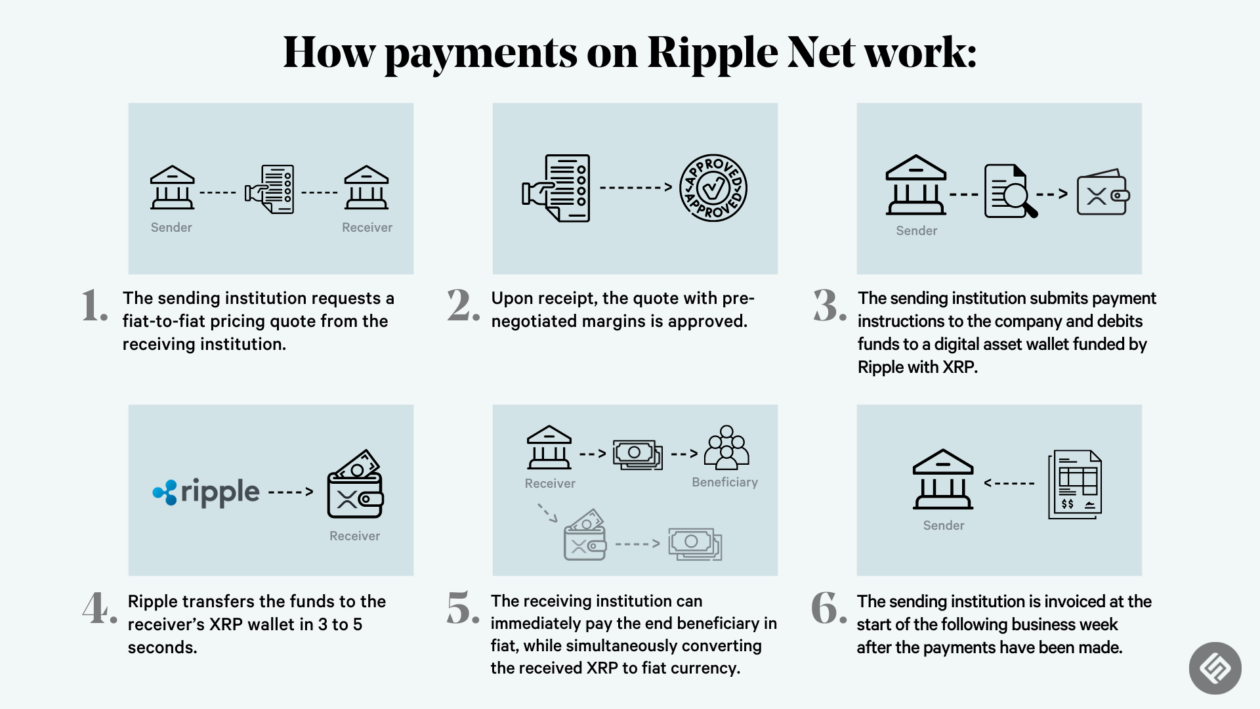
One of Ripple’s most significant contributions to the “Money” niche is On-Demand Liquidity (formerly known as xRapid). In traditional banking, if a bank in Mexico wants to settle a payment in Euros, it must maintain “nostro accounts” (pre-funded accounts in foreign currency) in Europe. This traps trillions of dollars in dormant capital globally.
ODL changes this equation by using XRP as a “bridge currency.” Instead of pre-funding accounts, a bank can convert Mexican Pesos into XRP, send the XRP to the destination, and convert it into Euros—all in about three to five seconds. This eliminates the need for pre-funded accounts, freeing up massive amounts of capital for banks to use elsewhere, which significantly improves their balance sheets and operational efficiency.
Speed, Scalability, and Cost Reduction
From a business finance perspective, Ripple’s value proposition is rooted in its metrics. While a Bitcoin transaction might take 10 to 60 minutes and incur significant fees during network congestion, an XRP transaction settles in roughly 3.8 seconds. Furthermore, the XRP Ledger can handle 1,500 transactions per second—a level of scalability that rivals Visa. For financial institutions, this translates to lower overhead, reduced volatility risk during settlement, and a better experience for the end consumer.
Investing in Ripple: Risks, Rewards, and Market Position
For personal finance enthusiasts and institutional investors alike, XRP represents a unique asset class. Unlike Bitcoin, which is often viewed as “digital gold” or a store of value, XRP is viewed as a “utility token.” Its value is theoretically linked to its adoption and use within the Ripple payment ecosystem.
Market Capitalization and Liquidity Factors
XRP consistently ranks among the top cryptocurrencies by market capitalization. For an investor, high market cap and high trading volume are indicators of liquidity, meaning one can enter or exit a position without causing drastic price swings. However, the supply of XRP is a point of contention. There is a total supply of 100 billion tokens, with a significant portion held in escrow by Ripple. The controlled release of these tokens into the market is a factor that investors must monitor, as it impacts the supply-demand equilibrium.
Regulatory Landscape and its Influence on Valuation
One cannot discuss Ripple as a financial asset without addressing the regulatory environment, specifically in the United States. The long-standing legal battle between the SEC and Ripple Labs has centered on whether XRP should be classified as a security.
In the world of finance, regulatory clarity is everything. A “security” classification would impose strict requirements on how the asset is traded, whereas a “commodity” or “currency” classification allows for more flexible market participation. The outcomes of these legal proceedings have historically caused significant volatility in XRP’s price, serving as a reminder that in the “Money” niche, the pen of a judge can be as powerful as the code of a developer.
Ripple vs. Traditional Banking (SWIFT)
To truly grasp what Ripple is, one must compare it to the incumbent system it seeks to improve. The competition between Ripple and SWIFT is a defining narrative in modern fintech and business finance.
Identifying the Inefficiencies of the Correspondent Banking Model
The current correspondent banking model is a “black box.” When a business owner in the US sends money to a supplier in Singapore, they often don’t know exactly when the money will arrive or what the final fees will be until the transaction is complete. Error rates in these manual, multi-step processes are high, often leading to delayed shipments and strained business relationships. This friction costs the global economy billions in lost productivity and fees every year.
The Ripple Solution: Real-Time Gross Settlement
Ripple offers a “Real-Time Gross Settlement” (RTGS) system. This means that instead of “batching” transactions and settling them days later, each transaction is settled individually and instantly. For a CFO or a corporate treasurer, this provides unprecedented certainty. Knowing that a $10 million payment has settled in five seconds allows for more precise cash flow management.
Furthermore, Ripple’s “RippleNet” provides a standardized protocol for banks to communicate. Unlike SWIFT, which only sends the message that money is coming, Ripple settles the actual value simultaneously. This convergence of messaging and settlement is what makes Ripple a disruptive force in the financial industry.
Conclusion: The Role of Ripple in the Digital Economy
What is Ripple? In the context of money and finance, it is the bridge between the legacy systems of the 20th century and the decentralized future of the 21st. It represents a shift from a world of “siloed” financial systems to an interconnected “Internet of Value.”
For the individual investor, XRP offers a way to speculate on the modernization of the global banking system. For the financial institution, Ripple provides the tools to survive in an era where customers demand instant gratification and zero fees. While the path has been marked by regulatory hurdles and market volatility, the underlying financial utility of the technology remains compelling.
As we move toward a global economy that is increasingly digital and borderless, the ability to move value as easily as a text message will no longer be a luxury—it will be a requirement. Ripple is positioned at the very center of that transition, redefining what it means to hold, transfer, and value money in a connected world.
aViewFromTheCave is a participant in the Amazon Services LLC Associates Program, an affiliate advertising program designed to provide a means for sites to earn advertising fees by advertising and linking to Amazon.com. Amazon, the Amazon logo, AmazonSupply, and the AmazonSupply logo are trademarks of Amazon.com, Inc. or its affiliates. As an Amazon Associate we earn affiliate commissions from qualifying purchases.