
The landscape of diabetes management has been dramatically reshaped by technological advancements, moving from periodic snapshots to continuous, data-rich insights. At the heart of this evolution lies the Glucose Management Indicator (GMI), a crucial metric that leverages sophisticated technology to provide a clearer, more dynamic picture of glycemic control. Understanding GMI isn’t just about a medical definition; it’s about appreciating the digital infrastructure, algorithms, and devices that bring this powerful indicator to life.
The Technological Foundation: CGM and Data-Driven Glycemic Insights
For decades, the primary benchmark for long-term blood sugar control in diabetes was the HbA1c test, a blood test providing an average glucose level over the preceding two to three months. While invaluable, HbA1c offers a single data point, missing the daily fluctuations, highs, and lows that significantly impact patient well-being and treatment efficacy. The advent of continuous glucose monitoring (CGM) technology marked a paradigm shift, paving the way for more granular and actionable metrics like GMI.
From HbA1c to Real-Time Glycemic Data
The limitation of HbA1c lies in its inability to capture glycemic variability. Two individuals might have the same HbA1c, yet one could experience stable glucose levels while the other endures frequent, dramatic swings between hyperglycemia and hypoglycemia. This “time in range” (TIR) concept, which quantifies the percentage of time a person’s glucose levels remain within a target range, became a critical missing piece. CGM technology provides the continuous data stream necessary to calculate TIR and, by extension, GMI. It moves beyond a retrospective average to offer a forward-looking, behavior-influencing feedback loop.
How Continuous Glucose Monitoring (CGM) Works
CGM systems represent a triumph of miniaturization and bio-sensing technology. They consist of a small sensor, typically inserted under the skin, which measures interstitial glucose levels every few minutes. A transmitter attached to the sensor sends this data wirelessly—via Bluetooth or proprietary radio frequencies—to a receiver, a dedicated display device, or directly to a smartphone app. This continuous stream of data, often hundreds of readings per day, forms the raw material for advanced glycemic analysis. The technology behind these sensors has evolved significantly, improving accuracy, wear time, and user comfort, making them an indispensable tool in modern diabetes care. The seamless integration of hardware (sensor, transmitter) and software (data processing, display) is fundamental to their utility.
The Algorithmic Shift: Deriving GMI from Sensor Data
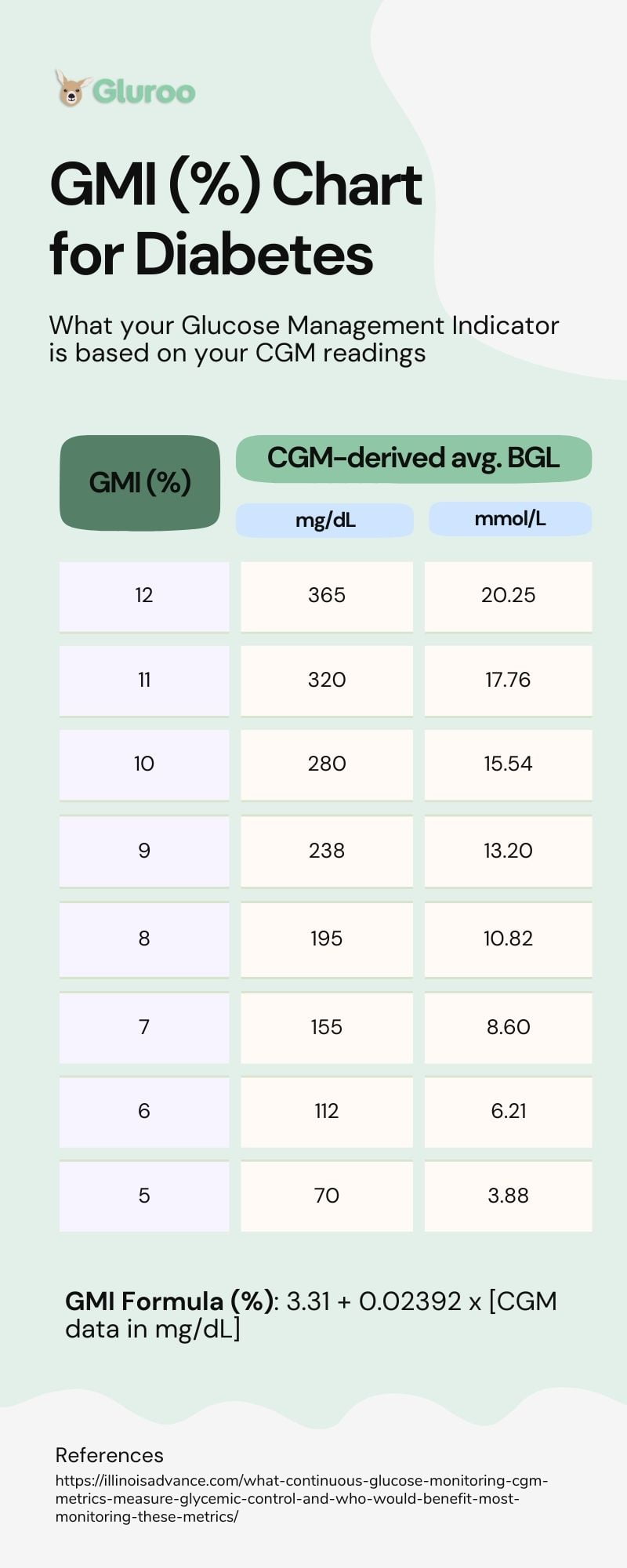
GMI is essentially an estimated HbA1c derived exclusively from CGM data. Instead of measuring glycated hemoglobin in red blood cells, GMI is a calculated value based on the average glucose levels recorded by a CGM over a period, typically 10 to 14 days or longer. The algorithm that computes GMI correlates these average glucose values from CGM data with statistically predicted HbA1c values. This correlation was established through extensive clinical trials and statistical modeling, creating a bridge between continuous glucose readings and the traditional HbA1c metric.
The formula for GMI (often approximated as: GMI (%) = 3.38 + 0.02 * [average glucose in mg/dL]) represents a complex piece of software engineering that transforms raw sensor data into a clinically meaningful indicator. This algorithmic interpretation allows healthcare providers and patients to monitor long-term glycemic trends without waiting for a quarterly lab test. It’s a digital proxy, providing immediate, data-driven feedback that reflects glycemic control based on continuous measurements.
GMI as a Digital Metric: Software, Apps, and User Experience
The true power of GMI emerges not just from its calculation, but from how this digital metric is presented, interpreted, and integrated within the broader ecosystem of health technology. Software applications play a pivotal role in transforming raw CGM data into actionable insights for both patients and clinicians.
Data Visualization and Interpretation in Diabetes Management Apps
Modern diabetes management apps are sophisticated platforms designed to make complex glycemic data understandable and actionable. These apps retrieve GMI values, alongside Time in Range, Glucose Variability, and other metrics, directly from CGM systems. They employ intuitive data visualization techniques—graphs, charts, and color-coded indicators—to highlight trends, identify patterns, and flag potential issues. Patients can visually track their GMI over time, correlate it with diet, exercise, and medication intake, and understand the impact of various lifestyle choices. This user-friendly interface is crucial for empowering individuals to take a more active role in managing their condition.
The software often includes features like:
- Trend Analysis: Showing GMI fluctuations week-to-week or month-to-month.
- Event Logging: Allowing users to manually input meal times, insulin doses, and exercise to see their direct impact on glucose levels and GMI.
- Target Ranges: Customization of desired glucose ranges, with alerts for excursions.
- Reporting: Generating comprehensive reports for healthcare providers, detailing GMI, TIR, and other key metrics in an easily digestible format.
Integrating GMI with Other Health Tech (Wearables, EMRs)
The utility of GMI is further amplified through its integration with a wider digital health ecosystem. Many diabetes apps can sync with other wearables, such as smartwatches and fitness trackers, to incorporate data on physical activity, heart rate, and sleep patterns. This holistic view allows for a more comprehensive analysis of factors influencing glucose control. For instance, a patient might observe a correlation between higher GMI readings and periods of reduced physical activity, or particular dietary habits.
Furthermore, secure integration with Electronic Medical Records (EMRs) systems is becoming increasingly common. This allows GMI data, alongside other CGM-derived metrics, to flow directly into a patient’s medical chart, providing clinicians with up-to-date information for more informed treatment decisions. This interoperability streamlines care, reduces administrative burden, and ensures that GMI is not just a patient-facing metric but also a critical component of clinical assessment.

The Role of AI and Machine Learning in Refining GMI and Predictions
The massive datasets generated by continuous glucose monitoring are a fertile ground for artificial intelligence (AI) and machine learning (ML) algorithms. These advanced computational techniques are already being applied to:
- Refine GMI Calculation: AI can potentially identify more nuanced correlations between average glucose and predicted HbA1c, leading to even more accurate GMI estimates that account for individual metabolic differences.
- Predict Future Glucose Trends: ML models can analyze past GMI values, current glucose levels, insulin dosages, and other factors to predict future glucose excursions, allowing for proactive interventions.
- Personalized Recommendations: AI can leverage GMI and associated data to offer highly personalized recommendations on diet, exercise, and medication adjustments, moving towards truly individualized diabetes management.
- Identify Patterns: ML can uncover subtle patterns in glycemic data that might be missed by human observation, helping to optimize therapy and prevent complications.
The integration of AI makes GMI not just a reporting metric, but a dynamic input into intelligent systems designed to optimize health outcomes.
Enhancing Diabetes Management Through GMI-Enabled Tech
GMI, powered by advanced technology, transcends a mere diagnostic value; it becomes a cornerstone of dynamic, patient-centric diabetes management. Its digital nature facilitates better patient engagement and more precise clinical interventions.
Empowering Patients with Actionable Digital Insights
Before GMI and CGM, patients often operated with limited visibility into their daily glucose patterns, relying on finger-prick tests that provided isolated snapshots. GMI, presented through intuitive apps, demystifies complex glycemic data. Patients can see immediate feedback on how lifestyle choices affect their glucose control, enabling them to make informed adjustments in real-time. For example, a patient might observe that a particular food consistently leads to a higher GMI trend, prompting them to modify their diet. This immediate, data-driven understanding transforms abstract medical advice into concrete, actionable insights, fostering greater adherence to treatment plans and overall self-efficacy.
Personalized Feedback Loops and Behavioral Nudges
GMI contributes to powerful feedback loops. When patients receive regular GMI updates, they gain a tangible measure of their progress or areas needing improvement. Many diabetes apps incorporate features that use GMI and related metrics to provide personalized behavioral nudges. These could include reminders to take medication, suggestions for healthy eating based on past glucose responses, or encouragement to increase physical activity. Gamification elements, where users earn points or badges for maintaining target GMI ranges, can further motivate positive behavior. These digital nudges are designed to reinforce healthy habits and provide ongoing support, extending care beyond the clinic walls.
Telehealth and Remote Monitoring Capabilities
The digital nature of GMI and CGM data is perfectly suited for telehealth and remote monitoring. Healthcare providers can securely access a patient’s GMI trends and full CGM reports remotely, enabling them to assess glycemic control without an in-person visit. This capability has proven invaluable, especially in rural areas or for patients with mobility issues, and has seen a significant boost in adoption. Remote consultations can be more productive as clinicians have access to a rich dataset of continuous glucose information, allowing for timely adjustments to insulin dosages, dietary advice, and lifestyle recommendations. GMI thus facilitates proactive and efficient diabetes care delivery, bridging geographical gaps and enhancing continuity of care.
The Future of GMI and Diabetes Technology
The trajectory of GMI is intertwined with the relentless innovation in diabetes technology. As sensors become more accurate, data processing more sophisticated, and integration more seamless, GMI’s role will only expand.
Advancements in Sensor Technology and Data Accuracy
Future CGM sensors are anticipated to be even smaller, longer-lasting, and potentially capable of measuring additional biomarkers beyond glucose. Enhanced accuracy will lead to more precise GMI calculations, reducing any current discrepancies between GMI and traditional HbA1c. Non-invasive glucose monitoring technologies, if they become viable and accurate, could revolutionize data collection even further, making GMI more accessible and less burdensome for all individuals with diabetes. These hardware improvements will directly feed into more robust and reliable GMI data.
Cybersecurity and Privacy in Health Data Management
As GMI data becomes more central to diabetes management, the importance of cybersecurity and data privacy grows exponentially. Companies developing CGM systems and associated apps are continually investing in robust encryption, secure data storage, and compliance with stringent health data regulations (like HIPAA and GDPR). The future will see continued advancements in biometric authentication, blockchain for secure data sharing, and enhanced patient controls over their own health data. Ensuring the integrity and confidentiality of GMI and other personal health information is paramount for maintaining patient trust and facilitating the secure evolution of digital health.
The Promise of Closed-Loop Systems and Automated Insulin Delivery
Perhaps the most exciting frontier for GMI and diabetes technology is in the development of fully closed-loop systems, often referred to as artificial pancreases. These systems integrate CGM data, including GMI trends, with insulin pumps and sophisticated algorithms to automatically adjust insulin delivery in real-time. GMI helps these algorithms understand the long-term glycemic context, enabling more intelligent and adaptive insulin dosing strategies. As AI and ML models become more sophisticated, they will utilize GMI to learn individual responses and proactively manage glucose levels, minimizing the burden of daily diabetes management and moving closer to a truly automated approach to glycemic control. GMI, therefore, is not just a backward-looking metric but an integral component in the development of autonomous, future-forward diabetes care.
aViewFromTheCave is a participant in the Amazon Services LLC Associates Program, an affiliate advertising program designed to provide a means for sites to earn advertising fees by advertising and linking to Amazon.com. Amazon, the Amazon logo, AmazonSupply, and the AmazonSupply logo are trademarks of Amazon.com, Inc. or its affiliates. As an Amazon Associate we earn affiliate commissions from qualifying purchases.