
The Fisher Equation stands as a cornerstone in the realm of finance and economics, providing a fundamental relationship between nominal interest rates, real interest rates, and inflation. Named after American economist Irving Fisher, this equation offers a crucial lens through which investors, policymakers, and consumers can understand the true cost of borrowing and the actual return on savings, stripped of the distorting effects of price level changes. In an economic landscape often characterized by fluctuating inflation, grasping the Fisher Equation is not merely an academic exercise but a practical necessity for informed financial decision-making, from personal savings strategies to multi-million dollar corporate investments and national monetary policy.

Understanding the Core Concept
At its heart, the Fisher Equation illuminates the critical distinction between nominal and real values in financial markets. This distinction is paramount because money, the medium of exchange, does not hold a constant purchasing power over time. Inflation, the general increase in prices and fall in the purchasing value of money, erodes the value of future cash flows and returns. Without accounting for inflation, an investor might mistakenly believe they are generating a substantial return, when in reality, their purchasing power has barely changed or even diminished.
Nominal vs. Real Rates
The nominal interest rate is the stated rate on a loan or investment. It’s the percentage increase in the amount of money you will have. For instance, if you deposit $1,000 in a savings account with a 5% nominal interest rate, you will have $1,050 at the end of the year. This rate does not account for changes in the purchasing power of money due to inflation. It’s the rate you see advertised by banks or quoted in financial contracts.
Conversely, the real interest rate reflects the true return on an investment or the true cost of borrowing, after adjusting for inflation. It measures the increase in your purchasing power. If your $1,050 at the end of the year can buy fewer goods and services than your original $1,000 plus a proportionate share of new goods, then your real return is lower than your nominal return. The real interest rate tells you how much more goods and services you can buy with your interest earnings. It is a more accurate indicator of the economic benefit or cost.
The Role of Inflation
Inflation acts as the bridge between nominal and real rates. When inflation is positive, the purchasing power of money declines over time. Lenders demand compensation for this erosion of value, and borrowers are willing to pay it, understanding that the money they repay in the future will be worth less than the money they borrowed today.
Consider a scenario where the nominal interest rate is 5% and inflation is 3%. While your money grows by 5% in absolute terms, the goods and services that money can buy have become 3% more expensive. Your real gain in purchasing power is therefore closer to 2%. If inflation were to exceed the nominal interest rate, say 7%, your real interest rate would be negative (-2%), meaning you would actually lose purchasing power despite earning a positive nominal return. This highlights why investors must always factor in inflation when evaluating potential returns and why borrowers benefit when inflation erodes the real value of their debt.
The Formula and its Components
The Fisher Equation formally quantifies the relationship between nominal interest rates, real interest rates, and inflation. It can be expressed in two primary forms: the exact (or multiplicative) form and the approximate (or simplified) form. Both are crucial for different contexts, with the approximate form being more commonly used due to its simplicity, especially for lower rates of inflation.
Exact vs. Approximate Fisher Equation
The exact Fisher Equation is given by:
(1 + Nominal Rate) = (1 + Real Rate) * (1 + Inflation Rate)
From this, we can derive the real interest rate:
Real Rate = [(1 + Nominal Rate) / (1 + Inflation Rate)] – 1
And the nominal interest rate:
Nominal Rate = [(1 + Real Rate) * (1 + Inflation Rate)] – 1
This precise formula holds true for any level of interest and inflation, capturing the compounding effect between the real return and the inflation rate.
However, for practical purposes, especially when real rates and inflation rates are relatively low (typically below 10-15%), the approximate Fisher Equation is widely used due to its ease of calculation:
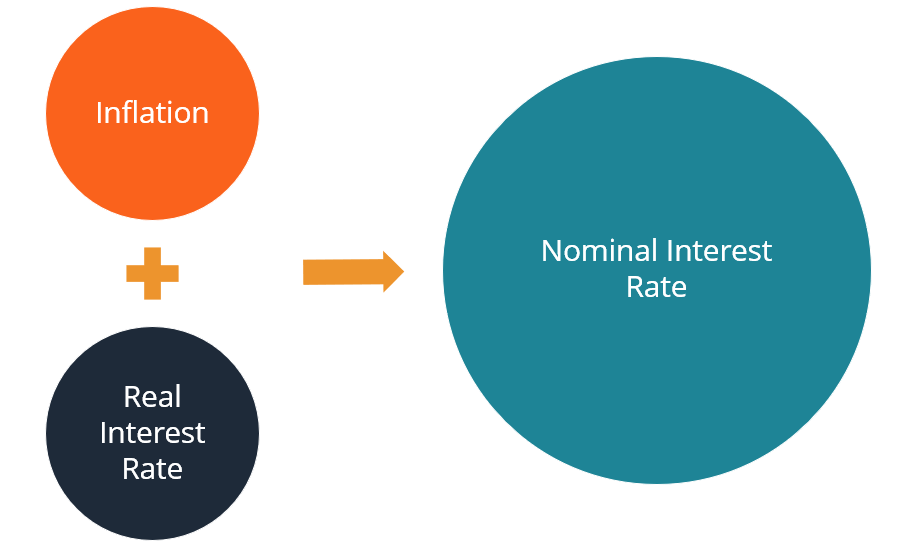
Nominal Rate ≈ Real Rate + Inflation Rate
Or, rearranged to solve for the real rate:
Real Rate ≈ Nominal Rate – Inflation Rate
This simplified version is intuitive: it states that the nominal interest rate broadly reflects the sum of the desired real return and the expected compensation for inflation. The approximation arises because it neglects the product term (Real Rate * Inflation Rate) from the exact equation, which is small enough to be disregarded when rates are low. For instance, if the nominal rate is 5% and inflation is 3%, the approximate real rate is 2%. The exact real rate is [(1.05 / 1.03) – 1] ≈ 0.0194 or 1.94%, demonstrating the closeness of the approximation.
Deconstructing the Variables
- Nominal Interest Rate (i or R_nominal): This is the market interest rate, the rate quoted on bonds, loans, and savings accounts. It’s the percentage return an investor receives in monetary terms before adjusting for inflation. Lenders set this rate based on their desired real return plus their expectation of future inflation.
- Real Interest Rate (r or R_real): This is the inflation-adjusted interest rate. It represents the actual increase in purchasing power for lenders and the true cost of borrowing for borrowers. It is the rate that influences economic decisions like consumption vs. saving, and investment in capital projects.
- Inflation Rate (π or R_inflation): This is the rate at which the general level of prices for goods and services is rising, and subsequently, the purchasing power of currency is falling. In the context of the Fisher Equation, it typically refers to the expected inflation rate over the period of the loan or investment, as future inflation is inherently uncertain at the time the rate is set.
The use of expected inflation is a critical nuance. Lenders and borrowers negotiate nominal rates based on their best estimates of future inflation. If actual inflation turns out to be higher than expected, borrowers benefit (their real cost of borrowing decreases), and lenders lose (their real return decreases). Conversely, if actual inflation is lower than expected, lenders benefit, and borrowers face a higher real cost.
Practical Applications in Finance and Investing
The Fisher Equation is far more than a theoretical concept; it is an indispensable tool for analysis and decision-making across various financial domains. Its insights influence everything from individual savings choices to macroeconomic policy.
Informing Investment Decisions
For individual investors, understanding the Fisher Equation is crucial for evaluating the true profitability of various investments. A bond yielding 4% might seem attractive, but if expected inflation is 3.5%, the real return is only 0.5%. This provides minimal growth in purchasing power and might make other assets, such as stocks or real estate, appear more appealing despite their higher nominal volatility. Investors use the real rate to compare investments across different inflation environments or to assess whether their portfolio is truly growing in value. It helps them set realistic return expectations and select assets that offer adequate compensation for inflation risk.
Central Bank Policy and Interest Rates
Central banks, like the Federal Reserve in the U.S. or the European Central Bank, closely monitor the Fisher Equation’s implications when setting monetary policy. Their primary objective often involves maintaining price stability (controlling inflation) and fostering maximum sustainable employment. By influencing the nominal interest rate (e.g., through the federal funds rate), central banks implicitly aim to manage the real interest rate. If inflation expectations rise, a central bank might need to raise nominal rates significantly to maintain a target real rate that is conducive to economic growth or to cool an overheating economy. Conversely, during periods of low inflation or deflation, central banks might lower nominal rates, even into negative territory in some economies, to push real rates down and stimulate borrowing and investment.
Corporate Finance and Capital Budgeting
Businesses use the Fisher Equation in capital budgeting decisions. When evaluating potential projects, companies must determine if the expected returns compensate for both the nominal cost of capital and the erosion of purchasing power due to inflation. The real cost of capital is often a more appropriate discount rate for analyzing real cash flows from projects. For example, if a company borrows at a 7% nominal rate and expects 4% inflation, its real cost of borrowing is approximately 3%. This real cost helps them assess whether a project’s real returns will justify the investment and contribute to shareholder wealth in real terms. It also influences decisions regarding debt financing versus equity financing, as the real burden of debt can change significantly with unexpected inflation.
Limitations and Real-World Considerations
While powerful, the Fisher Equation operates under certain assumptions and has limitations that must be considered in real-world applications. It provides a foundational framework but does not capture every nuance of financial markets.
Expected vs. Actual Inflation
The most significant limitation arises from the distinction between expected inflation and actual inflation. The nominal interest rate is set based on the market’s collective expectation of future inflation over the life of the loan or investment. However, actual inflation often deviates from these expectations. If actual inflation turns out to be higher than expected, the real return to lenders is lower than anticipated, and the real cost to borrowers is also lower. Conversely, if actual inflation is lower than expected, lenders benefit, and borrowers face a higher real burden. This uncertainty about future inflation introduces risk, known as inflation risk, which both lenders and borrowers try to account for in their agreements.
Other Market Influences
The Fisher Equation isolates the relationship between nominal rates, real rates, and inflation. However, real-world interest rates are influenced by numerous other factors beyond just inflation expectations. These include:
- Risk Premium: Lenders demand additional compensation for the risk of default by the borrower. A riskier borrower will pay a higher nominal rate, even if inflation expectations are constant.
- Liquidity Premium: Longer-term investments often command a higher nominal rate to compensate investors for the reduced liquidity and greater uncertainty associated with tying up capital for extended periods.
- Supply and Demand for Loanable Funds: The overall availability of capital and the demand for borrowing influence market interest rates. High demand for loans relative to supply can push rates up, independent of inflation expectations.
- Government Policy: Fiscal policies (e.g., government borrowing) and other regulatory interventions can also impact market interest rates.
These factors mean that while the Fisher Equation provides a vital baseline, observed nominal interest rates in the market encapsulate more than just the real rate and expected inflation. Analysts often refer to the “Fisher Effect” to describe the tendency for nominal interest rates to move one-for-one with expected inflation, assuming other factors remain constant, though perfect one-for-one movement is rare in practice.
Integrating the Fisher Equation into Your Financial Toolkit
For anyone engaged in financial planning, investment analysis, or economic forecasting, the Fisher Equation offers a powerful conceptual framework. It encourages a deeper look beyond stated interest rates to understand the true financial implications of economic activities.
Personal Finance Planning
For individuals, incorporating the Fisher Equation means critically evaluating savings accounts, certificates of deposit (CDs), and bonds. A 2% interest rate on a savings account, while seemingly positive, delivers a negative real return if inflation is 3%. This insight should drive decisions about where to park emergency funds versus where to invest for long-term growth. It emphasizes the need for investments that not only keep pace with inflation but also provide a meaningful real return to increase actual purchasing power over time, a crucial aspect of retirement planning and wealth accumulation.

Macroeconomic Analysis
Economists and financial analysts use the Fisher Equation to interpret macroeconomic data and forecast future economic trends. By observing changes in nominal interest rates and inflation expectations (derived from sources like inflation-indexed bonds), they can infer movements in real interest rates, which are key drivers of investment, consumption, and economic growth. Understanding the real interest rate helps in assessing the stance of monetary policy, the competitiveness of an economy, and the attractiveness of a country’s financial assets to international investors.
In conclusion, the Fisher Equation is a cornerstone concept that transcends simple arithmetic. It compels financial participants to think in terms of purchasing power rather than just monetary units, offering a more accurate and profound understanding of wealth accumulation, debt burdens, and the overall dynamics of financial markets. Its continued relevance underscores the enduring importance of inflation in shaping financial outcomes for individuals, businesses, and entire economies.
aViewFromTheCave is a participant in the Amazon Services LLC Associates Program, an affiliate advertising program designed to provide a means for sites to earn advertising fees by advertising and linking to Amazon.com. Amazon, the Amazon logo, AmazonSupply, and the AmazonSupply logo are trademarks of Amazon.com, Inc. or its affiliates. As an Amazon Associate we earn affiliate commissions from qualifying purchases.