
Selecting the correct fishing rod size is paramount for optimizing performance and enhancing the overall angling experience. Much like choosing specialized software or a specific hardware configuration, the right rod acts as a precision instrument, finely tuned to execute specific tasks. This guide delves into the technical specifications and operational considerations necessary to make an informed selection, treating the fishing rod as a critical piece of angling technology.
Understanding the Core Specifications: Length, Power, and Action
The fundamental characteristics of a fishing rod—length, power, and action—are the primary determinants of its functional application. Each attribute plays a critical role in how the rod interacts with line, lures, and fish, akin to how CPU speed, RAM, and GPU power define a computing system’s capabilities.

Rod Length: Reach, Accuracy, and Line Control
Rod length directly influences casting distance, accuracy, and leverage. Shorter rods, typically ranging from 4 to 6 feet, excel in confined spaces or when pinpoint accuracy is required for short-range presentations. Their compact design facilitates maneuverability in dense brush, under docks, or from kayaks, offering superior control during close-quarters combat with fish. The reduced leverage of a shorter rod can, however, translate to more direct power transfer to the angler, demanding greater physical input.
Conversely, longer rods, often extending from 7 to 14 feet or more, are engineered for maximizing casting distance. The increased flex and stored energy in a longer blank allow for greater line velocity upon release, propelling lures further across open water. This extended reach is invaluable for covering expansive areas, reaching distant structures, or maintaining a wider spread of lines when trolling. Furthermore, the added length provides enhanced leverage during a fight, allowing the angler to exert more pressure on the fish with less strain, effectively increasing the system’s mechanical advantage. However, longer rods may compromise precision in tight spots and require more open space for casting. The choice of length, therefore, involves a trade-off between power, casting range, and operational environment.
Rod Power (Weight): Matching Your Catch and Lure
Rod power, often referred to as its “weight” or “taper,” quantifies the amount of force required to bend the rod blank. It dictates the rod’s load-bearing capacity and its suitability for specific lure weights and target species. Categories typically range from Ultra-Light to Heavy, each designed for distinct operational parameters.
- Ultra-Light (UL) rods possess minimal backbone, designed for casting minuscule lures (e.g., 1/32 to 1/8 oz) and handling small fish such as panfish or trout. They offer exceptional sensitivity, allowing the angler to detect the subtlest bites.
- Light (L) rods are a step up, accommodating slightly heavier lures (e.g., 1/16 to 1/4 oz) and small to medium-sized fish. They strike a balance between finesse and modest pulling power.
- Medium-Light (ML) and Medium (M) rods represent the versatile core, capable of handling a broad spectrum of lures (e.g., 1/8 to 1/2 oz for ML, 1/4 to 3/4 oz for M) and a wider range of freshwater species like bass, walleye, and smaller predatory fish. They are often considered all-around performers.
- Medium-Heavy (MH) and Heavy (H) rods are engineered for substantial loads, designed to cast larger lures (e.g., 3/8 to 1 oz+ for MH, 1/2 to 2 oz+ for H) and subdue robust, hard-fighting fish in both fresh and saltwater environments. Their robust construction provides significant lifting power.
- Extra-Heavy (XH) and Ultra-Heavy (UH) rods are specialized tools for extreme applications, such as battling large offshore pelagic species or handling immense baits and tackle.
Matching rod power to lure weight is crucial for optimal casting efficiency and preventing rod damage. An underpowered rod attempting to cast a heavy lure will struggle and risk breakage, while an overpowered rod will fail to load properly with a light lure, hindering casting distance and feel.
Rod Action: Sensitivity, Hooksets, and Casting Dynamics
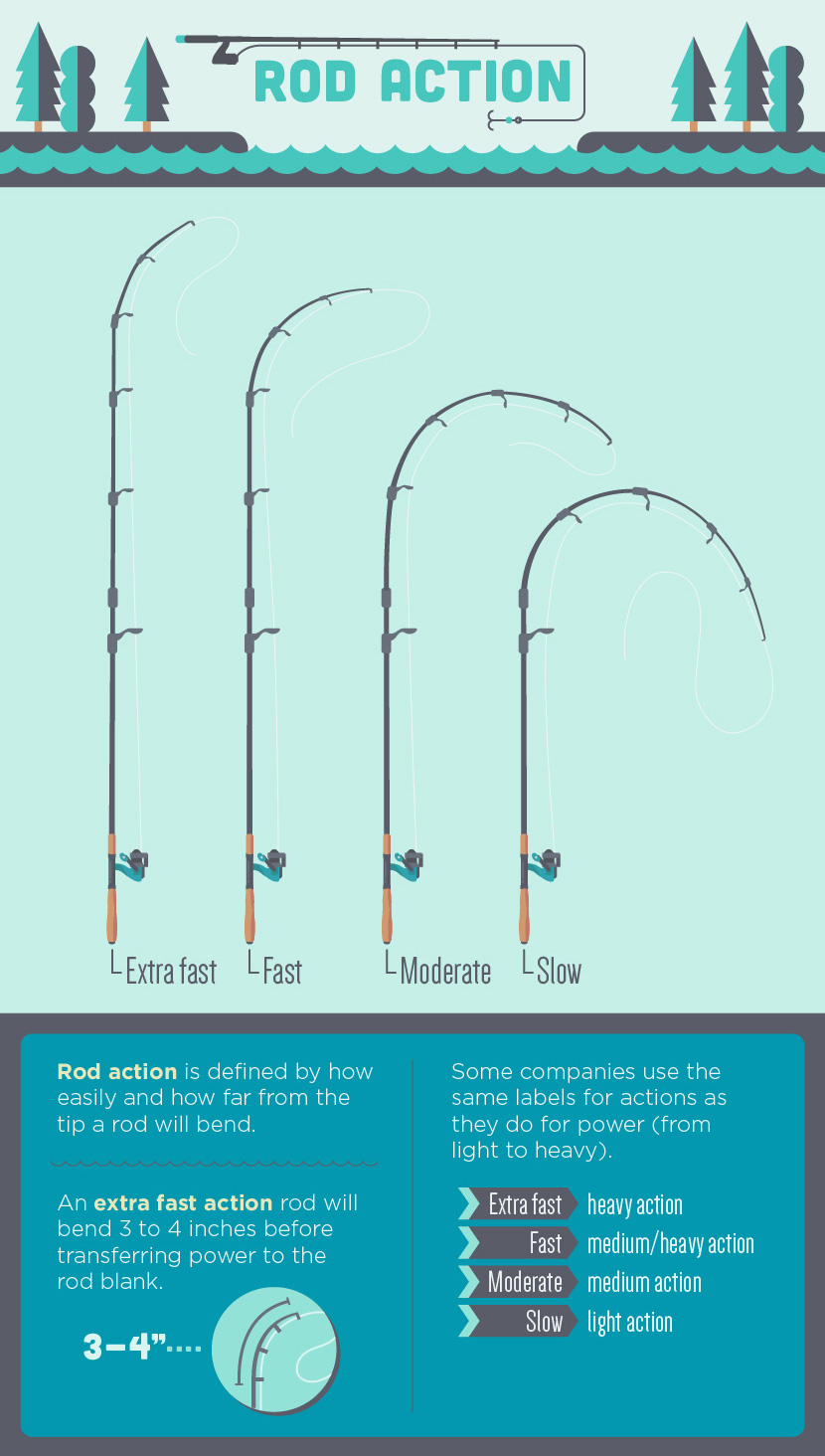
Rod action describes where along the blank the rod bends when pressure is applied. This characteristic profoundly impacts sensitivity, hook-setting capability, and casting dynamics.
- Fast Action rods bend primarily in the upper third or quarter of the blank. This concentrated flex point provides maximum sensitivity, allowing anglers to discern subtle strikes or changes in bottom topography. Fast action rods also deliver powerful, quick hooksets due to their rigid midsection, which rapidly transmits force to the hook. They are excellent for single-hook lures and situations requiring immediate angler response.
- Moderate-Fast Action rods bend in the upper half of the blank, offering a balance between sensitivity and flexibility. They provide good casting distance with a wider range of lure types and offer a slightly more forgiving feel during a fight, reducing the chance of pulling the hook from a fish’s mouth.
- Moderate Action rods bend from the middle to the lower half of the blank. This deeper bend allows for longer, smoother casts, particularly with crankbaits and other treble-hook lures, as it prevents the lures from ripping out during aggressive retrieves. The moderate action acts as a shock absorber, cushioning head shakes.
- Slow Action rods flex almost down to the handle. These rods are ideal for casting very light baits or for techniques where maximum flex is needed to absorb violent runs, often found in fly fishing or specialized panfish applications. They provide the most “give,” protecting light lines and delicate presentations.
The appropriate action is critical for the intended fishing technique. For example, a fast-action rod is typically preferred for jigging or worm fishing where bite detection and quick hooksets are paramount, whereas a moderate-action rod is better suited for reaction baits like crankbaits.
Selecting the Right Rod for Your Target Species and Fishing Environment
The specific environment and target species are primary drivers for rod selection, influencing the necessary power, length, and action. Just as network topology changes for different data transmission needs, fishing rod specifications adapt to diverse aquatic ecosystems.
Freshwater Rods: Panfish to Predator
Freshwater fishing encompasses a vast array of species and techniques. For panfish (crappie, bluegill), an Ultra-Light to Light power rod, often 5 to 6 feet in length with a moderate to fast action, offers the finesse needed for light lines and small baits. For trout, similar specifications apply, though longer lengths (6-8 feet) can be beneficial for casting in wider streams or lakes.
Bass fishing is highly specialized, demanding a diverse arsenal. For finesse techniques like drop-shotting or shaky head jigs, a 6’6″ to 7′ Medium-Light or Medium power rod with a fast action is preferred for sensitivity and precise lure control. For power fishing with jigs or Texas-rigged worms, a 7′ to 7’6″ Medium-Heavy rod with a fast action provides the backbone for penetrating hooksets and muscling fish from cover. Crankbait and spinnerbait fishing often benefits from a 6’6″ to 7’6″ Medium to Medium-Heavy rod with a moderate or moderate-fast action to enhance casting distance and prevent pulling hooks. For pike and muskellunge, formidable predators, Heavy to Extra-Heavy power rods, typically 8 to 9 feet in length, are required to cast large baits and subdue powerful fish.
Saltwater Rods: Inshore, Nearshore, and Offshore Applications
Saltwater environments demand robust gear capable of withstanding corrosive conditions and battling powerful fish.
- Inshore fishing for species like redfish, snook, and speckled trout often utilizes 6’6″ to 7’6″ Medium to Medium-Heavy power rods with a fast to moderate-fast action. These offer the versatility to cast a range of lures and baits while providing sufficient power for strong inshore fighters.
- Nearshore fishing for species such as snapper, smaller groupers, or king mackerel typically calls for 7′ to 8′ Medium-Heavy to Heavy power rods, often with moderate-fast actions for vertical jigging or moderate actions for live baiting.
- Offshore fishing for large pelagic species like tuna, marlin, and swordfish requires the pinnacle of rod engineering. These are typically Heavy to Ultra-Heavy power rods, ranging from 5’6″ to 9′ depending on the technique (e.g., stand-up trolling rods are shorter and extremely powerful, while conventional deep-dropping rods can be longer). Their construction emphasizes immense lifting power, durability, and robust components to handle extreme loads.
Specialized Techniques: Fly Fishing, Ice Fishing, and Trolling
Specific angling techniques often necessitate highly specialized rod designs. Fly fishing rods are categorized by “line weight” (e.g., 5-weight, 8-weight), directly correlating to the weight of the fly line they are designed to cast, not the lure itself. Lengths vary, from short rods for small streams to long rods for spey casting. Ice fishing employs very short rods (18-36 inches) for maximum sensitivity and maneuverability in a confined shelter, with powers ranging from Ultra-Light for panfish to Medium for walleye. Trolling rods are designed to keep baits at specific depths and absorb sustained pressure, often featuring long, powerful blanks with a softer tip to absorb strikes and a strong butt section for leverage.
Beyond the Basics: Materials, Components, and Ergonomics
Beyond length, power, and action, the materials and components of a rod significantly impact its overall performance, durability, and user experience—much like the choice of chassis, processors, and peripheral devices in a high-performance system.
Rod Materials: Graphite, Fiberglass, and Composites
- Graphite (Carbon Fiber) rods are prized for their exceptional sensitivity, lightweight nature, and high stiffness-to-weight ratio. They are ideal when detecting subtle bites is crucial and casting accuracy is paramount. Higher modulus graphite generally translates to a lighter, stiffer, and more sensitive rod, though it can also be more brittle.
- Fiberglass rods are renowned for their durability, flexibility, and parabolic bend, which provides a forgiving action that excels with treble-hooked lures and live bait. They are less sensitive and heavier than graphite but often more resilient to impact.
- Composite rods combine materials like graphite and fiberglass to leverage the strengths of both, aiming for a balance of sensitivity, durability, and flexibility. This hybrid approach often results in a versatile rod suitable for a broader range of applications.
Reel Seats and Guides: Durability and Performance
The reel seat securely fastens the reel to the rod, requiring robust construction, often from graphite or aluminum, to withstand torque and stress. A well-designed reel seat ensures a stable connection and comfortable grip.
Rod guides, the rings that direct the fishing line along the blank, are critical for line flow, friction reduction, and heat dissipation. Materials like ceramic (e.g., Alconite, SiC, Zirconia) are commonly used for their hardness and smoothness, which minimize line wear and extend casting distance. The number, size, and spacing of guides are optimized for each rod’s length and action to ensure uniform blank loading and prevent line contact with the rod. High-quality guides are essential for maximizing the lifespan of both line and rod.
Handle Design: Comfort and Control
The handle material and design significantly influence ergonomic comfort and control. Common materials include cork, EVA foam, and composite blends. Cork offers a lightweight, sensitive feel, while EVA foam provides durability and a comfortable grip even when wet. Handle length and shape are tailored to the rod’s intended application. Shorter handles are ideal for casting accuracy and maneuverability, while longer handles provide leverage for two-handed casting and fighting larger fish. A well-designed handle reduces angler fatigue and enhances overall operational efficiency.
Integrating Your Rod with Other Tackle: A Systemic Approach
The fishing rod does not operate in isolation; it is a critical component within a larger tackle system. Optimal performance is achieved when the rod is harmoniously integrated with the reel, line, and lure, much like a well-configured computer system where hardware and software work in unison.
Line Weight and Rod Compatibility
Every rod has a recommended line weight range, typically printed on the blank. Adhering to this specification is crucial. Using line that is too light can risk snapping during a fight or heavy retrieve, while line that is too heavy can overload the rod, reduce casting distance, and potentially cause damage. The rod is designed to flex and distribute stress optimally within its specified line range.
Reel Size and Balance
The chosen reel must balance appropriately with the rod. A reel that is too heavy or too light will disrupt the rod’s inherent balance point, leading to increased angler fatigue and reduced casting efficiency. A properly balanced setup allows the rod to pivot smoothly with minimal effort, enhancing feel and control. Reel size should also correspond to the rod’s power and the line capacity required for the target species. A smaller, lighter reel is paired with lighter rods for finesse applications, while larger, heavier reels are matched with powerful rods for heavy lines and big fish.
Lure Weight and Casting Efficiency
Similar to line weight, rods are rated for a specific lure weight range. Casting lures outside this range compromises performance. Too light a lure will not properly load the rod, resulting in short, inefficient casts. Too heavy a lure can overload the rod, preventing it from flexing correctly, and risking blank damage or snapping during the cast. Optimal casting efficiency is achieved when the lure weight falls within the sweet spot of the rod’s designed specifications, allowing the blank to load and unload energy effectively.
Making the Final Decision: Testing and Personal Preference
While technical specifications provide a robust framework, the ultimate selection often involves hands-on evaluation and personal preference.
Hands-On Evaluation: Feel and Balance
Whenever possible, physically handle the rod. Assess its balance point with your preferred reel attached. A well-balanced setup should feel natural in hand, with the balance point ideally just forward of the reel stem. Perform simulated casting motions to gauge how the rod loads and recovers. Pay attention to the handle ergonomics and overall comfort. What feels good to one angler may not to another, underscoring the subjective nature of the “perfect” fit.

Budget vs. Performance: Value Proposition
The market offers fishing rods across a vast price spectrum. While higher-priced rods often incorporate advanced materials, superior componentry, and refined craftsmanship, excellent performance can be found at various price points. Define your budget and prioritize the features most critical for your intended use. Consider the long-term value proposition: a durable, well-performing rod that enhances your fishing experience may justify a higher initial investment, similar to selecting premium software tools for professional applications. The goal is to maximize your return on investment in terms of angling success and enjoyment, ensuring your gear empowers, rather than hinders, your pursuit.
aViewFromTheCave is a participant in the Amazon Services LLC Associates Program, an affiliate advertising program designed to provide a means for sites to earn advertising fees by advertising and linking to Amazon.com. Amazon, the Amazon logo, AmazonSupply, and the AmazonSupply logo are trademarks of Amazon.com, Inc. or its affiliates. As an Amazon Associate we earn affiliate commissions from qualifying purchases.