
The question “What is the last number of Pi?” strikes at the heart of both fundamental mathematics and the very limits of technological computation. For those immersed in the world of technology, this query, while seemingly simple, opens a fascinating portal into advanced computing, algorithmic innovation, and the relentless pursuit of precision that defines much of our digital age. The direct answer is that there is no “last number” to Pi, a concept deeply rooted in its mathematical nature. However, the quest to understand and compute Pi to ever-increasing precision has been a monumental driver of technological progress, stretching the boundaries of what computers can achieve.
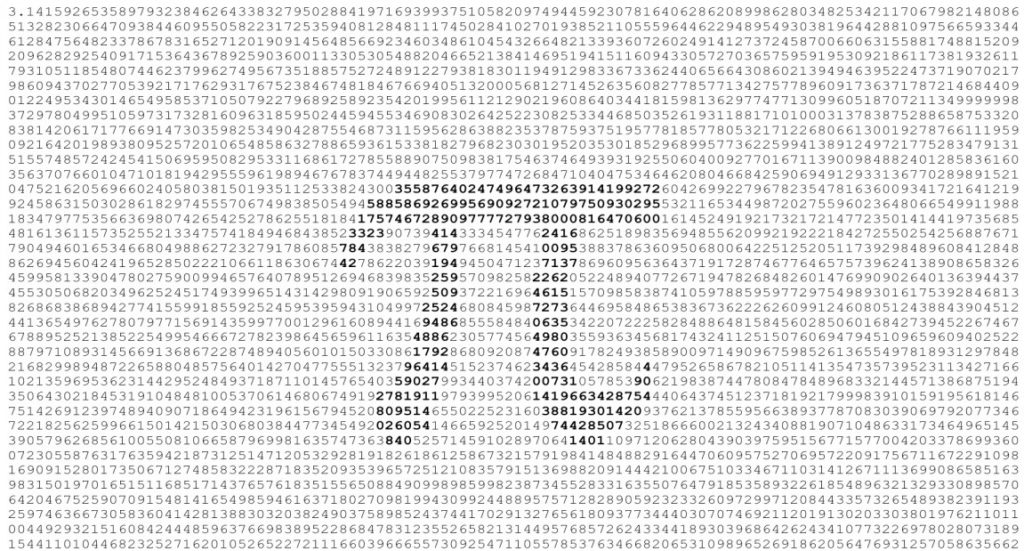
The Infinite Nature of Pi and Computational Reality
To understand why there isn’t a “last number” in Pi’s sequence, we must first grasp its mathematical identity. Pi (π) is the ratio of a circle’s circumference to its diameter, a constant value approximately equal to 3.14159. But its true nature is far more profound, classifying it as an irrational number.
Understanding Irrationality
An irrational number is a real number that cannot be expressed as a simple fraction (p/q) and, consequently, has a non-repeating, non-terminating decimal representation. This means Pi’s digits continue infinitely without settling into any repeating pattern. Every digit we compute is just one more step on an endless numerical journey. Therefore, the concept of a “last number” is fundamentally contradictory to Pi’s definition. Unlike rational numbers that eventually terminate or repeat their decimal expansions, Pi extends into infinity, making the search for its final digit an impossible one.
The Human Quest for Precision
Despite the mathematical impossibility of finding a “last digit,” humanity’s fascination with Pi’s exact value has spanned millennia. Ancient civilizations, from the Babylonians to the Egyptians and Greeks, devised geometric methods to approximate Pi, with Archimedes notably using polygons to narrow down its range. These early approximations, while rudimentary by today’s standards, represented humanity’s nascent efforts to quantify the universe.
The advent of calculus in the 17th century provided mathematicians with powerful new tools, such as infinite series, to calculate Pi with much greater accuracy. Formulas like the Madhava-Leibniz series marked a turning point, allowing for systematic computation of Pi’s digits. However, these methods were still laborious and prone to human error, yielding only a few hundred digits after significant effort. The true explosion in Pi’s known digits, and the technological challenges it presented, would only begin with the rise of computing.
The Technological Frontier of Pi Calculation
The quest for Pi’s digits has evolved from a purely mathematical endeavor into a formidable challenge for computer science and engineering. Calculating Pi to billions, and now trillions, of digits requires pushing the limits of hardware, software, and algorithmic efficiency.
Supercomputers and Parallel Processing
Modern Pi calculation is synonymous with supercomputing. What once took human mathematicians years to achieve, supercomputers can now accomplish in hours or days. Early mainframe computers in the mid-20th century were quickly deployed to compute Pi, marking a significant milestone in computational history. For instance, ENIAC calculated Pi to 2,037 digits in 1949, a feat that demonstrated the raw power of electronic computation.
Today, projects aiming for trillions of digits rely on massively parallel architectures, where thousands of processing cores work in concert. Distributed computing initiatives have also leveraged networks of personal computers, harnessing collective power to chip away at the numerical frontier. The sheer scale of data processing, inter-processor communication, and memory management in these endeavors represents a significant stress test for supercomputer designs and networking protocols. The challenge isn’t just raw computational power but also how efficiently this power can be coordinated and utilized to perform complex arithmetic operations at unprecedented scales.
Advanced Algorithms and Software
Beyond sheer hardware power, the exponential growth in Pi’s known digits is largely attributable to the development of sophisticated algorithms and specialized software. Early computational methods often relied on arctangent series formulas, like Machin’s formula (1706), which was used for centuries. However, for truly high-precision calculations, more efficient algorithms were necessary.
The Chudnovsky algorithm, developed in the late 1980s by the Chudnovsky brothers, became a cornerstone for modern Pi computation. This algorithm converges extremely rapidly, adding about 14 new digits per term, making it significantly more efficient than previous methods. Another class of algorithms, such as the Borwein algorithms, also contributed to the rapid expansion of known digits.
These algorithms necessitate highly optimized software that can handle arbitrary-precision arithmetic—calculations involving numbers with an effectively infinite number of digits. Standard computer hardware typically operates with fixed-precision numbers (e.g., 64-bit floating-point numbers), which are insufficient for Pi’s vast expanses. Custom software libraries are developed to perform arithmetic operations on these enormous numbers, often employing techniques like the Fast Fourier Transform (FFT) for rapid multiplication of extremely large integers. Furthermore, efficient memory management, judicious use of disk I/O, and robust error-checking mechanisms are paramount when dealing with data sets that can exceed petabytes in size for the intermediate calculations and final results.
Benchmarking and Pushing Hardware Limits
Calculating Pi serves as an invaluable benchmark for new computational hardware. It’s an ideal stress test for processors, memory subsystems, and storage solutions. The continuous, intensive computation pushes CPUs to their limits, tests the integrity and speed of RAM, and rigorously evaluates the performance of solid-state drives (SSDs) and traditional hard drives in writing and reading enormous data files.
This benchmarking process provides critical feedback to hardware manufacturers and system architects. Bottlenecks in data transfer rates, inefficiencies in caching, or limitations in processing power become glaringly apparent during Pi computations. This feedback loop is instrumental in validating new chip designs, optimizing data pathways, and improving overall system architecture, benefiting a wide range of scientific and engineering applications far beyond the realm of Pi itself.
Beyond the Digits: Pi’s Role in Modern Tech and Future Implications
While the direct utility of knowing Pi to trillions of digits might not be immediately obvious for everyday applications, the technological advancements driven by its computation have far-reaching implications across various tech domains.
Cryptography and Randomness
The underlying number theory and computational methods explored in the pursuit of Pi contribute to our understanding of complex numerical systems, which are foundational to modern cryptography. While Pi’s digits aren’t directly used as cryptographic keys, the rigorous mathematical and computational frameworks developed for large number arithmetic are vital for secure encryption algorithms that rely on manipulating vast prime numbers and modular exponentiation. Furthermore, the question of whether Pi’s digits exhibit true statistical randomness (a property known as normality) has implications for random number generation in computing, a critical component for secure systems and simulations.
Algorithmic Efficiency and Optimization
The relentless pursuit of faster algorithms for Pi has yielded significant breakthroughs in computational science. Techniques developed for optimizing Pi calculations—such as advanced multiplication algorithms and methods for parallelizing complex tasks—are transferable to other high-performance computing problems. From scientific simulations in physics and climate modeling to financial forecasting and artificial intelligence, the lessons learned in making Pi computation more efficient translate into faster, more powerful software across the technological landscape. Optimizing code for numerical stability and performance is a cross-cutting skill honed by these extreme challenges.
AI and Mathematical Exploration
Looking to the future, artificial intelligence could potentially play a role in mathematical exploration, including aspects related to Pi. While AI cannot magically find a “last digit,” it might assist in discovering new, more efficient algorithms for Pi calculation or help prove long-standing conjectures about its properties, such as its normality. Machine learning could be employed to analyze patterns in Pi’s existing digits, although, given its irrational nature, finding predictable patterns would contradict its mathematical definition. Nevertheless, AI’s capacity for pattern recognition and algorithmic discovery could open new avenues in theoretical mathematics and computational number theory. The challenge of AI handling infinite concepts versus finite computation itself is a fascinating area of research.

The Endless Pursuit: A Symbol for Innovation
The question “what is the last number of Pi?” ultimately leads to an exploration of infinity and the finite capabilities of our technology. The answer—that there isn’t one—doesn’t diminish the value of the pursuit. Instead, it transforms the quest into a perpetual benchmark for human ingenuity and technological advancement.
The continuous cycle of developing faster hardware, more efficient algorithms, and sophisticated software to push the known digits of Pi further is a microcosm of scientific and technological progress itself. It symbolizes humanity’s enduring curiosity, our desire to quantify the universe, and our relentless drive to overcome computational boundaries. In an increasingly digital world, where precision and efficiency are paramount, the humble constant Pi remains a powerful, albeit indirect, catalyst for innovation, reminding us that some journeys, like Pi’s digits, are truly endless.
aViewFromTheCave is a participant in the Amazon Services LLC Associates Program, an affiliate advertising program designed to provide a means for sites to earn advertising fees by advertising and linking to Amazon.com. Amazon, the Amazon logo, AmazonSupply, and the AmazonSupply logo are trademarks of Amazon.com, Inc. or its affiliates. As an Amazon Associate we earn affiliate commissions from qualifying purchases.