
In the complex landscape of personal finance and risk management, understanding your insurance choices is paramount. Among the many decisions individuals face when securing automobile coverage, the “tort” option stands out as a critical determinant of financial exposure and potential recovery after an accident. Specifically, grasping “limited tort” is essential for anyone seeking to optimize their insurance spending while safeguarding their financial future. This choice, predominantly found in certain states, dictates your rights to sue for non-economic damages following a motor vehicle collision, directly impacting both your premium costs and your potential financial recourse.
Understanding Tort Law Fundamentals
To fully appreciate limited tort, one must first grasp the foundational concept of “tort” itself. In legal terms, a tort is a civil wrong that causes a claimant to suffer loss or harm, resulting in legal liability for the person who commits the tortious act. Unlike criminal law, which deals with offenses against the state, tort law addresses wrongs between private parties, aiming to provide a remedy for injuries suffered.
Defining “Tort” in a Nutshell
At its core, a tort involves a breach of a duty of care owed by one individual to another, leading to an injury. These injuries can be physical, emotional, or financial. Common examples of torts include negligence (the most frequent in car accidents), intentional torts like assault or battery, and strict liability torts, where liability is imposed regardless of fault. When a driver acts negligently, causing an accident and subsequent injuries, they have committed a tort. The injured party then typically has the right to seek compensation for their losses through a civil lawsuit.
The Spectrum of Injury Claims
When an accident occurs, the injured party can generally claim two types of damages: economic and non-economic. Economic damages are quantifiable financial losses, such as medical bills, lost wages, rehabilitation costs, and property damage. These are objective and relatively straightforward to calculate. Non-economic damages, however, are more subjective and compensate for intangible losses like pain and suffering, emotional distress, loss of enjoyment of life, disfigurement, and loss of companionship. These types of damages are often substantial and play a significant role in the overall compensation sought in personal injury claims. Your choice of tort option directly impacts your ability to recover these non-economic damages.
Limited Tort vs. Full Tort: The Insurance Choice
When purchasing auto insurance in states that offer tort options, drivers typically face a critical decision: choose limited tort or full tort coverage. This choice is not merely an administrative detail; it has profound financial implications for both premiums and potential future claims.
What Limited Tort Entails
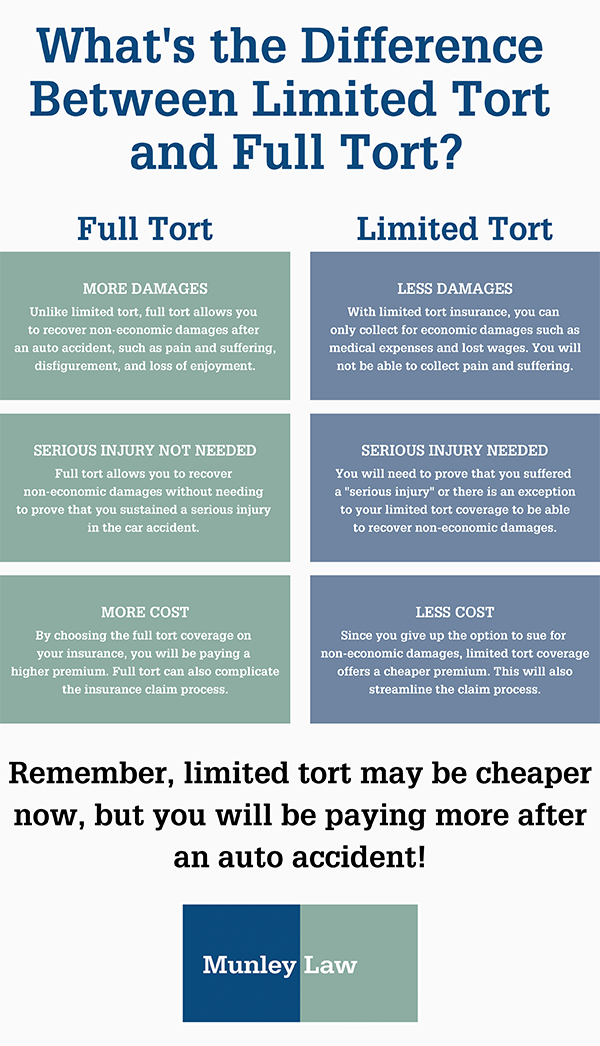
Opting for limited tort coverage means you agree to restrict your right to sue the at-fault driver for non-economic damages (such as pain and suffering, emotional distress, or loss of enjoyment of life) following an accident. In exchange for this limitation, you typically pay a lower insurance premium. This choice is a financial trade-off: you save money upfront on premiums, but you significantly limit your ability to seek full compensation for subjective harms if you are injured in an accident caused by another driver. Under limited tort, you can still recover all economic damages (medical bills, lost wages, property damage) but your ability to claim non-economic damages is severely restricted, generally only permitted if your injuries meet a specific “serious injury” threshold defined by state law.
The Full Tort Alternative
In contrast, choosing full tort coverage means you retain your full, unrestricted right to sue an at-fault driver for all damages, including both economic and non-economic damages, regardless of the severity of your injuries. This option provides the broadest possible legal recourse if you are injured in an accident. Naturally, because it offers greater protection and potential for recovery, full tort coverage comes with a higher insurance premium compared to limited tort. For many, the peace of mind that comes with the ability to pursue compensation for all aspects of their suffering justifies the increased cost.
The Financial Implications of Each Choice
The decision between limited and full tort is fundamentally a financial one, weighing current costs against future financial protection.
- Premium Savings: Limited tort offers immediate financial benefits through lower monthly or annual premiums. This can be attractive for budget-conscious individuals or those who perceive their risk of a serious accident as low.
- Potential Future Recovery: The trade-off is in potential future recovery. If involved in an accident where you are not at fault, limited tort severely constrains the financial compensation you can receive for subjective suffering. This means you might bear the emotional and physical burden of injuries without adequate financial remuneration for pain and distress. Full tort, while more expensive upfront, provides a wider safety net, allowing for comprehensive claims that reflect the full impact of an injury on your life.
- Risk Tolerance: The choice often boils down to an individual’s financial risk tolerance. Are you comfortable accepting the risk of limited compensation for non-economic damages in exchange for lower premiums? Or do you prioritize comprehensive protection, even if it means higher ongoing costs?
Navigating the Limited Tort Thresholds
For those who select limited tort, the financial implications become especially critical when an accident occurs. While the general rule is that non-economic damages are waived, state laws provide specific exceptions that can “break the tort option,” allowing an injured party to pursue a full claim. Understanding these thresholds is crucial for personal financial planning and anticipating potential recovery.
The “Serious Injury” Exception
The most common and significant exception to the limited tort rule is the “serious injury” threshold. If your injuries sustained in an accident meet your state’s legal definition of a “serious injury,” you can bypass the limited tort restriction and sue for non-economic damages. The precise definition of “serious injury” varies by state but generally includes conditions such as:
- Death: The ultimate serious injury.
- Serious Impairment of Body Function: This often refers to an objectively manifested impairment of an important body function that affects the person’s ability to lead a normal life. This can be complex and often requires medical expert testimony.
- Permanent Serious Disfigurement: This would include significant scarring or other visible alterations to one’s physical appearance that are considered permanent.
- Fractures: Some states specifically include certain types of bone fractures as serious injuries, or a certain level of severity of a fracture.
Proving a serious injury can be a challenging and lengthy legal process, requiring extensive medical documentation and, often, litigation. This can add significant financial strain in terms of medical costs and legal fees, even if ultimately successful.

Other Exceptions to Limited Tort
Beyond the serious injury threshold, other circumstances can allow a limited tort policyholder to bypass the restrictions:
- At-Fault Driver is Uninsured: If the at-fault driver does not have insurance, most limited tort policies allow the injured party to seek full non-economic damages from their own uninsured motorist coverage. This is a critical protection for limited tort policyholders.
- At-Fault Driver is Out-of-State: In some jurisdictions, if the at-fault driver is from a state that does not have a tort option system, or is operating a vehicle not registered in the tort-option state, the injured party may be able to seek full damages.
- DUI Conviction: If the at-fault driver is convicted of driving under the influence (DUI) in connection with the accident, the injured party often has their limited tort option waived, allowing them to pursue full non-economic damages. This acts as a punitive measure against drunk drivers.
- Intentional Acts: If the accident resulted from an intentional act (e.g., road rage leading to an assault), the limited tort option may not apply.
- Commercial Vehicle: Accidents involving certain types of commercial vehicles or vehicles owned by businesses may also fall under exceptions.
Case Examples and Practical Scenarios
Consider a scenario: Two drivers, Alice and Bob, are involved in a rear-end collision, with Bob being at fault.
- Alice (Limited Tort): Alice sustains whiplash and soft tissue injuries, resulting in weeks of physical therapy, pain medication, and discomfort. Her medical bills and lost wages are covered. However, because her injuries do not meet the “serious injury” threshold, she cannot sue Bob for her pain and suffering or the disruption to her daily life. She saved on premiums but is now financially limited in her recovery for non-economic harms.
- Bob (Full Tort): Suppose Bob, through no fault of his own, had chosen full tort. He would have paid higher premiums. If he were in Alice’s shoes and suffered similar injuries, he would have the right to sue for his pain and suffering in addition to his economic losses, potentially securing a significantly larger settlement or award.
These scenarios highlight the tangible financial consequences of the tort choice.
The Economic Rationale for Limited Tort
The existence of limited tort options in auto insurance is not arbitrary; it’s rooted in a broader economic rationale aimed at controlling insurance costs and managing the legal system’s burden. For individuals, understanding this rationale can help in making a more informed personal finance decision.
Premium Savings and Cost Management
The primary driver behind limited tort laws is the desire to reduce auto insurance premiums. Non-economic damages, particularly for pain and suffering, can be highly subjective and often represent a significant portion of personal injury settlements and awards. By restricting the ability to claim these damages, insurers face fewer large payouts, especially for less severe injuries. This reduction in potential liability allows them to offer lower premiums to policyholders who choose the limited tort option. From a societal perspective, this can make auto insurance more affordable and accessible, reducing the number of uninsured motorists. For individuals, the savings can be substantial over time, freeing up funds for other financial goals or necessities.
Risk Acceptance and Personal Responsibility
Choosing limited tort also reflects an individual’s acceptance of a certain level of financial risk. By opting for lower premiums, the policyholder is essentially agreeing to self-insure (or absorb) the risk of not being fully compensated for non-economic damages in the event of an accident caused by another party. This concept aligns with principles of personal responsibility in finance, where individuals weigh potential future costs against current savings. It encourages a more proactive approach to risk management, potentially leading drivers to be more cautious or to invest in supplementary insurance products if they are particularly risk-averse.
Balancing Protection and Affordability
Ultimately, limited tort options represent an attempt to strike a balance between comprehensive consumer protection and insurance affordability. In states where these options are available, policymakers recognize the need to keep essential services like auto insurance within reach for a wider population. The trade-off is designed to allow individuals to tailor their insurance coverage to their personal financial situation and risk appetite. For some, the cost savings outweigh the diminished ability to pursue non-economic damages; for others, the robust protection of full tort is a non-negotiable financial safeguard. The existence of both options provides flexibility, but also places the onus on the individual to understand the implications for their personal finances.
Making an Informed Decision
Given the significant financial ramifications, the choice between limited and full tort is not one to be made lightly. It requires careful consideration of personal circumstances, risk tolerance, and future financial planning.
Assessing Your Risk Tolerance
Your personal risk tolerance is a key factor. Are you comfortable with potentially forgoing compensation for pain and suffering in exchange for lower premiums? Consider your lifestyle, driving habits, and the typical severity of accidents in your area. If you live in an area with heavy traffic and a higher incidence of minor collisions, the cumulative impact of unreimbursed pain and suffering claims under limited tort could be significant. Conversely, if you drive infrequently and consider yourself very low-risk, the premium savings might be more appealing. Evaluate your financial safety net: do you have sufficient savings or disability insurance to cover potential long-term impacts of an injury if non-economic damages are unavailable?
Consulting Financial and Legal Professionals
Before making a definitive choice, it is highly advisable to consult with both an insurance professional and, if possible, a personal injury attorney.
- Insurance Agents: An experienced insurance agent can provide a detailed breakdown of the premium differences between limited and full tort options, explain the specific definitions and exceptions in your state, and help you understand how these choices integrate with your other coverage (e.g., health insurance, disability insurance, uninsured/underinsured motorist coverage).
- Personal Injury Attorneys: While you hope to never need one, an attorney specializing in personal injury law can offer invaluable insights into the practical implications of limited tort. They can explain how the “serious injury” threshold is typically interpreted in your state’s courts, the challenges in proving non-economic damages under limited tort, and the potential financial outcomes in various accident scenarios. Their perspective can illuminate the true cost of the lower premium in the event of an accident.

Long-Term Financial Planning and Insurance Reviews
Your tort option choice should not be a one-time decision. It should be an integral part of your ongoing long-term financial planning. As your life circumstances change—you marry, have children, change jobs, or your financial situation improves or declines—your risk tolerance and need for comprehensive coverage may also evolve.
- Regular Reviews: Periodically review your auto insurance policy, ideally annually, with your insurance agent. Discuss any life changes and reassess whether your current tort option still aligns with your financial goals and risk profile.
- Budgeting for Protection: Factor the cost of your chosen tort option into your overall household budget. Consider if the premium savings from limited tort genuinely outweigh the potential for significant, unreimbursed financial and emotional burdens after a serious accident.
By thoroughly understanding “what is limited tort” and its intricate relationship with personal finance, individuals can make informed decisions that protect their assets, manage their risks, and ensure their financial well-being, both today and in the uncertain future.
aViewFromTheCave is a participant in the Amazon Services LLC Associates Program, an affiliate advertising program designed to provide a means for sites to earn advertising fees by advertising and linking to Amazon.com. Amazon, the Amazon logo, AmazonSupply, and the AmazonSupply logo are trademarks of Amazon.com, Inc. or its affiliates. As an Amazon Associate we earn affiliate commissions from qualifying purchases.