
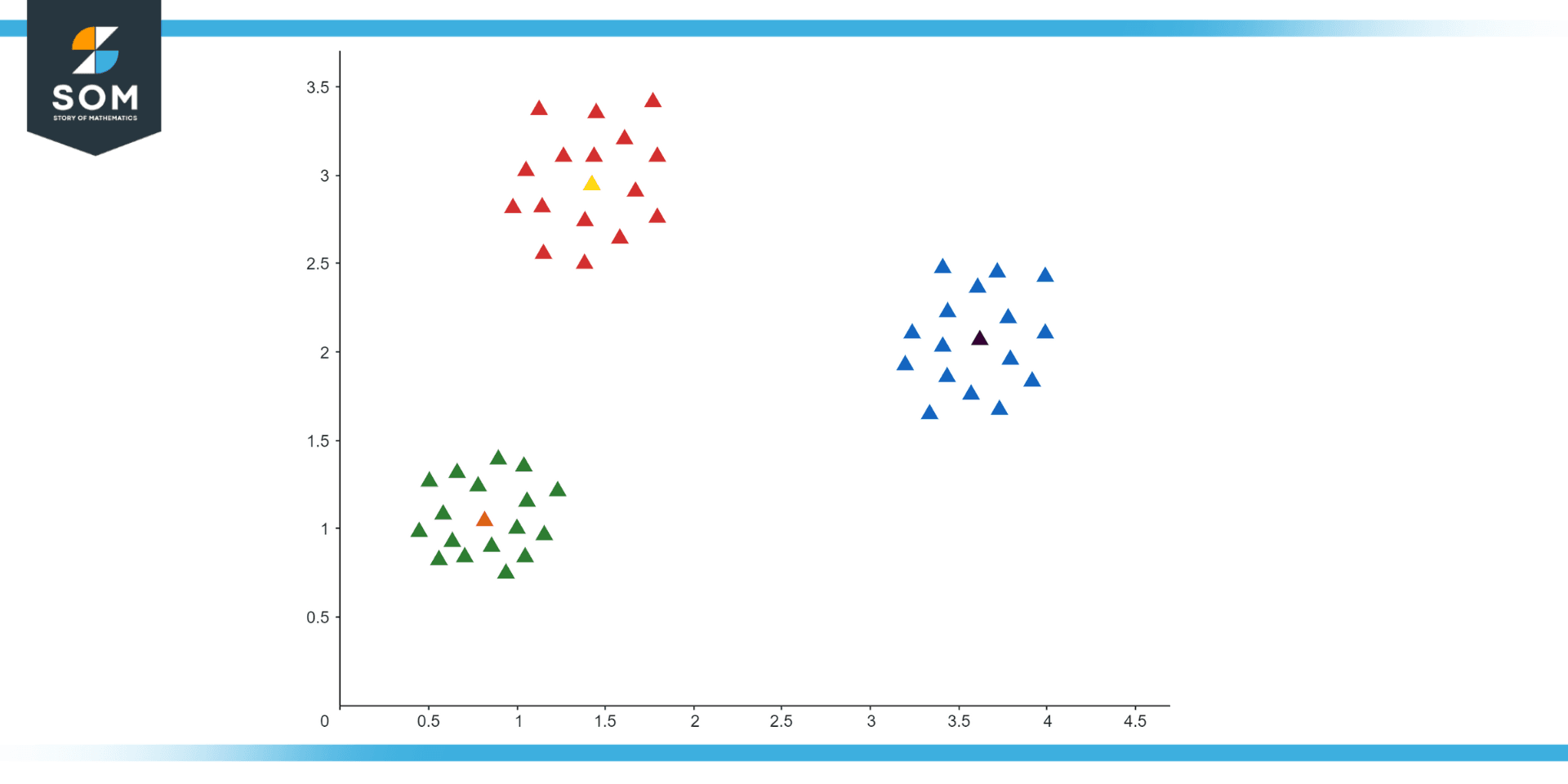
The concept of a “cluster” in mathematics, particularly within statistics and computer science, refers to a collection of data points that are grouped together because they share similar characteristics. Imagine a scatter plot of various data points; a cluster would be a distinct “cloud” of these points, separated by some discernible distance or difference from other such clouds. At its core, clustering is an unsupervised machine learning technique, meaning it operates without pre-labeled categories, seeking instead to discover inherent groupings within a dataset. This fundamental mathematical principle underpins a vast array of technological advancements, from AI to software design and data security.

The Foundational Concept of Clustering
Clustering’s mathematical foundation is built on the premise of identifying patterns and structures in data where explicit labels are absent. The goal is to maximize intra-cluster similarity while minimizing inter-cluster similarity.
Defining a Cluster
Mathematically, a cluster is not a rigidly defined entity but rather a heuristic concept. It’s an aggregation of data points such that points within the same cluster are more similar to each other than to those in other clusters. “Similarity” is quantified using various distance metrics, such as Euclidean distance, Manhattan distance, cosine similarity, or Jaccard index, depending on the nature of the data (numerical, categorical, textual). For instance, in a two-dimensional space, points physically close to each other would form a cluster based on Euclidean distance. In higher dimensions, these distances become more abstract but the principle remains.
The Goal of Clustering: Unsupervised Learning
Clustering algorithms fall under the umbrella of unsupervised learning. Unlike supervised learning, which uses labeled training data to predict outcomes (e.g., classifying emails as spam or not spam), unsupervised learning explores data to find hidden patterns or groupings without any prior knowledge of what those groups might be. This makes clustering incredibly powerful for exploratory data analysis, pattern recognition, and anomaly detection. It helps to simplify complex datasets by organizing them into more manageable, meaningful subgroups.
Mathematical Basis: Proximity and Similarity
The efficacy of any clustering algorithm hinges on its ability to accurately measure the proximity or similarity between data points.
- Distance Metrics: These are mathematical functions that quantify how “far apart” two data points are. Common choices include:
- Euclidean Distance: The straight-line distance between two points in Euclidean space. It’s widely used for numerical data.
- Manhattan Distance (L1 Norm): The sum of the absolute differences of their Cartesian coordinates. Often used when movements are restricted to a grid (like city blocks).
- Cosine Similarity: Measures the cosine of the angle between two vectors. It’s particularly effective for high-dimensional data like text documents, where it assesses orientation rather than magnitude.
- Centroids and Medoids: Many clustering algorithms define a cluster’s center using a centroid (the mean of all points in a cluster) or a medoid (an actual data point within the cluster that is closest to the center). These serve as representative points for their respective clusters.
- Density: Some algorithms define clusters based on the density of data points in a given region. Areas with a high concentration of points, separated by regions of lower concentration, are identified as clusters.
Why Clustering Matters in Technology and AI
The abstract mathematical concept of clustering translates directly into tangible benefits across virtually every domain touched by technology and artificial intelligence. It serves as a cornerstone for building intelligent systems that can learn, adapt, and make informed decisions from vast, unstructured datasets.
Data Exploration and Pattern Recognition
In the age of big data, the ability to make sense of massive, raw datasets is paramount. Clustering provides a vital tool for initial data exploration. For data scientists, it can reveal underlying structures, identify natural groupings, and expose hidden patterns that might otherwise remain unseen. This is crucial in fields like bioinformatics, where clustering can group genes with similar expression patterns, or in anomaly detection, where outliers that don’t fit into any established cluster might signal fraudulent activities or system malfunctions. Software tools for data visualization and business intelligence heavily leverage clustering to present complex data in an understandable format.
Machine Learning and AI Applications
Clustering is not just an analytical tool; it’s an integral part of many machine learning and AI algorithms.
- Customer Segmentation: E-commerce platforms and marketing automation tools use clustering to segment customers based on purchasing habits, browsing history, and demographic data. This allows for highly personalized recommendations, targeted advertising, and optimized marketing campaigns, enhancing user experience and driving sales.
- Image and Video Analysis: In computer vision, clustering is used for tasks like object recognition, image segmentation (dividing an image into regions of interest), and facial recognition systems. For instance, pixels with similar color or texture properties can be clustered together to identify distinct objects within an image.
- Natural Language Processing (NLP): Clustering helps organize text documents into themes, group similar articles, or identify synonyms and related terms within large corpora. This is vital for search engines, recommendation systems, and content categorization tools.
- Recommendation Systems: Services like Netflix or Spotify use clustering to group users with similar tastes or items with similar attributes, then recommend new items based on these groupings.
- Anomaly Detection: Identifying unusual patterns, whether in network traffic (cybersecurity), credit card transactions (fraud detection), or manufacturing sensor data (predictive maintenance), heavily relies on identifying data points that do not conform to any established cluster.
Business Intelligence and Decision Making
For businesses, clustering transforms raw data into actionable insights. By segmenting markets, identifying customer cohorts, or understanding operational inefficiencies, companies can make data-driven decisions that improve efficiency, optimize resource allocation, and foster innovation. Financial institutions use clustering to group clients by risk profiles, while logistics companies use it to optimize delivery routes by clustering geographically proximate destinations. These insights are often delivered through advanced analytics dashboards and enterprise resource planning (ERP) systems.
Key Clustering Algorithms and Their Tech Implementations
The mathematical theory of clustering has given rise to numerous algorithms, each with its strengths, weaknesses, and preferred applications in technology.

K-Means: Simplicity and Speed
K-Means is perhaps the most widely known and used clustering algorithm due to its simplicity and computational efficiency.
- How it works conceptually: The algorithm iteratively assigns data points to one of k clusters (where k is a predefined number), based on the closest cluster centroid (mean). It then recalculates the centroids based on the new assignments, repeating until the assignments no longer change or a maximum number of iterations is reached.
- Tech applications: K-Means is pervasive. It’s used in image compression (reducing the number of colors in an image by clustering similar pixel colors), customer segmentation in CRM software, document analysis for categorizing articles, and anomaly detection in network security to flag unusual traffic patterns. Its speed makes it suitable for large datasets, though it struggles with clusters of varying densities or non-spherical shapes.
Hierarchical Clustering: Tree-like Relationships
Hierarchical clustering builds a hierarchy of clusters, represented as a tree-like diagram called a dendrogram. It can be agglomerative (bottom-up, starting with individual points and merging them) or divisive (top-down, starting with all points in one cluster and splitting them).
- Tech applications: This method is powerful when the relationships between clusters are important, offering more insight into the data structure than K-Means. It’s heavily used in bioinformatics for gene expression analysis, grouping similar DNA sequences or proteins. In taxonomy, it helps classify species. Document similarity tools can use hierarchical clustering to show how different topics or articles relate at various levels of granularity.
DBSCAN: Density-Based Discovery
DBSCAN (Density-Based Spatial Clustering of Applications with Noise) excels at finding arbitrarily shaped clusters and identifying outliers as noise.
- How it works conceptually: DBSCAN groups together points that are closely packed together, marking as outliers those points that lie alone in low-density regions. It requires two parameters:
eps(maximum distance between two samples for one to be considered as in the neighborhood of the other) andmin_samples(the number of samples in a neighborhood for a point to be considered as a core point). - Tech applications: This algorithm is particularly valuable in geospatial data analysis for identifying hot spots of activity or crime, traffic pattern analysis, and geology for identifying mineral deposits. Its ability to handle noise makes it robust for real-world, messy datasets often found in IoT sensor networks and environmental monitoring.
Gaussian Mixture Models (GMM): Probabilistic Approach
Unlike K-Means which assigns each point to exactly one cluster, GMM is a probabilistic model that assumes data points are generated from a mixture of several Gaussian distributions.
- How it works conceptually: Instead of hard assignments, GMM provides a probability that each data point belongs to each cluster. This “soft assignment” allows for more nuanced clustering, especially when clusters overlap.
- Tech applications: GMMs are used in advanced statistical modeling software, speech recognition (where different sounds can be modeled as Gaussian mixtures), image recognition (modeling pixel distributions), and biometric authentication systems for recognizing patterns in voice or gait. It offers greater flexibility than K-Means by allowing clusters to have different sizes and correlations.
Challenges and Considerations in Applying Clustering Technology
While powerful, clustering is not a silver bullet. Its effective application in technology requires careful consideration of several challenges.
Defining “Optimal” Clusters: The Role of Domain Knowledge
One of the biggest challenges is determining the “correct” number of clusters (k in K-Means) or the appropriate density parameters (in DBSCAN). There’s no universal mathematical formula for optimality, as the best grouping often depends on the specific problem context and domain knowledge. Techniques like the Elbow Method or Silhouette Score provide statistical guidance, but ultimately, human insight is crucial to interpret and validate the results, ensuring they are meaningful for the intended technological application.
Scalability for Big Data: Distributed Computing
Traditional clustering algorithms can be computationally intensive, especially with massive datasets common in modern big data environments. Processing terabytes or petabytes of data requires specialized solutions. Technologies like Apache Spark, Hadoop MapReduce, and cloud-based distributed computing platforms (e.g., AWS EMR, Google Cloud Dataproc) are essential for scaling clustering algorithms to handle such volumes, parallelizing computations across many machines. Developing algorithms optimized for parallel execution is an active area of research.
Interpretability and Actionability: Bridging Math and Business Value
A cluster result, however mathematically sound, is only valuable if it can be interpreted and acted upon. In a business context, simply knowing there are five customer segments isn’t enough; understanding who those customers are, why they form a segment, and what actions can be taken to target them is paramount. This requires linking the abstract mathematical clusters back to real-world features and characteristics, often involving qualitative analysis and collaboration between data scientists, business analysts, and domain experts. Poor interpretability can lead to insights that cannot be translated into practical software features or business strategies.
The Future of Clustering in an AI-Driven World
As AI continues to evolve, so too will the role and sophistication of clustering. It remains a foundational element, constantly integrating with newer paradigms and addressing emerging data challenges.
Integration with Deep Learning
Deep learning models, particularly autoencoders, are increasingly used to learn lower-dimensional, meaningful representations of data. Clustering can then be applied to these learned embeddings, often leading to more robust and semantically rich clusters than when applied to raw data. This hybrid approach allows for the discovery of complex, non-linear patterns that traditional clustering might miss, enhancing capabilities in areas like image recognition, natural language processing, and personalized content recommendation.
Real-time Clustering and Streaming Data
The rise of IoT devices, real-time analytics, and streaming data necessitates algorithms that can perform clustering on-the-fly. Traditional batch processing is insufficient for applications requiring immediate insights, such as fraud detection in financial transactions or anomaly detection in industrial sensor data. New algorithms and distributed stream processing frameworks are being developed to enable continuous, incremental clustering, allowing AI systems to adapt to evolving data patterns in real-time.
Ethical Considerations and Bias Detection
As clustering informs critical decisions, the ethical implications of its use are gaining prominence. Biases present in training data can be perpetuated or even amplified by clustering algorithms, leading to unfair or discriminatory outcomes (e.g., in loan applications, hiring processes, or criminal justice). Future advancements will increasingly focus on developing interpretable and fair clustering algorithms, alongside tools for detecting and mitigating algorithmic bias, ensuring that the insights generated by these mathematical tools are equitable and responsible.
In essence, “cluster in math” is far more than an academic concept; it’s a dynamic, evolving discipline providing the mathematical backbone for much of the technology and AI that shapes our world, continuously pushing the boundaries of what machines can understand and achieve.
aViewFromTheCave is a participant in the Amazon Services LLC Associates Program, an affiliate advertising program designed to provide a means for sites to earn advertising fees by advertising and linking to Amazon.com. Amazon, the Amazon logo, AmazonSupply, and the AmazonSupply logo are trademarks of Amazon.com, Inc. or its affiliates. As an Amazon Associate we earn affiliate commissions from qualifying purchases.