
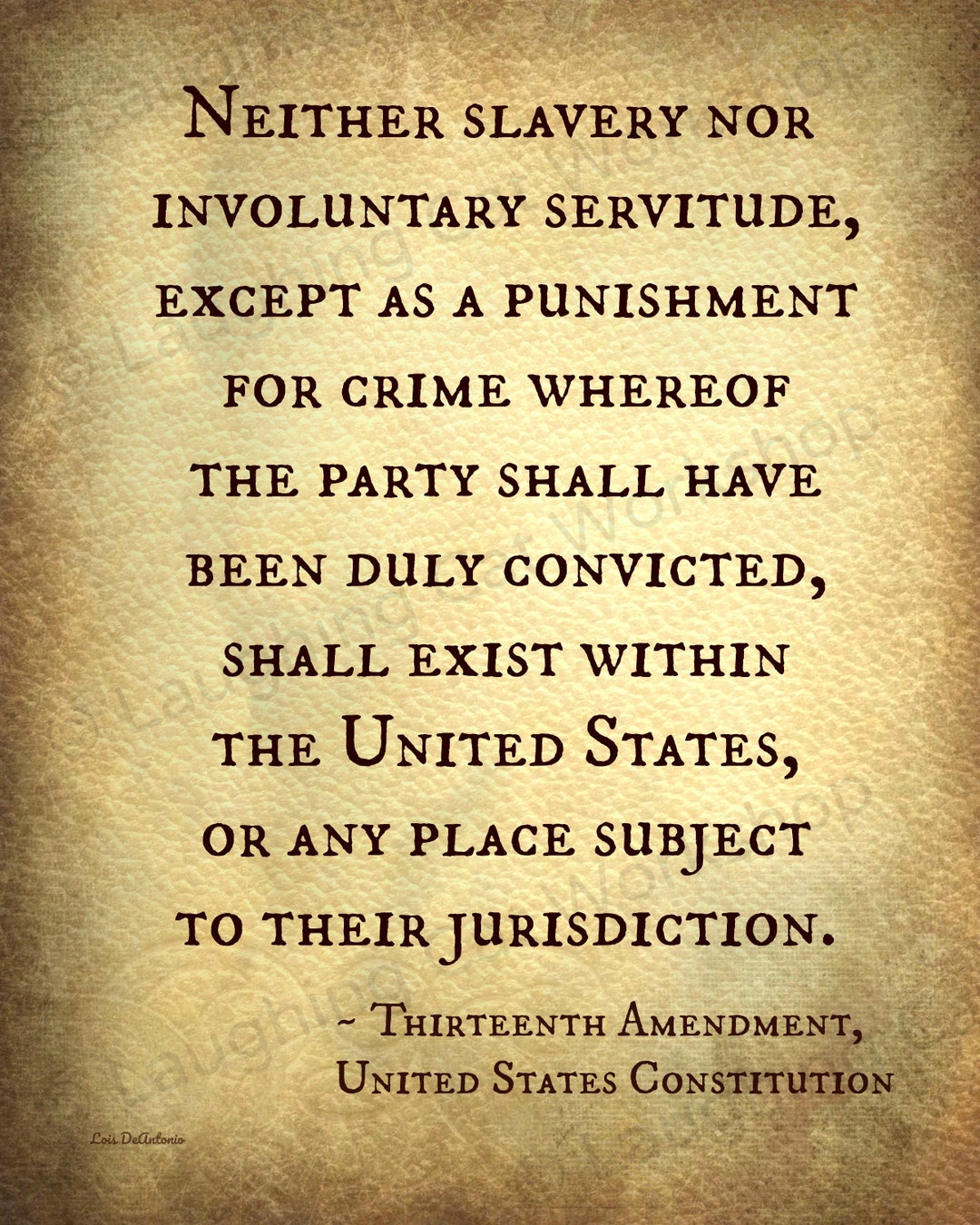
The 13th Amendment to the United States Constitution, ratified on December 6, 1865, fundamentally reshaped the nation’s economic and social landscape by abolishing slavery and involuntary servitude, except as punishment for a crime. While often viewed through a purely historical or legal lens, its profound implications for wealth creation, labor markets, personal finance, and modern business ethics are undeniable. This amendment didn’t just free individuals; it dismantled a massive economic system built on human chattel, instigating a financial revolution whose echoes still resonate in today’s economic structures, investment strategies, and corporate governance. Understanding the 13th Amendment from a financial perspective reveals its enduring impact on capital allocation, wealth distribution, and the very foundation of labor economics in America.
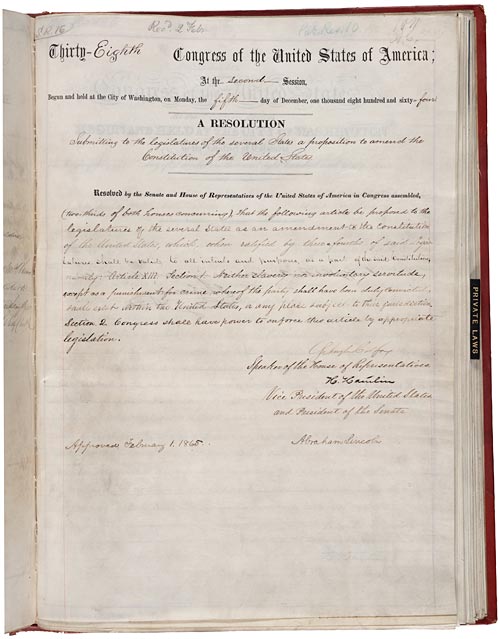
The Economic Revolution of Abolition
The 13th Amendment represented arguably the largest reallocation of capital and human resources in American history, transforming the nation’s primary labor system and creating an entirely new economic paradigm. Before its passage, the institution of slavery was deeply intertwined with the nation’s financial machinery, driving significant sectors of the economy.
Slavery: An Economic Engine of Capital Accumulation
For over two centuries, slavery was a cornerstone of the American economy, particularly in the Southern states, but its financial tentacles reached nationwide. Enslaved individuals were not merely laborers; they were capital assets, often valued more highly than land or industrial machinery. The “price” of an enslaved person represented a significant investment, with market values fluctuating based on age, gender, skills, and prevailing economic conditions. This human capital was mortgageable, insurable, and transferable, forming a substantial portion of the nation’s total wealth.
The system generated immense profits for slaveholders and beneficiaries of the system, fueling industries from cotton and tobacco to sugar and rice production. These agricultural outputs, produced by unpaid forced labor, were major export commodities, generating foreign exchange and driving domestic manufacturing and shipping industries. Banks provided loans collateralized by enslaved people, insurance companies underwrote policies protecting against their loss, and slave traders operated a vast, complex market. The accumulation of wealth for many prominent families, institutions, and even early industrial endeavors was directly tied to this exploitative economic model, demonstrating a profound intersection of capital, labor, and systemic injustice. The entire financial infrastructure of the Southern economy, and a significant portion of the national economy, was built on the premise of perpetual, unpaid labor.
The Financial Disruption of Freedom
The ratification of the 13th Amendment triggered an unprecedented economic disruption. Overnight, an estimated four million people were transformed from capital assets into free individuals. This meant a complete write-off of trillions of dollars in “human capital” from the balance sheets of slaveholders. The immediate financial shock was immense for those whose wealth was primarily denominated in enslaved people. Plantations, once highly profitable due to free labor, suddenly faced the monumental challenge and expense of hiring, training, and paying a workforce.
This shift necessitated a fundamental restructuring of agricultural finance, labor contracts, and property valuation. The Southern economy, heavily reliant on slave labor, was thrown into disarray. While the amendment did not provide any compensation to slaveholders for their “lost property,” it also did not provide reparations or direct financial aid to the newly freed population. This asymmetry laid the groundwork for persistent economic disparities. The transition from a non-wage labor system to a nascent wage economy required new financial models for businesses and individuals alike, forever altering the dynamics of supply and demand for labor, and introducing the concept of widespread paid labor as the default economic standard.
Reshaping Personal Finance and Wealth Building
Beyond the immediate economic upheaval, the 13th Amendment initiated a long and arduous journey toward financial freedom for African Americans, a journey often hampered by systemic obstacles and discriminatory practices that continue to impact wealth distribution today.
Barring the Path to Financial Parity
While the 13th Amendment abolished legal slavery, it did not automatically guarantee economic equality or provide the tools for financial success. The newly freed population, largely uncompensated for generations of forced labor, began their journey to financial independence with virtually no assets, land, education, or access to capital. The promise of “forty acres and a mule,” briefly considered as a form of reparations, never materialized on a widespread scale, depriving millions of the foundational assets needed for wealth creation.
Instead, many formerly enslaved people found themselves trapped in new forms of economic dependency, such as sharecropping. Under this system, they leased land from former slaveholders, paying a portion of their crops as rent and often falling into perpetual debt to landlords and merchants for supplies. This cycle of debt and limited financial mobility effectively mimicked aspects of their former bondage, severely limiting opportunities to accumulate savings, own land, or invest in their futures. Discriminatory practices like “Black Codes,” Jim Crow laws, and later, redlining and unequal access to education and employment, systematically denied African Americans the means to build wealth, secure mortgages, or participate fully in the emerging industrial economy. These barriers were not just social; they were explicitly economic, designed to maintain a racial hierarchy that limited financial agency and mobility.
Generational Wealth Gaps and Economic Legacy
The initial economic disadvantages faced by African Americans post-13th Amendment compounded over generations, contributing directly to the persistent racial wealth gap observed today. The inability to accumulate foundational assets like land or housing, combined with restricted access to capital, education, and fair labor markets, meant that families were unable to pass down significant intergenerational wealth. This contrasts sharply with white families who, over the same period, benefited from policies promoting homeownership (e.g., GI Bill mortgages) and capital accumulation, often on land or through industries initially built with enslaved labor.
The financial legacy of the 13th Amendment is evident in disparities in homeownership rates, retirement savings, entrepreneurial success, and overall net worth. For instance, studies consistently show that median Black household wealth is a fraction of median white household wealth. This gap is not solely attributable to contemporary income differences but is deeply rooted in historical economic disadvantages stemming from slavery and its immediate aftermath, demonstrating how legal freedom did not equate to economic freedom. Understanding the financial implications of the post-13th Amendment era is crucial for comprehending modern economic inequality and for informing policies aimed at fostering more equitable financial opportunities.
Business Finance and Modern “Involuntary Servitude” Risks
While the explicit chattel slavery abolished by the 13th Amendment is a relic of the past, the amendment’s prohibition against “involuntary servitude” has contemporary relevance in the globalized economy. This clause is increasingly invoked in discussions around ethical supply chains, human trafficking, and responsible investing, posing significant financial risks and opportunities for modern businesses.
Ethical Supply Chains as a Financial Imperative
In today’s interconnected global economy, the principle of prohibiting involuntary servitude extends to corporate responsibility regarding their supply chains. Businesses are under increasing scrutiny to ensure that their products and services are not tainted by forced labor, debt bondage, or other exploitative practices. Cases of modern slavery—whether in agriculture, manufacturing, or service industries—present immense financial risks to companies. These risks include severe reputational damage leading to consumer boycotts and loss of market share, legal liabilities in the form of fines and lawsuits, and disruption to operations due due to investigations or enforcement actions.
From a business finance perspective, ensuring ethical supply chains is no longer merely a moral consideration but a strategic financial imperative. Companies that fail to conduct thorough due diligence and manage these risks effectively can see their valuations plummet, their access to capital constrained, and their long-term financial viability threatened. Conversely, businesses demonstrating strong commitments to ethical labor practices can enhance their brand value, attract socially conscious consumers and investors, and build more resilient supply chains.
ESG Investing and the 13th Amendment’s Echo
The principles embedded in the 13th Amendment — concerning human dignity and freedom from forced labor — are foundational to the “Social” (S) component of Environmental, Social, and Governance (ESG) investment criteria. ESG investing, which considers a company’s impact on society and the planet alongside traditional financial metrics, increasingly influences capital allocation decisions. Investors are scrutinizing companies’ labor practices, human rights policies, and supply chain transparency to assess their ESG performance.
Companies found to have links to involuntary servitude or exploitative labor practices face significant investor backlash, potentially leading to divestment, lower credit ratings, and increased cost of capital. Pension funds, asset managers, and individual investors are integrating ESG factors into their portfolio management, recognizing that strong social governance, including adherence to ethical labor standards, correlates with long-term financial stability and reduced risk. The 13th Amendment, therefore, serves as a historical precedent for contemporary ethical investing frameworks, signaling that the treatment of labor is a material financial consideration.
Regulatory Compliance and the Cost of Unethical Labor
Governments worldwide, including the United States, are enacting and enforcing stricter laws against forced labor. For example, the U.S. Tariff Act of 1930 prohibits the importation of goods made with forced labor, leading to increased customs enforcement and “Withhold Release Orders” (WROs) that block products from entering the U.S. market. Other regulations, such as the California Transparency in Supply Chains Act and similar legislation globally, mandate disclosures about efforts to eradicate slavery and human trafficking from supply chains.
The financial costs of non-compliance are substantial. Companies can face hefty fines, confiscation of goods, criminal charges, and exclusion from lucrative government contracts. Beyond direct penalties, the operational disruptions caused by supply chain investigations, product recalls, and re-sourcing efforts can severely impact profitability and shareholder value. Conversely, investing in robust compliance programs, supply chain mapping technologies, and independent audits, while requiring upfront capital expenditure, serves as a critical risk management strategy. It protects against financial penalties, preserves brand reputation, and ensures continuity of operations, demonstrating how the fundamental prohibition of involuntary servitude, enshrined in the 13th Amendment, continues to shape modern business finance and operational strategy.
aViewFromTheCave is a participant in the Amazon Services LLC Associates Program, an affiliate advertising program designed to provide a means for sites to earn advertising fees by advertising and linking to Amazon.com. Amazon, the Amazon logo, AmazonSupply, and the AmazonSupply logo are trademarks of Amazon.com, Inc. or its affiliates. As an Amazon Associate we earn affiliate commissions from qualifying purchases.