
In the vast landscape of computer science and theoretical computation, few concepts are as foundational, as challenging, and as hotly debated as “NP.” Far from a simple acronym, NP represents a crucial class of problems that underpins our understanding of what computers can and cannot efficiently achieve. To grasp NP, one must delve into the realm of computational complexity theory, an area that categorizes problems based on the resources—primarily time—required by an algorithm to solve them. Understanding NP is not merely an academic exercise; it has profound implications for algorithm design, cryptography, artificial intelligence, and numerous other fields that rely on efficient problem-solving.
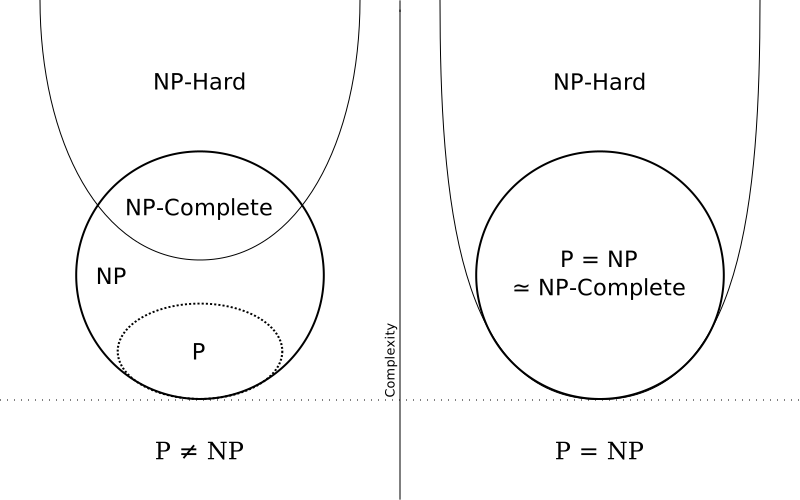
Unpacking Computational Complexity: P vs. NP
The journey to understanding NP begins with its counterpart, P, and the fundamental distinction between them. Computational complexity theory aims to classify problems according to their inherent difficulty, independent of specific hardware or programming languages. This classification uses idealized computational models, most notably the Turing machine, to measure the time (number of steps) or space (memory) an algorithm needs as a function of the input size.
Defining P (Polynomial Time)
P stands for “Polynomial time.” A problem is considered to be in the class P if there exists an algorithm that can solve it in a time that is bounded by a polynomial function of the input size. In simpler terms, if a problem has an input of size ‘n’ (e.g., ‘n’ items to sort, ‘n’ vertices in a graph), a polynomial-time algorithm will complete its task in a number of steps proportional to n, n², n³, or any other polynomial term.
Problems in P are generally regarded as “efficiently solvable” or “tractable.” As the input size grows, the time required to solve them grows at a manageable rate. Examples of problems in P include:
- Sorting: Arranging a list of numbers in ascending or descending order. Standard algorithms like Merge Sort or Quick Sort run in O(n log n) time, which is polynomial.
- Searching: Finding a specific item in a sorted list (binary search is O(log n)).
- Graph Reachability: Determining if there is a path between two nodes in a graph.
The class P represents the set of all decision problems (problems with a yes/no answer) that can be solved by a deterministic algorithm in polynomial time.
Defining NP (Non-deterministic Polynomial Time)
NP stands for “Non-deterministic Polynomial time.” Crucially, this does not mean “non-polynomial time.” Instead, a problem is in the class NP if a given solution to the problem can be verified in polynomial time. That is, if someone hands you a potential answer to an NP problem, you can quickly (in polynomial time) check whether that answer is correct.
Consider the distinction:
- For problems in P, we can find a solution efficiently.
- For problems in NP, if a solution exists, we can verify its correctness efficiently.
It is important to understand that every problem in P is also in NP. If you can find a solution efficiently, you can certainly verify a given solution efficiently (by simply finding it yourself and comparing). The converse, however, is the core of the P vs. NP problem: can every problem whose solution can be efficiently verified also be efficiently found?
Examples of problems in NP (for which no known polynomial-time algorithm exists for finding a solution, only for verifying one):
- Boolean Satisfiability Problem (SAT): Given a Boolean formula, is there an assignment of truth values to its variables that makes the formula true? If someone gives you an assignment, you can quickly plug in the values and check if the formula holds.
- Traveling Salesperson Problem (TSP): Given a list of cities and the distances between each pair of cities, what is the shortest possible route that visits each city exactly once and returns to the origin city? If someone provides a route, you can easily calculate its total distance and check if it visits each city once. Finding the shortest route, however, is immensely difficult.
- Subset Sum Problem: Given a set of integers, is there a non-empty subset whose sum is zero? If someone points out a subset, you can quickly sum its elements.
The “non-deterministic” part of NP refers to a theoretical model of computation, a “non-deterministic Turing machine,” which can make multiple choices simultaneously. If any of these choices leads to a solution, the problem is considered solvable by the machine. This is equivalent to saying that if a solution exists, we can “guess” it and then verify it in polynomial time.
The Significance of NP-Completeness
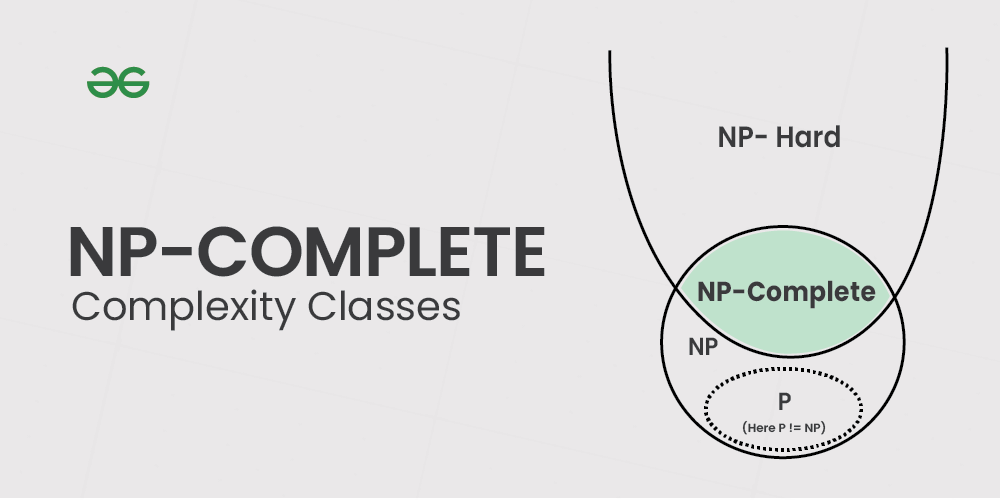
Within the class NP, there exists a special subset of problems known as NP-complete problems. These are the “hardest” problems in NP, in the sense that if you could find a polynomial-time algorithm for any one NP-complete problem, you could use that algorithm to solve every other problem in NP in polynomial time. This concept is central to understanding the practical limitations and theoretical challenges of computation.
What Makes a Problem NP-Complete?
A decision problem L is NP-complete if two conditions are met:
- L is in NP: A given solution to L can be verified in polynomial time.
- L is NP-hard: Every other problem in NP can be transformed (or “reduced”) into L in polynomial time. This means that if you have an efficient way to solve L, you can efficiently solve any other problem in NP by first transforming it into L and then solving the transformed problem.
The first problem proven to be NP-complete was the Boolean Satisfiability Problem (SAT), demonstrated by Stephen Cook in 1971. Since then, thousands of other problems across various domains have been shown to be NP-complete, including TSP, Subset Sum, Clique Problem, Vertex Cover, and many more. The implication is profound: these problems are all “equally hard” in a theoretical sense.
Real-World Implications of NP-Complete Problems
The prevalence of NP-complete problems in diverse fields highlights their practical importance and the frustration they often cause.
- Logistics and Supply Chain: Optimizing delivery routes (TSP), scheduling tasks, or allocating resources often involve NP-complete challenges. Companies like FedEx or Amazon constantly grapple with variants of these problems.
- Circuit Design: Minimizing the size or power consumption of integrated circuits involves problems like Boolean satisfiability or graph coloring, which are NP-complete.
- Financial Modeling: Portfolio optimization, risk assessment, and algorithmic trading can involve combinatorial complexities that fall into the NP-complete category.
- Bioinformatics: Protein folding, DNA sequencing alignment, and drug discovery often encounter NP-complete subproblems, requiring sophisticated computational approaches.
- Artificial Intelligence: Many planning, scheduling, and learning tasks in AI are NP-complete.
- Cryptography: The security of many cryptographic systems relies on the presumed difficulty of solving certain problems, often NP-hard problems (though not necessarily NP-complete decision problems). For instance, factoring large numbers, while not known to be NP-complete, is a hard problem that forms the basis of RSA encryption.

When faced with an NP-complete problem, practitioners understand that a generally efficient algorithm (one that works well for all possible inputs) is highly unlikely to exist. This knowledge directs efforts towards alternative strategies.
The P vs. NP Problem: A Million-Dollar Question
The most significant unsolved problem in theoretical computer science, and indeed one of the Clay Mathematics Institute’s seven Millennium Prize Problems (each carrying a million-dollar reward for its solution), is the P vs. NP problem. It asks: Is P equal to NP? Or, equivalently, if a solution to a problem can be verified quickly, can it also be found quickly?
Why Proving P=NP or P≠NP Matters
The answer to this question would have monumental consequences:
- If P = NP: This would mean that every problem whose solution can be quickly verified can also be quickly found. It would imply that efficient algorithms exist for all NP-complete problems. Imagine instantly finding optimal solutions to the Traveling Salesperson Problem, perfectly scheduling every flight globally, or efficiently designing highly complex molecular structures. This would revolutionize science, engineering, and economics. Cryptography, which relies on the difficulty of certain problems, would be severely threatened, potentially breaking many modern encryption schemes. It would, in a sense, mean that creativity and finding solutions are no harder than recognizing them.
- If P ≠ NP (the widely believed outcome): This would confirm that there are indeed problems whose solutions are easy to check but fundamentally hard to find. It would formally establish the inherent computational difficulty of NP-complete problems, validating decades of research into approximation algorithms and heuristics. The security of current cryptographic systems would remain intact (assuming they rely on genuinely hard problems). It would imply a fundamental limit to what computers can achieve efficiently, guiding researchers to focus on problems that are realistically solvable.
Current Status and Research
To date, no one has proven P=NP or P≠NP. The vast majority of computer scientists believe that P ≠ NP. Decades of attempts to find polynomial-time algorithms for NP-complete problems have failed, leading to a strong intuition that such algorithms simply do not exist. Similarly, no one has been able to prove that such algorithms cannot exist.
Research continues on multiple fronts:
- Lower Bounds: Proving that certain problems cannot be solved in polynomial time.
- Circuit Complexity: Exploring the minimum size of Boolean circuits required to solve problems.
- Proof Complexity: Studying the length of proofs in logical systems.
- New Models of Computation: Investigating the power of quantum computers or other non-traditional computing paradigms to potentially solve NP-complete problems faster.
Strategies for Tackling NP Problems
Given the widely accepted (though unproven) belief that P ≠ NP, directly solving NP-complete problems optimally for large inputs in polynomial time is generally considered infeasible. Therefore, computer scientists and engineers employ various strategies to manage these computationally intensive challenges.
Approximation Algorithms
For many optimization problems within NP (e.g., finding the shortest route, the minimum set cover), it might not be possible to find the absolute best solution efficiently. However, it is often possible to find a solution that is “good enough”—one that is within a guaranteed factor of the optimal solution. These are called approximation algorithms.
For instance, there are approximation algorithms for the Traveling Salesperson Problem that can find a route that is at most twice as long as the optimal route, and they do so in polynomial time. The trade-off is precision for efficiency.
Heuristics and Metaheuristics
When even approximation guarantees are hard to achieve or when the guaranteed bound is too loose, engineers often turn to heuristics. A heuristic is a technique designed to solve a problem faster or more effectively when classic methods are too slow or fail to find an exact solution, by sacrificing optimality, completeness, accuracy, or precision. Heuristics are essentially “rules of thumb” that work well in practice, though without formal guarantees.
Metaheuristics are higher-level algorithmic frameworks that guide a search process to find good solutions in a vast search space. Examples include:
- Simulated Annealing: Inspired by the annealing process in metallurgy, it explores the solution space by gradually reducing the chance of accepting worse solutions.
- Genetic Algorithms: Mimicking natural selection, they evolve a population of candidate solutions through processes like mutation and crossover.
- Ant Colony Optimization: Based on the foraging behavior of ants, it builds solutions incrementally through probabilistic choices.
- Tabu Search: Explores the solution space by iteratively moving from a solution to an adjacent one, while using a “tabu list” to avoid recently visited solutions and prevent cycles.
These methods are particularly useful for real-world problems where perfect optimality is less critical than finding a high-quality solution quickly.
Quantum Computing’s Potential Role
Quantum computing represents a paradigm shift in computational power, leveraging quantum-mechanical phenomena like superposition and entanglement. While quantum computers are not expected to solve all NP-complete problems in polynomial time (meaning P≠NP would likely still hold even with quantum computers), they could potentially offer significant speedups for specific types of problems.
Shor’s algorithm, for example, can factor large numbers exponentially faster than classical computers, which has profound implications for cryptography (specifically breaking RSA). Grover’s algorithm provides a quadratic speedup for unstructured search problems. The full extent of quantum computing’s impact on NP problems is still an active area of research, but it offers a tantalizing prospect for tackling problems currently deemed intractable.
In conclusion, NP is a fundamental concept in computer science that delineates the boundary between problems whose solutions can be efficiently checked and those whose solutions can be efficiently found. While the P vs. NP question remains open, its implications shape our understanding of computational limits and drive innovation in algorithm design, leading to sophisticated strategies for managing the complexity inherent in many real-world challenges.
aViewFromTheCave is a participant in the Amazon Services LLC Associates Program, an affiliate advertising program designed to provide a means for sites to earn advertising fees by advertising and linking to Amazon.com. Amazon, the Amazon logo, AmazonSupply, and the AmazonSupply logo are trademarks of Amazon.com, Inc. or its affiliates. As an Amazon Associate we earn affiliate commissions from qualifying purchases.