
In the vast and ever-expanding digital landscape, the act of creating and sharing content has become ubiquitous. From stunning photographs and insightful articles to revolutionary software and captivating music, digital assets are the lifeblood of the modern internet. Yet, underlying this prolific creation lies a fundamental legal framework: copyright. Traditionally, copyright grants creators exclusive rights over their work, dictating who can use, distribute, or modify it. While crucial for protecting intellectual property, this often rigid framework can sometimes hinder the collaborative spirit and free exchange of information that defines much of the digital world. This is where Creative Commons licenses step in, offering a nuanced and flexible solution that bridges the gap between traditional “all rights reserved” copyright and the desire for broader sharing and reuse.

At their core, Creative Commons (CC) licenses are a set of standardized public copyright licenses that allow creators to communicate which rights they reserve and which rights they waive for the benefit of recipients and the public. They are not an alternative to copyright, but rather a way for creators to modify the “all rights reserved” default of copyright, granting specific permissions for others to use their work under certain conditions, free of charge. These licenses provide a clear, legally sound mechanism for individuals, institutions, and organizations to share their creative and intellectual works while still retaining fundamental control. For anyone engaged with digital content – whether as a creator, developer, educator, or consumer – understanding Creative Commons licenses is essential for navigating the complex terrain of intellectual property in the information age.
The Core Concept: Bridging Copyright and Open Sharing
The inception of Creative Commons in 2001 was a direct response to the limitations of traditional copyright in the digital era. The internet thrives on sharing, remixing, and building upon existing works. However, the default “all rights reserved” status of copyright meant that explicit permission was required for virtually any use beyond fair use, creating friction and uncertainty. Creative Commons sought to streamline this process, providing creators with an intuitive way to proactively grant permissions.
Traditional Copyright vs. Flexible Permissions
Traditional copyright, enshrined in law globally, automatically vests creators with exclusive rights from the moment a work is fixed in a tangible medium. These rights typically include the right to reproduce, distribute, perform, display, and create derivative works. To use a copyrighted work, one generally needs to seek permission from the rights holder, often involving licensing fees or complex legal agreements.
Creative Commons licenses, by contrast, offer a spectrum of choices that lie between the extremes of “all rights reserved” and “no rights reserved” (public domain). They empower creators to select a license that best reflects their desire for sharing and reuse, while clearly communicating these terms to potential users. This flexibility is crucial in digital environments where content is easily copied, modified, and redistributed, often globally and instantaneously. Instead of demanding permission for every use, CC licenses state what uses are already permitted, provided the terms of the license are followed.
Empowering Digital Content Creators
For digital content creators, Creative Commons licenses offer several compelling advantages. They allow creators to share their work with a broader audience, fostering collaboration and maximizing impact without sacrificing all control. For instance, a photographer might want their images to be used non-commercially in educational materials, or a musician might want their instrumental tracks to be remixed by others, provided they are credited. CC licenses provide the legal infrastructure to facilitate these wishes. They provide legal certainty for both the licensor (the creator) and the licensee (the user), reducing the need for individual negotiations and minimizing the risk of copyright infringement for users who adhere to the specified terms. This “permission in advance” model significantly lowers the barrier to entry for content reuse, fueling the growth of open educational resources, free cultural works, and collaborative digital projects.
Navigating the Spectrum of Creative Commons Licenses
Creative Commons licenses are built upon a modular system, combining four main elements. Understanding these elements is key to deciphering any CC license and ensuring proper compliance. Each license is available in three formats: the human-readable “Commons Deed,” the lawyer-readable “Legal Code,” and a machine-readable format for software to interpret.
Attribution (CC BY): The Foundation
The Attribution element (BY) is present in all Creative Commons licenses. It simply requires that users give appropriate credit to the creator of the work. This typically means acknowledging the author, providing a link to the original work, and indicating if changes were made. This is the least restrictive of the elements, and a CC BY license (meaning only Attribution is required) is the most permissive, allowing others to distribute, remix, adapt, and build upon the work, even commercially, as long as they credit the original creator.
ShareAlike (CC SA): Fostering Collaboration
The ShareAlike element (SA) dictates that if you adapt or build upon the licensed material, you must distribute your contributions under the same license as the original. This ensures that derivative works remain “open” and accessible under similar terms, promoting a cumulative and collaborative ecosystem. It’s often compared to the “copyleft” concept in free software, ensuring that the freedoms granted persist through subsequent versions.
NonCommercial (CC NC): Protecting Financial Interests
The NonCommercial element (NC) restricts the use of the licensed material to non-commercial purposes. This means that users cannot use the work primarily for commercial advantage or monetary compensation. Defining “commercial use” can sometimes be nuanced, but generally, it refers to uses that are profit-driven or directly support a business venture. This element is popular among creators who want their work to be widely shared for personal or educational use, but wish to reserve commercial exploitation rights for themselves.
NoDerivatives (CC ND): Preserving Original Intent
The NoDerivatives element (ND) specifies that the licensed work can be copied and distributed in its original, unmodified form, but cannot be adapted, remixed, transformed, or built upon. This is the most restrictive element, ensuring the integrity of the original work is maintained. Creators might choose this license if they want their work to be widely disseminated but are concerned about misrepresentation or alteration of their original message or artistic vision.
Combining Elements: Building Specific Permissions
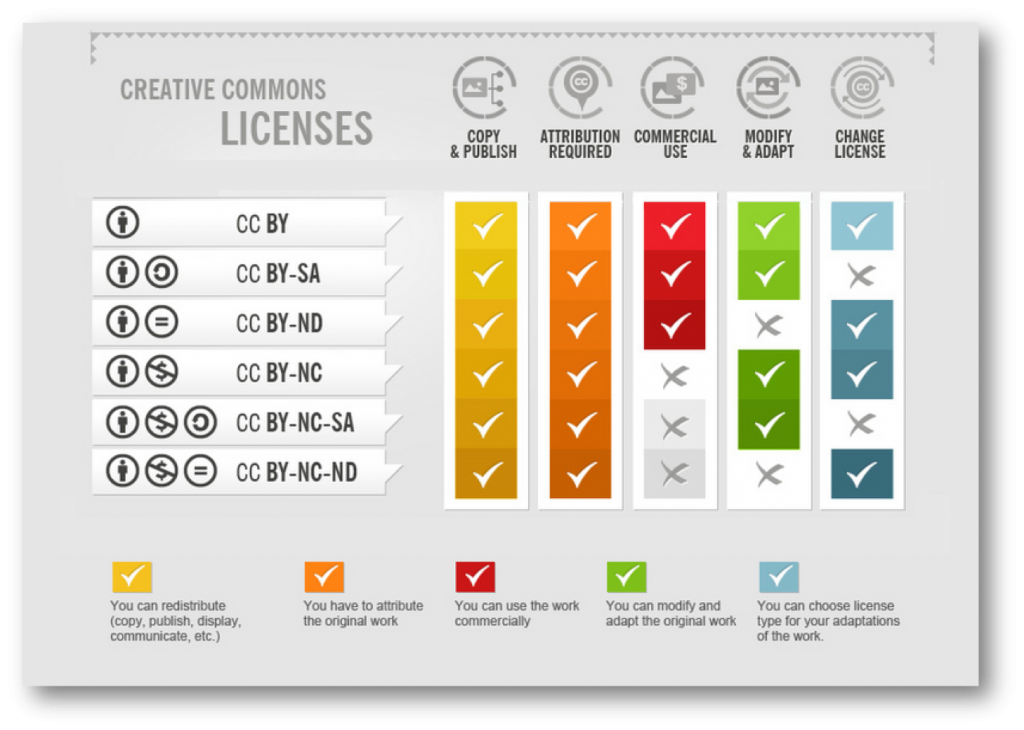
These four elements can be combined to create six standard Creative Commons licenses, each offering a distinct set of permissions:
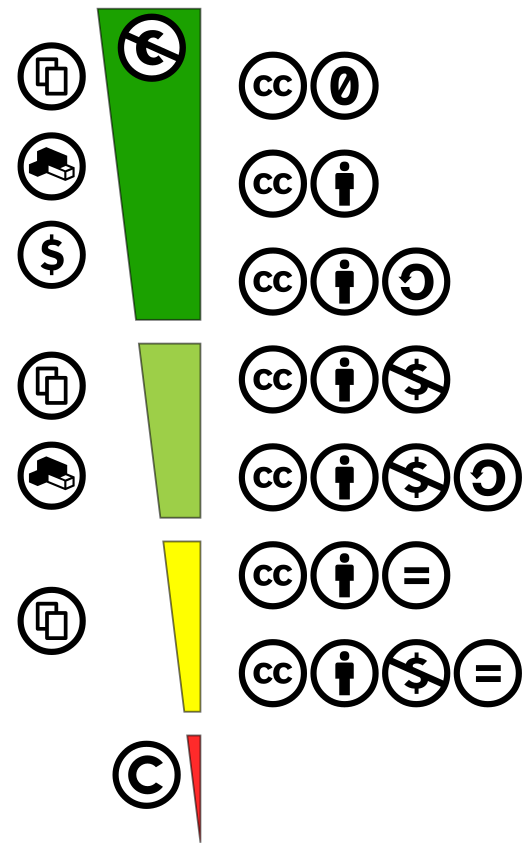
- CC BY (Attribution): The most open license.
- CC BY-SA (Attribution-ShareAlike): Allows remixing and commercial use, but derivatives must carry the same license.
- CC BY-NC (Attribution-NonCommercial): Allows remixing, but only for non-commercial purposes.
- CC BY-ND (Attribution-NoDerivatives): Allows commercial and non-commercial redistribution, but no modifications.
- CC BY-NC-SA (Attribution-NonCommercial-ShareAlike): Allows remixing for non-commercial purposes, but derivatives must carry the same license.
- CC BY-NC-ND (Attribution-NonCommercial-NoDerivatives): The most restrictive CC license, allowing only non-commercial redistribution in its original form.
In addition to these, there is also the CC0 Public Domain Dedication, which allows creators to waive all copyright and place their work directly into the public domain, making it entirely free for any use without attribution.
Creative Commons in the Digital Ecosystem
The impact of Creative Commons licenses resonates across numerous sectors within the digital ecosystem, facilitating open access, collaboration, and innovation in ways traditional copyright could not easily achieve.
Software and Open Source Projects
While many open-source software projects use specific software licenses like the GNU General Public License (GPL) or MIT License, Creative Commons licenses are sometimes used for documentation, user interfaces, or accompanying creative assets within software projects. CC BY-SA, in particular, shares philosophical similarities with “copyleft” software licenses, ensuring that improvements and derivatives remain open. The open source movement, with its emphasis on collaboration and shared innovation, aligns perfectly with the spirit of Creative Commons.
Digital Media: Images, Audio, Video
Creative Commons is particularly prevalent in digital media. Websites like Flickr, Wikimedia Commons, and Soundcloud host millions of CC-licensed images, audio tracks, and videos. This vast repository of openly licensed content empowers designers, videographers, podcasters, and educators to enrich their projects without legal ambiguity or exorbitant costs. From background music for YouTube videos to stock photos for blog posts, CC-licensed media fuels a significant portion of online content creation.
Data and Open Science Initiatives
In the realm of scientific research and data, Creative Commons licenses (especially CC0 and CC BY) are increasingly adopted to facilitate Open Science. Researchers can license their datasets, publications, and even pre-prints, enabling broader access, verification, and reuse by the global scientific community. This accelerates discovery, fosters transparency, and maximizes the societal benefit of publicly funded research. Open data initiatives leverage CC licenses to make government data, environmental data, and demographic information freely available for analysis and application development.
Educational Resources and Open Access
Open Educational Resources (OER) heavily rely on Creative Commons licenses. Textbooks, course modules, lecture notes, and multimedia educational content are often licensed under CC BY or CC BY-SA, allowing educators worldwide to freely adopt, adapt, and distribute materials. This reduces costs for students, promotes equitable access to education, and enables curriculum customization. Similarly, the Open Access movement in scholarly publishing often utilizes CC BY licenses to make research articles freely available to anyone with an internet connection, bypassing traditional journal paywalls.
Legal Clarity in the Age of Remixes and AI
As digital culture increasingly involves remixes, mashups, and the use of artificial intelligence (AI) in content generation, Creative Commons licenses offer a vital framework for legal clarity. They provide clear guidance on what can be used and how, enabling a vibrant culture of digital creation while respecting creators’ rights. AI developers, for instance, might seek out CC-licensed datasets for training models, knowing the terms of use are clearly articulated. This avoids potential legal disputes and fosters innovation within ethical boundaries.
Benefits and Considerations for Creators and Users
Creative Commons licenses offer tangible benefits, but also necessitate careful consideration from both those granting and those using the licenses.
For Creators: Wider Reach and Collaboration
By opting for a Creative Commons license, creators significantly expand the potential audience and impact of their work. Their content becomes readily available for use in projects, education, and research across the globe, often leading to increased visibility and recognition. It facilitates collaboration, as others can build upon and contribute to their work, potentially leading to new innovations and unforeseen applications. For those whose goal is to disseminate knowledge, art, or software as widely as possible, CC licenses are an invaluable tool.
For Users: Access to a Vast Pool of Resources
For users, Creative Commons licenses unlock a vast, legally clear, and often free-to-use repository of digital content. This dramatically reduces the time, cost, and legal complexity associated with finding and obtaining permission to use copyrighted material. Students, educators, independent developers, small businesses, and non-profits particularly benefit from access to high-quality images, audio, video, software components, and educational materials that might otherwise be out of reach due to budget constraints or complex licensing negotiations.
Important Due Diligence and Compliance
Despite the clarity they offer, both creators and users must exercise due diligence. Creators must carefully select the license that truly reflects their intentions, understanding the implications of each element. Once a work is licensed under Creative Commons, it is generally irrevocable. Users, on the other hand, bear the responsibility of thoroughly understanding and strictly adhering to the terms of the specific CC license attached to any work they use. This includes proper attribution, respecting non-commercial clauses, and ensuring derivative works are licensed appropriately under ShareAlike terms if applicable. Failure to comply with license terms can result in copyright infringement, despite the initial “open” nature of the license. Always check the specific license details, especially if using content from a platform that aggregates CC-licensed works, as details can vary or platforms might mislabel licenses.
In conclusion, Creative Commons licenses are a sophisticated and indispensable tool in the modern digital ecosystem. They represent a pragmatic and progressive approach to intellectual property, enabling a world where creativity and knowledge can flourish through sharing, while simultaneously empowering creators to maintain control over their contributions. As digital creation and consumption continue to evolve, understanding and utilizing Creative Commons licenses will remain crucial for fostering a vibrant, collaborative, and legally sound online environment.
aViewFromTheCave is a participant in the Amazon Services LLC Associates Program, an affiliate advertising program designed to provide a means for sites to earn advertising fees by advertising and linking to Amazon.com. Amazon, the Amazon logo, AmazonSupply, and the AmazonSupply logo are trademarks of Amazon.com, Inc. or its affiliates. As an Amazon Associate we earn affiliate commissions from qualifying purchases.