
The ending of Christopher Nolan’s Interstellar is a mind-bending exploration of theoretical physics, advanced technology, and the ultimate frontier of human capability. While often interpreted through emotional and philosophical lenses, the climax of the film—Cooper’s journey through the Tesseract—presents a fascinating conceptual framework for understanding hypothetical future technologies and the extreme implications of spacetime manipulation. From gravitational communication to the practical navigation of black holes and the harnessing of higher dimensions, the film’s finale challenges our current technological paradigms and inspires speculation on the ultimate limits of scientific discovery.
The Tesseract: An Interface Beyond Dimensions
At the core of Interstellar‘s conclusion is the Tesseract, a five-dimensional construct designed by an advanced, future human civilization. This isn’t merely a symbolic space; it functions as a highly sophisticated, if abstract, technological interface. Cooper’s entry into the Tesseract is akin to a user entering a virtual environment, but one that grants control over fundamental aspects of reality. It is a controlled environment that allows for the precise manipulation of gravity and time within a limited spatial region, acting as a terminal to access and interact with the past.

Gravitational Communication: Data Across Time and Space
The most critical function Cooper performs within the Tesseract is communicating with his daughter, Murph, across different points in time. This isn’t telepathy; it’s a depiction of gravitational communication. Unlike electromagnetic waves (radio, light), which are constrained by the speed of light and disperse rapidly, gravity theoretically propagates across all dimensions simultaneously and with infinite range, albeit weakly. The Tesseract amplifies Cooper’s ability to manipulate gravity, allowing him to subtly alter objects in Murph’s four-dimensional reality.
Specifically, Cooper uses gravitational pulses to transmit binary code, represented by falling books or the movement of a watch’s second hand. This represents a highly advanced form of data transmission, far beyond our current RF or optical methods. It implies a technology capable of generating and modulating gravitational waves with such precision that they can encode complex information. Such a system would require an understanding of quantum gravity far exceeding present-day physics and engineering, suggesting future civilizations might harness fundamental forces of the universe for communication, effectively sending data across vast cosmic distances and even temporal barriers.
The Fifth Dimension as a Computational Canvas
The Tesseract itself, being a five-dimensional space, provides the necessary canvas for this manipulation. In a five-dimensional space, all moments in a three-dimensional object’s lifespan exist simultaneously and are accessible. Cooper, positioned within this higher dimension, can “see” and “touch” multiple points in his daughter’s personal timeline. This concept positions a higher dimension not just as an abstract theoretical concept, but as a potential operating system or a data visualization tool for spacetime itself. It transforms the universe into a massive, interconnected database where temporal coordinates can be targeted and influenced. This implies a future technology capable of constructing or entering such spaces, utilizing them for unparalleled computational and informational access.
Black Holes and Wormholes: Navigating Cosmic Tech Frontiers
Cooper’s journey to the Tesseract begins with a suicidal plunge into Gargantua, a supermassive black hole. This act, facilitated by the advanced spacecraft Endurance and the presence of a wormhole, showcases theoretical navigation technologies far beyond our current capabilities.
Precision Navigation for Interstellar Travel
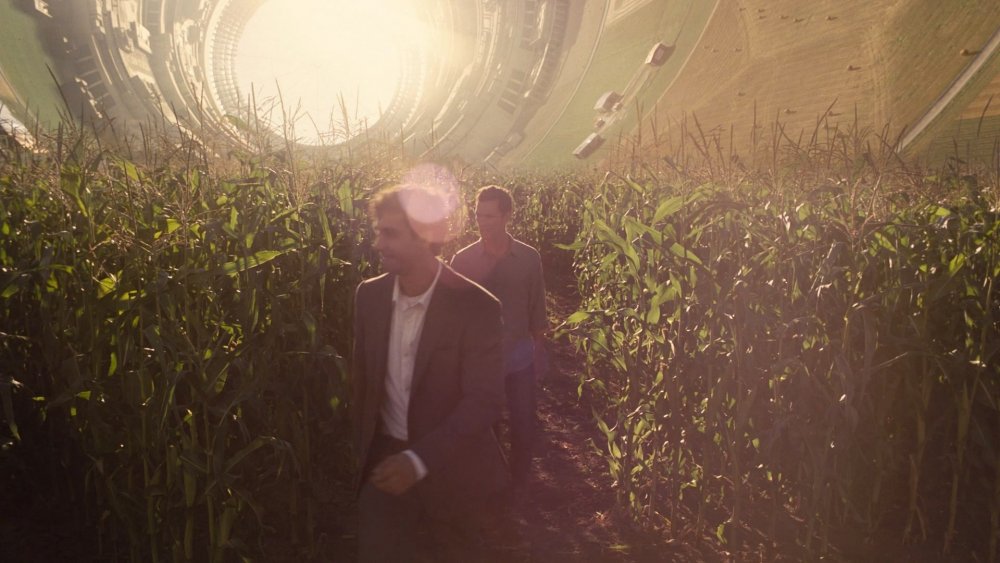
The Endurance spacecraft, while visually plausible by today’s standards, houses propulsion and navigation systems that are purely speculative. The ability to approach a supermassive black hole and not be immediately torn apart by tidal forces or consumed by the event horizon speaks to highly sophisticated structural integrity fields or propulsion systems that can counteract extreme gravitational gradients. This implies a mastery of energy manipulation and exotic matter far exceeding even theoretical blueprints like warp drives.
The wormhole, a “shortcut” through spacetime, is presented as a stable, navigable phenomenon, a monumental technological achievement in itself. While theoretical physicists like Kip Thorne (who consulted on the film) confirm wormholes are mathematically possible, their stability and the method of keeping them open would require negative energy—a concept we currently only understand abstractly. The ability to create, maintain, and precisely navigate such a structure represents a pinnacle of cosmic engineering, enabling travel across vast interstellar distances within a human lifespan. The film portrays this not as magic, but as the result of intelligent, deliberate intervention by a future civilization, implying the eventual development of technologies that manipulate spacetime geometry itself.
Cooper’s Journey: A Human-AI Collaboration for Survival
Cooper’s survival and success within the Tesseract are not solely a testament to human ingenuity. He is aided by TARS, an advanced AI robot. TARS is a critical technological component in the mission’s success, embodying principles of advanced robotics, data analysis, and ethical AI.
The Role of ‘They’ and Advanced Intelligence
The mysterious ‘They’ who create the wormhole and the Tesseract are revealed to be future humans. This implies not just technological advancement, but also a profound evolution of intelligence and possibly even consciousness. Their ability to manipulate spacetime suggests a form of “meta-technology” that transcends mere machinery, relying on an understanding of cosmic mechanics that borders on divine. This posits that future intelligence, potentially enhanced by or integrated with AI, could achieve a level of technological mastery that allows them to orchestrate events across millennia and multiple dimensions, acting as cosmic engineers for the survival of their species. The Tesseract, in this context, can be seen as an ultimate ‘AI-assisted’ rescue environment, custom-tailored by future intelligences.
TARS plays a crucial role by collecting crucial quantum data from inside Gargantua’s singularity, data that the future ‘They’ could presumably not retrieve directly due to paradoxes, or perhaps for the very reason of preserving a direct human link for Cooper. TARS’s computational power and data storage capabilities are integral to decoding the information necessary for Murph to solve the gravity equation, highlighting the indispensable role of advanced AI as tools for scientific discovery in extreme environments.
Echoes in Real-World Tech & Scientific Inspiration
While Interstellar‘s ending delves deep into speculative science fiction, the concepts it explores resonate with active research areas in contemporary physics and technology. The film, through its dramatic narrative, serves as a powerful speculative model for potential future tech.
Quantum Computing and Spacetime Manipulation
The idea of a Tesseract manipulating gravity and time taps into theoretical explorations of quantum gravity and the potential for quantum computing to model and even influence spacetime at its most fundamental level. Researchers in quantum physics are striving to understand the fabric of reality at the smallest scales, and while direct spacetime manipulation is decades or centuries away, the computational power required to understand and predict such phenomena would necessitate advancements far beyond classical computing—perhaps hinting at a future where quantum computers could simulate and, eventually, interact with higher dimensions. The Tesseract could be seen as a macroscopic, accessible representation of such a quantum environment.
The Pursuit of Unified Theories
The grand ambition of the “They”—to save humanity by engineering a cosmic escape route—reflects humanity’s own relentless pursuit of a unified theory of physics. A theory that seamlessly integrates general relativity with quantum mechanics could unlock the secrets of gravity, black holes, and the very structure of the universe, potentially leading to the technological breakthroughs depicted in Interstellar. The film’s ending thus functions as a powerful imaginative projection of what might be possible if humanity ever achieves a complete understanding of the fundamental laws governing our existence, paving the way for technologies that manipulate space, time, and gravity, not just for survival, but for reaching beyond the confines of our solar system and perhaps even our present reality.
aViewFromTheCave is a participant in the Amazon Services LLC Associates Program, an affiliate advertising program designed to provide a means for sites to earn advertising fees by advertising and linking to Amazon.com. Amazon, the Amazon logo, AmazonSupply, and the AmazonSupply logo are trademarks of Amazon.com, Inc. or its affiliates. As an Amazon Associate we earn affiliate commissions from qualifying purchases.