
In the fast-paced world of global finance, few terms carry as much weight or historical significance as the “Dow Jones Industrial Average.” Often referred to simply as “the Dow,” this index serves as a primary barometer for the health of the United States stock market and, by extension, the broader global economy. Whether you are a seasoned institutional investor or someone just beginning to explore personal finance, understanding the mechanics, history, and relevance of the Dow is essential.
Created over a century ago, the Dow Jones Industrial Average (DJIA) has survived world wars, economic depressions, and technological revolutions. While newer, broader indices like the S&P 500 have gained popularity among data analysts, the Dow remains the most cited index in mainstream media. This article explores the intricacies of the DJIA, dissecting how it works, why it matters, and how you can use it to inform your investment strategy.

1. The Mechanics of the Index: How the Dow Moves
The Dow Jones Industrial Average is fundamentally different from most other modern stock indices. To understand its movements, one must look past the raw numbers and understand the unique mathematical framework that governs it.
The Price-Weighted Methodology
Unlike the S&P 500 or the Nasdaq Composite, which are market-capitalization-weighted, the Dow is a price-weighted index. In a market-cap-weighted index, the size of a company (its total market value) determines its influence. In the Dow, the stock price alone dictates the weight of a company within the average.
For example, if a company with a stock price of $200 sees a 1% move, it will have a significantly larger impact on the Dow’s total points than a company with a stock price of $50 making the same 1% move. This methodology has faced criticism over the years, as it suggests that a company’s share price is more important than its overall valuation, but it remains the foundational logic of the index as established by its founders.
The Role of the Dow Divisor
Because the Dow is price-weighted, things like stock splits or spinoffs could potentially wreak havoc on the index’s continuity. If a high-priced stock undergoes a 2-for-1 split, its price halves, which would theoretically cause the Dow to “drop” hundreds of points even if the market value of the company stayed the same.
To prevent this, the index uses the “Dow Divisor.” This is a continuously adjusted numerical value used to maintain the consistency of the average. Instead of simply dividing the sum of the 30 stock prices by 30, the sum is divided by the Dow Divisor. As of recent years, the divisor is actually a fraction less than one, meaning that a $1 movement in any of the 30 stocks results in a movement of many points in the index itself.
A Historical Perspective: From 1896 to Today
Founded by Charles Dow and Edward Jones, the index originally consisted of just 12 companies, mostly involved in heavy industry—railroads, cotton, gas, and sugar. Over time, the index expanded to 30 companies and shifted its focus to reflect the American economy’s transition from manufacturing to services, technology, and healthcare. This evolution ensures that while the name “Industrial” remains, the index actually represents a cross-section of the modern corporate landscape.
2. The Components: The 30 Blue-Chip Titans
The Dow is often described as a “Blue-Chip” index. This term refers to companies that are well-established, financially sound, and leaders in their respective industries. Selection for the Dow is considered a mark of prestige, signaling that a corporation is a pillar of the American economy.
Selection Criteria: What Makes a Dow Component?
Unlike other indices that follow strict rules based on market size or liquidity, the Dow’s components are selected by a committee. This committee, managed by S&P Dow Jones Indices, looks for companies with an excellent reputation, sustained growth, and interest among a broad range of investors.
There are no rigid rules, but the committee generally maintains a balance across sectors, ensuring that the 30 stocks collectively represent the diverse facets of the U.S. economy. Because there are only 30 slots, the competition is fierce. When a company is “dropped” from the Dow, it is often seen as a sign that its industry is in decline or that the company has lost its status as a market leader.
The Evolving Face of the Index
The composition of the Dow is not static. In the early 20th century, the index was dominated by steel and oil. Today, it features technology giants like Microsoft and Apple, healthcare leaders like UnitedHealth Group, and financial services behemoths like Goldman Sachs and JPMorgan Chase.
The inclusion of tech stocks marked a significant shift in the index’s philosophy. For decades, the Dow was slow to adopt high-growth tech firms because their volatile prices could disproportionately swing the index. However, the committee eventually recognized that an index claiming to represent the American economy could not ignore the Silicon Valley revolution.
Sector Representation and Balance
While the Dow only tracks 30 companies, those companies are carefully chosen to cover various sectors, including:
- Information Technology: Reflecting the digital economy.
- Healthcare: Acknowledging the aging population and medical innovation.
- Consumer Discretionary: Tracking how Americans spend their disposable income (e.g., Nike, McDonald’s).
- Financials: The backbone of the capital markets.
- Industrials: Keeping a foot in the traditional roots of the index (e.g., Boeing, Caterpillar).

3. The Dow as an Economic Bellwether
Why does the media report on the Dow every single day? Why do politicians and CEOs use it as a scoreboard for national prosperity? The answer lies in the index’s psychological and historical influence.
A Century of Economic History
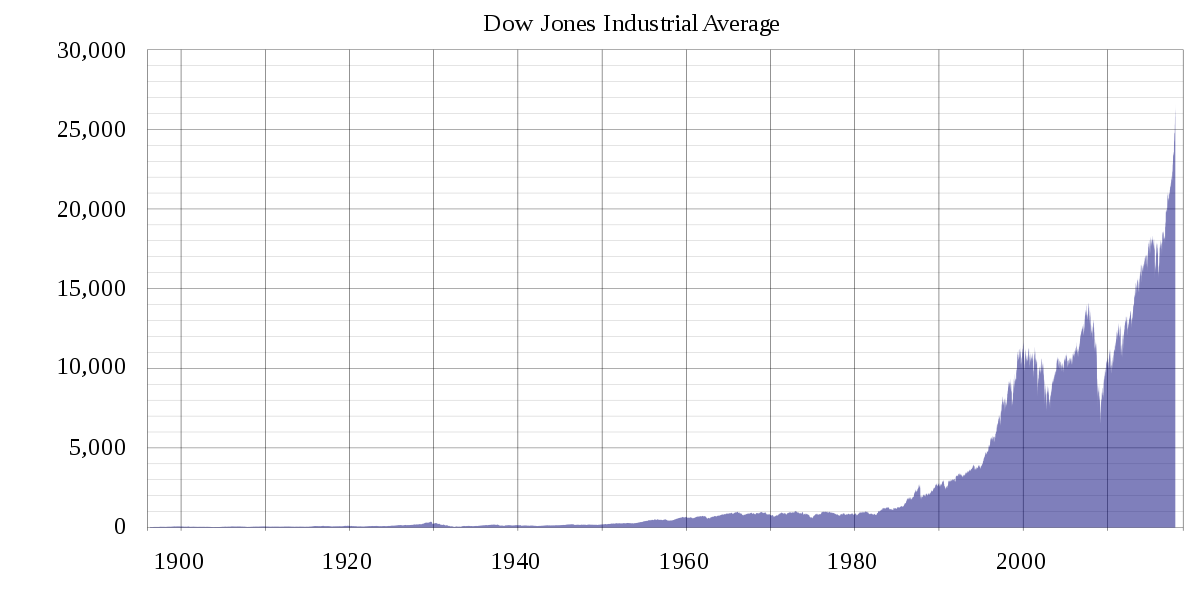
The Dow has been a witness to every major economic event of the last 130 years. It provides a continuous thread of data through the Great Depression, the post-WWII boom, the stagflation of the 1970s, the dot-com bubble, and the Great Recession. Because of this longevity, investors use the Dow to identify long-term trends and cycles that newer indices cannot capture with the same historical depth.
Why the Media Obsesses Over the Dow
For the general public, the “points” of the Dow are easier to digest than the “percentages” of the S&P 500. Hearing that “the Dow is up 500 points” creates a visceral reaction of growth and optimism, whereas “the S&P 500 is up 1.2%” feels more academic to the average person. This has solidified the Dow’s place in the public consciousness as the definitive “pulse” of Wall Street.
Predicting Market Sentiment
Investors often look to the Dow to gauge “investor sentiment.” When the 30 largest, most stable companies in the country are performing well, it suggests a high level of confidence in the economy. Conversely, if the Dow begins to falter while smaller-cap indices are rising, it can signal that institutional investors are becoming risk-averse, moving money out of “safe” blue-chip stocks in anticipation of a downturn.
4. Criticisms and Limitations of the Dow
Despite its fame, the Dow is not without its detractors. Professional fund managers and academics often argue that the Dow is an outdated relic that doesn’t accurately reflect the complexities of the modern market.
The Weighting Controversy
The primary criticism of the Dow is its price-weighted nature. Critics argue that it is illogical for a $300 stock to have three times more influence than a $100 stock, regardless of which company is actually more valuable. In the S&P 500, if a company is worth $3 trillion, it has more “weight” than a company worth $500 billion. In the Dow, if the $500 billion company happens to have a higher nominal share price, it carries more weight. This can lead to “distorted” movements where one or two high-priced stocks drag the entire index down, even if the majority of the other 28 companies are up.
Diversification Shortfalls
With only 30 stocks, the Dow is not a diversified representation of the thousands of companies traded on U.S. exchanges. It completely ignores small-cap and mid-cap companies, which are often the true engines of innovation and economic growth. For an investor looking to capture the “total market” return, relying solely on the Dow would provide a very narrow and potentially skewed perspective.
The “Survivor Bias”
Because the Dow committee removes underperforming companies and replaces them with thriving ones, the index inherently suffers from “survivor bias.” It shows the performance of the winners. While this makes for a great historical chart of growth, it doesn’t always reflect the struggle of the average American business that isn’t a “blue-chip” titan.
5. How to Invest in the Dow Jones Industrial Average
Understanding the Dow is one thing; putting that knowledge into practice is another. While you cannot “buy” the Dow itself—as it is just a mathematical average—there are several financial instruments that allow you to track its performance.
Exchange-Traded Funds (ETFs) and the Dow
The most popular way to invest in the Dow is through an ETF that tracks the index. The most famous of these is the SPDR Dow Jones Industrial Average ETF Trust (Ticker: DIA), often referred to as “Diamonds.” When you buy shares of DIA, the fund manager uses that money to buy all 30 stocks in the Dow in the exact proportions required to mirror the index. This allows individual investors to own a piece of 30 of the world’s most powerful companies with a single transaction.
Index Mutual Funds
For long-term investors, particularly those using 401(k)s or IRAs, index mutual funds that track the Dow are a common choice. These funds function similarly to ETFs but are often traded only once per day at the closing price. They are excellent tools for “dollar-cost averaging,” where you invest a set amount of money every month regardless of where the market stands.
Strategic Role in a Diversified Portfolio
For most investors, the Dow serves as the “Large-Cap Value” or “Core” component of their portfolio. Because the companies in the Dow are typically older and more stable, they often pay dividends. This makes the Dow an attractive option for income-focused investors or those nearing retirement who want exposure to the stock market but with less volatility than high-growth tech sectors or small-cap stocks.
Conclusion: The Enduring Legacy of the Dow
The Dow Jones Industrial Average is more than just a list of stocks; it is a narrative of American capitalism. From its humble beginnings as a collection of industrial giants to its current status as a digital-age powerhouse, it has remained the most iconic symbol of financial prosperity in the world.
While it has its mathematical flaws and limited scope, its ability to distill the complexities of the market into a single, digestible number is unmatched. For the modern investor, the Dow provides a sense of perspective—a reminder that despite short-term market crashes and economic uncertainty, the largest companies in the world have a history of resilience and long-term growth. By understanding how the Dow works, you are better equipped to navigate your own financial journey, using the “30 titans” as a guidepost for your personal investment strategy.
aViewFromTheCave is a participant in the Amazon Services LLC Associates Program, an affiliate advertising program designed to provide a means for sites to earn advertising fees by advertising and linking to Amazon.com. Amazon, the Amazon logo, AmazonSupply, and the AmazonSupply logo are trademarks of Amazon.com, Inc. or its affiliates. As an Amazon Associate we earn affiliate commissions from qualifying purchases.