
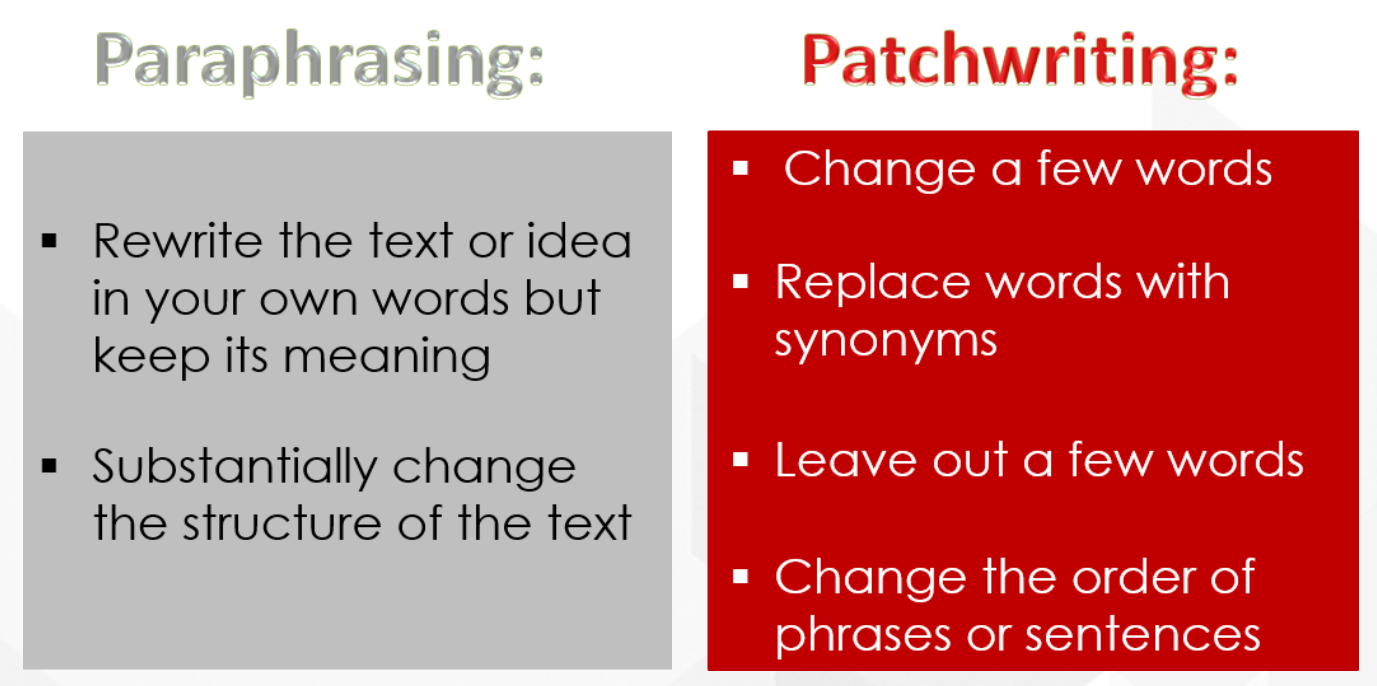
In the digital era, the boundaries of academic and professional writing have become increasingly blurred by the ease of information retrieval. Among the various practices that surface in this landscape, patchwriting—often misunderstood as simple paraphrasing—stands out as a critical issue in both integrity and cognitive development. Defined as the act of borrowing phrases, clauses, or sentence structures from a source text and weaving them into one’s own work with only minor modifications, patchwriting occupies a murky middle ground between original composition and blatant plagiarism. Understanding this practice is essential for educators, students, and professionals alike, as it represents a fundamental misunderstanding of how information synthesis should function.
The Anatomy of Patchwriting: Beyond Simple Copying
Patchwriting is rarely performed with malicious intent. Unlike plagiarism, where an author attempts to pass off an entire work as their own, patchwriting often stems from a lack of confidence in one’s own analytical voice or an inadequate grasp of the source material. It is a process of “stitching” together the words of experts in an attempt to sound authoritative.
The Mechanics of Mimicry
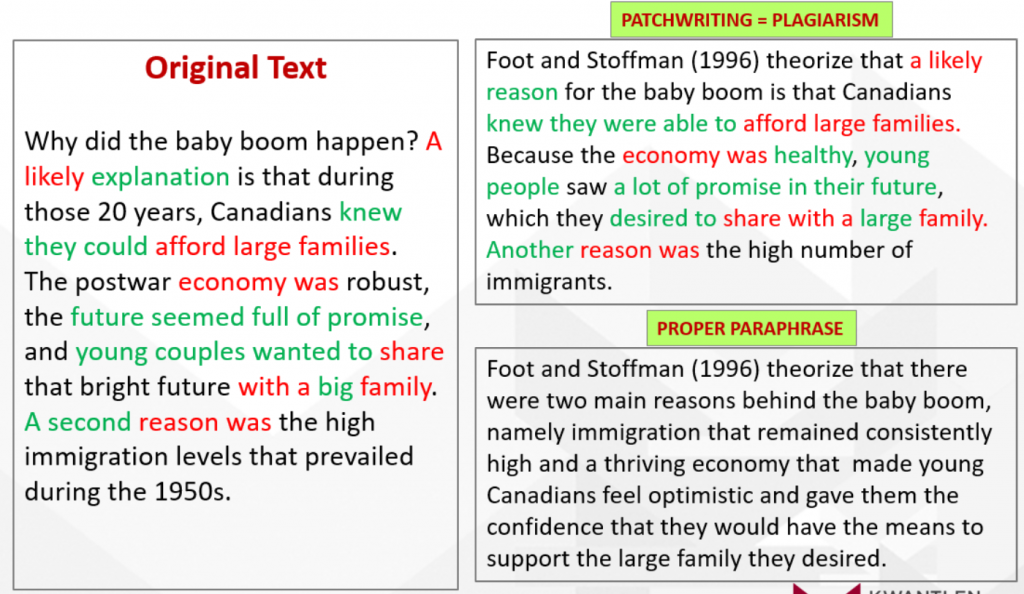
The defining characteristic of patchwriting is the retention of the source’s syntax and vocabulary, even when some words are swapped for synonyms. For instance, if an original sentence reads, “The implementation of distributed ledger technology facilitates decentralized verification of transactional data,” a patchwriter might revise it to, “Using distributed ledger tech helps to simplify the decentralized checking of transaction records.” While the vocabulary has shifted slightly, the underlying structure—the logic, the cadence, and the specific phrasing—remains tethered to the original author.
Why Writers Resort to Patching
Most instances of patchwriting occur when a writer lacks the “semantic bandwidth” to process the information fully. When a writer encounters complex jargon or dense theoretical concepts, they often feel intimidated. By clinging to the structure of the source, they create a safety net. They assume that if they retain the original sentence structure, they are less likely to misinterpret the author’s point. Unfortunately, this dependency prevents the writer from truly internalizing the information and developing a unique perspective.
The Academic and Intellectual Costs
While patchwriting might allow a writer to complete an assignment or a report with apparent speed, the long-term impact on intellectual growth is significant. Writing is, at its core, a form of thinking. When one engages in patchwriting, they are bypassing the cognitive labor required to translate external ideas into personal understanding.
Stunting Critical Thinking
When a writer merely patches together existing text, they are not practicing synthesis. Synthesis requires breaking down ideas, identifying the connections between different sources, and rebuilding those ideas within the framework of one’s own arguments. Patchwriting acts as a barrier to this process. By relying on the structural “scaffolding” provided by someone else’s sentence, the writer fails to test whether their own logic holds up. Over time, this leads to a stagnation of voice; the writer becomes a conduit for other people’s thoughts rather than a producer of their own.
The Problem of Attribution
A common misconception is that if a writer cites their sources, patchwriting becomes acceptable. However, attribution is not a blanket defense against poor writing habits. Even if a patchwriter includes a footnote, the resulting text remains derivative and structurally unoriginal. Academic integrity is not just about giving credit; it is about demonstrating that the author has engaged with the literature in a way that generates something new. Patching serves only to “dress up” existing ideas rather than advancing them.
Identifying and Correcting the Habit
Recognizing patchwriting in one’s own work—or in the work of others—is the first step toward developing a more robust writing style. It requires moving away from the source material and toward a more active, dialogue-based engagement with the content.
Strategies for Original Synthesis
To avoid patchwriting, one must change the physical process of drafting. Many writers fall into the trap of having the source text open on one half of their screen and their document on the other, reading a line and then immediately “tweaking” it. This is the primary driver of patchwriting.
A more effective method is the “Read, Close, Write” approach. After reading a passage from a source, the writer should close the book or minimize the browser window. They should then take a moment to formulate the core idea in their own words, perhaps by explaining it as if they were teaching the concept to a peer. Only after the idea has been internalized and expressed internally should the writer turn back to their draft to record it. This forces the writer to engage with the concept rather than the vocabulary.
The Role of Summarization and Direct Quotation
Writers must also learn to distinguish between the three primary ways of incorporating information: summarizing, paraphrasing, and direct quoting. Patchwriting is essentially a failed attempt at paraphrasing. A successful paraphrase requires a complete restructuring of the source sentence and a total shift in phrasing, ensuring the writer has mastered the underlying meaning. When a writer feels they cannot rewrite a sentence without losing its precision, the correct academic choice is to use a direct quotation. By enclosing the exact words in quotation marks and citing the author, the writer signals to the reader that the phrasing is deliberate and belongs to the source, thereby preserving the integrity of their own voice.
Cultivating a Professional Voice
Ultimately, the move away from patchwriting is a move toward professional maturity. Whether in academic research or corporate report writing, the value a writer provides lies in their ability to contextualize information.
The Importance of Voice
A professional voice is built on the foundation of confidence. It is the ability to take disparate pieces of data and harmonize them into a cohesive narrative. When a writer patchwrites, they project uncertainty; they are effectively saying, “I am not sure how to explain this, so I will borrow the structure of someone who does.” By contrast, taking the time to digest material and present it through a personal analytical lens shows competence. It indicates that the writer has not just collected information but has mastered it.

Continuous Improvement
Developing a writing style that avoids patchwriting is an iterative process. It involves consistent self-critique. When reviewing a draft, a writer should highlight every sentence that feels “too formal” or “too dense” and ask themselves: “Did I write this, or am I repeating a structure I found in a source?” If the latter, they must strip the sentence back to the core data and rewrite it from scratch.
While it may take longer to draft a document this way, the resulting work will be infinitely more valuable. It will be characterized by clarity, coherence, and a singular, consistent voice. By rejecting the shortcuts of patchwriting, writers do more than just improve their technical proficiency; they sharpen their ability to think critically, evaluate evidence, and contribute original, high-quality ideas to their respective fields. In an information-heavy world, the ability to synthesize rather than replicate is not just a skill—it is a competitive advantage.
aViewFromTheCave is a participant in the Amazon Services LLC Associates Program, an affiliate advertising program designed to provide a means for sites to earn advertising fees by advertising and linking to Amazon.com. Amazon, the Amazon logo, AmazonSupply, and the AmazonSupply logo are trademarks of Amazon.com, Inc. or its affiliates. As an Amazon Associate we earn affiliate commissions from qualifying purchases.