
In the intricate world of construction, project management, and civil engineering, the Bill of Quantities—commonly referred to as the BOQ—serves as the foundational document for almost every major development project. It is the bridge between a design’s conceptual vision and the financial reality of executing that work. For contractors, developers, and quantity surveyors, the BOQ is not merely a list of materials; it is a vital instrument for risk management, cost control, and contractual transparency.
The Definition and Purpose of a BOQ
At its core, a Bill of Quantities is a document prepared by a cost consultant or a quantity surveyor that provides project-specific quantified items of the work to be carried out. It breaks down a construction project into individual components, detailing the labor, materials, and equipment required to complete each phase.

Bridging Design and Execution
The primary purpose of the BOQ is to provide a standardized basis for competitive tendering. By issuing the same Bill of Quantities to multiple contractors, a client ensures that every bid is based on the exact same scope of work. This allows the client to compare “apples to apples” when selecting a contractor. Without a standardized BOQ, contractors might interpret blueprints differently, leading to vast discrepancies in pricing that make objective comparison impossible.
Managing Project Risk
Beyond the tendering phase, the BOQ acts as a safeguard against cost overruns. It assigns a monetary value to every segment of the project. If a variation occurs—such as a change in building material or an unexpected site condition—the unit rates established in the original BOQ provide a clear, contractual mechanism to value that variation. This transparency protects both the owner, who avoids predatory pricing, and the contractor, who is fairly compensated for additional work.
How a BOQ is Compiled
The compilation of a Bill of Quantities is a methodical process that requires deep technical knowledge of construction methods. A high-quality BOQ is rarely generated in a single pass; it is the culmination of meticulous “take-offs” and market analysis.
The Take-Off Process
The process begins with the “take-off,” where a quantity surveyor examines architectural and engineering drawings to measure and quantify every element of the building. This involves calculating the exact cubic meters of concrete, the total length of electrical conduit, the number of fixtures, and the man-hours required for installation. Modern technology has revolutionized this process; BIM (Building Information Modeling) software now allows surveyors to extract quantities directly from 3D models, significantly reducing human error and increasing the speed of document production.
Standardization and Classification
To ensure clarity, BOQs are typically structured according to standardized industry codes, such as the New Rules of Measurement (NRM) or the Method of Measurement (SMM). These standards dictate how items should be described, categorized, and measured. By following these rules, the industry maintains a common language. For instance, the way “structural steel” is measured in one project will be consistent with how it is measured in another, ensuring that contractors understand exactly what is included in a specific line item.
The Role of Unit Rates
Once quantities are defined, they are paired with unit rates. These rates are derived from current market data, labor costs, overheads, and profit margins. A well-constructed BOQ includes a “preamble,” which sets out the conditions under which these rates apply, accounting for site access limitations, regional labor regulations, and potential inflation.
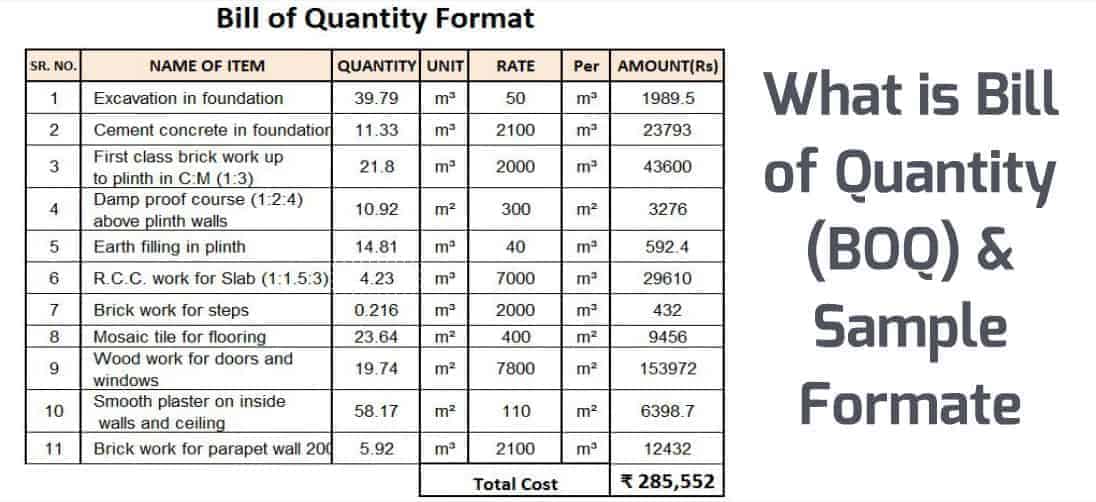
The BOQ in the Tendering and Contract Lifecycle
The Bill of Quantities is far more than a static document produced before construction begins; it is a “living” contract document that influences the project’s health until the final handover.
Competitive Tendering
When a client puts a project out to tender, contractors are invited to submit their prices against the quantities provided in the BOQ. The contractor fills in the rate column for each item, which, when multiplied by the quantity, provides the total cost for that section of work. This process reveals which contractors are the most efficient. A contractor might offer lower rates for excavation but higher rates for electrical work based on their specific expertise and supply chain advantages.
Interim Valuations and Progress Payments
Construction projects are rarely paid for in one lump sum. Instead, contractors submit “interim valuations” based on the progress of the work. The BOQ makes this process straightforward. If a contractor has completed 50% of the concrete pouring, they can claim 50% of the cost allocated to that item in the BOQ. This transparency prevents cash flow disputes and provides the project owner with a clear view of how much of their budget has been consumed at any given stage of development.
Handling Variations and Claims
Variations—changes in the scope of work requested by the client or necessitated by site conditions—are inevitable in construction. When a design change occurs, the contractor and the quantity surveyor refer back to the BOQ. If the work is “like-for-like,” the unit rates in the BOQ are applied to the new quantities. This pre-agreed pricing structure eliminates the need to renegotiate every minor change, saving time and preventing litigation.
Digital Transformation in BOQ Management
The traditional, paper-heavy approach to Bill of Quantities is rapidly giving way to digital ecosystems. This shift is transforming the accuracy and speed of financial management in the construction sector.
Integration with BIM
Building Information Modeling (BIM) has moved the BOQ into the digital age. By linking the 3D model to cost data—a process known as 5D BIM—teams can see the financial implications of a design choice in real-time. If an architect decides to change the exterior cladding material, the 5D model automatically updates the BOQ, showing the change in cost immediately. This level of agility allows for superior value engineering, where the team can optimize for cost without sacrificing structural integrity.
Cloud-Based Collaboration
Modern platforms now allow for cloud-based BOQ management. Stakeholders, including the client, the project manager, and the contractor, can access the same version of the document from anywhere in the world. This removes the risk of working with outdated spreadsheets and ensures that all parties are aligned on the current financial status of the project. Automation features within these platforms also help in detecting discrepancies in quantities, flagging potential errors before they become costly site disputes.

Enhanced Accuracy through AI
Artificial intelligence is beginning to play a role in the estimation phase. By analyzing historical project data, AI tools can predict potential cost overruns or highlight items that are consistently underpriced during the tender phase. This predictive capability allows project managers to build smarter contingencies into their budgets, ensuring that the BOQ is not just an estimate, but a reliable forecast of final project costs.
The Bill of Quantities remains the backbone of the construction industry. As projects grow in complexity and sustainability requirements become more stringent, the role of the BOQ as a tool for financial rigor, contractual clarity, and efficient project delivery has never been more important. By mastering the BOQ, professionals ensure that the physical act of building remains tethered to the financial reality of the budget.
aViewFromTheCave is a participant in the Amazon Services LLC Associates Program, an affiliate advertising program designed to provide a means for sites to earn advertising fees by advertising and linking to Amazon.com. Amazon, the Amazon logo, AmazonSupply, and the AmazonSupply logo are trademarks of Amazon.com, Inc. or its affiliates. As an Amazon Associate we earn affiliate commissions from qualifying purchases.