
In the evolving landscape of personal finance and alternative asset acquisition, the jewelry market has undergone a seismic shift. For decades, the diamond industry maintained a near-monopoly on the concept of high-end engagement rings and luxury accessories. However, the rise of lab-grown alternatives—most notably moissanite—has introduced a compelling case for the savvy consumer. Understanding what a moissanite gem is requires a shift in perspective: moving away from marketing-driven legacy values toward a rational, cost-benefit analysis of luxury assets.
The Financial Logic of Choosing Moissanite
From a personal finance perspective, purchasing a diamond often represents a significant loss in capital the moment the transaction is finalized. Due to high retail markups and the perceived value established by artificial scarcity, traditional diamonds rarely serve as liquid investments for the average consumer. Moissanite, by contrast, allows individuals to allocate their capital more efficiently, effectively maximizing their purchasing power.

Cost Efficiency and Opportunity Cost
The primary financial driver behind the popularity of moissanite is the drastic price discrepancy. A moissanite stone can cost as little as 10% to 15% of an equivalent-sized, high-quality diamond. When a consumer chooses a $1,500 moissanite ring over a $15,000 diamond ring, they are not merely saving money; they are managing their cash flow. The $13,500 differential can be redirected into high-yield savings accounts, index funds, or debt reduction, transforming a luxury purchase into a strategic financial decision.
Valuation and Asset Longevity
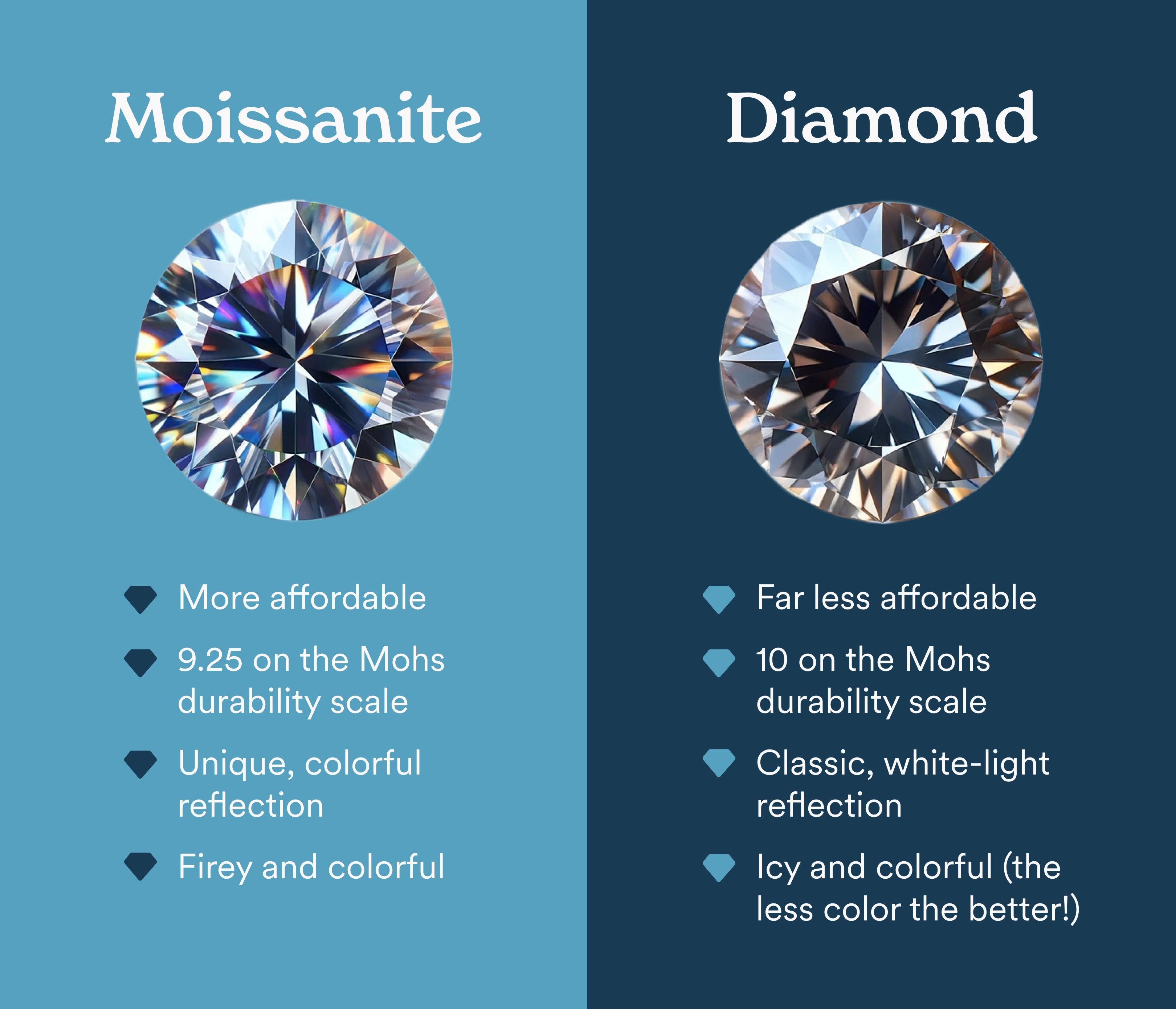
Unlike synthetic cubic zirconia, which depreciates to zero and loses its luster over time, moissanite is a silicon carbide crystal. It possesses a Mohs hardness rating of 9.25, making it the second-hardest gemstone available for jewelry. From an asset management standpoint, this durability ensures that the item retains its physical integrity for a lifetime, offering a “use-value” that is virtually identical to that of a diamond. Investors in fine jewelry are increasingly recognizing that the “resale value” of a diamond is often a myth for retail consumers, making the lower entry cost of moissanite a superior financial play.
Scientific Composition and Market Value
Understanding the material science behind moissanite is essential for the modern, budget-conscious buyer. Initially discovered by Nobel Prize-winning chemist Henri Moissan in 1893, this mineral was found in the crater of a meteorite. Because natural moissanite is incredibly rare, virtually all moissanite sold on the market today is synthesized in laboratories.
Optical Superiority and Brilliance
One of the most compelling reasons for moissanite’s market growth is its refractive index. Moissanite has a refractive index of 2.65 to 2.69, which is significantly higher than that of a diamond (2.42). This results in a higher degree of brilliance and “fire”—the dispersion of light into spectral colors. While traditional jewelers once labeled this as a tell-tale sign of its non-diamond status, many consumers now perceive this increased light reflection as a superior aesthetic quality.

Consistency Through Technology
In the realm of investment and procurement, consistency is key. Mining natural gemstones creates variables in clarity, color, and structural integrity that affect market price unpredictably. Moissanite is produced under controlled laboratory conditions, ensuring a high level of uniformity. For the consumer, this translates to a reduced risk of purchasing a flawed product. When purchasing high-end assets, standardization is a marker of quality, and the lab-grown process eliminates the guesswork and “conflict-free” verification issues often associated with diamond mining.
Strategic Procurement for the Value-Oriented Buyer
For those looking to build a high-quality personal collection without the burden of excessive overhead, purchasing moissanite requires a shift in buying strategy. Because the brand premium is significantly lower than that of diamonds, the market is more transparent, allowing for better price comparisons and more favorable consumer terms.
Avoiding the “Luxury Tax”
In traditional jewelry retail, a massive percentage of the price tag covers branding, marketing, and multi-layered distribution networks. Moissanite is frequently sold through direct-to-consumer (DTC) channels. By bypassing the traditional retail intermediaries, consumers can secure high-grade, near-colorless stones at wholesale-adjacent prices. When evaluating a purchase, the buyer should focus on the quality of the cut and the certification of the laboratory rather than the prestige of the jewelry brand.
Diversification of Personal Jewelry Assets
Wealth management often involves the diversification of assets. By spending less on the “center stone” of an engagement ring or fashion piece, an individual can afford to purchase a larger carat weight or a more complex, artisanal setting. This strategy allows the consumer to curate a jewelry box that reflects their personal style and financial goals without the psychological toll of spending multiple months’ salary on a single depreciating item. Furthermore, the longevity of moissanite means that these pieces remain viable long-term assets for family heirlooms or future resale, provided the setting is crafted from high-quality precious metals like platinum or 18k gold.
The Future of Alternative Gemstones in a Modern Portfolio
The jewelry industry is currently witnessing a transition similar to the move from film to digital photography. As technology makes it easier to produce gems that are physically durable and aesthetically stunning, the reliance on high-priced mined stones will likely continue to wane.
Why the Market is Shifting
The shift toward moissanite is supported by two major trends: the rise of the conscious consumer and the emphasis on financial pragmatism. Younger generations are increasingly prioritizing experiences, travel, and financial security over the possession of expensive, status-driven symbols. The “diamond-is-mandatory” narrative is losing its grip as social proof shifts toward those who can demonstrate intelligence in their spending habits rather than just the ability to spend.
Final Financial Assessment
If we define a “smart purchase” as one that yields the highest utility at the lowest cost without sacrificing durability, moissanite is arguably the most efficient gemstone on the market. It offers the refractive beauty that the industry demands, the hardness required for daily wear, and a price point that empowers the individual to maintain their financial autonomy.
For the person focused on personal finance, the decision is clear. By choosing moissanite, you are not buying a “cheap substitute.” You are choosing an intelligently engineered gemstone that aligns with a disciplined approach to wealth preservation. Whether for an engagement, a gift, or a self-purchase, the data confirms that the value proposition of moissanite is currently unrivaled. By decoupling the emotional weight of jewelry from the financial burden of high-cost traditional alternatives, the informed consumer can enjoy the luxury of diamonds without the associated financial inefficiency. The moissanite gem stands as a testament to the fact that in the modern economy, true value is found not in the scarcity of a material, but in the wisdom of how that material is acquired.
aViewFromTheCave is a participant in the Amazon Services LLC Associates Program, an affiliate advertising program designed to provide a means for sites to earn advertising fees by advertising and linking to Amazon.com. Amazon, the Amazon logo, AmazonSupply, and the AmazonSupply logo are trademarks of Amazon.com, Inc. or its affiliates. As an Amazon Associate we earn affiliate commissions from qualifying purchases.