
Business Service Management (BSM) represents a strategic shift in how organizations manage their IT infrastructure, moving away from a siloed, device-centric approach toward one that is deeply aligned with business outcomes. In an era where digital operations form the backbone of every enterprise, BSM acts as the bridge between technical performance and business value. It is the practice of managing IT services in a way that directly supports the goals of the organization, ensuring that every server, application, and network component is viewed through the lens of its impact on the business.
At its core, BSM is about shifting the focus from “Is the server up?” to “Are the customers able to complete their transactions?” By mapping IT components to specific business processes, BSM provides IT teams with a unified view of the health of their services, allowing them to prioritize actions based on business impact rather than just technical urgency.

The Pillars of Business Service Management
To effectively implement BSM, organizations must shift their operational philosophy. This requires a transition from reactive firefighting to proactive, service-oriented management. This process rests on three primary pillars: visibility, alignment, and process integration.
Establishing Service Visibility
Visibility is the foundation of BSM. Without a clear understanding of the dependencies between infrastructure components and business services, IT teams are essentially working in the dark. A robust BSM implementation utilizes an automated discovery process to create a dynamic service map. This map acts as a real-time representation of the relationships between hardware, software, middleware, and the business workflows they support.
When a disruption occurs, visibility allows IT operations to immediately identify which business services are affected. Instead of receiving hundreds of disparate alerts from individual devices, administrators see a clear picture of how a single failing component is rippling through the service ecosystem.
Driving Business-IT Alignment
Alignment is often the most challenging aspect of BSM because it requires cross-departmental collaboration. BSM forces IT to define services in terms that business stakeholders understand. For instance, rather than reporting on “uptime for database cluster 04,” the IT department reports on “availability of the e-commerce checkout process.”
By quantifying the status of these services, IT becomes a strategic partner. Business leaders gain the ability to make informed decisions about technology investments based on clear service performance metrics, effectively breaking down the historical communication wall between the technical staff and the executive suite.
Integrated Service Processes
BSM integrates disparate IT processes—such as incident management, change management, and problem management—into a cohesive framework. When a change is proposed to an underlying infrastructure component, the BSM system automatically highlights potential risks to the associated business services. This integration prevents the “unintended consequences” that frequently cause outages during updates or maintenance windows, ensuring that technical changes do not inadvertently cripple critical business functions.
The Operational Benefits of Adopting BSM
Adopting a Business Service Management framework provides measurable advantages that ripple throughout the entire organization. By streamlining operations and sharpening the focus on business-critical tasks, companies can significantly reduce their overhead while increasing their agility.
Reducing Mean Time to Repair (MTTR)
One of the most immediate benefits of BSM is the dramatic reduction in Mean Time to Repair. In traditional IT environments, troubleshooting often involves a “war room” scenario where multiple teams scramble to isolate a problem. With BSM, the correlation between technical errors and business impact is pre-defined. The system narrows down the scope of the investigation, allowing support teams to pinpoint the root cause of an outage far more quickly.
This efficiency doesn’t just save time; it saves revenue. By minimizing downtime for customer-facing applications, businesses can protect their bottom line and maintain customer trust, which is often tied directly to the reliability of their digital services.
Improving Infrastructure Utilization
BSM provides the data necessary to optimize IT spending. Through service mapping, organizations often discover that they are over-provisioning infrastructure for services that have low business impact, while simultaneously under-investing in critical systems. BSM exposes these inefficiencies, allowing CIOs to reallocate resources—both human and hardware—to the areas that provide the highest return on investment.
Enhancing Compliance and Risk Management
In today’s regulatory environment, the ability to demonstrate control over digital services is essential. BSM provides an audit trail of how services are managed, changed, and maintained. Because the system tracks dependencies, it also simplifies the process of assessing risk. If a regulatory requirement mandates a change to data storage protocols, BSM allows IT teams to identify every business service that relies on that storage, ensuring the update is performed without violating security or compliance standards.
Implementing BSM: Best Practices and Challenges
The transition to BSM is not merely a software installation project; it is a transformation of organizational culture. Organizations that attempt to implement BSM without addressing the underlying cultural and process requirements often find themselves with powerful tools that lack the human buy-in necessary to produce results.
Moving Beyond the Silos
The greatest obstacle to BSM is the existence of organizational silos. Development, networking, and server teams often operate under different metrics and incentives. To succeed, these teams must be united under a common language: the “Service.” When teams move from measuring their own performance (e.g., “my network is up”) to measuring the performance of the business service (e.g., “our trading platform is processing trades”), the silos begin to dissolve.
Data Quality and Configuration Management
BSM is only as good as the underlying data. A Configuration Management Database (CMDB) is usually the engine behind BSM, and it must be accurate to be effective. Relying on manually updated spreadsheets is a recipe for failure in modern, dynamic environments. Organizations must invest in automated discovery tools that constantly scan the network to maintain an up-to-date map of assets and dependencies. If the service map is outdated, the BSM system will provide misleading alerts, ultimately damaging the credibility of the entire initiative.
Prioritizing High-Impact Services
Do not attempt to map every single application in the organization at once. A common mistake is to try to achieve comprehensive coverage on day one. Instead, follow a phased approach. Start with the top five business-critical services—the systems that directly generate revenue or provide essential customer service. By showing quick, high-visibility wins, the IT department can demonstrate the value of BSM, garnering the executive support and cultural momentum needed to roll the strategy out across the rest of the enterprise.

The Future of BSM in the Digital Ecosystem
As the enterprise landscape continues to evolve, the definition of a “service” is becoming more complex. The proliferation of hybrid cloud environments, microservices, and edge computing means that IT infrastructure is no longer confined to a physical data center. BSM is evolving to meet these challenges.
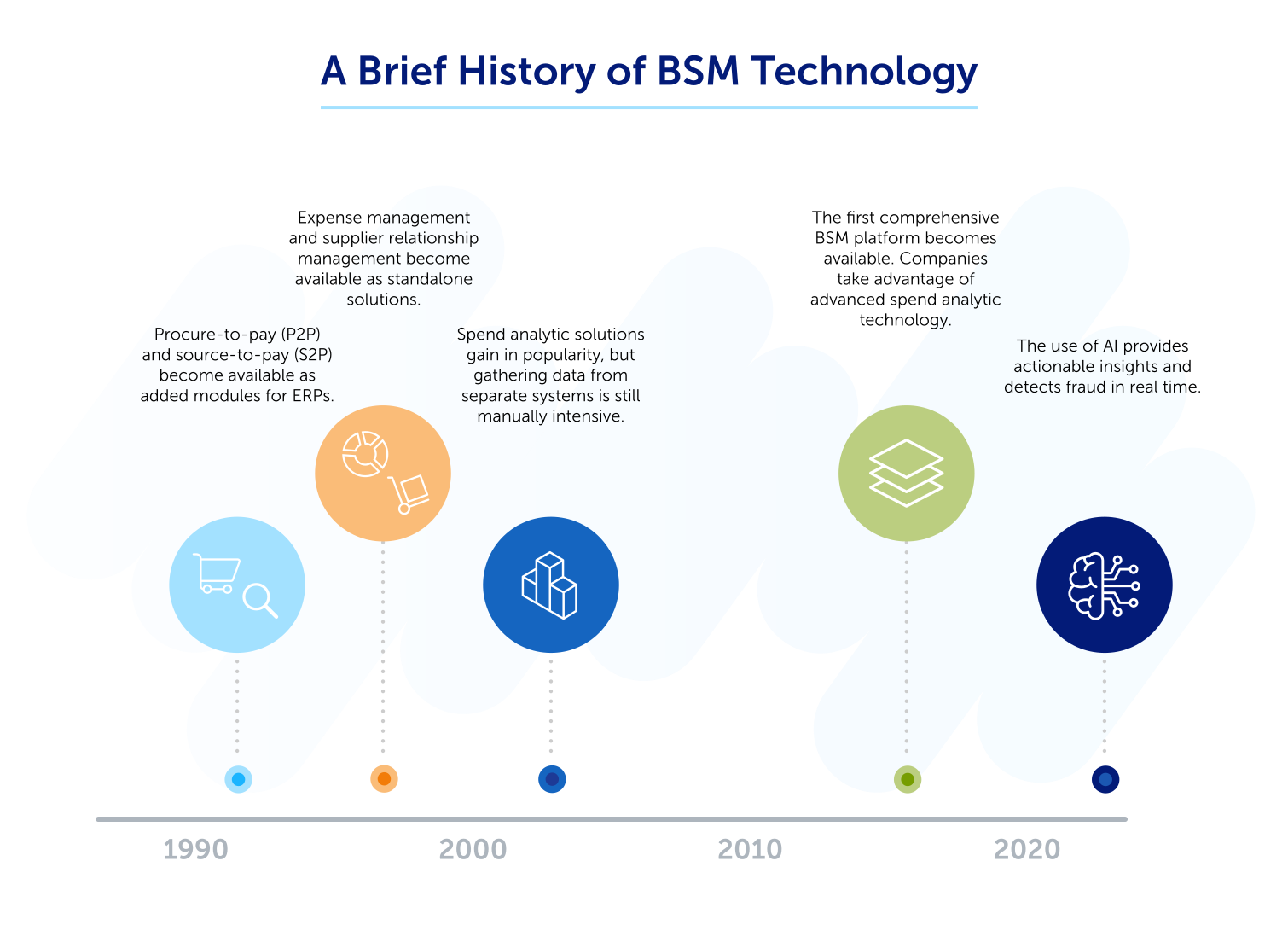
Modern BSM platforms are increasingly leveraging Artificial Intelligence and Machine Learning to manage the complexity of modern digital services. This evolution, often referred to as AIOps, allows BSM systems to predict service disruptions before they happen by analyzing patterns in massive volumes of machine data. Rather than waiting for a failure, the BSM platform can identify anomalies in traffic or performance metrics and alert administrators to intervene before the end-user ever notices a dip in quality.
Furthermore, as companies embrace DevOps and continuous delivery, BSM is integrating with the CI/CD pipeline. This creates a feedback loop where developers can see the production-level performance of the code they deploy. This transparency encourages better development practices, as engineers gain a clearer understanding of how their code impacts the broader business service.
In conclusion, Business Service Management is the essential framework for any modern enterprise that views IT as a driver of competitive advantage rather than just a cost center. By focusing on service availability, maintaining strict visibility, and fostering a culture of cross-functional alignment, organizations can turn their infrastructure into a highly reliable, responsive engine that powers their business objectives. BSM provides the clarity and control needed to navigate the complexities of the digital age, ensuring that technology continues to serve the business, not the other way around.
aViewFromTheCave is a participant in the Amazon Services LLC Associates Program, an affiliate advertising program designed to provide a means for sites to earn advertising fees by advertising and linking to Amazon.com. Amazon, the Amazon logo, AmazonSupply, and the AmazonSupply logo are trademarks of Amazon.com, Inc. or its affiliates. As an Amazon Associate we earn affiliate commissions from qualifying purchases.