
Value Added Tax, commonly known as VAT, is a consumption tax placed on a product whenever value is added at each stage of the supply chain, from production to the point of sale. For businesses operating within the United Kingdom, understanding VAT is not merely an administrative requirement; it is a fundamental pillar of financial compliance and cash flow management. Whether you are a sole trader, a small business owner, or a growing enterprise, mastering the mechanics of the UK VAT system is essential for maintaining tax health and avoiding penalties from His Majesty’s Revenue and Customs (HMRC).
How the UK VAT System Functions
At its core, VAT is an indirect tax. This means the tax is collected by businesses on behalf of the government. When a business sells goods or services, it charges VAT to the customer, and when it purchases goods or services for its own operations, it pays VAT to its suppliers.
The Mechanism of Input and Output Tax
The “value-added” aspect of the tax is realized through the distinction between output tax and input tax. Output tax is the VAT you charge your customers on your sales. Input tax is the VAT you pay on the purchases and expenses related to your business activities. At the end of each VAT period—usually every three months—businesses calculate the difference. If your output tax exceeds your input tax, you pay the difference to HMRC. If your input tax is higher, you can reclaim the difference from HMRC.
Taxable Turnover and Registration Thresholds
Not every business in the UK is required to register for VAT. Registration becomes mandatory once your “taxable turnover”—the total value of everything you sell that is not exempt from VAT—exceeds the government-set threshold, which is currently £90,000 in a rolling 12-month period. However, businesses can also choose to register for VAT voluntarily even if their turnover is below this threshold. Voluntary registration is often chosen by businesses that deal primarily with other VAT-registered companies or those that make many VAT-able purchases, as it allows them to reclaim input tax on their expenses.
Understanding Rates and Categorizations
The UK tax system applies different VAT rates depending on the nature of the goods or services provided. Identifying the correct category for your products is critical, as misclassifying items can lead to significant financial errors.
The Standard Rate
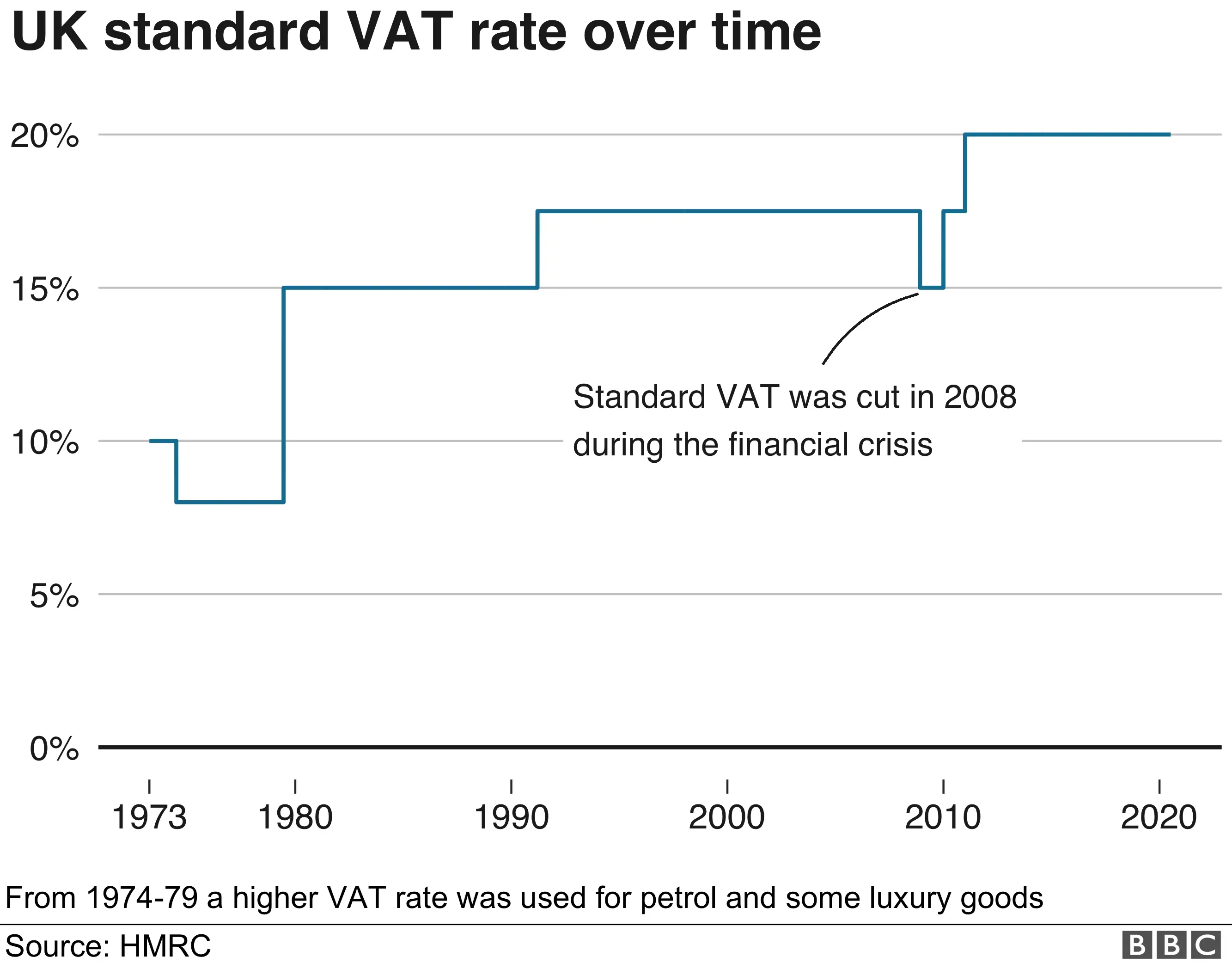
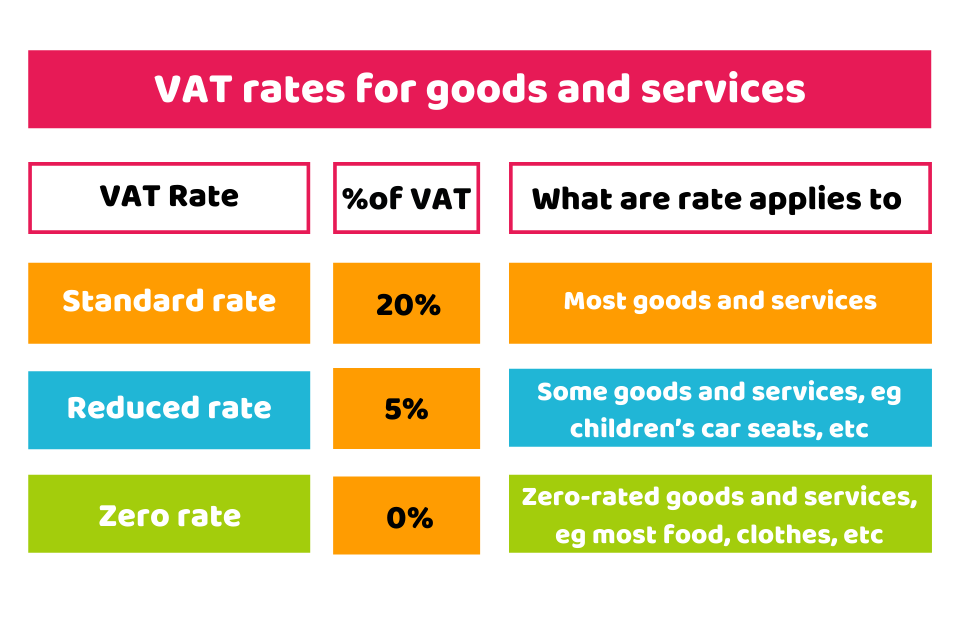
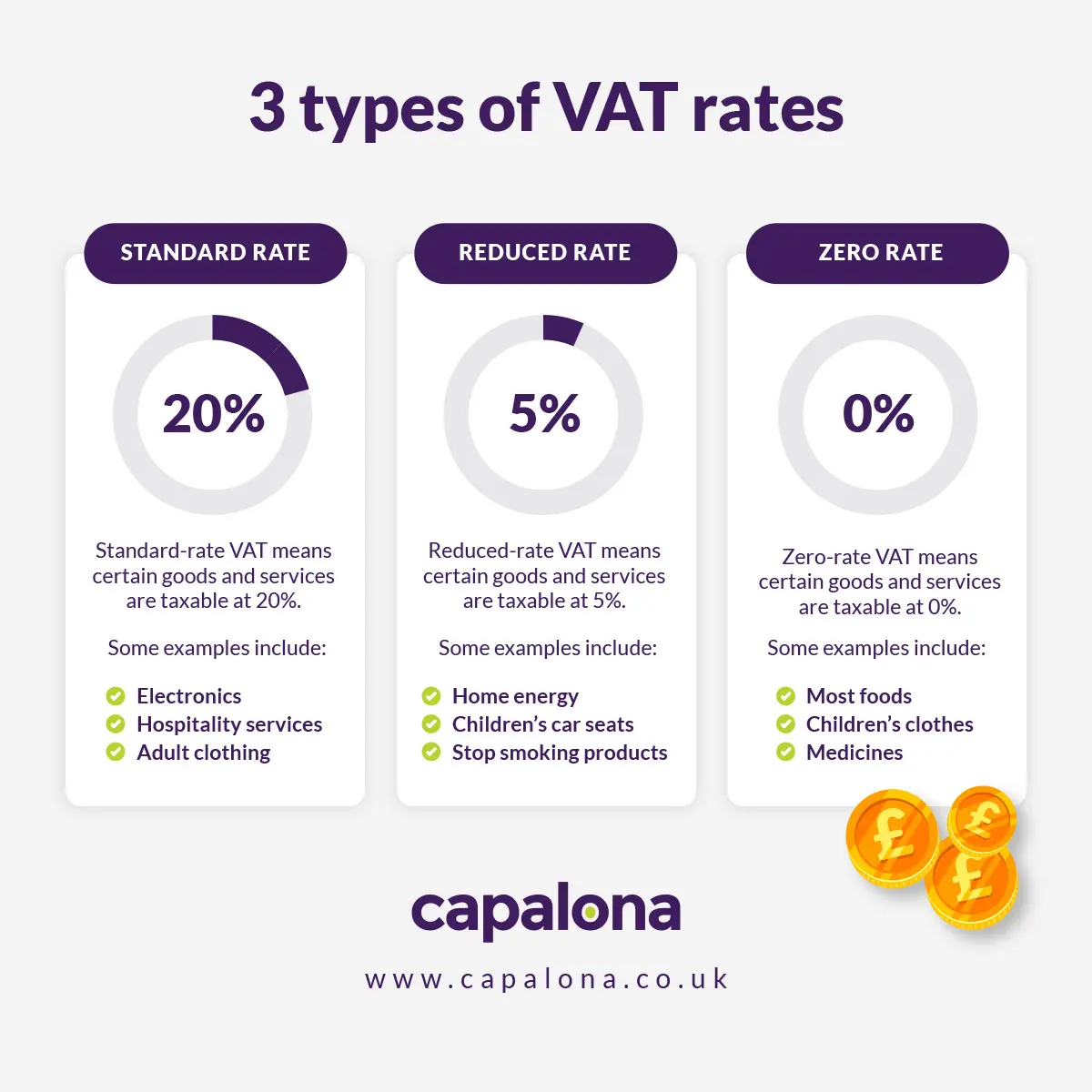
The standard rate of VAT in the UK is 20%. This applies to the vast majority of goods and services, including electronics, professional services, most clothing, and alcohol. If a product or service does not fall under specific reduced or zero-rate categories, it is almost certainly subject to the 20% standard rate.
Reduced and Zero-Rated Goods
Some items are taxed at a reduced rate of 5%. This category covers specific essentials, such as domestic fuel and power, certain energy-saving materials installed in homes, and children’s car seats.
Beyond the reduced rate, the UK system features “zero-rated” goods. It is a common misconception that zero-rated goods are the same as exempt goods. Zero-rated goods are still taxable, but the rate of VAT applied is 0%. This is crucial for businesses because it means you can still reclaim input tax on the costs associated with producing or selling these items. Common examples include most food items, books, newspapers, and children’s clothing.
VAT Exemptions
Exemptions are distinct from zero-rated goods. If you provide goods or services that are exempt from VAT, you do not charge VAT on them, but you also cannot reclaim the input tax on purchases related to those goods or services. Key examples of exempt supplies include financial services, insurance, and the rental of residential properties. If your business model involves exempt supplies, you must be careful, as you may face “partial exemption” rules that limit your ability to reclaim VAT on overheads.
VAT Accounting Schemes for Small Businesses
Managing VAT returns can be complex for small businesses with limited accounting resources. To simplify the process, HMRC offers several specialized accounting schemes designed to reduce the administrative burden.
The Flat Rate Scheme
The Flat Rate Scheme is designed to help small businesses simplify their VAT accounting. Instead of calculating the exact VAT on every individual invoice, you pay a fixed percentage of your total turnover to HMRC. The percentage rate you pay depends on your industry sector. While this saves time on bookkeeping, it is important to calculate whether it is financially beneficial for your business; if your business has very few expenses, the flat rate might result in you paying more VAT than you would under the standard accounting method.
The Cash Accounting Scheme
Under standard accounting, you must pay VAT to HMRC based on when you issued your invoice, regardless of whether the client has paid you yet. This can create cash flow problems if you have long payment terms. The Cash Accounting Scheme allows you to pay VAT to HMRC only when your customers have actually paid your invoices. This is highly beneficial for businesses that struggle with late payments or cash flow fluctuations, as it ensures you are not paying out tax money that you have not yet received.
The Annual Accounting Scheme
For those who prefer long-term planning, the Annual Accounting Scheme allows you to submit just one VAT return per year rather than four. You make nine monthly or three quarterly interim payments based on your estimated liability, followed by a final balancing payment. This is excellent for cash flow management and reduces the frequency of contact with HMRC, though it requires accurate forecasting to ensure the interim payments are aligned with actual performance.
Compliance, Digitalization, and Making Tax Digital
The UK government has aggressively modernized tax administration through the “Making Tax Digital” (MTD) initiative. For any business registered for VAT, MTD is not optional—it is a legal requirement.
Digital Record Keeping
Under MTD rules, businesses must maintain their VAT records in a digital format. This does not mean you need an expensive enterprise-grade ERP system; it means you cannot manually keep track of your VAT on paper or via unlinked spreadsheets. You must use MTD-compatible software to keep digital records of your sales and purchases, and that software must be used to submit your VAT returns directly to HMRC’s portal via an Application Programming Interface (API).
The Risks of Non-Compliance
HMRC utilizes sophisticated data analytics to identify discrepancies in VAT returns. Failing to register when required, charging the wrong rates, or failing to submit digital returns can result in severe penalties. These include late filing surcharges, interest on underpaid tax, and heavy fines for “inaccurate returns” if the error is deemed to be caused by carelessness or deliberate concealment.
To mitigate these risks, businesses are strongly encouraged to utilize cloud-based accounting platforms. These tools automate the calculation of VAT, store digital trails for the mandatory six-year record-keeping period, and ensure that submissions are sent to HMRC in the correct, standardized format. Regularly auditing your VAT position—or consulting with a qualified accountant—is a proactive strategy to ensure that your business remains compliant as it scales, preventing unexpected tax bills that could destabilize your operational budget. By treating VAT as an integrated part of your financial strategy rather than an afterthought, you protect your business’s integrity and ensure you are only paying the tax that is legally due.
aViewFromTheCave is a participant in the Amazon Services LLC Associates Program, an affiliate advertising program designed to provide a means for sites to earn advertising fees by advertising and linking to Amazon.com. Amazon, the Amazon logo, AmazonSupply, and the AmazonSupply logo are trademarks of Amazon.com, Inc. or its affiliates. As an Amazon Associate we earn affiliate commissions from qualifying purchases.