
In the realm of spatial reasoning and geometric design, the concept of a “face” serves as the fundamental building block for understanding three-dimensional objects. Whether you are delving into architectural modeling, 3D printing software, or the underlying mathematics of computational design, the face represents the primary interface between an object and the surrounding space. Mastering this concept is not merely an academic exercise; it is the cornerstone of professional digital design, engineering, and structural analysis.
Defining the Geometric Face
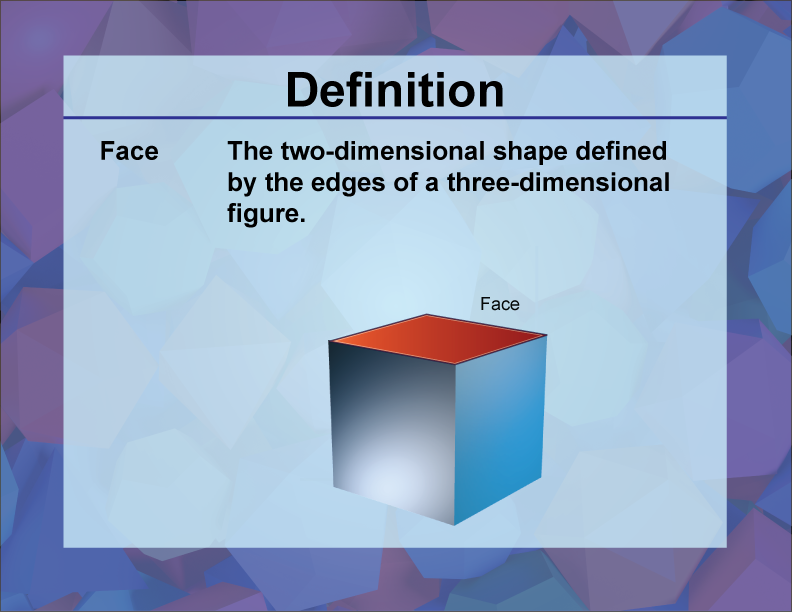
At its most basic level, a face is a flat, two-dimensional surface that forms part of the boundary of a three-dimensional solid. In geometric terminology, a solid object—such as a cube, a pyramid, or a complex polyhedron—is composed of faces, edges, and vertices. The face is the “enclosure” that separates the interior volume of the object from the exterior world.
The Mathematics of Planarity
For a surface to qualify as a geometric face in the strictest sense, it must be planar. This means that all points on the surface must lie on the same two-dimensional plane. If you draw a straight line between any two points on the surface, the entirety of that line segment must remain within the face itself. In technical design, non-planar surfaces—often referred to as “warped” surfaces—are frequently broken down into multiple smaller, triangular faces to ensure mathematical consistency and stability during rendering.
Faces, Edges, and Vertices: The Triad of Form
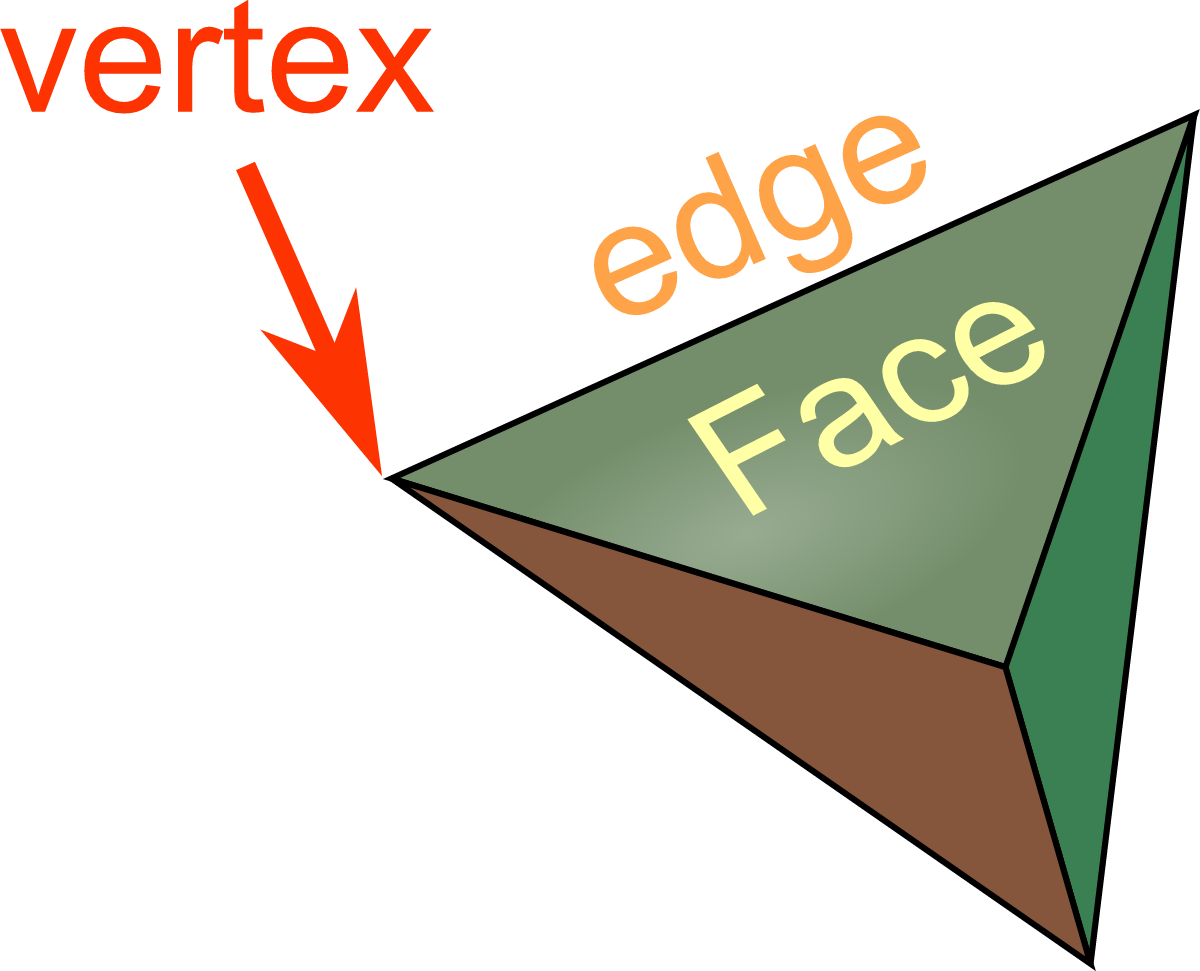
The face cannot exist in isolation. It is defined by its boundaries. An edge is the line segment where two faces meet, and a vertex is the point where three or more edges intersect. This triad—faces, edges, and vertices—is governed by Euler’s Polyhedron Formula, which states that for any convex polyhedron, the number of vertices minus the number of edges plus the number of faces always equals two ($V – E + F = 2$). This mathematical relationship is vital for verifying the integrity of complex 3D meshes in software environments.
The Role of Faces in Digital Design and CAD
In modern software development, particularly within Computer-Aided Design (CAD) and 3D modeling, the “face” takes on a digital identity. When a designer creates a 3D model, they are essentially creating a collection of faces that define the boundary representation (B-Rep) of the object.
Polygon Meshes and Tessellation
Most digital software represents 3D shapes through polygon meshes. Since computers are most efficient at calculating triangles, complex curves and surfaces are often “tessellated” or subdivided into a network of tiny, flat, triangular faces. The density of these faces determines the resolution of the model.
- Low-Poly Modeling: Uses a limited number of large faces to represent an object, common in early video games or performance-intensive mobile applications where computational efficiency is paramount.
- High-Poly Modeling: Employs millions of microscopic faces to capture intricate details, used heavily in cinematic CGI and high-end engineering simulations.
Normals: Defining the Direction of a Face
In software, every face is assigned a “normal”—a vector perpendicular to the surface of the face. The normal tells the rendering engine which side of the face is the “outside” and which is the “inside.” If a normal is flipped, the software may render the face as invisible or cause lighting artifacts. Understanding how to manage and flip face normals is a primary skill for any professional working in digital 3D environments, as it directly impacts how light, shadow, and texture are applied to a virtual surface.

Architectural and Engineering Applications
Beyond the screen, the concept of a face is critical in structural engineering and material science. When designing a physical structure, the “face” often dictates how a material will perform under stress, wind load, or aesthetic scrutiny.
Load-Bearing Surfaces
In civil engineering, faces represent the planes upon which external forces act. When calculating the structural load on a building facade or a bridge truss, engineers analyze the surface area of each face to determine pressure distribution. A perfectly planar face ensures that stress is distributed evenly across the structural member, preventing the localized material failure that can occur with irregular or warped surfaces.
Aesthetic Facades in Contemporary Design
In the niche of architectural design, the term “facade” is derived directly from the geometric concept of a face. Contemporary architecture, particularly styles incorporating parametric design, relies on the manipulation of faces to create fluid, non-traditional shapes. By calculating the intersection and angle of hundreds of individual triangular faces, architects can create the illusion of a smooth, curving structure—such as a dome or an organic-shaped tower—while utilizing rigid, flat materials like glass or metal panels.
Advanced Geometric Modeling: Beyond Polygons
While planar faces remain the gold standard for solid modeling, advanced software and manufacturing processes occasionally move toward “NURBS” (Non-Uniform Rational B-Splines). Unlike standard polygonal faces, NURBS are defined by mathematical equations rather than flat vertices.
NURBS vs. Polygon Faces
In high-precision manufacturing, such as aerospace engineering or automotive design, polygonal faces are often considered insufficient because they contain “faceting” (the visible edge where two triangles meet). Engineers prefer NURBS surfaces because they provide mathematically perfect curvature. However, in the final stages of production—such as additive manufacturing (3D printing)—these perfect curves are almost always converted back into a “tessellated” mesh of tiny triangular faces. This process highlights that even in the most advanced digital workflows, the triangle-based face remains the universal language of 3D geometry.
Optimization and Complexity Management
For professionals working with complex assemblies, the goal is often to optimize the “face count.” An unnecessary abundance of faces can lead to “bloated” files, slow rendering times, and difficulty in editing. Conversely, an insufficient count results in poor visual quality and inaccurate physics simulations. The art of geometry, therefore, lies in finding the “Goldilocks zone”—the minimum number of faces required to accurately describe a volume without over-burdening the system or the material resources.
The Future of Geometric Faces in AI and Simulation
As artificial intelligence begins to dominate the digital design landscape, the way we define and manipulate faces is evolving. AI-driven generative design software now allows creators to input constraints—such as weight, material, and function—and the software automatically generates an optimized mesh.
In this context, the face is no longer just a passive plane; it is an active variable in a machine-learning algorithm. AI analyzes how faces interact, how they can be combined to reduce weight, and how they can be structured to withstand greater impact. For the professional in tech or engineering, understanding the geometric face is no longer just about drawing lines—it is about understanding how these units of geometry interface with the algorithms that are currently redefining the limits of physical reality.
Whether you are looking at the digital mesh of an AI-generated model, the blueprint of a commercial skyscraper, or the polygon count of a high-performance simulation, the face remains the fundamental unit of structure. It is the boundary that defines the form, the data point that holds the texture, and the surface that interacts with the world. Mastery of this concept is, and will remain, the definitive mark of professional geometric competence.
aViewFromTheCave is a participant in the Amazon Services LLC Associates Program, an affiliate advertising program designed to provide a means for sites to earn advertising fees by advertising and linking to Amazon.com. Amazon, the Amazon logo, AmazonSupply, and the AmazonSupply logo are trademarks of Amazon.com, Inc. or its affiliates. As an Amazon Associate we earn affiliate commissions from qualifying purchases.