
Understanding the boiling point of a substance is a fundamental exercise in physical chemistry, yet its practical applications extend far beyond the laboratory. While we often think of the boiling point as a fixed constant—such as 100°C for water—it is, in reality, a dynamic variable influenced by a variety of physical and environmental conditions. Grasping these influences allows scientists, engineers, and industrial designers to optimize processes ranging from food safety to chemical manufacturing.
The Role of Atmospheric Pressure
The most significant external factor dictating the boiling point of any liquid is the atmospheric pressure exerted upon its surface. To understand why, one must first understand what occurs during the boiling process at the molecular level.
Vapor Pressure and Equilibrium
A liquid boils when its vapor pressure—the pressure exerted by the gas molecules escaping the liquid surface—equals the external pressure pushing down on that surface. As heat is applied, the kinetic energy of the molecules increases, causing more of them to transition from a liquid state to a gaseous state. When these internal and external forces reach parity, bubbles of vapor can form within the bulk of the liquid and rise to the surface.
The Altitude Effect
This relationship explains why water boils at a lower temperature at higher altitudes. As elevation increases, the column of air above the earth becomes less dense, resulting in lower atmospheric pressure. For instance, at sea level, the standard atmospheric pressure is 101.3 kPa, allowing water to boil at 100°C. At the summit of Mount Everest, however, the pressure is significantly lower, causing water to boil at approximately 70°C.
This phenomenon is not merely a theoretical curiosity; it has profound implications for thermal processing. In culinary arts, the time required to cook food is dictated by the temperature of the boiling water rather than the mere act of boiling. Because water boils at a lower temperature at higher altitudes, food cooked in boiling water at elevation takes considerably longer to prepare, as the internal energy transfer is slower.
Intermolecular Forces and Molecular Structure
While external pressure provides the environmental context for boiling, the intrinsic properties of the substance itself are governed by intermolecular forces. These forces determine how tightly molecules hold onto one another, effectively dictating how much energy is required to push them into a gaseous state.
London Dispersion Forces
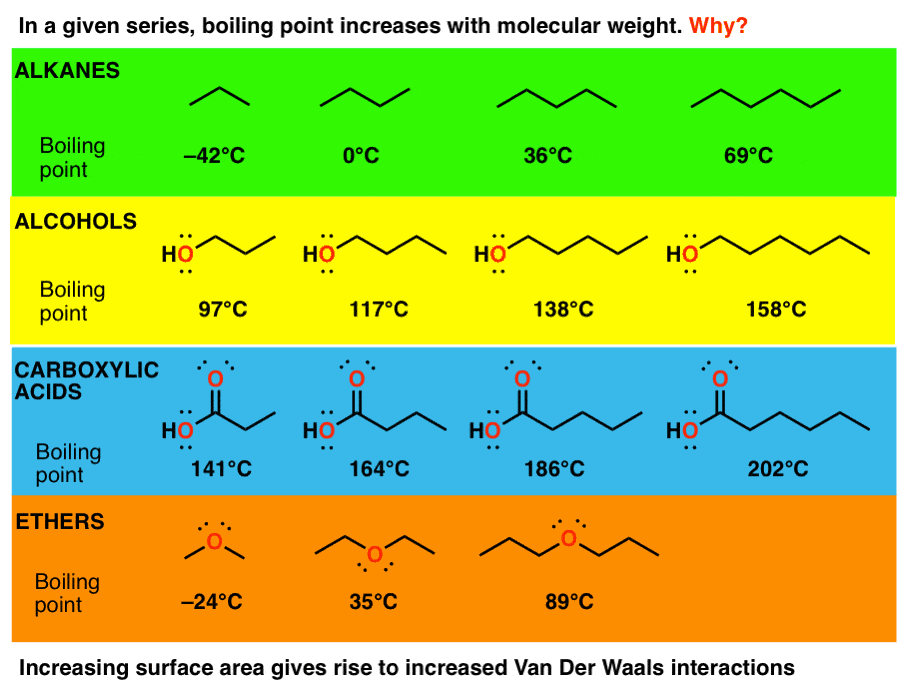
Nonpolar molecules, such as simple hydrocarbons, are held together primarily by London dispersion forces. These are temporary, induced dipoles that arise due to the random movement of electrons. The strength of these forces is highly dependent on the molecular weight and the shape of the molecule. Generally, larger molecules with greater surface area exhibit stronger dispersion forces, which increases their boiling point.
Dipole-Dipole Interactions and Hydrogen Bonding
Polar molecules, which possess a permanent dipole moment, experience stronger attractive forces than nonpolar ones. The most potent of these interactions is hydrogen bonding. This occurs when a hydrogen atom is covalently bonded to a highly electronegative atom such as oxygen, nitrogen, or fluorine.
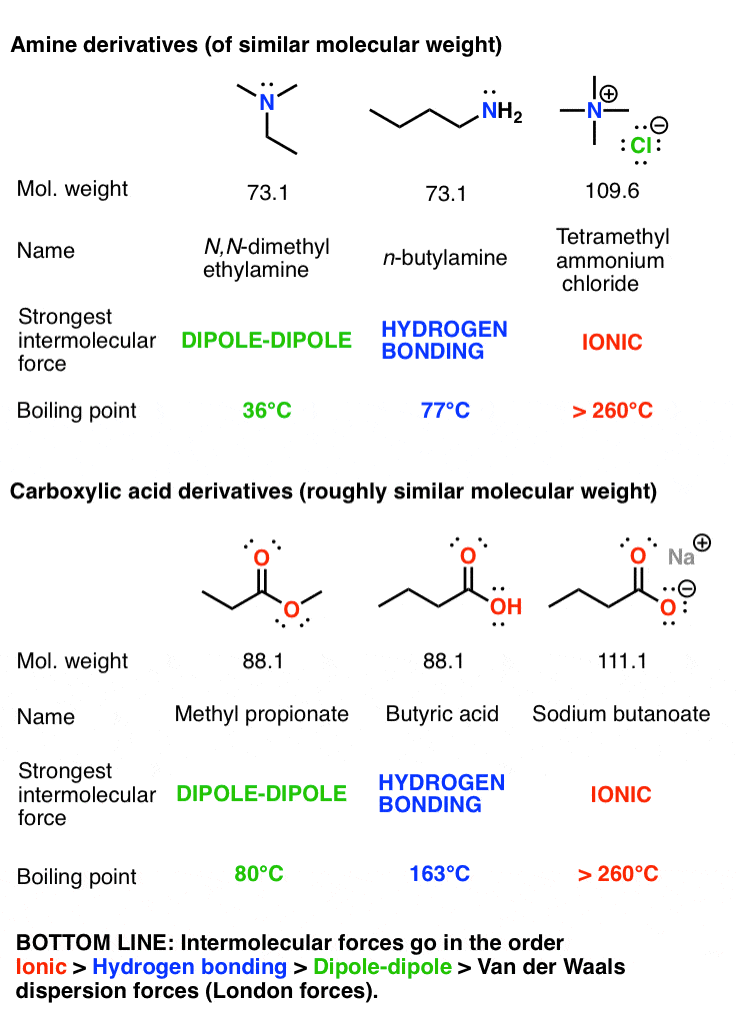
Water is the quintessential example of this. Despite its relatively low molecular weight, water has an exceptionally high boiling point compared to other molecules of similar size (like hydrogen sulfide). The hydrogen bonds between water molecules require significant thermal energy to break, forcing the liquid to reach a much higher temperature before it can transition into steam. Understanding these atomic interactions allows material scientists to predict the properties of new synthetic substances before they are even synthesized.
Impurities and Solute Concentration
In the practical world, we rarely deal with perfectly pure substances. The addition of a solute to a solvent results in a phenomenon known as boiling point elevation, a concept central to colligative properties in chemistry.
The Impact of Non-Volatile Solutes
When a non-volatile solute—such as salt or sugar—is dissolved in a liquid, it interferes with the liquid’s ability to transition into the vapor phase. The solute particles occupy space at the surface of the liquid, effectively blocking some of the solvent molecules from escaping.
To compensate for this “blockage” and reach a state where vapor pressure equals atmospheric pressure, the liquid must be heated to a higher temperature than it would reach in its pure state. This is why adding salt to water when cooking pasta causes the water to boil at a slightly higher temperature. While the temperature increase in a typical kitchen setting is modest, in industrial applications, the degree of boiling point elevation is a critical metric used to determine the concentration of solutions.
Industrial Applications and Concentration Control
In chemical engineering, evaporators are used to concentrate liquids by boiling off the solvent. As the concentration of the solute increases, the boiling point of the solution rises. Monitoring this elevation provides engineers with real-time data regarding the concentration of the product, allowing for automated control systems to maintain product quality and safety without the need for constant manual sampling.
Environmental and Practical Implications
The interplay of these factors—pressure, molecular structure, and purity—creates a complex landscape for fluid management in technology and industry.
Thermal Management in Electronics
As microprocessors and power systems become more compact, the challenge of heat dissipation becomes more acute. Engineers often utilize specialized cooling fluids that must maintain specific phase-change properties under varying environmental pressures. By selecting fluids with tailored intermolecular forces, designers can create “heat pipes” that utilize the boiling point of a working fluid to transfer heat away from sensitive components efficiently. If the fluid’s boiling point is too high, the system overheats; if it is too low, the fluid may vaporize prematurely, failing to cycle through the cooling loop effectively.

Safety and Pressure Vessels
In settings ranging from industrial reactors to domestic pressure cookers, the ability to control the boiling point is a matter of safety. Pressure cookers work by intentionally increasing the internal pressure above atmospheric levels. By sealing the chamber, the device forces the water to reach temperatures higher than its standard 100°C boiling point. This increased thermal energy dramatically accelerates the breakdown of starches and proteins, allowing for rapid cooking while simultaneously ensuring that the elevated temperature is sufficient to kill common foodborne pathogens.
Conversely, in vacuum distillation processes used in the petrochemical industry, the objective is to lower the boiling point. By significantly reducing the pressure inside a distillation column, manufacturers can boil and separate components of crude oil at lower temperatures than would be required at atmospheric pressure. This prevents the thermal degradation of delicate hydrocarbon chains, ensuring the integrity of the final products like fuel, lubricants, and plastics.
Ultimately, the boiling point is far more than a static number on a thermometer. It is a precise intersection of environmental physics and molecular chemistry. Whether through the regulation of atmospheric pressure in high-altitude environments, the strategic selection of chemical compounds in industrial cooling, or the manipulation of colligative properties to enhance manufacturing, understanding what affects the boiling point remains a cornerstone of physical science. By mastering these variables, we gain the ability to manipulate the state of matter, driving innovation across fields as diverse as global culinary techniques and high-tech electronic manufacturing. The boiling point acts as a gateway, reflecting the intricate balance between energy input and the fundamental forces that hold our physical world together.
aViewFromTheCave is a participant in the Amazon Services LLC Associates Program, an affiliate advertising program designed to provide a means for sites to earn advertising fees by advertising and linking to Amazon.com. Amazon, the Amazon logo, AmazonSupply, and the AmazonSupply logo are trademarks of Amazon.com, Inc. or its affiliates. As an Amazon Associate we earn affiliate commissions from qualifying purchases.