
In an increasingly mobile-centric world, consumers are constantly evaluating their wireless options to balance coverage, cost, and data reliability. Google Fi Wireless—formerly known as Project Fi—has emerged as a unique player in the telecommunications market. By ditching the traditional “single carrier” model, Google Fi has carved out a niche that appeals to tech-savvy users and frequent travelers alike. But to understand why the service functions the way it does, one must first look at the underlying network architecture that powers it.
The Hybrid Network Model: How Google Fi Operates
Unlike traditional Mobile Virtual Network Operators (MVNOs) that typically piggyback on a single parent carrier, Google Fi was designed as a hybrid network. Its primary strategy is to intelligently switch between multiple cellular networks and an expansive ecosystem of secure Wi-Fi hotspots to ensure the best possible signal for the user.

T-Mobile Integration
Since the acquisition of Sprint by T-Mobile, the primary cellular backbone for Google Fi has been the T-Mobile 5G and 4G LTE network. As the core partner, T-Mobile provides the foundational coverage map that keeps subscribers connected in most urban and rural areas across the United States. When a Google Fi device is not connected to Wi-Fi, it defaults to T-Mobile’s infrastructure.
The Evolution from Network Switching
In its early years, Google Fi was famous for “Network Switching.” It utilized a proprietary SIM card that allowed phones to toggle between T-Mobile, Sprint, and U.S. Cellular based on whichever signal was strongest at a user’s exact location. Following the consolidation of major U.S. carriers, Google Fi has pivoted its focus. While it maintains the T-Mobile partnership as its primary provider, the service now optimizes its connectivity through “Wi-Fi offloading” and advanced software integration to maintain the seamless experience that defined its early reputation.
The Role of Wi-Fi in the Google Fi Ecosystem
The true “secret sauce” of the Google Fi service is its aggressive and sophisticated use of Wi-Fi. Google’s infrastructure is built to treat Wi-Fi not just as a backup, but as a primary data highway.
Automated Wi-Fi Offloading
When you use a Google Fi-compatible device, the phone is constantly scanning for known or high-quality public Wi-Fi networks. When a connection is established, the service automatically routes data—and often even voice calls—through that Wi-Fi connection. This serves two purposes: it reduces the strain on the cellular network and, for users on flexible data plans, it helps minimize cellular data consumption.
The Google VPN Advantage
One of the most critical aspects of Google Fi’s service model is its emphasis on digital security. Because the service encourages frequent connections to public Wi-Fi, Google integrates a built-in Virtual Private Network (VPN) for its subscribers. When active, this VPN encrypts the user’s traffic, ensuring that even if a user is connected to an open, unsecured coffee shop Wi-Fi, their personal data, browsing history, and passwords remain shielded from potential bad actors. This integration is seamless, requiring no manual toggling by the user, and reinforces Google’s push toward a “security-first” mobile experience.
Device Compatibility and Software Synergy
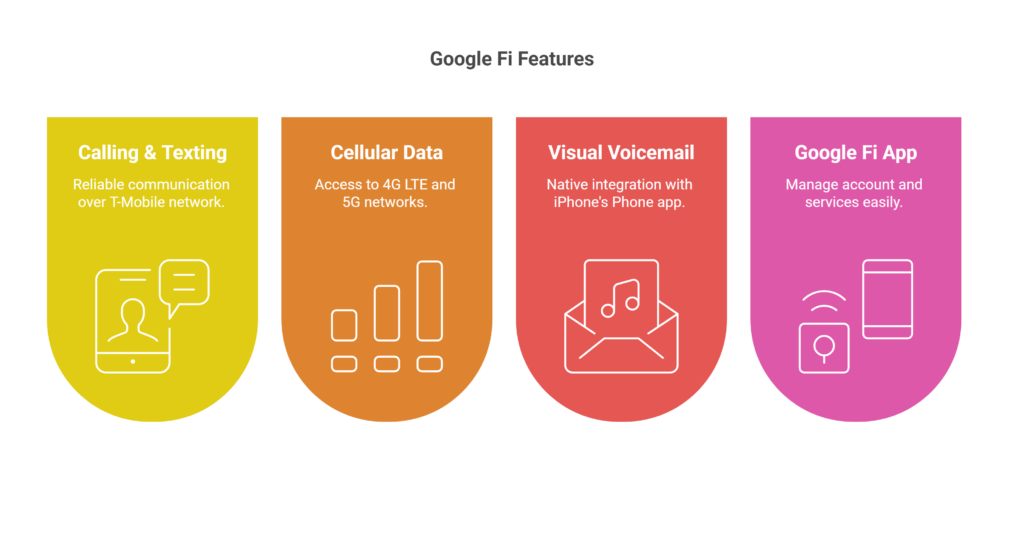
Because Google Fi utilizes specialized network protocols to handle the transition between cellular bands and Wi-Fi, the hardware a user chooses plays a significant role in the quality of the service.
Designed for Fi
While Google Fi now supports a wide range of unlocked smartphones—including iPhones and various Android models—the experience is most refined on devices labeled “Designed for Fi.” These handsets are pre-loaded with the necessary carrier settings and software hooks to handle network handoffs with near-zero latency. Using a “Designed for Fi” phone ensures that the device can take full advantage of Google’s network-switching software and the integrated VPN.
Android vs. iOS Experiences
Users who bring their own devices, such as the latest Samsung Galaxy or iPhone models, can still access Google Fi service, but they function essentially like standard MVNO users. They receive T-Mobile coverage directly, and while they can manually enable Google’s VPN, they may lack the automatic, background network-management features that are baked into the Google Pixel line. This distinction is vital for potential subscribers who prioritize the technical “intelligence” of the service over simple connectivity.
International Roaming and Global Strategy
One of the defining features that sets Google Fi apart from budget-tier carriers is its international roaming capability. While many MVNOs charge exorbitant roaming fees or limit international data to specific countries, Google Fi uses its global partner agreements to provide data in over 200 countries and territories.
How Global Coverage Works
Google Fi leverages wholesale roaming agreements with international carriers. Because Google is not a traditional local carrier in these regions, it negotiates access to local networks globally. This allows users to land in a foreign country, turn on their phone, and receive immediate data access at the same rate they pay in the United States.
Simplifying the Global User Experience
This “it just works” approach is facilitated by Google’s cloud-based backend, which manages the authentication process across different global networks. Instead of navigating local SIM card shops or dealing with expensive “international day passes” that many domestic carriers force upon their customers, Google Fi users experience a unified data ecosystem. For the frequent business traveler or the digital nomad, this eliminates the friction of international communication, making the service a powerful tool for global mobility.
Evaluating the Future of the Google Fi Model
As 5G technology matures and the lines between cellular and high-speed home internet continue to blur, Google Fi’s position in the tech market appears secure. By prioritizing software-defined networking, the company has created a product that feels less like a traditional utility and more like a smart platform.
The Shift Toward Data-Centric Pricing
The current pricing structure of Google Fi—split between a “Flexible” plan and an “Unlimited” plan—reflects the modern reality of data consumption. By providing data-only SIM cards at no extra cost (which can be inserted into tablets or older phones), Google encourages a multi-device ecosystem. This allows a single user to share their data bucket across a laptop, a tablet, and a smartphone, further solidifying the service as a hub for a person’s entire digital life.

Reliability vs. Innovation
For the consumer, the question remains: is Google Fi the right service? For those living in areas with robust T-Mobile coverage and those who rely heavily on secure Wi-Fi, the service offers an unparalleled combination of security and convenience. While it may not offer the absolute lowest price point compared to some ultra-budget prepaid carriers, the value proposition lies in the seamless integration of network-level security and the inclusion of international roaming.
Ultimately, Google Fi uses a hybrid approach that leans heavily on T-Mobile’s cellular infrastructure, bolstered by a sophisticated layer of software that prioritizes security and smart connectivity. It represents a significant evolution in how consumers interact with their service providers—shifting the power from the carrier’s physical towers to the user’s software-defined experience. As 5G continues to expand and global connectivity becomes an essential utility for the modern professional, Google Fi’s model serves as a blueprint for how mobile services will operate in the future.
aViewFromTheCave is a participant in the Amazon Services LLC Associates Program, an affiliate advertising program designed to provide a means for sites to earn advertising fees by advertising and linking to Amazon.com. Amazon, the Amazon logo, AmazonSupply, and the AmazonSupply logo are trademarks of Amazon.com, Inc. or its affiliates. As an Amazon Associate we earn affiliate commissions from qualifying purchases.