
Understanding your annual salary when you are paid by the hour is a fundamental step in personal financial planning. While a paycheck stub provides a clear snapshot of your earnings per pay period, it often obscures the bigger picture of your total yearly income. When you earn $35 an hour, you are operating at a significant benchmark in the modern workforce, but translating that hourly rate into an annual figure requires a clear grasp of standard work cycles and deductions.
Calculating Your Gross Annual Income
The simplest way to determine your yearly salary from an hourly wage is to multiply your rate by the standard number of working hours in a year. In the United States, a standard full-time work week is defined as 40 hours. When you extend this over a full calendar year, it provides a consistent baseline for your income calculations.
The Standard 2,080-Hour Baseline
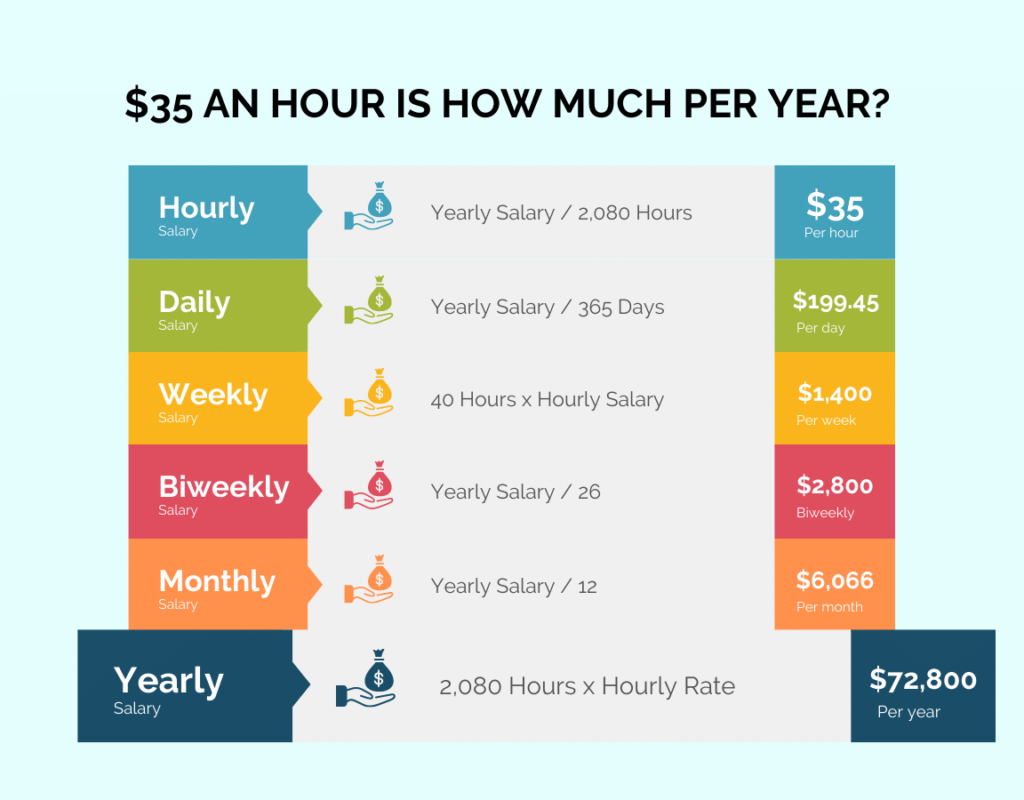
There are 52 weeks in a year. If you work exactly 40 hours per week for all 52 weeks, you arrive at a total of 2,080 working hours. To calculate your gross annual income at $35 per hour:
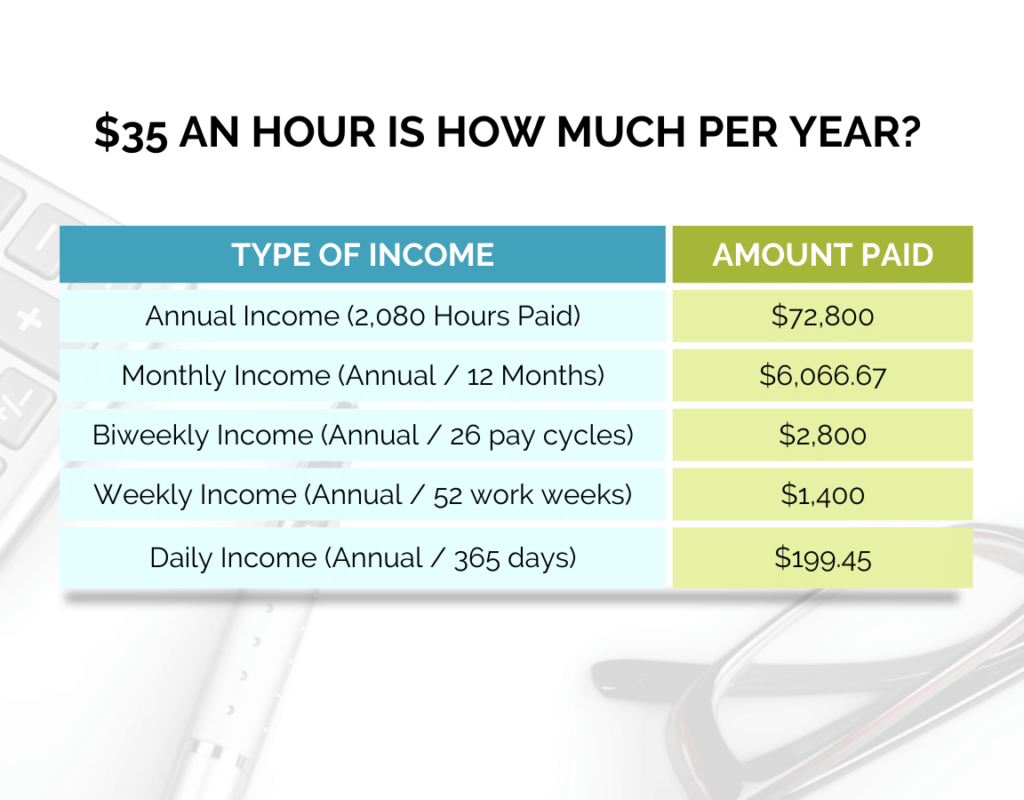
$35/hour × 2,080 hours = $72,800 per year.
This figure represents your gross pay, which is the total amount you earn before any taxes, insurance premiums, or retirement contributions are taken out. While $72,800 is the mathematical baseline, it is crucial to recognize that this assumes you are paid for every hour of the 2,080-hour work year, including holidays and vacation time, provided your company offers paid time off (PTO). If your employment arrangement does not include paid leave, your actual income will be lower based on the specific number of days you take off.
Adjusting for Unpaid Time Off
If your employer does not provide paid vacation days or sick leave, you must adjust the calculation to reflect your actual take-home potential. If you plan to take two weeks of unpaid time off, your working hours drop from 2,080 to 2,000 (40 hours × 50 weeks). In this scenario, your gross annual income would be:
$35/hour × 2,000 hours = $70,000 per year.
Being aware of these variables is essential for accurate budgeting, especially for contractors, freelancers, or hourly employees in roles that do not offer comprehensive benefits packages.
From Gross to Net: Understanding Your Take-Home Pay
Knowing you earn $72,800 annually is only the beginning. The amount that actually hits your bank account—your net income—is significantly less due to mandatory deductions. Understanding these variables is what separates those who simply “get by” from those who successfully manage their personal finances.
Federal and State Tax Obligations
The largest portion of your paycheck will be claimed by taxes. While Federal Income Tax rates vary based on your filing status and total income, you must also account for FICA taxes, which include Social Security (6.2%) and Medicare (1.45%). These are flat-rate deductions that apply regardless of your tax bracket.
Furthermore, depending on where you live, you may be subject to state and local income taxes. If you reside in a state like California or New York, your take-home pay will be notably lower than if you live in a state with no income tax, such as Texas or Florida. For someone earning $72,800, a conservative estimate for total tax withholding—including federal, FICA, and potential state taxes—typically ranges from 20% to 25%. This means you might see an annual take-home figure closer to $54,600 to $58,240.
Benefit Deductions and Retirement Contributions
Beyond government taxes, your net pay is further impacted by your personal choices regarding benefits:
- Health Insurance: If you opt for employer-sponsored health, dental, or vision plans, these premiums are deducted pre-tax.
- 401(k) or Retirement Plans: Contributing to a 401(k) or 403(b) reduces your taxable income in the short term, but it also reduces your immediate liquid cash flow. While this is a vital investment in your future, it must be accounted for when you calculate your monthly budget.
- HSA/FSA Contributions: Health Savings Accounts are effective tools for tax-advantaged saving, but they also lower your net paycheck.
Strategic Budgeting at $35 Per Hour
Earning $72,800 gross equates to approximately $6,066 per month before taxes. After accounting for a standard 20–25% deduction for taxes and benefits, your monthly “net” budget is likely to fall between $4,500 and $4,850. Managing this amount effectively requires a structured approach to spending and saving.
The 50/30/20 Rule
A proven method for managing this income level is the 50/30/20 budget framework:
- 50% for Needs ($2,250 – $2,425): This includes your rent or mortgage, utilities, groceries, basic transportation, and insurance. At this income level, housing should ideally remain under 30% of your gross income to ensure you are not “house poor.”
- 30% for Wants ($1,350 – $1,455): This category covers dining out, streaming subscriptions, hobbies, travel, and non-essential shopping.
- 20% for Savings and Debt Repayment ($900 – $970): This is the engine of your financial growth. It should be directed toward an emergency fund, high-interest debt elimination, or retirement accounts.
Evaluating Lifestyle Inflation
When moving into the $35/hour bracket, it is common for individuals to experience “lifestyle inflation”—the tendency to increase spending as income increases. While it is tempting to upgrade your vehicle or move into a more expensive apartment, doing so early can derail your long-term financial security. By maintaining a lifestyle that aligns with a slightly lower income, you can accelerate your path to wealth building, such as maximizing a Roth IRA or building an investment portfolio.
Long-Term Wealth Building and Career Growth
The transition from an hourly wage to long-term wealth is a journey of consistency. Making $35 an hour provides a solid middle-class foundation, but the objective should always be to optimize this income for future freedom.
Leveraging Career Transitions
If your goal is to move beyond the constraints of an hourly wage, consider how your current role fits into your long-term career strategy. Hourly employees often face a “ceiling” where growth is limited by the number of hours they can physically work. To break through this, look for opportunities that offer performance bonuses, equity, or a transition into a salaried management position.
Investing the Surplus
Because you are paid hourly, you may feel as though your income is static. However, if you consistently invest the 20% savings portion of your income, you utilize the power of compound interest. Even modest monthly contributions into a low-cost index fund or an exchange-traded fund (ETF) can result in a significant nest egg over a decade. At $35 an hour, you have the breathing room to not only cover your living expenses but to also position yourself as an investor.

The Importance of Emergency Reserves
An hourly wage, while steady, can be vulnerable to fluctuations in work demand, seasonal layoffs, or personal health issues. Because you do not have the same safety net as a salaried employee in some contexts, maintaining an emergency fund that covers 3 to 6 months of your essential expenses is paramount. This fund acts as your personal “insurance policy,” ensuring that a temporary loss of hours does not lead to high-interest debt.
Ultimately, seeing $35 an hour as $72,800 a year is more than just a math exercise. It is a tool for empowerment. When you understand the relationship between your hourly effort and your annual capability, you take control of your financial narrative, allowing you to prioritize the goals that truly matter—whether that is buying a home, paying down student loans, or retiring early.
aViewFromTheCave is a participant in the Amazon Services LLC Associates Program, an affiliate advertising program designed to provide a means for sites to earn advertising fees by advertising and linking to Amazon.com. Amazon, the Amazon logo, AmazonSupply, and the AmazonSupply logo are trademarks of Amazon.com, Inc. or its affiliates. As an Amazon Associate we earn affiliate commissions from qualifying purchases.