
Understanding the conversion of decimals into fractions is a fundamental skill in personal finance and business mathematics. Whether you are calculating interest rates, adjusting investment portfolio allocations, or determining the cost-per-unit for a small business venture, the ability to pivot between decimal and fractional representations is essential for precision and clarity. While 3.25 is a straightforward number, its fractional representation serves as a practical gateway to mastering the arithmetic required for effective money management.
The Mathematical Foundation of Decimal-to-Fraction Conversion
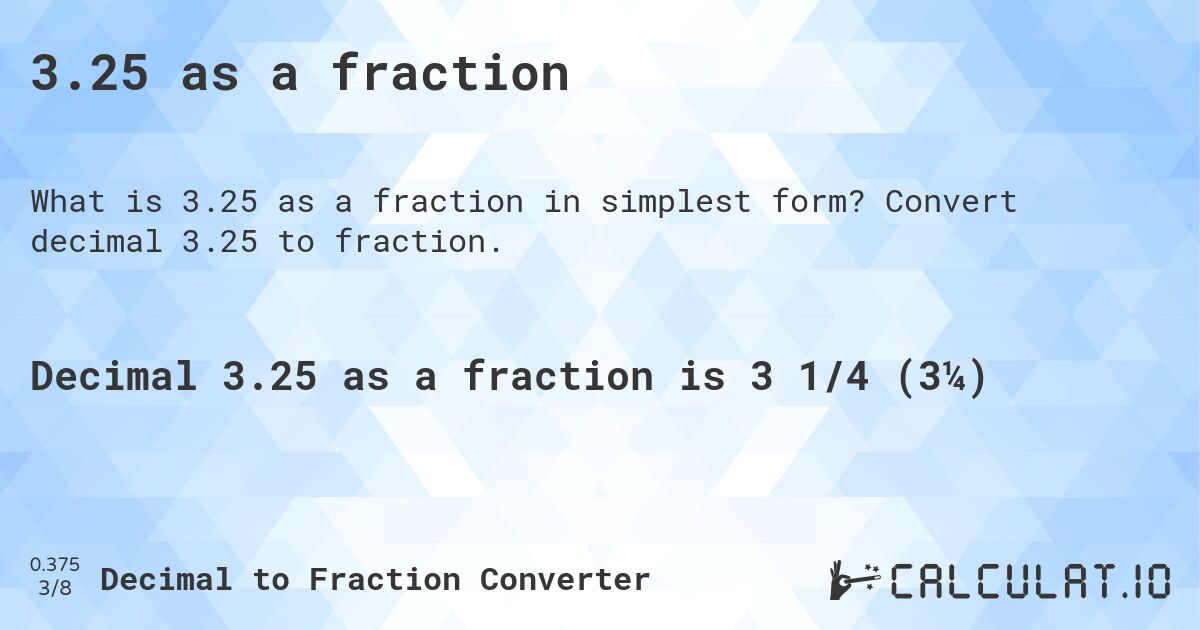
At its core, a decimal is simply another way to write a fraction whose denominator is a power of ten. To convert a decimal like 3.25 into a fraction, we must examine the place value of the digits following the decimal point.
Breaking Down the Place Values
The number 3.25 consists of a whole number (3) and a decimal component (0.25). In our base-ten system, the first digit after the decimal point represents tenths, and the second digit represents hundredths. Therefore, 0.25 can be read as twenty-five hundredths, which translates directly to the fraction 25/100.
Combining the Whole Number and the Fraction
To express 3.25 in its entirety, we combine the whole number with the decimal fraction: 3 and 25/100. In financial terminology, this is known as a mixed number. While 3 25/100 is technically correct, it is rarely the final form used in accounting or financial reporting because it is not yet in its most simplified state. Reducing the fraction ensures that your financial calculations remain clean and easy to interpret.
Simplifying the Fraction for Financial Clarity
In professional financial contexts, complexity often leads to errors. Simplifying 25/100 is a necessary step to achieve the cleanest expression of the value. By finding the greatest common divisor (GCD) of the numerator and the denominator, we can reduce the fraction to its lowest terms.
The Reduction Process
To simplify 25/100, we look for the largest number that divides evenly into both 25 and 100. Both numbers are divisible by 25.
- 25 ÷ 25 = 1
- 100 ÷ 25 = 4
Thus, the fraction 25/100 simplifies to 1/4. When we reattach the whole number, 3.25 becomes the mixed number 3 1/4. This simplified version is far more practical for calculations involving rates of return, loan interest, or inventory volume, as it reduces the likelihood of decimal-point errors during manual arithmetic.
Converting to an Improper Fraction
In certain financial modeling scenarios—such as calculating compound interest or growth rates—it is often easier to work with improper fractions rather than mixed numbers. To convert 3 1/4 into an improper fraction, multiply the whole number (3) by the denominator (4) and add the numerator (1).
- (3 * 4) + 1 = 13
- The result is 13/4.
Using 13/4 in equations allows for smoother multiplication and division, a technique frequently employed by financial analysts when building spreadsheet models or evaluating debt-to-equity ratios.
Practical Applications in Personal Finance
Translating decimals into fractions is more than just a classroom exercise; it is a vital tool for making informed financial decisions. When you view a number like 3.25 through the lens of a fraction, you gain a better intuitive grasp of its proportion relative to other values in your budget.
Interest Rates and Debt Repayment
Many interest rates are quoted as percentages, but they are applied as decimals. If a financial product offers a 3.25% interest rate, understanding this as 3 1/4 percent helps in visualizing the cost of borrowing. When you break 3.25% down, you see that it represents a small, fractional slice of your total principal. For those managing high-interest debt, visualizing the rate as a fraction can help in prioritizing which debts to pay off first, as the “1/4” indicates a specific fraction of the total balance being consumed by interest charges each period.
Investing and Asset Allocation
In the world of investing, asset allocation is often described in percentages that translate easily into fractions. If your strategy calls for a 3.25% allocation to a specific high-risk asset class, identifying this as roughly 1/31st of your total portfolio (using the improper fraction 13/4 converted to a percentage) allows you to more effectively balance your risk profile. While 3.25% is a specific figure, seeing it as a fraction helps investors avoid “decimal blindness,” where the true weight of an allocation is obscured by a long string of zeros and decimal places.
Business and Small Enterprise Accounting
For small business owners, pricing is often based on fractional margins. If you are marking up a product to achieve a specific margin, you might be dealing with calculations that involve 3.25 times the cost of goods sold. Calculating this as 13/4 of the cost is often faster and less prone to rounding errors than multiplying by 3.25 repeatedly. This is particularly relevant in retail and wholesale, where fractional units are common, and maintaining precise margins can be the difference between profitability and loss.
Why Accuracy in Representation Matters
The precision of financial data is the bedrock of fiscal health. Whether you are balancing a personal ledger or auditing a corporate balance sheet, the way you represent your numbers can impact your strategy.
Preventing Rounding Errors
When working with software like Excel or financial calculators, the computer works in binary, which can sometimes lead to infinitesimal rounding errors when converting between decimals and fractions. By keeping your figures in fractional form as long as possible before converting to a final currency output, you maintain higher precision throughout the intermediate steps of your calculation.
Improving Communication with Stakeholders
In a boardroom or a bank meeting, clarity is power. Presenting a return on investment as “3 and a quarter percent” or “thirteen-quarters of a percent” often resonates more clearly with human intuition than citing a string of decimals. It implies a sense of mastery over the data. Professionals who can toggle between decimal and fractional representations demonstrate a level of analytical competence that builds trust with clients and investors.
Enhancing Financial Literacy
Ultimately, the transition from decimal to fraction is about increasing your financial literacy. It encourages you to stop taking numbers at face value and start questioning how they relate to the larger picture of your financial life. When you see 3.25, you now know it represents 3.25 units, or 13/4, or 325%. Each representation offers a different vantage point, and by mastering all of them, you gain a 360-degree view of your financial assets and liabilities.
In conclusion, the conversion of 3.25 to 13/4 or 3 1/4 is a simple but powerful example of how mathematical literacy influences financial strategy. By mastering these conversions, you equip yourself with the tools necessary to analyze data accurately, communicate clearly, and make better-informed decisions regarding your money. Whether you are adjusting an investment strategy, calculating interest, or analyzing business costs, the fraction form is a valuable addition to your financial toolkit.
aViewFromTheCave is a participant in the Amazon Services LLC Associates Program, an affiliate advertising program designed to provide a means for sites to earn advertising fees by advertising and linking to Amazon.com. Amazon, the Amazon logo, AmazonSupply, and the AmazonSupply logo are trademarks of Amazon.com, Inc. or its affiliates. As an Amazon Associate we earn affiliate commissions from qualifying purchases.