
In the realm of digital computing and software development, the transition between numerical formats is more than a simple mathematical exercise; it is a fundamental requirement for data integrity and computational accuracy. Converting a decimal to a fraction—often referred to as “rationalization” in computational circles—is a critical process used in everything from computer graphics and CAD software to high-frequency trading algorithms and blockchain smart contracts. While humans see 0.75 and 3/4 as identical values, a computer perceives them through vastly different architectural lenses. This guide explores the technical methodologies, programmatic implementations, and software tools used to bridge the gap between floating-point decimals and rational fractions.
The Computational Logic Behind Decimal-to-Fraction Conversion
At its core, converting a decimal to a fraction within a digital environment requires an understanding of how numbers are stored. Unlike base-10 mathematics used by humans, computers operate in binary (base-2), which often leads to “floating-point errors.” Understanding the logic of conversion is the first step in building robust technical solutions.
Terminating vs. Repeating Decimals in Data Processing
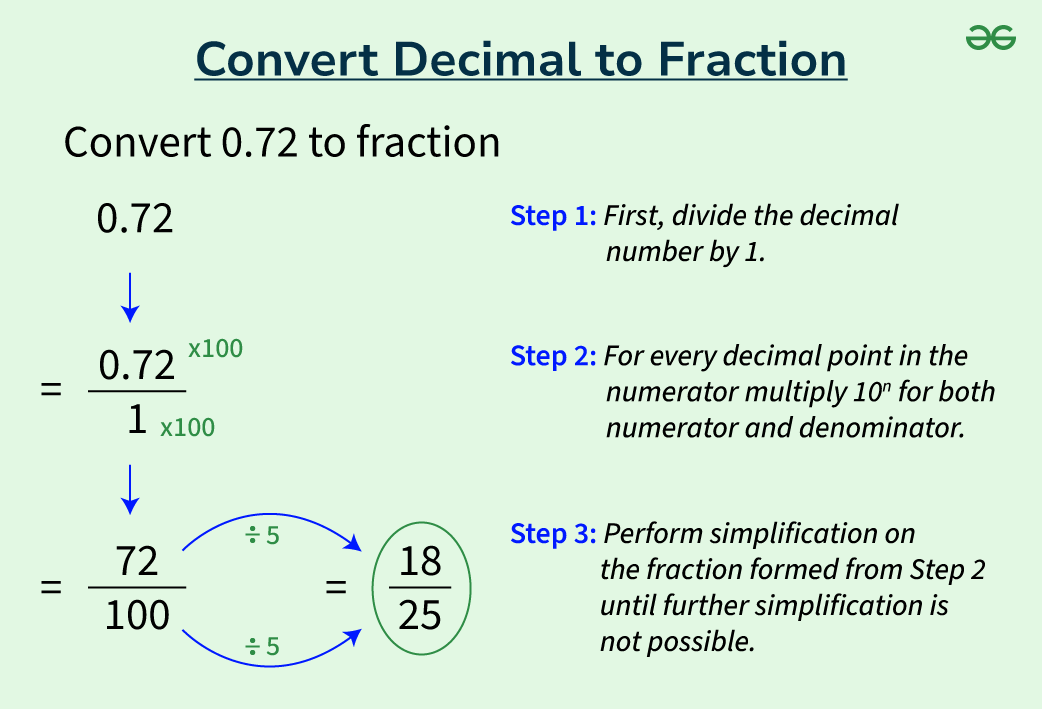
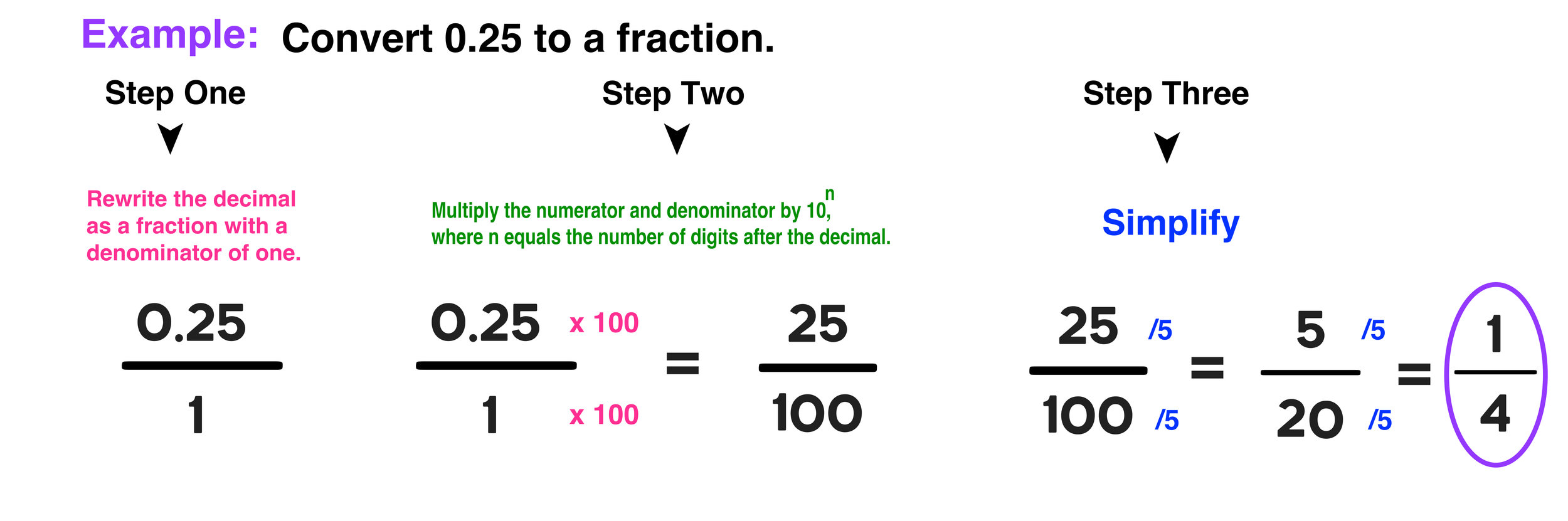
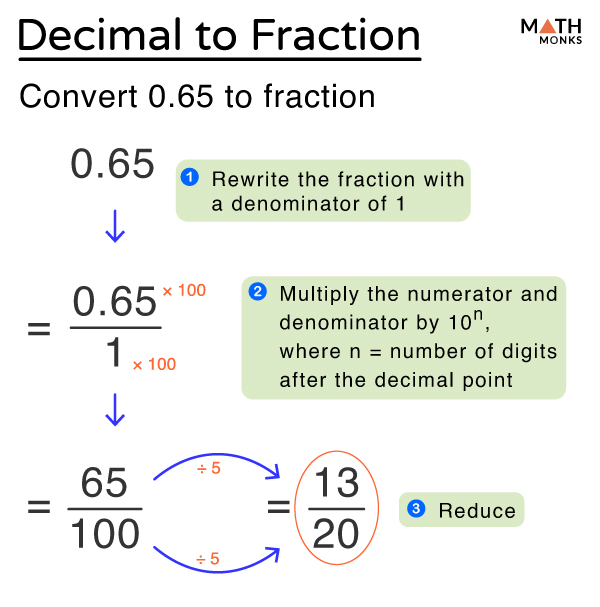
In technical applications, decimals are categorized into two primary types: terminating and repeating. A terminating decimal, such as 0.125, has a finite number of digits. To convert this algorithmically, a system identifies the place value of the last digit. For 0.125, the last digit is in the thousandths place, leading to the initial fraction of 125/1000.
Repeating decimals (or “recurring” decimals), such as 0.333…, present a more complex challenge for software. In tech environments, these are often handled by recognizing patterns or using symbolic math engines. The logic involves setting the decimal as an equation (e.g., x = 0.333), multiplying by a power of 10 to shift the decimal point (10x = 3.333), and subtracting the original equation to eliminate the infinite tail (9x = 3, therefore x = 3/9 or 1/3). Implementing this logic in an AI tool or a calculator requires a high degree of pattern recognition.
The Role of the Greatest Common Divisor (GCD) Algorithm
Once a decimal is represented as a raw fraction (like 125/1000), the next technical step is simplification. This is achieved through the Euclidean Algorithm to find the Greatest Common Divisor (GCD). The GCD is the largest positive integer that divides each of the integers without a remainder.
In a software environment, the Euclidean algorithm is highly efficient because it uses recursion. For example, to simplify 125/1000, the algorithm repeatedly replaces the larger number with the remainder of the division of the two numbers until the remainder is zero. The final non-zero number is the GCD. Dividing both the numerator and denominator by this GCD results in the “reduced” fraction (1/8), which is the optimized data format for many technical applications.
Implementing Conversions in Modern Programming Languages
For developers and software engineers, manual conversion is impractical. Instead, we rely on libraries and built-in functions that handle the heavy lifting of numerical analysis. Different languages offer various levels of precision and abstraction for converting decimals to fractions.
Using the Python fractions Library for High Precision
Python is widely regarded as a premier language for data science and mathematical modeling due to its robust standard libraries. The fractions module provides support for rational number arithmetic. By using fractions.Fraction(decimal_value).limit_denominator(), a developer can convert a floating-point number into its nearest rational equivalent.
This is particularly useful because Python’s limit_denominator() function allows the developer to specify the maximum allowable denominator. This is vital in scenarios where a precise conversion of a floating-point error (like 0.3333333333333333) needs to be mapped back to a clean 1/3. Without this technical safeguard, the computer might attempt to represent the decimal as a massive, unwieldy fraction that consumes unnecessary memory.
Handling Floating-Point Errors in JavaScript and C++
In languages like JavaScript or C++, decimals are often stored as 64-bit floats (IEEE 754 standard). This can lead to precision issues where 0.1 + 0.2 does not exactly equal 0.3. When building a digital converter in these languages, engineers must implement a “tolerance” or “epsilon” value.
A common technical approach in C++ is to use a “continued fraction” algorithm. This iterative method provides a series of increasingly accurate rational approximations for any real number. By stopping the iteration when the approximation is within a specific tolerance of the original decimal, developers can create highly efficient conversion tools that balance the need for precision with computational speed.
Leveraging Productivity Software and Digital Tools
Beyond custom code, many technical professionals utilize specialized software to manage numerical conversions. These tools provide user-friendly interfaces for complex mathematical transformations, making them indispensable in engineering and financial tech sectors.
Mastering Custom Number Formatting in Microsoft Excel
Excel remains the backbone of data management in many industries. To convert decimals to fractions in Excel, users often rely on the “Format Cells” feature. However, the technical power lies in the “Custom” formatting strings.
By applying a format like # ??/??, a user instructs Excel’s engine to approximate the decimal to the nearest fraction with up to two digits in the denominator. For more specialized technical work—such as construction or mechanical engineering—Excel can be forced to use specific denominators (e.g., # ??/16) to ensure that all decimal measurements are converted into standard fractional units used in physical manufacturing.
AI-Powered Calculators and Symbolic Math Engines
The rise of AI and symbolic computation tools like Wolfram Alpha and MATLAB has revolutionized how we handle non-integer values. Unlike standard calculators that convert everything to a float, symbolic engines treat numbers as objects.
When a user inputs a decimal into a symbolic engine, the tool doesn’t just perform a division; it cross-references the value against a database of mathematical constants and patterns. If an AI tool sees the decimal 0.7071, it identifies it as an approximation of the square root of 2 divided by 2 (or 1/√2). This level of “intelligent conversion” is essential in fields like digital signal processing and quantum computing, where the relationship between the numbers is more important than the rounded decimal value.
Why Digital Precision Matters: From Graphics to Blockchain
The transition from decimal to fraction is not just about aesthetics; it is a critical component of modern technology infrastructure. The way a system handles these conversions can impact everything from the visual fidelity of a video game to the security of a financial transaction.
Vector Scaling and Aspect Ratios
In the world of UI/UX design and digital graphics, fractions are superior to decimals for maintaining scale. Aspect ratios (like 16:9 or 21:9) are essentially fractions. When software scales an image, using fractional ratios prevents the “rounding creep” that occurs when decimals are multiplied repeatedly. If a graphic engine uses 0.5625 instead of 9/16, the cumulative rounding errors over millions of pixels can result in distorted images or “dead pixels” at the edge of the screen. By maintaining the fractional integrity, the tech ensures that every pixel is mapped with mathematical certainty.
Smart Contracts and Fixed-Point Arithmetic
One of the most modern applications of decimal-to-fraction logic is found in blockchain technology. Many blockchain virtual machines (like the Ethereum Virtual Machine) do not support floating-point decimals to avoid “non-determinism.” If two different computers rounded a decimal differently, the entire blockchain could de-sync.
To solve this, developers use “fixed-point arithmetic” or represent values as large integers with a “scaling factor” (essentially a fraction where the denominator is a power of 10). For example, to represent 1.25 tokens, the system might store the integer 125 with a denominator of 100. Understanding how to manually and programmatically move between these formats is a prerequisite for any developer working in the Decentralized Finance (DeFi) space, where a single decimal error can lead to the loss of millions of dollars in liquidity.
Conclusion: The Future of Numerical Representation
As we move toward an era of more complex AI and spatial computing, the ability to transition seamlessly between decimals and fractions remains a cornerstone of the tech industry. Whether it is through the recursive elegance of the Euclidean algorithm, the precision of Python’s specialized libraries, or the rigid requirements of blockchain architecture, the conversion process is a testament to our need for both flexibility and accuracy.
For tech professionals, the takeaway is clear: decimals are for measurement, but fractions are for logic. By mastering the technical methods of conversion, you ensure that your software, designs, and data remain as precise as the mathematics they are built upon. As computational power grows, our tools for handling these conversions will only become more sophisticated, further blurring the line between the continuous world of decimals and the discrete world of rational fractions.
aViewFromTheCave is a participant in the Amazon Services LLC Associates Program, an affiliate advertising program designed to provide a means for sites to earn advertising fees by advertising and linking to Amazon.com. Amazon, the Amazon logo, AmazonSupply, and the AmazonSupply logo are trademarks of Amazon.com, Inc. or its affiliates. As an Amazon Associate we earn affiliate commissions from qualifying purchases.