
In the context of automotive safety and defensive driving, the phrase “do not overdrive your headlights” is more than just a colloquialism; it is a fundamental principle of physics and risk management. While often taught in basic driver’s education, the concept is frequently misunderstood or ignored by seasoned motorists, leading to a significant number of nighttime collisions. At its core, the expression serves as a guideline for balancing speed with visibility, ensuring that a driver never enters a stretch of road that they cannot safely clear or navigate within the illumination provided by their vehicle’s lighting system.

The Physics of Visibility and Stopping Distance
To understand the concept, one must first break down the relationship between reaction time, braking distance, and light projection. Driving at night presents an inherent sensory limitation: your field of vision is restricted to the reach of your low or high beams. When you “overdrive” your headlights, you are traveling at a speed where the distance required to bring your vehicle to a complete stop exceeds the distance at which your headlights illuminate the road ahead.
Calculating the Safety Gap
The safety gap is determined by the sum of your reaction time and your mechanical braking distance. On average, a alert driver requires about 1.5 seconds to perceive a hazard and move their foot to the brake pedal. At 60 miles per hour, your vehicle travels 88 feet per second. In that 1.5-second reaction window alone, you have traveled 132 feet before the brake pads have even engaged.
When you factor in the physical distance required for the car to come to a full stop on a dry road—approximately another 150 to 200 feet—your total stopping distance is well over 300 feet. If your headlights are only effectively illuminating objects 200 feet in front of you, you are essentially driving blind regarding potential hazards in the final 100 feet of your stopping sequence. By the time you see an obstacle, it is mathematically impossible to avoid a collision.
The Impact of Environmental Variables
Environmental factors act as force multipliers for the danger of overdriving headlights. Rain, fog, and sleet significantly reduce the efficacy of your headlight throw. Water droplets scatter light, creating a “glare back” effect that further obscures the road. In these conditions, a driver must drastically reduce speed, because the effective range of the headlights has effectively shrunk, while the stopping distance on a wet, slick surface has simultaneously expanded.
The Psychology of Night Driving
Human cognition often fails us in low-light environments. Because we are accustomed to daytime driving where we can see hundreds of yards ahead, the brain tends to subconsciously assume that the road remains clear even when visibility is limited. This cognitive bias leads to the common mistake of maintaining highway speeds long after the sun has set.
Overconfidence and Familiarity
Drivers frequently fall into the trap of overconfidence when driving on roads they know well. We tell ourselves, “I know there isn’t a turn or an intersection for the next five miles.” This familiarity creates a false sense of security that overrides the biological reality of limited vision. However, road conditions are dynamic. A fallen tree, a stray animal, or a stalled vehicle without hazard lights does not care how well you know the local topography. Overdriving your headlights is an act of gambling against unknown variables.

The “Black Hole” Effect
Another psychological challenge is the “black hole” effect, occurring when your eyes become accustomed to the concentrated light on the road immediately in front of the hood. This draws your focus downward, creating a tunnel vision effect that makes you less aware of the periphery. When the eyes are locked on a small pool of light, they lose the ability to detect motion in the dark shadows just beyond that circle, further narrowing your window of opportunity to react to unexpected hazards.
Best Practices for Nighttime Safety
Adopting a defensive posture at night is a hallmark of a professional driver. It requires a conscious effort to adjust driving habits based on the technological limitations of the vehicle and the environmental realities of the journey.
Strategic Speed Management
The most effective way to prevent overdriving your headlights is simple: slow down. If you are driving on an unlit rural road at night, your speed should be calibrated to your visibility, not the speed limit sign. If you find yourself unable to see an obstacle in time to stop, you are exceeding the safe speed for the current light conditions. Reducing your speed by just 5 to 10 miles per hour can bring your stopping distance back within the illumination range of your headlights, providing a critical buffer for safety.
Maintenance of the Lighting System
Many drivers treat headlights as a binary system—either they work or they don’t. In reality, headlight performance degrades significantly over time.
- Lens Clarity: Modern headlight housings are made of polycarbonate, which yellows and oxidizes over years of UV exposure. This creates a haze that blocks light output. Regularly polishing these lenses can restore significant distance to your beam pattern.
- Aiming: Headlights can be knocked out of alignment by potholes, minor bumps, or suspension wear. If your lights are pointed too low, you lose distance; if pointed too high, you glare other drivers and reduce your own ability to see the surface textures of the road. Periodic professional alignment ensures your light is being cast exactly where it is needed.
- Bulb Integrity: As halogen bulbs age, they lose luminosity. If your headlights seem dim, replacing them with high-quality, factory-spec bulbs can be a life-saving upgrade.
Leveraging High Beams Responsibly
High beams are a vital tool, yet they are underutilized. According to highway safety data, many drivers are hesitant to switch back to high beams on empty roads due to the effort involved. Utilizing the “high-low” switch as soon as oncoming traffic clears is essential. Furthermore, if you are driving in a vehicle with older lighting technology, consider that high beams are not just for brighter light—they are for longer-reaching light, which is exactly what is required to keep your stopping distance within your visibility range.
Technology as an Evolving Solution
In the modern automotive landscape, technology is beginning to mitigate the human error associated with overdriving headlights. Adaptive Forward Lighting (AFL) systems and automatic high-beam assist are becoming standard in many vehicles.
Adaptive Lighting Systems
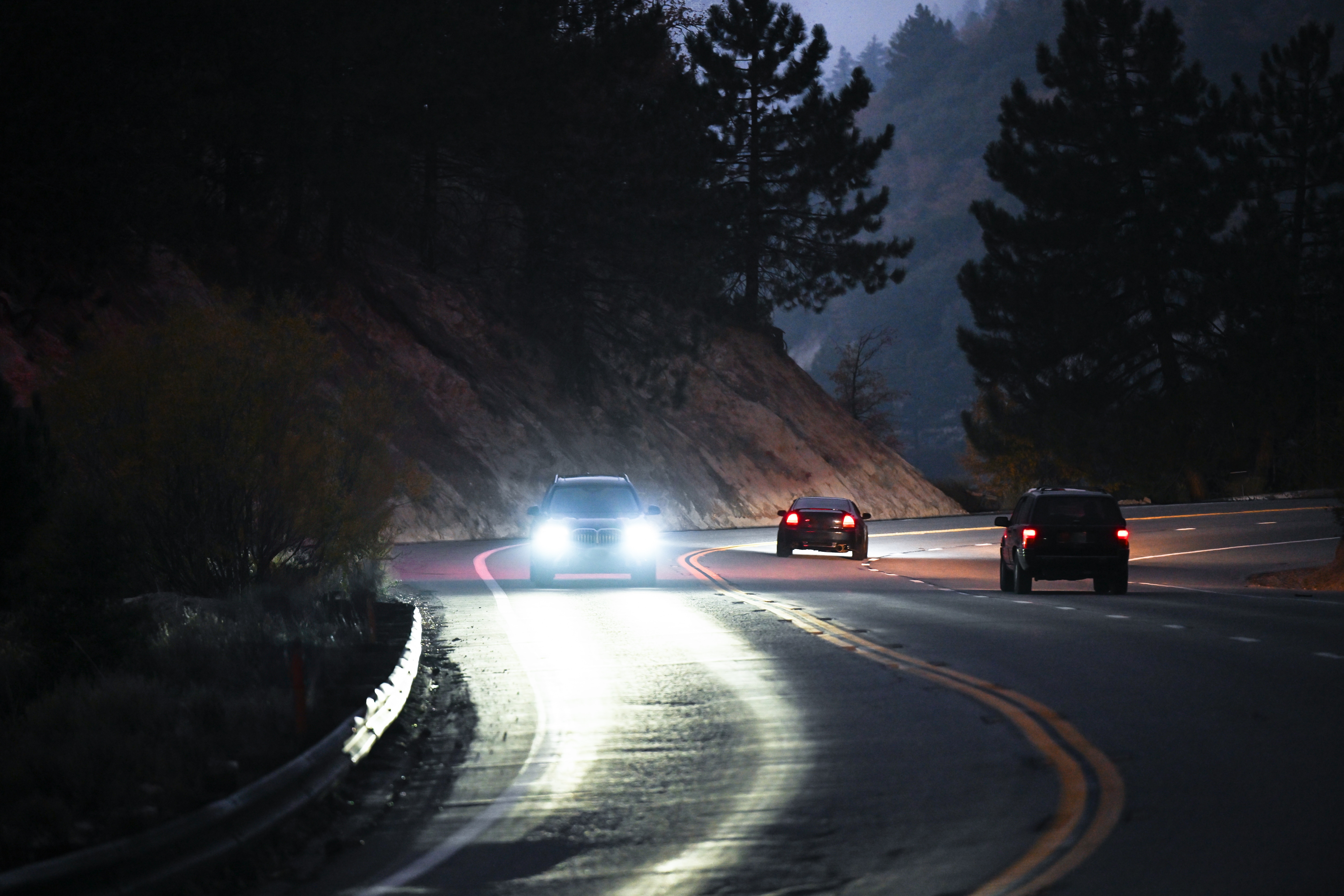
Adaptive headlights physically pivot in the direction of a turn, allowing the driver to see around curves before the vehicle enters them. This addresses the specific danger of driving on winding, dark roads where a static headlight beam would normally point into the woods or a field while the car is aimed at the road. By illuminating the actual path of travel, these systems effectively extend the driver’s ability to anticipate hazards.
Advanced Driver Assistance Systems (ADAS)
Beyond traditional lighting, modern vehicles are equipped with cameras, radar, and LIDAR that do not rely on visible light to detect objects. Forward Collision Warning (FCW) and Automatic Emergency Braking (AEB) act as a secondary set of “eyes” that function regardless of whether your headlights can illuminate the obstacle. While these systems are not an excuse to drive recklessly, they provide an essential failsafe in scenarios where a human driver might be overdriving their headlight range.
However, it is vital to remember that these technologies are assistants, not replacements for human judgment. The ultimate responsibility for adjusting speed to visibility remains with the driver. By respecting the physics of light and distance, maintaining vehicle equipment, and practicing the discipline of slowing down when the environment demands it, drivers can effectively end the practice of overdriving their headlights, making the roads safer for everyone.
aViewFromTheCave is a participant in the Amazon Services LLC Associates Program, an affiliate advertising program designed to provide a means for sites to earn advertising fees by advertising and linking to Amazon.com. Amazon, the Amazon logo, AmazonSupply, and the AmazonSupply logo are trademarks of Amazon.com, Inc. or its affiliates. As an Amazon Associate we earn affiliate commissions from qualifying purchases.