
When reviewing your auto insurance policy, you might encounter terminology that seems straightforward until you dig deeper into the coverage implications. One of the most significant yet frequently misunderstood concepts is “stacked insurance.” While it sounds like a complex financial derivative, it is actually a vital feature of uninsured and underinsured motorist (UM/UIM) coverage that can drastically change the amount of compensation you receive following a severe accident.
Stacked insurance is a strategy that allows policyholders to multiply the limit of their uninsured/underinsured motorist coverage by the number of vehicles they have insured on a single policy. For families with multiple cars, this creates a larger financial safety net. Understanding how to leverage this feature is essential for robust personal financial planning and risk management.
The Mechanics of Stacking Uninsured Motorist Coverage
At its core, stacked insurance addresses a specific gap in standard auto liability coverage: what happens when you are hit by a driver who has no insurance or insufficient coverage to pay for your medical bills and damages?
How Stacking Functions in Practice
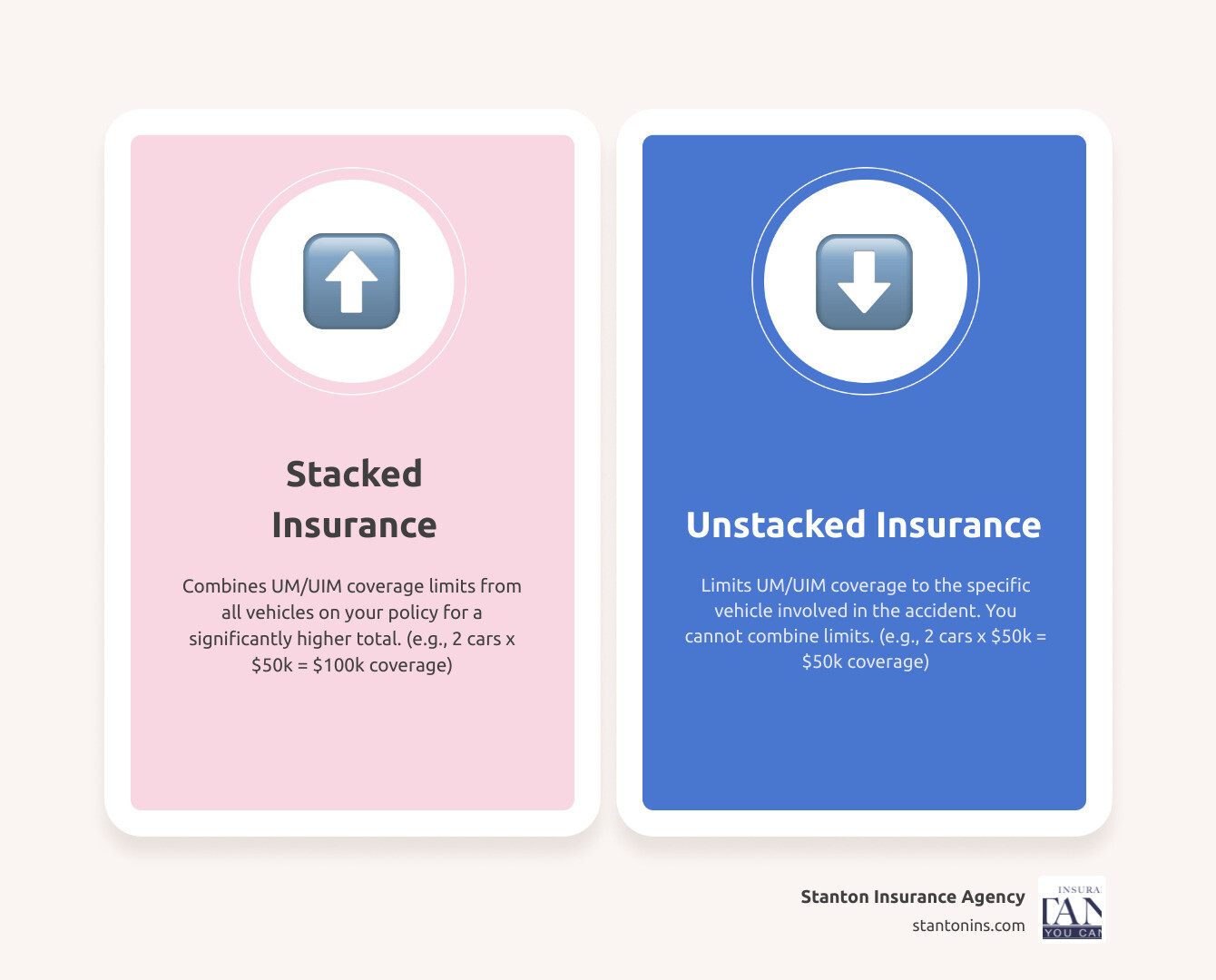
If you own two vehicles and carry $50,000 in uninsured motorist (UM) coverage, “non-stacked” insurance limits your total payout to that $50,000, regardless of how many vehicles are listed on your policy. With stacked insurance, you effectively multiply that coverage. In this scenario, your $50,000 per vehicle “stacks” to provide a total limit of $100,000.
This mechanism is particularly beneficial in multi-car households. If you are injured in an accident involving an underinsured driver, the stacked policy treats the coverage limits of each vehicle as additive rather than restrictive. It essentially creates a larger pool of funds available to cover significant expenses such as hospital stays, physical therapy, loss of wages, and long-term rehabilitation costs.
The Two Types: Intra-Policy vs. Inter-Policy
There are two primary ways that stacking manifests in the insurance industry. Intra-policy stacking applies to multiple vehicles under one single policy, as described above. This is the most common form consumers encounter.
Inter-policy stacking, on the other hand, involves combining limits from separate insurance policies. This is far less common and depends heavily on state regulations. Some states strictly prohibit inter-policy stacking, while others allow it under specific conditions. Because state laws vary wildly—with some states making stacking the default and others requiring a signed waiver to opt-out—it is crucial to verify your local department of insurance guidelines.
Assessing the Financial Value of Stacking
Choosing to stack your insurance is not merely a matter of administrative preference; it is a calculated financial decision. For many, it acts as a secondary layer of protection that bridges the gap between basic liability and high-cost catastrophic events.
The Cost-Benefit Analysis
The primary concern for most policyholders is the premium increase. Stacking does increase the total cost of your annual premium. However, the incremental increase is often negligible when compared to the potential out-of-pocket costs of an accident.
Consider the “What If” scenario: If you are struck by a driver who carries only the state-minimum liability, and your medical bills exceed that limit, you are personally responsible for the difference. If your injuries prevent you from working, your personal assets—savings, investments, and home equity—could be at risk. Paying a few extra dollars per month to ensure your coverage “stacks” acts as an affordable insurance policy against total financial devastation.
When Is Stacking Not Necessary?
While stacking provides significant utility, it is not universally required. If you live in a single-vehicle household, the concept of stacking is effectively moot. Because there is only one vehicle, there is no second or third limit to stack upon the first. In this instance, you should ensure your UM/UIM limit is set to a high enough baseline to cover potential injuries, rather than worrying about the mechanics of stacking.
Furthermore, if your net worth is protected by a high-limit umbrella insurance policy, you might find that your risk tolerance allows for lower underlying UM/UIM limits. However, even with an umbrella policy, many financial advisors recommend stacking as a primary defense before tapping into personal assets or secondary insurance layers.
The Role of State Legislation and Contractual Nuance
Insurance regulation is inherently local. What is considered standard procedure in Florida or Ohio may be illegal or entirely absent in California or Texas. Understanding the regulatory environment is the first step in assessing your policy.
State-Specific Mandatory Disclosure
In states where stacking is permitted, insurance companies are often legally mandated to offer it to you in writing. In many cases, if you choose not to stack, you must explicitly sign a waiver acknowledging that you are declining the additional coverage. This is a deliberate hurdle created by regulators to ensure that consumers do not accidentally forfeit a powerful layer of protection.
Before adjusting your coverage, pull your “Declarations Page.” Look for language that mentions “Uninsured Motorist Stacking” or “UM Stacking.” If the box is marked “N/A” or “No,” you are currently not utilizing this feature. If you have multiple cars and your policy doesn’t reflect this option, it may be because your state does not allow it, or because you have previously opted out of it.
The Impact of Household and Resident Relatives
One of the most complex aspects of stacking involves resident relatives. In many jurisdictions, if a relative living in your home is injured while in a different vehicle, they may still be entitled to the stacked limits of your primary policy. This expands the protective shield of your coverage beyond just yourself.
Conversely, some insurers have attempted to limit these “stacking” benefits through restrictive policy language. Legal battles over who is covered and how the limits apply are common. Consequently, it is wise to speak directly with an insurance agent to clarify whether the stacking on your policy extends to resident relatives and whether your current carrier has any specific exclusions regarding household members.
Strategic Implementation for Asset Protection
In the context of personal finance, your insurance policy should be viewed as an asset protection tool. Much like a diversified investment portfolio, your insurance strategy should be designed to mitigate risk across several dimensions.
Evaluating Your Coverage Limits
Before deciding to stack, ensure your base UM/UIM limit is adequate. If your base coverage is $25,000, stacking two cars only gives you $50,000. For most major medical events, $50,000 is insufficient. You should aim for higher base limits—ideally $100,000 or $250,000—before worrying about the stacking multiplier. By stacking high-limit base policies, you create a powerful defense against the widespread problem of underinsured drivers on the road.
Periodic Policy Audits
Your life circumstances change—you may acquire new vehicles, have children start driving, or experience changes in your household composition. These are the perfect times to audit your auto insurance. When adding a new vehicle to your policy, the representative may ask if you wish to stack your UM coverage. Do not default to “no” simply to keep the premium lower. Ask for a quote comparison to see exactly how much that extra layer of coverage costs. In most cases, the difference is modest compared to the peace of mind it provides.

Final Considerations for Consumers
Stacked insurance is one of the most effective ways to manage the inherent risk of the road. By turning your insurance policy into a modular, additive contract, you protect your family and your financial future. As you evaluate your current financial standing, look at your auto policy as more than just a legal requirement for registration. It is a critical component of your personal financial architecture. When combined with adequate liability limits and a solid umbrella policy, stacking provides a comprehensive shield that ensures an accident on the road doesn’t become a bankruptcy-level financial event. Always review the nuances of your specific state, keep your declarations page updated, and prioritize high-quality coverage over the lowest possible monthly premium.
aViewFromTheCave is a participant in the Amazon Services LLC Associates Program, an affiliate advertising program designed to provide a means for sites to earn advertising fees by advertising and linking to Amazon.com. Amazon, the Amazon logo, AmazonSupply, and the AmazonSupply logo are trademarks of Amazon.com, Inc. or its affiliates. As an Amazon Associate we earn affiliate commissions from qualifying purchases.