
Understanding your yearly income is the cornerstone of effective personal finance management. Whether you are applying for a mortgage, planning a rigorous household budget, or negotiating a salary increase, having a precise grasp of your annual earnings is non-negotiable. While the concept sounds simple—multiplying a paycheck by a set number of months—the reality is often more complex. Between fluctuating hourly shifts, performance-based bonuses, tax implications, and side hustles, the “yearly income” figure can become a moving target.
This guide provides a professional deep dive into the methodologies for calculating your annual earnings, ensuring you have the financial clarity needed to make informed decisions.
The Fundamental Distinction: Gross vs. Net Yearly Income
Before picking up a calculator, it is vital to distinguish between the two primary figures that define your financial life: Gross Annual Income and Net Annual Income. Confusing these two is one of the most common mistakes in personal finance, often leading to overspending and budgeting errors.
Defining Gross Annual Income
Gross annual income is the total amount of money you earn over the course of a year before any taxes or deductions are removed. For salaried employees, this is usually the number stated in an employment contract or offer letter. For freelancers, it is the total of all invoices paid by clients. This figure is the standard metric used by lenders and credit card companies to determine your creditworthiness and debt-to-income ratio.
The Reality of Net Annual Income
Net annual income, commonly referred to as “take-home pay,” is the amount of money that actually lands in your bank account. This is your gross income minus mandatory deductions (like federal, state, and local taxes, or Social Security) and voluntary deductions (such as health insurance premiums or 401(k) contributions). While gross income determines what you earn, net income determines how you live.
Why Both Metrics Matter for Financial Planning
You need both numbers for a holistic financial strategy. Your gross income is essential for tax planning and qualifying for financial products. However, your net income is the only figure that should be used when building a monthly budget. Relying on your gross income for budgeting is a recipe for debt, as it fails to account for the significant percentage of income that never reaches your pocket.
Calculating Yearly Income Based on Pay Frequency
The methodology for calculating your yearly income depends largely on how you are compensated. Different pay cycles require different multipliers to reach an accurate annual total.
The Hourly Wage Calculation
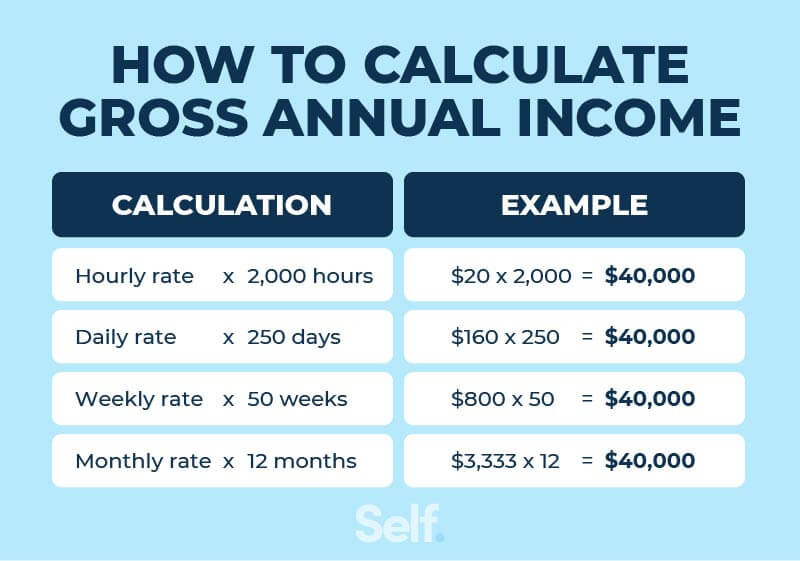
For hourly workers, the calculation starts with your hourly rate. If you work a consistent 40-hour week for the entire year (52 weeks), the standard formula is:
Hourly Rate × 40 hours × 52 weeks = Yearly Income.
A common shortcut used by HR professionals is the “2,080-hour rule,” which represents the total number of work hours in a standard year. If you earn $30 per hour, you would multiply $30 by 2,080 to arrive at a gross annual income of $62,400. However, if your hours fluctuate or you take unpaid leave, you must adjust the “weeks worked” variable to reflect your specific situation.
Bi-Weekly vs. Semi-Monthly Pay Cycles
Many employees confuse bi-weekly and semi-monthly pay schedules, but the difference impacts your monthly cash flow.
- Bi-Weekly: You are paid every two weeks, resulting in 26 pay periods per year. This often results in two “magic months” where you receive three paychecks instead of two.
- Semi-Monthly: You are paid twice a month (usually the 1st and 15th), resulting in 24 pay periods per year.
To find your yearly income on a bi-weekly schedule, multiply one gross paycheck by 26. For a semi-monthly schedule, multiply by 24.
Salaried Employees and Overtime
If you are an exempt salaried employee, your yearly income is generally fixed. However, non-exempt salaried employees may be eligible for overtime. When calculating yearly income in these cases, it is safest to use your base salary for your “floor” budget and treat overtime as a variable bonus. To calculate historical overtime, review your previous year’s W-2 or year-end pay stub to see the total “Overtime Paid” YTD (year-to-date) and add that to your current base.
Accounting for Variable Compensation and Side Hustles

In the modern economy, many individuals have “lumpy” income streams. Relying solely on a base salary calculation can lead to an incomplete financial picture, especially if a significant portion of your wealth comes from non-guaranteed sources.
Incorporating Bonuses and Commissions
If your role is heavy on sales commissions or annual performance bonuses, calculating yearly income requires a conservative approach. Financial advisors often recommend using a three-year average of bonuses to project future income. If you are in a new role, it is prudent to only include the “guaranteed” portion of your bonus in your primary yearly income figure, treating any excess as a windfall for savings or investment rather than essential income.
The Gig Economy: Calculating Freelance and Side Hustle Earnings
For those with side hustles or full-time freelance careers, yearly income is calculated as Gross Receipts minus Business Expenses.
If you earn $5,000 a month from consulting but spend $1,000 on software, advertising, and home office costs, your yearly income from that source is $48,000 ($4,000 x 12), not $60,000. Additionally, remember that self-employed individuals are responsible for both the employer and employee portions of Social Security and Medicare taxes, which must be factored into the “Net” calculation.
Passive Income Streams
To get a true sense of your annual financial power, you should also include passive income. This includes:
- Dividends: The annual payouts from stocks or mutual funds.
- Interest: Earnings from high-yield savings accounts or CDs.
- Rental Income: Total rent collected minus property management fees, taxes, and maintenance.
Including these streams provides a comprehensive view of your Total Annual Compensation, which is the ultimate metric of your financial health.
Navigating Deductions and Tax Implications
Once you have determined your gross yearly income, the next step is understanding the “leakage”—the money that disappears before it reaches your ledger.
Understanding Mandatory vs. Voluntary Deductions
Mandatory deductions are non-negotiable and include Federal Income Tax, State Income Tax, and FICA (Social Security and Medicare). Voluntary deductions are choices you make, such as contributions to a 401(k), Health Savings Account (HSA), or premiums for dental and life insurance. While voluntary deductions reduce your “take-home” pay, they often increase your overall net worth or provide essential services, so they should be tracked as part of your total wealth strategy.
Estimating Your Tax Bracket
The United States uses a progressive tax system, meaning different portions of your yearly income are taxed at different rates. As your yearly income increases, you may move into a higher tax bracket. When calculating your net yearly income, it is important to use your effective tax rate (the actual percentage of your total income that goes to taxes) rather than your marginal tax rate (the tax rate on your highest dollar earned).
Pre-tax vs. Post-tax Contributions
How you save for retirement affects your yearly income calculation. Contributions to a traditional 401(k) are “pre-tax,” meaning they reduce your taxable yearly income. For example, if you earn $100,000 and contribute $20,000 to a 401(k), the IRS only taxes you as if you earned $80,000. Conversely, Roth 401(k) contributions are “post-tax”; they do not lower your current taxable yearly income, but they provide tax-free income during retirement.
Using Your Yearly Income Data for Strategic Financial Growth
Calculating your yearly income is not just an arithmetic exercise; it is a diagnostic tool for your financial future. Once you have an accurate number, you can apply it to several key areas of wealth management.
Budgeting with the 50/30/20 Rule
A popular and effective way to use your yearly income figure is the 50/30/20 rule. Based on your net yearly income:
- 50% should go to Needs (housing, utilities, groceries).
- 30% should go to Wants (dining out, travel, hobbies).
- 20% should go to Savings and Debt Repayment.
Without an accurate yearly income calculation, it is impossible to know if you are over-allocating to “wants” at the expense of your financial security.
Preparing for Major Life Milestones
When you apply for a mortgage or a car loan, the lender will ask for your gross annual income. They use this to calculate your Debt-to-Income (DTI) ratio. Most lenders prefer a DTI ratio of 36% or less. By calculating your yearly income ahead of time, you can determine exactly how much house or car you can afford before you ever step foot in a showroom or open house.

The Importance of the Annual Financial Audit
Your yearly income is rarely static. Raises, inflation, changes in tax law, and shifts in investment returns mean that your income this year will likely be different from last year. Performing an “Annual Financial Audit” every January allows you to recalibrate your savings goals. If your yearly income has increased, you should watch out for “lifestyle creep”—the tendency to increase spending as income rises—and instead divert that extra income into investments or debt reduction.
In conclusion, knowing how to calculate your yearly income with precision allows you to move from a reactive financial state to a proactive one. By understanding the nuances of gross versus net, accounting for variable streams, and factoring in the impact of taxes, you create a solid foundation upon which a secure financial future can be built.
aViewFromTheCave is a participant in the Amazon Services LLC Associates Program, an affiliate advertising program designed to provide a means for sites to earn advertising fees by advertising and linking to Amazon.com. Amazon, the Amazon logo, AmazonSupply, and the AmazonSupply logo are trademarks of Amazon.com, Inc. or its affiliates. As an Amazon Associate we earn affiliate commissions from qualifying purchases.