
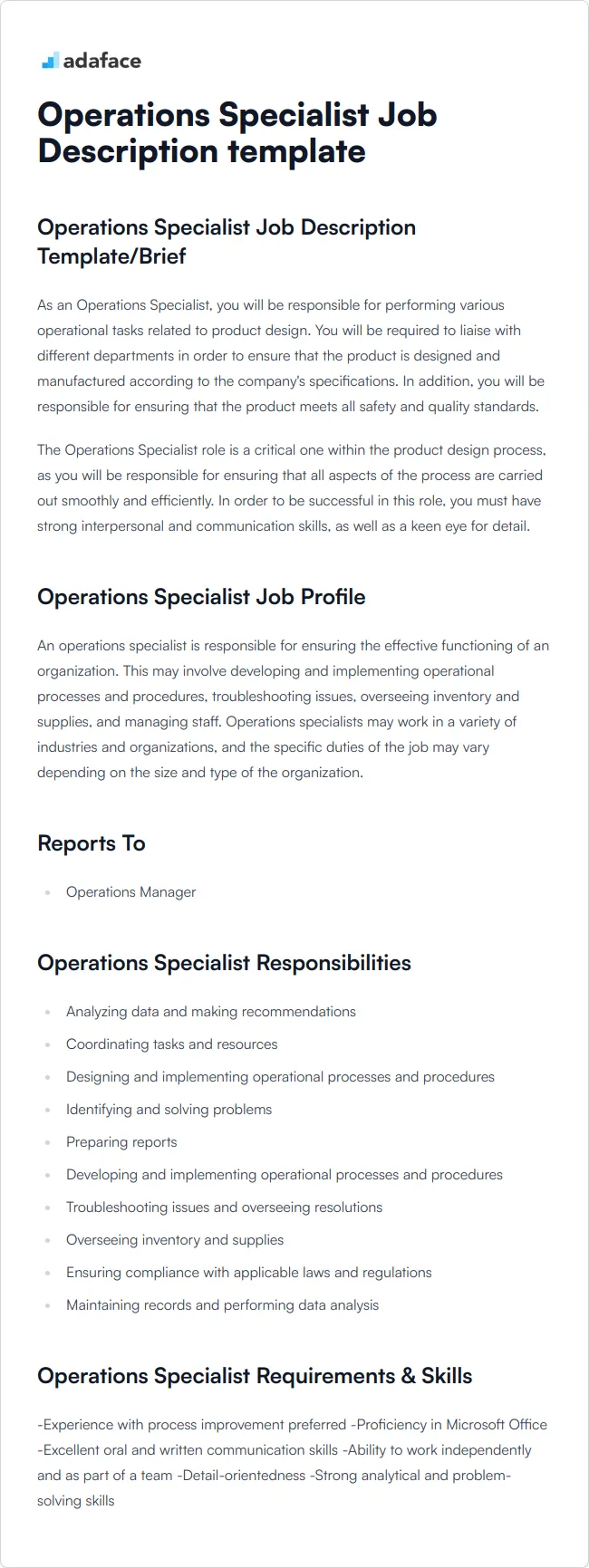
In the modern corporate ecosystem, businesses are constantly seeking ways to optimize their internal mechanics to remain competitive. While high-level strategy often gets the spotlight, the day-to-day viability of a company rests on the shoulders of the Operations Specialist. This role acts as the connective tissue between executive vision and ground-level execution, ensuring that resources, processes, and people are aligned toward a singular goal of efficiency.
An Operations Specialist is, at its core, a business architect. They identify bottlenecks, streamline workflows, and manage the complex logistics that allow a company to scale. Whether they are working within a lean startup or a massive multinational corporation, their objective remains the same: to remove friction from the business model.

The Core Mandate: Bridging Strategy and Execution
The primary function of an Operations Specialist is to bridge the gap between high-level strategic objectives and tactical daily tasks. While executives determine “what” the company should achieve, the Operations Specialist determines “how” to achieve it sustainably.
Workflow Optimization and Process Engineering
One of the most critical responsibilities of this role is the audit and improvement of internal processes. Operations Specialists spend significant time mapping out how work flows through an organization. They look for redundancy, communication silos, and manual tasks that could be automated. By implementing lean methodologies or adopting new project management frameworks, they create a streamlined environment where output is maximized without increasing headcount.
Cross-Departmental Liaison
Operations Specialists rarely work in a vacuum. Because they manage the “gears” of the company, they must interact with every department, from sales and marketing to engineering and customer support. They act as a neutral party that translates technical requirements into business objectives. If the engineering team is building a product, the Operations Specialist ensures that the customer support team has the training and resources to handle the launch. They facilitate the flow of information, preventing the “silo effect” that often kills productivity in growing firms.
Resource Allocation and Asset Management
Efficiency is fundamentally about the intelligent distribution of resources. This includes managing budgets, software subscriptions, physical office assets, and—most importantly—human capital. An Operations Specialist analyzes data to see where money is being spent versus where it is generating value. They often lead the charge in selecting the right tech stack, ensuring that the company isn’t paying for underutilized software licenses or inefficient third-party services.
The Strategic Toolkit: Data, Automation, and Systems
To perform effectively, an Operations Specialist must be fluent in the language of data. Their decisions are not based on intuition; they are derived from metrics, KPIs, and operational dashboards.
Data-Driven Decision Making
The role requires a high degree of analytical rigor. An Operations Specialist monitors performance metrics—such as turnaround time, cost per acquisition, or resource utilization rates—to spot trends before they become problems. If data shows that a specific lead-generation process is costing 20% more than projected, it is the Operations Specialist’s job to dig into the root cause. By maintaining a bird’s-eye view of organizational health, they provide leadership with the insights needed to pivot or scale with confidence.
The Role of Automation and Tech Integration
In the current professional landscape, the Operations Specialist is frequently the primary champion for digital transformation. This involves identifying manual, repetitive tasks—such as data entry, lead logging, or invoice processing—and finding software tools to automate them. By integrating APIs and leveraging project management platforms like Asana, Jira, or Monday.com, they build a digital infrastructure that allows the business to run 24/7 with minimal human error. They don’t just pick software; they design the workflows that ensure that software adds actual value.
Risk Mitigation and Compliance
Every operation carries a degree of risk. Whether it’s data privacy regulations, supply chain vulnerabilities, or simple human error in record-keeping, the Operations Specialist is the guardian of the company’s “safety manual.” They establish standard operating procedures (SOPs) that ensure consistency and compliance across the board. By creating a standardized way of doing things, they protect the company from legal pitfalls and internal volatility.
Managing Growth and Scalability
Perhaps the most challenging aspect of this position is the management of scale. It is easy to run a small, agile team; it is remarkably difficult to maintain that same level of agility as a company grows from 50 to 500 employees.
Standardizing for Scalability
As a business grows, the “informal” ways of working—those casual conversations and verbal agreements—inevitably break down. The Operations Specialist is responsible for formalizing these processes into scalable systems. This means writing comprehensive SOPs, documentation that allows new hires to onboard quickly and current employees to perform tasks consistently. They turn “tribal knowledge” into an accessible, searchable, and replicable organizational knowledge base.
Change Management
Scaling is rarely a smooth process; it involves constant change. New hires, new software, and new markets all introduce friction. The Operations Specialist acts as a change agent, helping the organization transition through growth phases. This requires emotional intelligence and communication skills. They must be able to sell the “why” behind new processes to teams that may be comfortable with the old ways. Successful operations management is as much about managing the cultural shift of an organization as it is about managing its logistics.
Maintaining Culture in a Process-Driven Environment
A common fear among employees is that “systems” make work feel robotic or sterile. A high-performing Operations Specialist understands this risk and strives to design systems that empower people rather than restrict them. By automating the mundane tasks, they actually free up the human workforce to focus on creative, high-value work. They facilitate a culture where processes exist to support the employee, making sure that when an issue arises, the system is flexible enough to allow for human judgment.
The Evolution of the Role: Why It Matters Now More Than Ever
The landscape of business has shifted. In the past, operations roles were often relegated to “back-office” clerical duties. Today, the Operations Specialist is a strategic partner to the CEO. As businesses operate in increasingly digital environments with global, distributed teams, the need for individuals who can design robust, adaptable systems has never been higher.
The Rise of Fractional Operations
As the gig economy grows and businesses become more comfortable with remote work, we are seeing the rise of the “fractional” Operations Specialist. Small to mid-sized companies that cannot afford a full-time Chief Operating Officer are increasingly hiring high-level Operations Specialists on a contract or fractional basis. This underscores the essential nature of the work—a business can survive without many things, but it cannot survive without a functional, efficient operational spine.
Future-Proofing the Business
Looking ahead, the role of the Operations Specialist will likely become even more intertwined with AI and machine learning. As AI tools become more sophisticated, the Operations Specialist will be responsible for “training” the organization on how to use these tools effectively. They will be the ones defining the ethics, boundaries, and practical applications of artificial intelligence within the company’s internal workflow.
In conclusion, the Operations Specialist is the unsung hero of the corporate world. They are the ones who turn chaos into order and vision into reality. By focusing on efficiency, data, and human-centric systems, they ensure that a business is not just growing, but growing sustainably. For those with a mind for logistics, a passion for technology, and a talent for cross-departmental coordination, this role offers an unparalleled opportunity to influence the success of a business from the inside out. Their impact is not always visible to the customer, but it is felt in every smooth transaction, every timely project delivery, and every milestone the company successfully achieves.
aViewFromTheCave is a participant in the Amazon Services LLC Associates Program, an affiliate advertising program designed to provide a means for sites to earn advertising fees by advertising and linking to Amazon.com. Amazon, the Amazon logo, AmazonSupply, and the AmazonSupply logo are trademarks of Amazon.com, Inc. or its affiliates. As an Amazon Associate we earn affiliate commissions from qualifying purchases.