
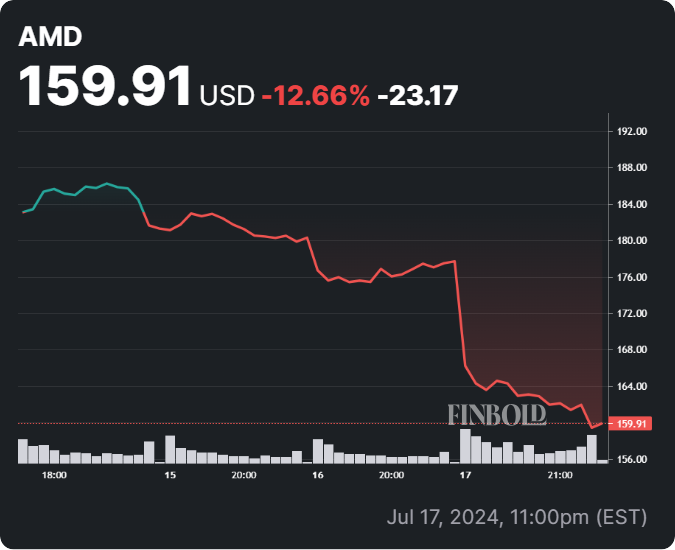
For investors tracking the volatile semiconductor industry, a sudden dip in a bellwether stock like Advanced Micro Devices (AMD) can trigger immediate concern and a scramble for answers. AMD, once a perennial underdog, has transformed into a formidable competitor in CPUs, GPUs, and data center solutions, boasting impressive growth over recent years. Its stock performance often reflects broader trends within the technology sector and the global economy. When AMD’s stock experiences a decline, it’s rarely due to a single isolated event but rather a confluence of macroeconomic pressures, company-specific developments, industry dynamics, and shifts in investor sentiment. Understanding these multifaceted factors is crucial for both short-term traders and long-term investors seeking to navigate the complexities of the financial markets. This article will delve into the various financial and market-related reasons that might explain why AMD’s stock is falling today, offering a comprehensive perspective rooted in the principles of investing and business finance.
Macroeconomic Headwinds and Market Sentiment
Stock markets do not operate in a vacuum. Broader economic conditions and the prevailing sentiment among investors significantly influence the performance of individual stocks, even those with strong fundamentals like AMD. A company’s valuation is intrinsically linked to the economic environment it operates within.
Rising Interest Rates and Inflation Concerns
One of the most significant macroeconomic factors impacting growth stocks, particularly in the tech sector, is the trajectory of interest rates and persistent inflation. Central banks worldwide, including the U.S. Federal Reserve, have been engaged in efforts to tame inflation through monetary tightening. Higher interest rates increase the cost of borrowing for companies, which can suppress future investment and growth initiatives. More importantly, from an investor’s perspective, higher rates reduce the present value of future earnings. Growth companies like AMD derive a substantial portion of their valuation from projected earnings many years down the line. When these future earnings are discounted at a higher rate, their present value decreases, making the stock less attractive, even if the underlying business outlook hasn’t changed. This often leads to a re-evaluation of high-growth, high-multiple stocks, prompting investors to shift capital towards more value-oriented or defensive sectors.
Broader Market Corrections and Tech Sector Vulnerability
AMD’s stock performance is frequently correlated with the broader market, especially the technology-heavy NASDAQ Composite index. If the overall market, or more specifically the tech sector, is undergoing a correction or experiencing significant selling pressure, AMD is highly likely to be dragged down with it. Market corrections can be triggered by a range of factors, including geopolitical instability, recession fears, or widespread profit-taking after extended bull runs. The tech sector, characterized by its often higher valuations and sensitivity to future growth expectations, is particularly vulnerable during periods of market retrenchment. When institutional investors de-risk their portfolios, they often trim positions in stocks that have seen substantial gains or carry higher perceived risk, even if the individual company’s performance remains robust. AMD, as a prominent semiconductor player, is a prime candidate for such portfolio adjustments during sector-wide downturns.
Geopolitical Tensions and Supply Chain Volatility
The semiconductor industry is inherently global, relying on intricate supply chains that span continents. Geopolitical tensions, trade disputes, or regional conflicts can have profound implications for AMD’s operations and financial outlook. For instance, increased friction between major economic powers could lead to tariffs, export restrictions, or disruptions in the supply of critical components or raw materials. Such events can elevate production costs, delay product launches, or limit market access, directly impacting AMD’s revenue and profitability. Furthermore, the memory of recent global supply chain disruptions (like those seen during the pandemic) makes investors particularly sensitive to any news that could signal renewed bottlenecks. Uncertainty regarding the stability of global trade and manufacturing networks can dampen investor confidence and exert downward pressure on semiconductor stocks.
Company-Specific Catalysts and Industry Dynamics
While macroeconomic factors set the stage, specific developments within AMD and the semiconductor industry itself often act as direct catalysts for stock movements. These factors are typically scrutinized in detailed financial reports and analyst briefings.
Quarterly Earnings Report Disappointments
Few events influence a stock more directly than the release of quarterly earnings reports. Even a slight miss on revenue or earnings per share (EPS) targets, as set by analyst consensus, can lead to a significant sell-off. Investors often react not just to past performance but also, and sometimes more strongly, to forward guidance. If AMD projects weaker-than-expected revenue or profit margins for upcoming quarters, or signals a slowdown in key segments like PC, data center, or gaming, investors may revise their growth expectations downward. This re-evaluation can trigger a wave of selling, as the stock’s current valuation may no longer be justified by its anticipated future financial performance. Discrepancies between management’s outlook and market expectations are potent drivers of short-term volatility.
Increased Competition in Key Segments
The semiconductor market is fiercely competitive, with innovation and market share constantly contested. AMD’s success has largely been attributed to its ability to challenge incumbents like Intel in CPUs and NVIDIA in GPUs and increasingly in AI accelerators. However, this competition is a double-edged sword. If Intel or NVIDIA unveil groundbreaking new products that surpass AMD’s offerings, capture significant market share, or price their products aggressively, it can erode AMD’s competitive advantage. Similarly, emerging players or new technologies that threaten AMD’s core markets can introduce investor uncertainty. Any perception that AMD is losing its edge in innovation, experiencing delays in product launches, or struggling to gain traction in burgeoning markets like AI infrastructure can prompt investors to reassess the company’s long-term growth trajectory and profitability, leading to a stock decline.
Product Cycle and Demand Fluctuations
The semiconductor industry is notoriously cyclical, often characterized by periods of strong demand followed by corrections. The post-pandemic surge in PC sales, gaming, and data center build-outs led to unprecedented demand for chips. However, if this demand begins to normalize or even contract, especially in the consumer PC market, AMD could face headwinds. An inventory build-up at customers or in AMD’s own channels, signaling an imbalance between supply and demand, can lead to reduced orders and pricing pressures. This cyclicality means that even fundamentally strong companies can experience periods of slower growth or even revenue declines. Investors, anticipating such downturns in the product cycle, may preemptively sell shares, especially if they believe the company’s valuation hasn’t fully accounted for a softening demand environment.
Analyst Ratings and Investor Behavior
Beyond the raw financials and industry trends, the psychology of the market and the influence of professional financial analysts play a significant role in daily stock movements. Investor behavior, whether rational or driven by sentiment, can amplify trends.
Downgrades and Price Target Adjustments
Research analysts at major investment banks constantly evaluate public companies, issuing ratings (e.g., “Buy,” “Hold,” “Sell”) and price targets. These reports are closely watched by institutional investors and can significantly sway market sentiment. If a prominent analyst downgrades AMD’s stock from a “Buy” to a “Hold” or “Sell,” or significantly reduces their price target, it often signals a perceived deterioration in the company’s outlook or a belief that the stock is overvalued. Such downgrades can prompt institutional investors, who often follow these recommendations, to trim or sell their positions, leading to a noticeable drop in share price. The rationale behind these adjustments, which often considers macro factors, competitive landscape, and company financials, can become a self-fulfilling prophecy in the short term.
Profit-Taking and Short-Term Trading
It’s important to remember that not all stock declines are indicative of fundamental problems. Sometimes, a stock falls simply because investors who have seen substantial gains decide to “take profits.” After a significant upward run, many investors will lock in their gains, selling shares to realize their profits. This selling pressure, especially if widespread, can temporarily depress the stock price. Furthermore, the prevalence of algorithmic and high-frequency trading means that large volumes of shares can be bought and sold based on technical indicators or minute news events, rather than long-term value. These short-term trading dynamics can create significant intraday or daily volatility, causing a stock to fall even without any new negative information about the company’s intrinsic value.
Rumors, Speculation, and News Overreactions
In the age of instant information, stock prices can be highly susceptible to rumors, speculative reports, or even minor news events that are overblown by the market. An unsubstantiated report about a new competitor, a potential supply chain disruption, or even a nuanced statement from a company executive taken out of context can trigger a knee-jerk reaction among investors. While often temporary, these reactions can lead to rapid price declines. The financial media and social media platforms can amplify such narratives, leading to periods where market sentiment, rather than sober financial analysis, dictates stock performance. For investors, distinguishing between genuine fundamental shifts and temporary market noise becomes critical during such periods.
The Long-Term Investor’s Perspective: Navigating Volatility
For investors with a long-term horizon, a single day’s or week’s stock decline, while unsettling, needs to be put into perspective. Market volatility is an inherent characteristic of investing, and successful long-term strategies often involve looking beyond immediate fluctuations.
Differentiating Noise from Fundamental Shifts
A short-term dip in AMD’s stock price doesn’t automatically invalidate its long-term investment thesis. Long-term investors are tasked with distinguishing between temporary market noise and genuine, material changes to the company’s fundamentals. Is the decline due to a broader market correction, profit-taking, or a minor earnings miss? Or is there a fundamental shift in AMD’s competitive position, its innovation pipeline, or its ability to execute its strategic vision? Evaluating the underlying reasons for the fall is paramount. A strong balance sheet, continued innovation in critical areas like AI and high-performance computing, and expanding market share can reassure long-term holders even during periods of short-term weakness.
Diversification and Risk Management
The unpredictability of individual stock movements underscores the importance of diversification in an investment portfolio. Placing all capital into a single stock, no matter how promising, exposes an investor to undue risk. A well-diversified portfolio, spread across different sectors, asset classes, and geographies, helps to mitigate the impact of any single stock’s poor performance. For those invested in growth stocks like AMD, maintaining a balanced portfolio that includes less volatile assets or those in different industries can provide a buffer against sector-specific downturns and reduce overall portfolio risk, aligning with core principles of sound financial management.
Opportunity in Correction?
Paradoxically, a fall in AMD’s stock price can present an opportunity for conviction investors who believe in the company’s long-term prospects. For those who have conducted thorough due diligence and are confident in AMD’s future growth drivers, a temporary price drop might be seen as a chance to acquire shares at a more attractive valuation. This “buying the dip” strategy is often employed by long-term value investors. However, it requires careful consideration and a clear understanding of the risks involved. It’s not about blindly buying every dip, but strategically adding to positions in high-conviction assets when their valuation becomes more compelling due to short-term market reactions rather than fundamental deterioration.
In conclusion, the reasons why AMD stock might be falling today are manifold, ranging from broad macroeconomic pressures like rising interest rates and inflation to company-specific challenges such as competitive threats or earnings disappointments. Investor behavior, driven by analyst reports, profit-taking, or even speculation, further contributes to daily price fluctuations. For the discerning investor, understanding these layers of influence is critical. A short-term decline does not inherently signal the end of a long-term growth story but rather necessitates a robust financial analysis to ascertain whether the underlying investment thesis remains intact. In the dynamic world of investing, vigilance, informed analysis, and a long-term perspective remain the most valuable tools for navigating market volatility.
aViewFromTheCave is a participant in the Amazon Services LLC Associates Program, an affiliate advertising program designed to provide a means for sites to earn advertising fees by advertising and linking to Amazon.com. Amazon, the Amazon logo, AmazonSupply, and the AmazonSupply logo are trademarks of Amazon.com, Inc. or its affiliates. As an Amazon Associate we earn affiliate commissions from qualifying purchases.