
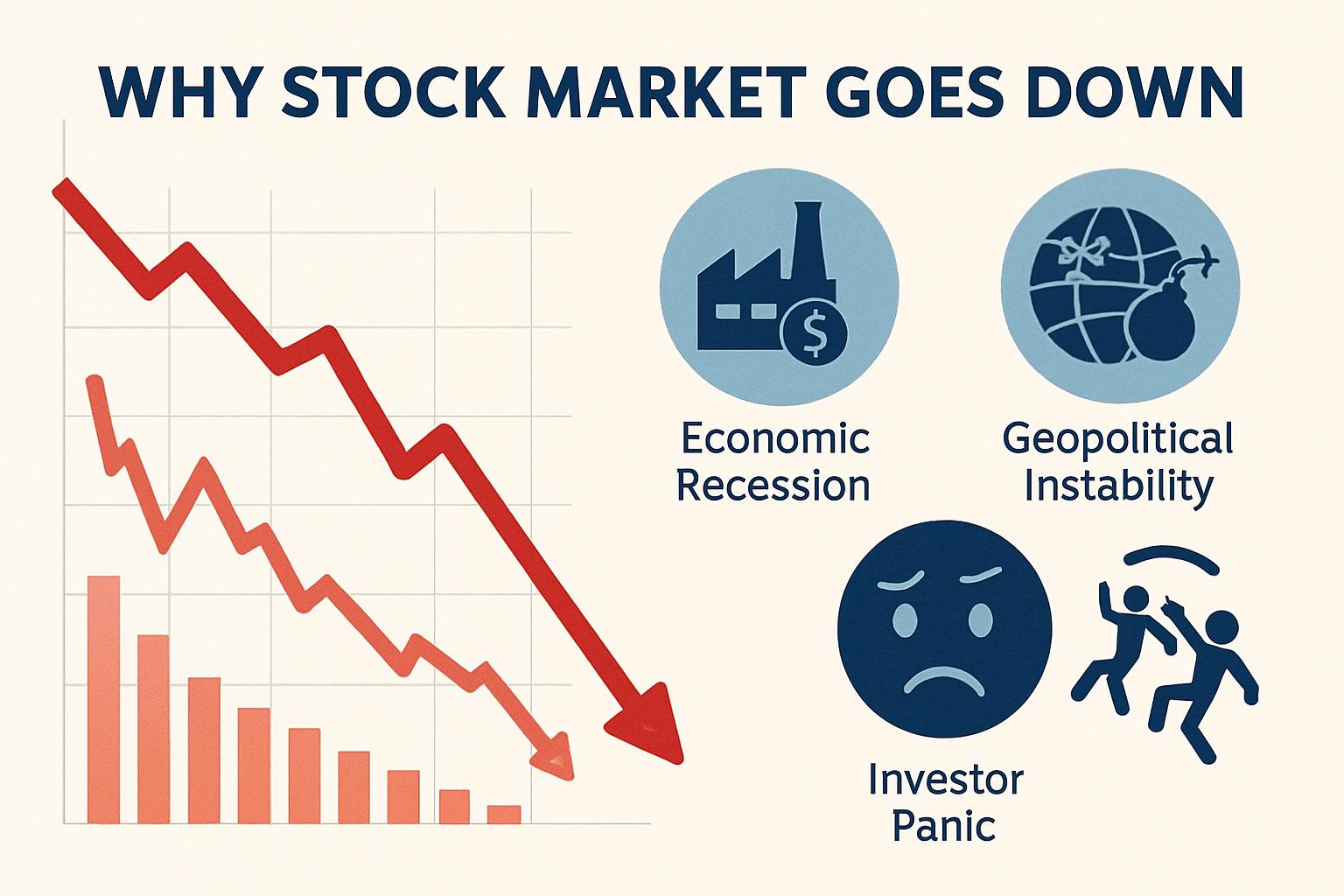
The stock market, a barometer of economic health and future expectations, is inherently cyclical. Periods of robust growth and surging investor confidence inevitably give way to phases of retrenchment, correction, or even outright bear markets. When the market experiences a sustained downturn, it’s rarely attributable to a single factor. Instead, a complex interplay of macroeconomic forces, geopolitical events, shifts in investor psychology, and corporate fundamentals often converges to create a challenging environment for equities. Understanding these underlying causes is crucial for investors seeking to navigate volatility and make informed decisions, transforming uncertainty into a foundation for resilience and prudent financial management.
Macroeconomic Headwinds and Monetary Policy Shifts
At the heart of many stock market downturns lie significant shifts in the macroeconomic landscape, particularly concerning inflation and the subsequent responses from central banks. These foundational elements dictate the cost of capital, consumer purchasing power, and corporate profitability, directly impacting investor sentiment and asset valuations.
Persistent Inflationary Pressures
Inflation, defined as the rate at which the general level of prices for goods and services is rising, erodes the purchasing power of money over time. When inflation becomes persistent and elevated, it presents a significant challenge to the stock market. For companies, higher input costs (raw materials, labor, energy) can compress profit margins, even if they manage to pass some costs on to consumers. For consumers, inflation diminishes discretionary income, leading to reduced spending on non-essential goods and services, which further dampens corporate revenues. Moreover, high inflation reduces the real return on investments, making current stock valuations appear less attractive when future earnings are discounted at a higher rate. It also creates uncertainty about future economic stability, prompting investors to seek safer assets or postpone investment decisions. The interplay between demand-pull inflation (excessive demand relative to supply) and cost-push inflation (rising production costs) can create a challenging environment where businesses struggle to maintain profitability while consumers face higher living expenses, ultimately weighing down market performance.
Central Bank Interest Rate Hikes
In response to persistent inflation, central banks, such as the U.S. Federal Reserve, typically resort to tightening monetary policy, primarily through raising benchmark interest rates. The goal is to cool down an overheating economy by making borrowing more expensive, thereby reducing demand and bringing inflation back down to target levels. However, these rate hikes have several ripple effects on the stock market. Higher interest rates increase the cost of capital for businesses, making it more expensive to borrow for expansion, investment, and even day-to-day operations. This can slow down corporate growth and reduce future earnings potential. Furthermore, higher interest rates make fixed-income investments, like government bonds, more attractive relative to equities. As the risk-free rate rises, investors demand a higher return from riskier assets like stocks, leading to a downward re-evaluation of stock prices. The “discount rate” used to value future earnings in discounted cash flow models increases, mechanically reducing the present value of a company’s projected profits. Aggressive rate hikes can also heighten fears of a looming recession, as the economy struggles to absorb higher borrowing costs, further contributing to market pessimism and selling pressure.
Slowing Global Economic Growth
A deceleration in global economic growth or, more severely, the prospect of a recession, is a potent trigger for stock market declines. Economic slowdowns translate directly into reduced consumer demand, lower corporate earnings, and diminished prospects for future expansion. Factors contributing to slowing growth can be diverse, including tightening financial conditions, reduced international trade, declining consumer confidence, and productivity stagnation. Interconnected global economies mean that a significant slowdown in one major region, like China or Europe, can have cascading effects worldwide. Companies with international operations may see their revenue streams suffer from weaker demand abroad, currency fluctuations, or increased protectionism. When investors anticipate a period of muted economic activity, they tend to reduce their exposure to riskier assets like stocks, opting instead for more defensive holdings or cash. The anticipation of lower GDP growth figures and corporate revenue forecasts often leads analysts to downgrade earnings estimates, providing a fundamental justification for lower stock valuations and triggering broad-based market sell-offs.
Geopolitical Tensions and Supply Chain Disruptions
Beyond the immediate economic indicators, external shocks emanating from geopolitical conflicts and the fragility of global supply chains can introduce significant uncertainty and direct economic costs, unsettling financial markets. These factors often have a broad impact, affecting everything from commodity prices to corporate operational efficiency.
Regional Conflicts and Their Global Impact
Geopolitical conflicts, whether localized wars, trade disputes, or heightened political instability in key regions, can send immediate shockwaves through global markets. Such events introduce a layer of unpredictability that investors inherently dislike. Direct impacts include disruptions to trade routes, sanctions affecting specific industries or nations, and increased defense spending diverting resources from other sectors. The perceived risk premium for holding assets in affected regions, or even globally, rises. For example, conflicts in energy-producing regions can directly impact oil and gas prices, which then ripple through the global economy by increasing transportation and production costs for virtually all industries. Similarly, trade wars can lead to tariffs, making imports more expensive, reducing export competitiveness, and disrupting established supply chains, forcing companies to restructure operations and absorb higher costs. The mere threat of escalation or expansion of a conflict can be enough to trigger significant market volatility, as investors price in worst-case scenarios and seek safer havens.
Energy Market Volatility
Energy, particularly oil and natural gas, serves as a fundamental input for nearly every sector of the global economy. Significant volatility in energy prices—especially sharp increases—can therefore be a major cause of stock market drops. When oil prices surge, businesses face higher costs for transportation, manufacturing, and heating, which can squeeze profit margins and lead to higher consumer prices (contributing to inflation). For consumers, higher fuel prices mean less discretionary income available for other goods and services, dampening overall demand. Energy market volatility can stem from various sources: geopolitical events (like conflicts in major producing regions), supply disruptions (e.g., pipeline closures, refinery outages), or demand shocks (e.g., rapid post-pandemic recovery). A sudden spike in energy costs acts as a tax on the global economy, reducing disposable income and corporate profitability, and can quickly translate into recessionary fears and widespread selling in equity markets, particularly affecting energy-intensive industries and those reliant on global logistics.
Lingering Supply Chain Fragilities
The COVID-19 pandemic exposed the fragility of highly optimized, just-in-time global supply chains. While some initial disruptions have eased, the system remains vulnerable to shocks, contributing to market instability. Ongoing issues can include labor shortages (e.g., truckers, factory workers), port congestion, geopolitical tensions affecting trade routes, and a lack of resilience in critical manufacturing hubs. When supply chains are disrupted, companies face delays in acquiring raw materials and components, leading to production slowdowns, order backlogs, and ultimately, missed revenue targets. The cost of logistics also increases, further eroding profit margins. For instance, semiconductor shortages have severely impacted industries from automotive to consumer electronics, forcing production cuts and delaying product launches. These fragilities create uncertainty about future corporate performance and can lead to lower earnings forecasts. Investors become wary of companies unable to consistently meet demand or manage their input costs, leading to divestment and contributing to broader market declines as these systemic issues highlight operational risks across numerous sectors.
Investor Sentiment and Market Psychology
While fundamental economic data and geopolitical events provide the ‘why,’ the ‘how’ of a stock market drop is often amplified by the collective behavior and psychological biases of investors. Fear, uncertainty, and the herd mentality can transform isolated concerns into widespread panic, accelerating declines.
Fear, Uncertainty, and Doubt (FUD)
Market downturns are often characterized by an overwhelming wave of Fear, Uncertainty, and Doubt (FUD). This emotional state can override rational analysis, leading investors to make decisions driven by panic rather than fundamental valuations. When negative news emerges—be it a weak earnings report, an unexpected interest rate hike, or a geopolitical flare-up—it can trigger a cascade of selling. As prices fall, the fear of further losses can prompt even long-term investors to liquidate holdings, trying to “cut their losses.” This selling pressure begets more selling, creating a downward spiral. Uncertainty about future economic conditions, corporate profitability, or the efficacy of policy responses further fuels FUD. Investors become hesitant to commit new capital, preferring to wait on the sidelines, which further reduces demand for equities. This cycle of fear can become a powerful self-fulfilling prophecy, pushing markets down even beyond what economic fundamentals might suggest, driven primarily by the collective psychology of participants.
The Self-Fulfilling Prophecy of Bear Markets
A bear market is often defined as a sustained decline of 20% or more from recent peaks. Once the market enters this territory, the psychological shift among investors can solidify a “self-fulfilling prophecy.” As more investors believe the market will continue to fall, they act on that belief by selling their holdings. This increased selling pressure drives prices even lower, validating the initial bearish sentiment and encouraging others to sell. Institutional investors, hedge funds, and even individual traders might employ strategies that accelerate this process, such as stop-loss orders or short selling, which profit from falling prices. Media coverage often intensifies during bear markets, highlighting negative economic news and expert warnings, which further reinforces the pessimistic outlook. This creates a feedback loop where negative sentiment fuels selling, which pushes prices down, which further entrenches negative sentiment. Over-correction can occur, where asset prices fall below their intrinsic value, simply because the prevailing market psychology is overwhelmingly negative and ignores long-term prospects.
Valuation Concerns and Profit-Taking
Prior periods of strong market performance can sometimes lead to inflated valuations, where stock prices grow faster than underlying corporate earnings. When interest rates are low and economic growth is robust, investors might be willing to pay a premium for future growth prospects. However, once macroeconomic conditions shift—for example, with rising interest rates or slowing growth—these high valuations become unsustainable. Investors begin to question whether current prices are justified by future earnings potential. This often leads to a reassessment of risk and reward. Experienced investors and large institutions may begin “profit-taking,” selling off portions of their portfolios that have seen significant gains to lock in profits and reduce exposure to overvalued assets. This systematic selling, especially in sectors that led the previous bull market (e.g., technology stocks with high price-to-earnings ratios), can initiate a broader market correction. The realization that assets are overvalued can trigger a rational adjustment, which, when combined with fear and uncertainty, can amplify into a more significant market drop, especially for companies whose growth expectations were overly optimistic.
Corporate Performance and Sector-Specific Challenges
Ultimately, the stock market reflects the collective health and future prospects of the companies listed within it. Therefore, a decline in corporate performance, or significant challenges facing key sectors, can be a direct and potent cause of market drops.
Earnings Downgrades and Revenue Misses
For individual companies, and by extension the broader market, earnings reports are critical benchmarks. When companies consistently report earnings per share (EPS) or revenue figures that fall below analyst expectations, or when management issues guidance for future periods that is significantly weaker than anticipated, it signals underlying problems. Earnings downgrades occur when analysts revise their future profit estimates downward, reflecting a more pessimistic outlook for a company’s prospects. These downgrades can be driven by a variety of factors: higher operating costs, weakening consumer demand, increased competition, or supply chain disruptions. When numerous prominent companies miss their targets or downgrade guidance, it creates a ripple effect, suggesting broader economic headwinds or sector-specific challenges. This often leads to a repricing of shares as investors adjust their valuation models based on reduced profit expectations, contributing to a widespread market downturn as the aggregate earnings outlook for the entire market deteriorates.
Impact of Higher Costs on Profit Margins
In an environment of elevated inflation and supply chain disruptions, businesses face a relentless assault on their profit margins. Higher costs for raw materials, energy, transportation, and labor can severely erode profitability, even if companies manage to maintain revenue levels. While some businesses can pass these increased costs on to consumers through higher prices, many face competitive pressures or consumer resistance that limit their ability to do so. Those that can raise prices risk alienating customers and losing market share. Those that cannot, see their gross and net profit margins shrink. This squeeze on margins means that for every dollar of revenue, less profit is generated, directly impacting a company’s bottom line. When profit margins decline across a significant portion of the market, the overall earnings growth outlook for equities darkens, leading to lower share prices. Investors become wary of companies struggling to maintain profitability in a high-cost environment, leading to divestment and a downward re-evaluation of their stock, collectively contributing to a market drop.
Sectoral Vulnerabilities and Concentration Risk
While broad economic factors often drive market downturns, specific sectors can also act as significant drags on overall performance, especially if the market is heavily concentrated in those areas. Sectors sensitive to economic cycles (cyclical stocks) like automotive, travel, luxury goods, or housing often suffer disproportionately during slowdowns as consumer discretionary spending declines. Similarly, sectors with high debt levels become vulnerable when interest rates rise, as their borrowing costs increase, potentially straining their ability to service debt or invest in growth. Technology, while often seen as resilient, can also face challenges, particularly if previous valuations were based on aggressive growth forecasts that become unsustainable in a tightening monetary environment. Over-reliance on a few dominant companies or sectors within an index can also create “concentration risk.” If these leading companies or sectors face specific headwinds (e.g., regulatory scrutiny, intense competition, or shifting consumer preferences), their decline can have an outsized impact on the entire market, pulling down broader indices even if other sectors are performing adequately. This highlights the importance of diversification and understanding the underlying health of key market segments.
In conclusion, a stock market drop is rarely a simple event but rather the complex outcome of multiple converging forces. From the tightening grip of central bank monetary policy battling persistent inflation, to the disruptive ripple effects of geopolitical conflicts and strained supply chains, and further amplified by the powerful currents of investor sentiment and specific corporate performance challenges—each factor plays a role. Understanding this multifaceted causality is essential for investors. While market downturns can be unsettling, they are a fundamental part of the investment cycle, often clearing the way for future growth. For the financially prudent, a comprehensive grasp of these drivers allows for more informed decision-making, emphasizing long-term strategies, diversification, and a disciplined approach to investing, rather than succumbing to short-term market noise.
aViewFromTheCave is a participant in the Amazon Services LLC Associates Program, an affiliate advertising program designed to provide a means for sites to earn advertising fees by advertising and linking to Amazon.com. Amazon, the Amazon logo, AmazonSupply, and the AmazonSupply logo are trademarks of Amazon.com, Inc. or its affiliates. As an Amazon Associate we earn affiliate commissions from qualifying purchases.