
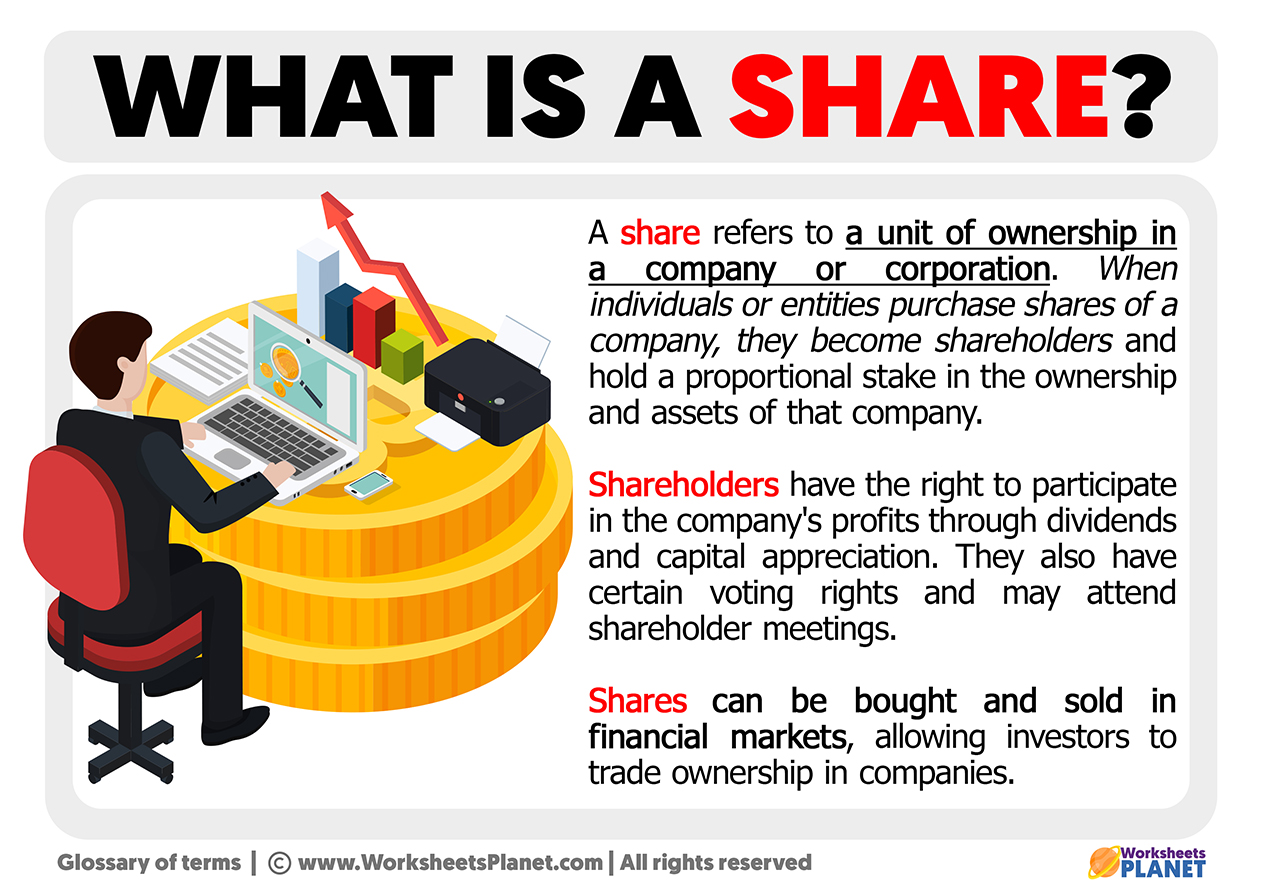
In the world of finance and wealth creation, few concepts are as foundational as the “share.” Whether you are a seasoned investor or a newcomer looking to build a secondary income stream, understanding the mechanics of company shares is essential. At its simplest, a share represents a unit of ownership in a corporation. When you purchase a share, you are essentially buying a small “slice” of that business, entitling you to a portion of its assets and earnings.
As a company grows, the value of those slices can increase, providing a path to capital appreciation and long-term financial security. However, shares are more than just numbers on a digital trading platform; they are legal instruments that carry specific rights, responsibilities, and risks. This guide explores the multifaceted nature of shares, how they function within the broader economy, and how they serve as a primary vehicle for personal and business finance.
Understanding the Fundamentals of Corporate Equity
The issuance of shares is the primary method by which companies raise “equity capital.” Unlike debt, which must be repaid with interest, equity represents permanent capital that the company does not have to return to investors. In exchange for this capital, the company grants investors a stake in its future.
The Concept of Fractional Ownership
When a business incorporates, its total value is divided into millions of small units called shares. If a company has 1,000,000 shares outstanding and you own 10,000 of them, you hold a 1% stake in that enterprise. This fractional ownership gives you a proportional claim on everything the company owns—from its physical real estate and inventory to its intellectual property and brand value.
Why Companies Issue Shares
For a business, issuing shares is a strategic move to fuel expansion. Startups often issue shares to “angel investors” or venture capitalists in exchange for the seed money needed to develop a product. As the company matures, it may undergo an Initial Public Offering (IPO), where it sells shares to the general public for the first time. This influx of cash can be used to fund research and development, acquire competitors, or pay down existing debt. By distributing ownership, the original founders trade total control for the resources necessary to scale the business to heights that would be impossible to reach alone.
Private vs. Public Shares
It is important to distinguish between private and public shares. Private shares belong to companies not listed on a public stock exchange. These are often held by founders, employees, and private equity firms. They are “illiquid,” meaning they are difficult to sell quickly. Public shares, on the other hand, are traded on major exchanges like the New York Stock Exchange (NYSE) or the NASDAQ. These shares are highly liquid; they can be bought or sold in seconds, providing investors with immediate access to their capital.
Different Classes and Types of Shares
Not all shares are created equal. Depending on the company’s charter and its financial goals, it may issue different “classes” of stock, each with distinct advantages and limitations. Understanding these distinctions is vital for any investor looking to align their portfolio with their specific risk tolerance and income needs.
Common Shares
Common shares are the most prevalent type of stock. When people talk about “buying stock,” they are almost always referring to common shares. These carry the most potential for long-term capital appreciation.
- Voting Rights: Holders of common shares typically have the right to vote on corporate matters, such as electing the board of directors or approving mergers. Usually, one share equals one vote.
- Residual Claim: In the event of bankruptcy and liquidation, common shareholders are last in line. They receive whatever is left only after creditors, bondholders, and preferred shareholders have been paid in full.
Preferred Shares
Preferred shares are a hybrid instrument, sharing characteristics with both stocks and bonds. They are often attractive to investors seeking consistent income rather than aggressive growth.
- Fixed Dividends: Preferred shares usually pay a predetermined dividend, similar to interest on a bond. This provides a steady income stream that is often higher than the dividends on common stock.
- Priority Status: As the name suggests, these shareholders have a “preference” over common shareholders. If the company pays dividends, preferred shareholders must be paid first. Similarly, in a liquidation scenario, they have a higher claim on assets than common stockholders.
- Lack of Voting Power: The trade-off for this security is that preferred shares usually do not carry voting rights.
Dual-Class Structures
In recent years, many tech-driven companies have adopted dual-class share structures. This involves creating “Class A” and “Class B” shares. Often, one class is sold to the public with standard voting rights, while another class—held by the founders—carries ten or even 100 times the voting power. This allows founders to maintain control over the company’s vision and strategy even after the company has gone public and raised billions from outside investors.
How Share Value is Determined
The price of a share is rarely a static number; it fluctuates based on a complex interplay of internal performance and external market forces. For the investor, understanding valuation is the difference between speculative gambling and informed investing.
Market Capitalization and Supply and Demand
At its most basic level, the price of a share is determined by supply and demand. If more people want to buy a stock than sell it, the price goes up. However, the total value of the company is measured by its “Market Capitalization,” calculated by multiplying the current share price by the total number of outstanding shares.
- Large-cap: Companies with a market cap of $10 billion or more.
- Mid-cap: Companies between $2 billion and $10 billion.
- Small-cap: Companies between $300 million and $2 billion.
Fundamental Valuation Metrics
To determine if a share price is “fair,” investors look at fundamental data. The most common metric is the Price-to-Earnings (P/E) ratio, which compares the share price to the company’s per-share earnings. A high P/E might suggest that investors expect high growth in the future, while a low P/E might indicate that the stock is undervalued or that the company is facing challenges. Other metrics include the Debt-to-Equity ratio and Free Cash Flow, which provide insights into the company’s financial health and its ability to sustain operations without excessive borrowing.
The Role of Market Sentiment
Share prices are not always rational. They are often driven by “sentiment”—the collective mood of the investing public. Positive news, such as a breakthrough product or a favorable economic report, can send prices soaring. Conversely, geopolitical instability or a negative rumor can cause a sell-off. This volatility is a core characteristic of the stock market, requiring investors to have a disciplined psychological approach to manage their emotions during market swings.
The Benefits and Risks of Owning Shares
Investing in shares is one of the most effective ways to build wealth over time, but it is not without its pitfalls. A balanced perspective on the rewards and risks is necessary for long-term success.
Potential for Capital Appreciation
The primary benefit of owning shares is capital appreciation. If you buy shares in a company when it is small or undervalued and hold them as the company expands its market share and profitability, the value of your holdings can multiply many times over. Historically, the stock market has outperformed most other asset classes, including bonds and real estate, over long periods.
Dividend Income
Many mature companies distribute a portion of their profits back to shareholders in the form of dividends. For the investor, this represents a form of “passive income.” This income can be spent to cover living expenses or, more effectively, reinvested through a Dividend Reinvestment Plan (DRIP). By reinvesting dividends, you purchase more shares, which in turn generate more dividends, creating a powerful compounding effect that can accelerate wealth accumulation.
Risks: Volatility and Loss of Principal
The most significant risk of share ownership is the potential loss of capital. Unlike a savings account, where your principal is generally protected, the value of a share can drop to zero if a company goes bankrupt. Even healthy companies experience “market risk,” where the entire stock market declines due to a recession or global crisis, dragging down the price of all shares regardless of individual company performance.
Building a Wealth Strategy Through Share Ownership
Understanding what shares are is only the first step. The second step is learning how to use them to achieve financial independence. This requires a shift from a consumer mindset to an owner mindset.
Diversification and Risk Management
One of the golden rules of investing is never to put all your eggs in one basket. By owning shares in various companies across different sectors (tech, healthcare, energy, consumer goods), you protect yourself against a downturn in any single industry. Many modern investors achieve this through Index Funds or Exchange-Traded Funds (ETFs), which allow them to buy a single “basket” that contains shares of hundreds or even thousands of different companies.
The Power of the Long-Term Perspective
The stock market is often a “voting machine” in the short term, reacting to every piece of news, but it is a “weighing machine” in the long term, eventually reflecting the true value of a company’s earnings. Successful investors typically ignore short-term noise and focus on the long-term trajectory of the businesses they own. By holding quality shares for decades rather than days, investors can benefit from the compounding growth of the global economy.

Shares as a Tool for Financial Tools and Side Income
For many, shares are not just a retirement plan but a tool for active financial management. Some use “side hustle” income to build a portfolio that eventually generates enough dividend income to cover their monthly bills. Others use shares as collateral for loans or as a way to participate in the growth of the companies they work for through Employee Stock Purchase Plans (ESPPs).
In conclusion, shares are the engine of the modern financial system. They bridge the gap between those who have capital and those who have the ideas and labor to create value. By owning shares, you move from being a mere participant in the economy to being a stakeholder in its success. Whether your goal is to build a massive corporate empire or simply to ensure a comfortable retirement, a deep understanding of shares is your most valuable asset on the path to financial literacy and wealth.
aViewFromTheCave is a participant in the Amazon Services LLC Associates Program, an affiliate advertising program designed to provide a means for sites to earn advertising fees by advertising and linking to Amazon.com. Amazon, the Amazon logo, AmazonSupply, and the AmazonSupply logo are trademarks of Amazon.com, Inc. or its affiliates. As an Amazon Associate we earn affiliate commissions from qualifying purchases.