
Understanding how to calculate loan payments is a fundamental skill for anyone managing personal or business finances. Whether you’re considering a mortgage, an auto loan, a personal loan, or financing a business venture, knowing the exact mechanics behind your monthly obligation empowers you to make informed decisions, budget effectively, and potentially save thousands of dollars over the life of the loan. This guide will demystify the process, breaking down the core components and formulas involved, while also exploring practical tools and strategies to manage your debt intelligently.
At its core, a loan payment calculation determines a fixed amount you pay regularly (usually monthly) to gradually repay both the principal amount borrowed and the interest accrued on that principal. This process, known as amortization, ensures that by the end of the loan term, your debt is fully satisfied. Without a clear grasp of this calculation, borrowers might fall prey to unfavorable terms, struggle with budgeting, or miss opportunities to optimize their financial situation.
Understanding the Fundamentals of Loan Payments
Before diving into complex formulas, it’s crucial to grasp the foundational elements that constitute any loan and influence its payment structure. These components are the building blocks upon which all calculations are based.
Key Components of a Loan
Every loan, regardless of its purpose, is defined by a few critical variables:
- Principal (PV): This is the initial amount of money you borrow. It’s the core debt that you are obligated to repay.
- Interest Rate (r): Expressed as a percentage, this is the cost of borrowing money. It’s the fee lenders charge for providing you with capital. Interest rates can be fixed (staying the same throughout the loan term) or variable (fluctuating with market conditions). For calculation purposes, an annual interest rate usually needs to be converted to a periodic rate (e.g., monthly).
- Loan Term (n): This refers to the total duration over which you agree to repay the loan, typically measured in years or months. A longer term generally results in lower monthly payments but higher total interest paid over time, and vice-versa.
- Payment Frequency: Most consumer loans require monthly payments, but some might be bi-weekly, quarterly, or annually. The frequency impacts how the interest rate is applied and how many payment periods are in the loan term.
Amortization Explained
Amortization is the process of gradually paying off a debt over time through a series of regular payments. Each payment is structured so that a portion goes towards reducing the principal balance, and another portion covers the accrued interest. In the early stages of an amortized loan, a larger share of your payment typically goes towards interest, with a smaller portion reducing the principal. As the loan matures, this ratio shifts, and more of each payment goes towards the principal, accelerating debt reduction. Understanding amortization is key because it illustrates how your equity builds in an asset (like a home) and how the total interest paid accumulates over time.
The Difference Between Simple and Compound Interest
While most consumer loans involve compound interest, it’s helpful to understand the distinction:
- Simple Interest: Calculated only on the principal amount of a loan. It’s less common for long-term loans but might appear in very short-term borrowing or specific types of bonds.
- Compound Interest: This is interest calculated on the initial principal and also on the accumulated interest from previous periods. This “interest on interest” effect means your debt grows more quickly than with simple interest, and conversely, your investments grow more quickly when compound interest is applied. All standard installment loans (mortgages, auto loans, personal loans) use compound interest, making the amortization formula essential.
The Core Formula for Loan Payment Calculation
The bedrock of loan payment calculation is the amortization formula. While intimidating at first glance, breaking it down makes it accessible and understandable.
Unpacking the Amortization Formula
The standard formula to calculate a fixed loan payment (P) for a fully amortizing loan is:
P = [PV * r * (1 + r)^n] / [(1 + r)^n – 1]
Let’s dissect each variable:
- P: Your monthly (or periodic) loan payment. This is what we are trying to find.
- PV (Principal Value): The initial loan amount, the total sum of money borrowed.
- r (Periodic Interest Rate): This is the interest rate per payment period. If your annual interest rate (APR) is 5% and you make monthly payments, you divide 0.05 by 12 (0.05/12 = 0.004167).
- n (Total Number of Payments): The total number of payments you will make over the life of the loan. If you have a 30-year loan with monthly payments, n would be 30 years * 12 months/year = 360 payments.
Step-by-Step Calculation Example
Let’s illustrate with a hypothetical personal loan:
- PV (Principal): $10,000
- APR (Annual Interest Rate): 7%
- Loan Term: 5 years (60 months)
-
Calculate ‘r’ (Periodic Interest Rate):
APR is 7%, so 0.07. For monthly payments, r = 0.07 / 12 = 0.0058333. -
Calculate ‘n’ (Total Number of Payments):
Loan term is 5 years. For monthly payments, n = 5 * 12 = 60. -
Substitute values into the formula:
P = [10000 * 0.0058333 * (1 + 0.0058333)^60] / [(1 + 0.0058333)^60 – 1]
P = [10000 * 0.0058333 * (1.0058333)^60] / [(1.0058333)^60 – 1]First, calculate (1.0058333)^60:
(1.0058333)^60 ≈ 1.417625Now, substitute back into the formula:
P = [10000 * 0.0058333 * 1.417625] / [1.417625 – 1]
P = [82.7225] / [0.417625]
P ≈ $198.07
So, your estimated monthly payment for this loan would be approximately $198.07.
Practical Considerations for Applying the Formula
While the formula is universal, precision requires attention to detail:
- Converting Annual Rates: Always ensure your ‘r’ is the periodic rate corresponding to your payment frequency. An annual rate must be divided by 12 for monthly payments, by 4 for quarterly, etc.
- Understanding ‘n’: Similarly, ‘n’ must be the total count of payments, not years. Multiply years by the number of payments per year.
- Rounding: Be mindful of rounding at intermediate steps. Using a calculator with sufficient decimal places will yield a more accurate final payment.

Leveraging Financial Tools for Accuracy and Efficiency
While manual calculation is excellent for understanding, modern financial tools offer speed, accuracy, and convenience, especially for complex scenarios.
Online Loan Calculators
These are perhaps the most accessible and widely used tools. Websites of banks, financial institutions, and independent financial aggregators offer free online loan calculators.
- Benefits: Instant results, user-friendly interfaces, often include amortization schedules showing principal/interest breakdown for each payment.
- How to Use Them: Simply input the principal amount, interest rate (APR), and loan term. Some advanced calculators allow for additional payments, different payment frequencies, or even comparing multiple loan scenarios.
Spreadsheet Software (Excel/Google Sheets)
For those who prefer a more hands-on approach or need to integrate calculations into larger financial models, spreadsheet software like Microsoft Excel or Google Sheets is invaluable.
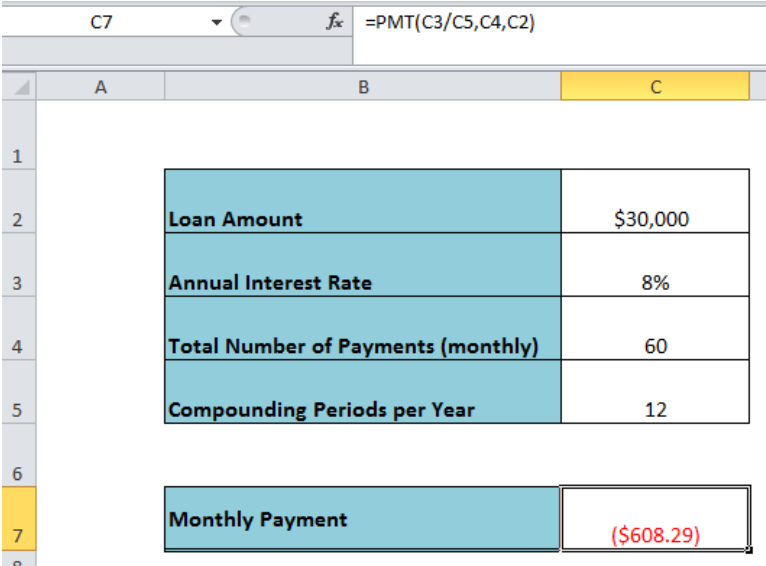
- Building Custom Calculators: You can set up cells for PV, r, and n, and then use the formula
=-PMT(rate, nper, pv)to calculate the payment. ThePMTfunction is specifically designed for this purpose.rate: The periodic interest rate (e.g.,B2/12if B2 contains the annual rate).nper: The total number of payments (e.g.,B3*12if B3 contains the term in years).pv: The present value or principal of the loan.
- Amortization Schedules: Spreadsheets can easily generate full amortization schedules, detailing how much principal and interest is paid with each installment, and showing the remaining balance over time.
Financial Apps and Software
Many personal finance apps and advanced financial software solutions offer integrated loan calculators as part of their broader budgeting and wealth management features.
- Their Role: These tools can track existing loans, automatically calculate payments, project debt payoff dates, and even model the impact of extra payments on your overall financial picture. They offer a holistic view of your debt obligations alongside your income and other expenses.
Beyond the Basic Payment: What Else to Consider
Calculating the basic payment is just the first step. A comprehensive understanding involves considering how other factors can influence your total cost and payment strategy.
The Impact of Extra Payments
Making additional payments towards your principal balance can significantly reduce the total interest paid and shorten the loan term. Since interest is calculated on the remaining principal, reducing the principal early means less interest accrues over the loan’s life. Many online calculators and spreadsheet models allow you to input extra payments to visualize these savings.
Understanding Total Cost of a Loan
While a low monthly payment might seem attractive, it’s essential to look at the total cost of the loan over its entire term.
- Total Interest Paid: This is the sum of all interest portions of your payments. A longer loan term typically results in a much higher total interest paid, even if the monthly payment is lower.
- Total Repayment Amount: Principal + Total Interest Paid. This figure provides the true cost of borrowing.
Refinancing and Its Implications
Refinancing involves taking out a new loan to pay off an existing one, usually to secure a lower interest rate, change the loan term, or convert between fixed and variable rates. When refinancing, you’ll go through a new payment calculation process with the new terms. This can lead to lower monthly payments, reduced total interest, or sometimes a longer overall repayment period if the new loan term is extended. Always compare the total costs of the old and new loans.
The Role of Escrow in Mortgage Payments
For many mortgages, the monthly payment includes not only principal and interest but also an escrow component. An escrow account is managed by your lender to collect funds for property taxes and homeowner’s insurance premiums. These funds are then paid out on your behalf when due. This means your “mortgage payment” is often higher than the principal and interest portion alone, and the escrow amount can fluctuate annually based on changes in taxes and insurance costs.
Strategies for Managing and Optimizing Loan Payments
Calculating your payment is a starting point; strategically managing it is where true financial empowerment lies.
Budgeting for Loan Payments
Integrate all your loan payments into your monthly budget. Ensure that your debt obligations are manageable relative to your income. Tools like the 50/30/20 rule (50% needs, 30% wants, 20% savings/debt repayment) can help structure your budget to accommodate loan payments without compromising other financial goals. A clear budget prevents missed payments and helps identify funds for extra principal payments.
Strategies for Early Repayment
If you have disposable income, applying it to loans can save substantial interest. Two popular methods include:
- Debt Snowball Method: Pay the minimum on all debts except the smallest one, which you attack with extra payments. Once the smallest is paid off, roll that payment amount into the next smallest debt, creating a “snowball” effect. This method provides psychological wins.
- Debt Avalanche Method: Pay the minimum on all debts except the one with the highest interest rate, which you attack with extra payments. Once that’s paid off, move to the next highest interest rate. This method is mathematically the most efficient, saving the most money on interest.
When to Seek Professional Financial Advice
For complex financial situations, large sums, or when considering significant financial decisions like multiple refinances or debt consolidation, consulting a certified financial planner or credit counselor is highly recommended. They can provide personalized advice, analyze your overall financial health, and help you strategize the most effective way to manage your loans and achieve your financial goals.

Conclusion
The ability to calculate loan payments is a foundational skill in personal finance, transforming abstract numbers into concrete, manageable figures. By understanding the core components – principal, interest, and term – and mastering the amortization formula, you gain clarity and control over your financial obligations. Furthermore, leveraging accessible tools like online calculators and spreadsheets enhances efficiency and accuracy. Beyond just the monthly payment, considering the total cost, the impact of extra payments, and the implications of refinancing equips you to make strategic decisions. Ultimately, an informed approach to calculating and managing your loan payments is a critical step towards financial stability and achieving your long-term wealth objectives.
aViewFromTheCave is a participant in the Amazon Services LLC Associates Program, an affiliate advertising program designed to provide a means for sites to earn advertising fees by advertising and linking to Amazon.com. Amazon, the Amazon logo, AmazonSupply, and the AmazonSupply logo are trademarks of Amazon.com, Inc. or its affiliates. As an Amazon Associate we earn affiliate commissions from qualifying purchases.