
Purchasing a car is often one of the most significant financial decisions an individual makes, second only to buying a home. For many, financing that purchase is a necessity, turning the dream of a new vehicle into a tangible reality. However, the world of car finance can appear daunting, filled with jargon and complex figures. Understanding “how to calculate car finance repayments” isn’t just about crunching numbers; it’s about empowering yourself with financial literacy, enabling you to make informed decisions that align with your budget and long-term financial goals.
The monthly repayment amount is more than just a figure; it’s a commitment that impacts your disposable income for years to come. A lack of understanding can lead to unexpected financial strain, higher overall costs, or even missed opportunities for saving and investing. By demystifying the calculation process, you gain control, negotiate more effectively, and ultimately drive away with a deal that truly suits you. This comprehensive guide will break down the mechanics of car finance repayments, offering insights, tools, and strategies to navigate this crucial aspect of car ownership confidently.
Understanding the Fundamentals of Car Finance
Before diving into the mathematical formulas, it’s essential to grasp the core components that dictate your monthly car finance repayments. These variables work in conjunction to determine the total cost of your loan and, consequently, the size of your regular payments.
Key Variables Influencing Repayments
Several critical factors contribute to the calculation of your car finance repayments:
- Principal Loan Amount (PV): This is the actual amount of money you borrow to buy the car after any deposit has been paid. It’s the starting point for all calculations. A higher principal naturally leads to higher repayments, all else being equal.
- Interest Rate (APR): The Annual Percentage Rate (APR) is perhaps the most significant factor after the principal. It represents the cost of borrowing money over a year, expressed as a percentage. It includes not just the interest rate but also any mandatory fees, giving you a more complete picture of the loan’s cost. A higher APR means more interest paid over the life of the loan, increasing your monthly repayments.
- Loan Term (n): This refers to the duration over which you agree to repay the loan, typically expressed in months or years. Common terms range from 24 to 72 months, sometimes even longer. While a longer loan term can reduce your monthly payments (spreading the cost over more installments), it almost always results in paying more interest overall because the lender has their money out for a longer period. Conversely, a shorter term means higher monthly payments but less total interest paid.
- Deposit: The initial lump sum you pay upfront reduces the principal loan amount. A larger deposit means you borrow less, which in turn lowers your monthly repayments and the total interest accrued over the loan term.
- Balloon Payment (for PCP/Lease): In certain finance agreements, particularly Personal Contract Purchase (PCP) or lease agreements, a significant lump sum payment is due at the end of the term. This “balloon payment” covers the predicted depreciation of the car over the loan period. While its presence means lower monthly payments during the agreement (as you’re only paying off the depreciation and interest, not the full car value), it represents a large financial obligation at the end if you choose to buy the car outright.
Types of Car Finance Agreements
The structure of the finance agreement also impacts how repayments are calculated and what they represent:
- Hire Purchase (HP): With HP, you essentially “hire” the car until you’ve paid off the full value plus interest. Your monthly repayments cover the entire cost of the car. At the end of the term, once all payments are made, you own the vehicle.
- Personal Contract Purchase (PCP): PCP offers lower monthly payments compared to HP because you’re not paying off the full value of the car. Instead, your payments cover the car’s depreciation over the agreement term, plus interest. At the end, you have three options: pay the balloon payment to own the car, return the car, or use any equity as a deposit for a new car.
- Personal Loan: You borrow a lump sum from a bank or credit union and use it to buy the car outright. Repayments are fixed monthly installments that include principal and interest. The car is immediately yours, and there’s no balloon payment or mileage restrictions from the lender, though the loan is unsecured or secured against the car itself.
Each type of finance has its own implications for repayment calculation and overall financial commitment, making it crucial to understand which one best suits your needs.
The Core Formula: Demystifying Repayment Calculation
At the heart of car finance repayment calculation is the amortization formula. While intimidating at first glance, understanding its components makes the process much clearer. This formula calculates the fixed monthly payment required to pay off a loan over a set period, including both principal and interest.
The Amortization Formula Explained
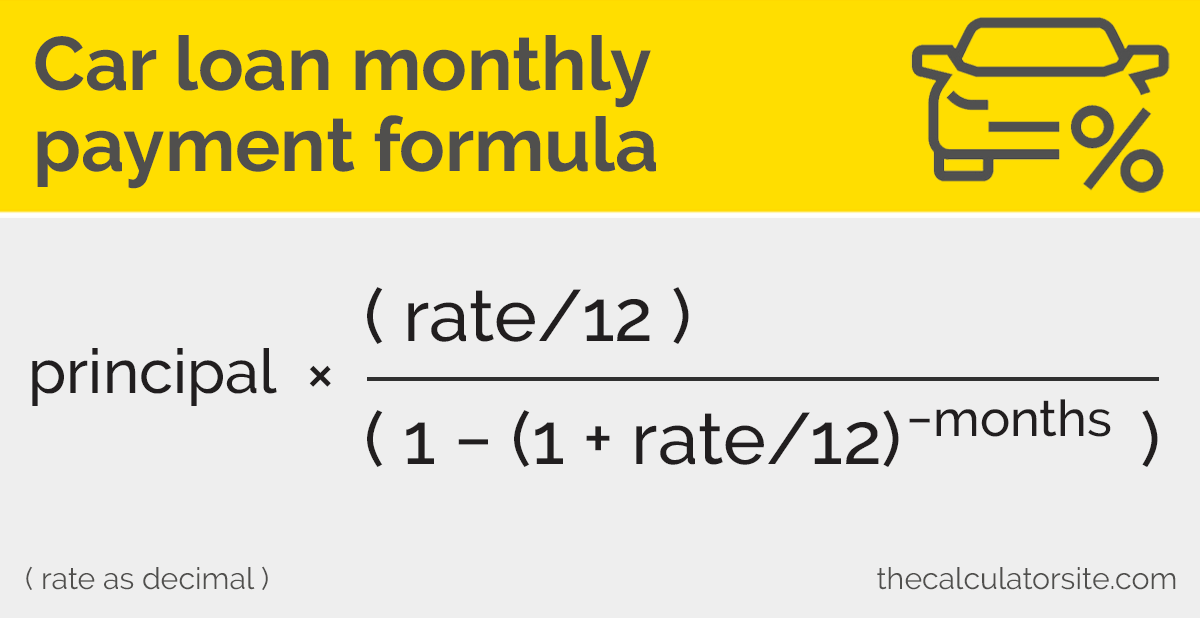
The standard formula for calculating fixed monthly loan repayments is:
M = P [ i(1 + i)^n ] / [ (1 + i)^n – 1]
Where:
- M = Monthly Payment
- P = Principal Loan Amount (the amount you borrow)
- i = Monthly Interest Rate (annual interest rate divided by 12)
- n = Total Number of Payments (loan term in months)
Let’s break down each component further:
- P (Principal Loan Amount): This is the cash price of the car minus any deposit you pay. If a car costs £20,000 and you put down a £2,000 deposit, your principal (P) is £18,000.
- i (Monthly Interest Rate): You’re usually quoted an Annual Percentage Rate (APR). To use it in the formula, you need to convert it to a monthly decimal rate.
- First, convert the APR from a percentage to a decimal:
APR / 100. - Then, divide that decimal by 12 to get the monthly rate:
(APR / 100) / 12. - For example, if the APR is 6%, then
i = (0.06 / 12) = 0.005.
- First, convert the APR from a percentage to a decimal:
- n (Total Number of Payments): This is the loan term expressed in months. If you have a 5-year loan,
n = 5 * 12 = 60.
Step-by-Step Calculation Example
Let’s walk through an example to solidify the understanding:
Scenario:
- Car Price: £25,000
- Deposit: £5,000
- APR: 7.2%
- Loan Term: 4 years (48 months)
Step 1: Determine the Principal Loan Amount (P)
P = Car Price – Deposit = £25,000 – £5,000 = £20,000
Step 2: Calculate the Monthly Interest Rate (i)
APR as decimal = 7.2 / 100 = 0.072
Monthly interest rate (i) = 0.072 / 12 = 0.006
Step 3: Determine the Total Number of Payments (n)
Loan Term in months (n) = 4 years * 12 months/year = 48 months
Step 4: Apply the Formula
M = P [ i(1 + i)^n ] / [ (1 + i)^n – 1]
M = 20,000 [ 0.006(1 + 0.006)^48 ] / [ (1 + 0.006)^48 – 1]
Let’s break down the exponent part first:
(1 + 0.006)^48 = (1.006)^48 ≈ 1.33231
Now substitute this back into the formula:
M = 20,000 [ 0.006 * 1.33231 ] / [ 1.33231 – 1 ]
M = 20,000 [ 0.00799386 ] / [ 0.33231 ]
M = 159.8772 / 0.33231
M ≈ £481.10
So, your estimated monthly repayment would be approximately £481.10.
Note: This formula is for a standard amortizing loan (like HP or a personal loan). PCP calculations are more complex as they factor in the guaranteed future value (balloon payment) and only amortize the depreciation amount, plus interest on the total amount borrowed.
Practical Tools and Resources for Calculation
While the manual calculation provides valuable insight, modern tools can simplify the process and offer quick, accurate estimates.
Online Car Finance Calculators

Numerous websites offer free, user-friendly car finance calculators. These tools typically require you to input the car price, deposit, loan term, and interest rate, and they instantly provide an estimated monthly repayment figure.
Benefits:
- Speed and Convenience: Get immediate results without complex math.
- Scenario Planning: Easily adjust variables (deposit, term, APR) to see how they impact repayments, helping you explore different financial scenarios.
- Comparison: Many calculators allow you to compare different loan offers side-by-side.
Limitations:
- Assumptions: Calculators may not account for all fees or specific terms of an agreement, especially for PCP deals.
- Accuracy: They provide estimates; the final figure from a lender might vary slightly.
- Generic: They might not incorporate specific factors like your credit score’s impact on your offered APR.
Spreadsheet Software (Excel/Google Sheets)
For those who prefer a more hands-on approach or need to manage multiple financial scenarios, spreadsheet software like Microsoft Excel or Google Sheets is incredibly powerful.
You can use built-in financial functions:
- PMT Function:
PMT(rate, nper, pv, [fv], [type])rate: The interest rate per period (monthly interest rate).nper: The total number of payments in the loan (loan term in months).pv: The present value, or the total value of all loan payments now (principal loan amount).fv(optional): The future value, or a cash balance you want to attain after the last payment is made. Default is 0 (relevant for PCP balloon payments).type(optional): When payments are due (0 for end of period, 1 for beginning).
Using the previous example: =PMT(0.006, 48, 20000) would yield approximately -£481.10 (negative because it’s an outflow). This method offers precision and the flexibility to build detailed amortization schedules.
Consulting Financial Advisors or Dealerships
While DIY calculations are empowering, don’t underestimate the value of professional advice.
- Financial Advisors: Can provide unbiased guidance on whether car finance fits into your broader financial plan and help you compare different options.
- Dealerships: Often have their own finance departments equipped with sophisticated software to calculate repayments precisely, taking into account current offers, your credit score, and specific vehicle details. They can also explain the nuances of their finance products, such as PCP agreements.
Beyond the Monthly Payment: Holistic Financial Considerations
While the monthly repayment figure is crucial, a truly informed decision requires looking beyond this single number and considering the broader financial implications of car ownership.
Total Cost of Ownership (TCO)
The monthly finance repayment is just one part of the equation. The Total Cost of Ownership (TCO) includes:
- Loan repayments (principal + interest): The focus of this guide.
- Insurance: A mandatory and significant ongoing cost.
- Fuel/Charging: Varies based on vehicle efficiency and usage.
- Maintenance and Servicing: Regular upkeep is essential.
- Road Tax/Vehicle Excise Duty: An annual government levy.
- Depreciation: The loss of value over time, especially relevant for PCP deals.
- Unexpected Repairs: Always a possibility.
Factoring in these costs gives you a realistic picture of the true financial burden of owning a car, preventing budget shocks down the line.
Impact of Your Credit Score
Your credit score plays a pivotal role in the interest rate you’ll be offered. Lenders assess your creditworthiness to determine the risk of lending to you. A higher credit score typically translates to lower interest rates and, consequently, lower monthly repayments and total loan costs. Conversely, a poor credit score can lead to higher APRs or even rejection of finance applications. Before applying for car finance, it’s wise to check your credit score and take steps to improve it if necessary.
Budgeting for Car Ownership
Integrating car repayments and associated costs into your overall budget is non-negotiable. Ensure that the total monthly outgoing for your car (finance + insurance + fuel + maintenance buffer) is comfortably affordable within your income, leaving room for other expenses, savings, and emergencies. A common rule of thumb is that total car expenses should not exceed 10-15% of your net monthly income. Overstretching your budget for a car can lead to financial stress and hinder other financial goals.
Strategies for Optimizing Your Car Finance
With a solid understanding of how repayments are calculated, you can proactively implement strategies to secure a more favourable finance deal.
Maximizing Your Deposit
As demonstrated earlier, a larger upfront deposit directly reduces the principal loan amount. This lowers your monthly repayments and, critically, the total amount of interest you’ll pay over the loan term. If possible, save aggressively for a substantial deposit before purchasing a car.
Careful Consideration of Loan Term
While extending the loan term reduces monthly payments, it invariably increases the total interest paid over the life of the loan. Strive for the shortest loan term that you can comfortably afford. This strategy minimizes interest charges and allows you to own the car outright sooner, freeing up your monthly budget for other financial pursuits. Always balance monthly affordability with the total cost implications.
Improving Your Credit Score
Prior to applying for car finance, dedicate time to enhancing your credit score. This involves:
- Paying bills on time.
- Reducing existing debt.
- Avoiding new credit applications in the months leading up to a car purchase.
- Checking your credit report for errors.
A higher credit score signals lower risk to lenders, enabling you to qualify for more competitive interest rates and better terms.
Shopping Around for the Best Rates
Never settle for the first finance offer you receive. Approach multiple lenders – banks, credit unions, online finance brokers, and even dealership finance departments – to compare their APRs and terms. Even a small difference in the interest rate can translate to hundreds or thousands of pounds in savings over the loan term. Be sure to compare like-for-like products (e.g., HP from one lender against HP from another).
Negotiating the Car Price
Remember that the principal loan amount starts with the price of the car itself. Negotiating a lower purchase price for the vehicle will directly reduce the amount you need to borrow, thus decreasing both your monthly repayments and the total interest. Don’t be afraid to haggle; a few hundred pounds off the car’s price can have a noticeable impact on your finance deal.

Conclusion
Calculating car finance repayments doesn’t have to be a mystery. By understanding the key variables, the underlying mathematical formulas, and the various finance structures, you equip yourself with the knowledge to navigate the complex world of car loans. Whether you use online calculators, spreadsheet functions, or the detailed guidance of a financial professional, taking the time to understand your financial commitment is an investment in your financial well-being.
Beyond the numbers, remember to consider the holistic costs of car ownership and align your finance choices with your broader financial goals. By applying smart strategies like maximizing your deposit, optimizing your loan term, improving your credit score, and diligently shopping for the best rates, you can secure a car finance deal that is not only affordable but also financially sound. Empower yourself with this knowledge, and drive away with confidence, knowing you’ve made a truly informed and intelligent decision.
aViewFromTheCave is a participant in the Amazon Services LLC Associates Program, an affiliate advertising program designed to provide a means for sites to earn advertising fees by advertising and linking to Amazon.com. Amazon, the Amazon logo, AmazonSupply, and the AmazonSupply logo are trademarks of Amazon.com, Inc. or its affiliates. As an Amazon Associate we earn affiliate commissions from qualifying purchases.