
The question of Bitcoin’s original price is complex, lacking a straightforward answer typical of traditional assets. Unlike a company stock that launches with an Initial Public Offering (IPO) at a predetermined price, Bitcoin emerged from a purely conceptual framework, gradually acquiring value through computation, bartering, and eventually, formal exchange. To truly understand its genesis price, one must delve into its origins as a digital experiment and trace its journey from a cryptographic curiosity to a global financial phenomenon.
The Genesis of a Digital Currency
Bitcoin’s journey began not with a price tag, but with an idea and a technical solution. Its conceptual birth laid the groundwork for its subsequent valuation, which was initially non-existent in monetary terms.
Satoshi Nakamoto’s Vision
In October 2008, an anonymous entity known as Satoshi Nakamoto published a whitepaper titled “Bitcoin: A Peer-to-Peer Electronic Cash System.” This seminal document outlined a revolutionary concept: a decentralized digital currency free from government or financial institution control, secured by cryptography. Nakamoto’s vision was to create a system for online payments that did not require a trusted third party, thereby addressing issues of trust and cost inherent in traditional financial systems. The immediate goal was functionality and security, not market valuation.
The Whitepaper and Initial Code Release
The whitepaper was followed by the release of the Bitcoin software client in January 2009. On January 3, 2009, the first block of the Bitcoin blockchain, known as the “genesis block,” was mined. This block contained a cryptic message embedded by Nakamoto: “The Times 03/Jan/2009 Chancellor on brink of second bailout for banks.” This message served as both a timestamp and a commentary on the prevailing financial crisis, underscoring Bitcoin’s potential as an alternative to a failing traditional banking system. At this point, Bitcoin had no monetary value; its “price” was simply the computational effort and electricity consumed by early adopters to mine new blocks and earn the first batches of BTC. These initial coins were mined for virtually nothing beyond the cost of hardware and power, effectively establishing a theoretical “original price” of zero for the digital asset itself.
Pricing in the Earliest Days: More Concept Than Commodity
For months after its inception, Bitcoin remained an obscure project among cryptographers and tech enthusiasts. Its valuation was not in dollars or euros, but in its utility as a proof-of-concept and the intellectual curiosity it inspired.
The First Transactions: Computing Power for Coins
In its infancy, Bitcoin’s “price” was implicitly tied to the cost of mining. Early miners used readily available CPUs to process transactions and secure the network, receiving 50 Bitcoins per block as a reward. The electricity cost was minimal, and the hardware was common. Therefore, the “original price” from a mining perspective was effectively the marginal cost of computing power and electricity, which for an individual miner could be fractions of a cent per Bitcoin, or even less, given the nascent state of the network and the abundance of easy blocks. These first Bitcoins were not purchased; they were generated.
The first recorded peer-to-peer Bitcoin transaction for something other than mining rewards occurred on January 12, 2009, when Satoshi Nakamoto sent 10 Bitcoins to Hal Finney, a renowned cryptographer. This was a technical transaction, not a commercial one, further illustrating Bitcoin’s initial lack of a market price.
The Pizza Transaction: A Landmark Valuation
The most famous early transaction that assigned a real-world value to Bitcoin occurred on May 22, 2010. Laszlo Hanyecz, a programmer in Florida, made history by paying 10,000 Bitcoins for two Papa John’s pizzas. At the time, 10,000 Bitcoins were worth approximately $41, based on the exchange rate established by an early Bitcoin forum member who facilitated the purchase. This transaction, now celebrated annually as “Bitcoin Pizza Day,” is widely regarded as the first commercial transaction using Bitcoin and provides the earliest concrete valuation of the cryptocurrency in fiat terms. This implies that on May 22, 2010, the “price” of one Bitcoin was roughly $0.0041 (less than half a cent).
Early Exchanges and Minimal Value
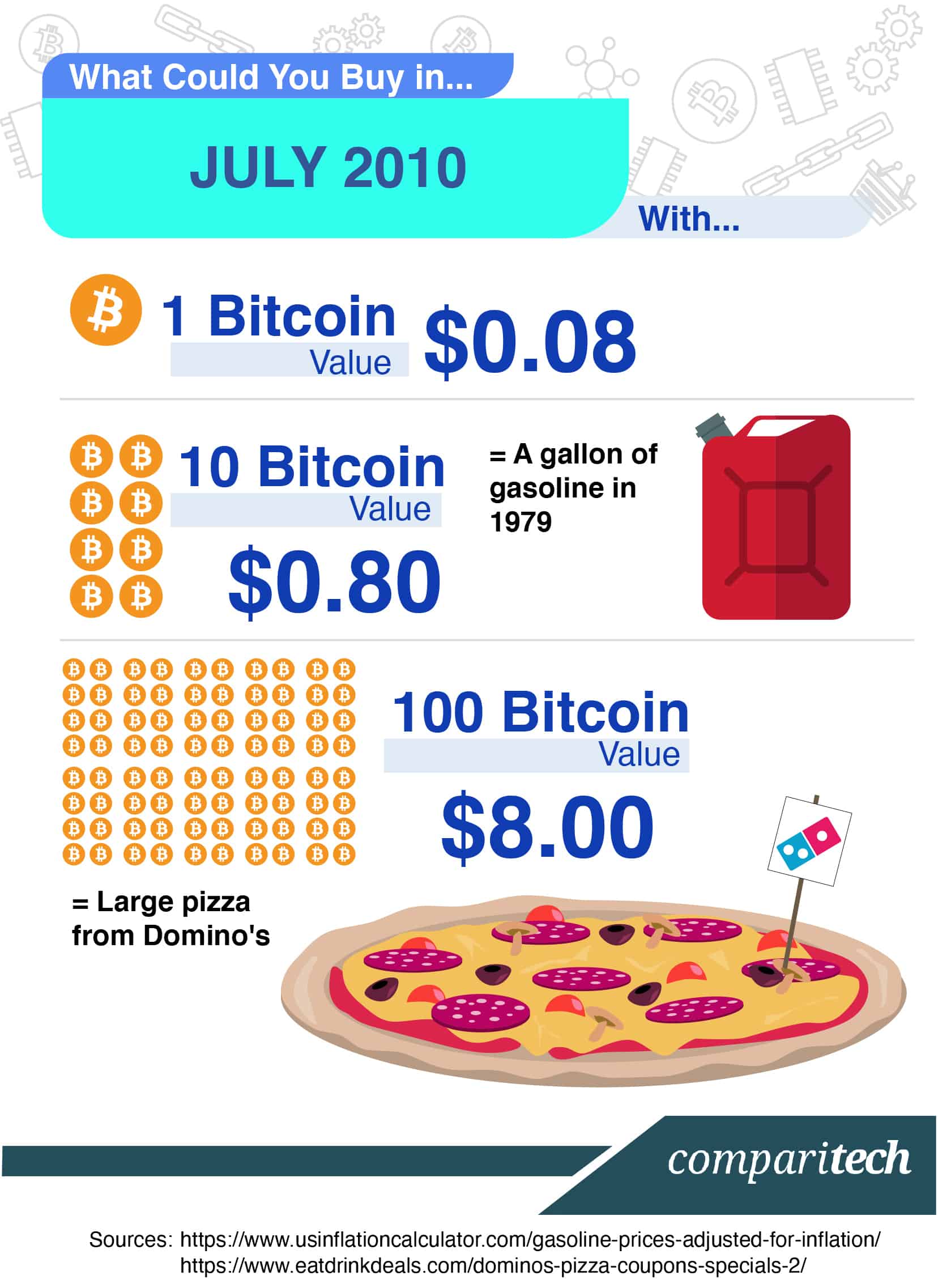
Shortly after the pizza transaction, rudimentary exchanges began to emerge, allowing users to trade Bitcoin for fiat currency. The first such exchange, BitcoinMarket.com, launched in March 2010. Prices on these early platforms were extremely low and highly volatile. For instance, in July 2010, Bitcoin’s price first crossed $0.08 per coin on these nascent exchanges. These were the very beginnings of a market-driven price, but even then, the asset was largely unknown, and its trading volume was minuscule, making its “original price” a moving target defined by minimal liquidity and speculative interest.
From Pennies to Prominence: Bitcoin’s Price Evolution
The period following these initial transactions marked Bitcoin’s transition from a niche experiment to a nascent financial asset, experiencing dramatic fluctuations that would become its hallmark.
The First Significant Price Jumps (2010-2011)
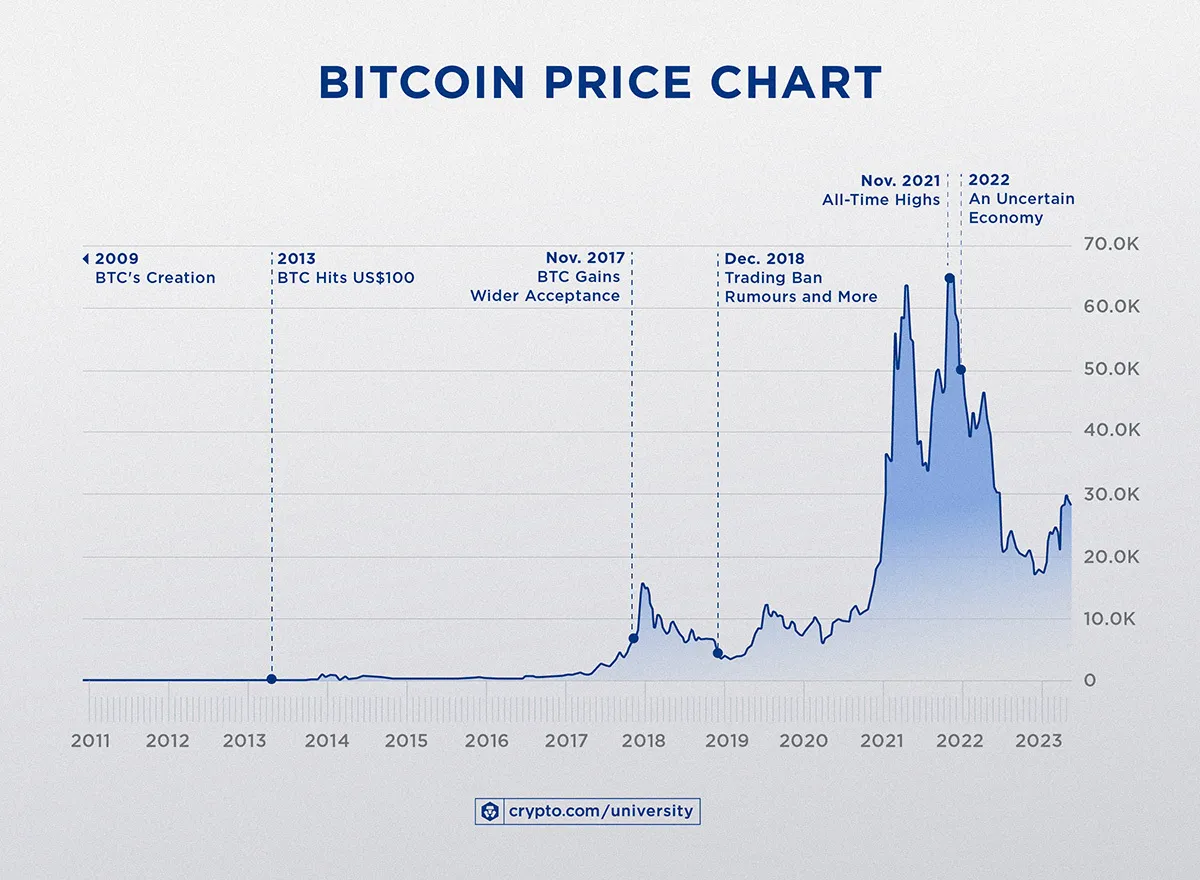
Bitcoin’s price first saw significant upward movement in late 2010 and early 2011. By February 2011, it reached parity with the US dollar, trading at $1 per Bitcoin. This milestone marked a psychological turning point, demonstrating that a purely digital currency could hold tangible value. The price continued to climb, briefly touching $31 in June 2011 before crashing back down due to various factors, including security breaches on early exchanges like Mt. Gox. These early boom-and-bust cycles established Bitcoin’s reputation for extreme volatility, a characteristic that remains relevant for investors today.
Volatility as a Defining Characteristic
From its very low original “price” points, Bitcoin’s valuation has been characterized by sharp, often unpredictable, price swings. This volatility is a function of its relatively small market cap compared to traditional assets, its decentralized nature, speculative trading, technological developments, regulatory news, and macroeconomic factors. For early investors, this volatility presented both immense risk and unprecedented reward, transforming initial investments of mere dollars into fortunes. Understanding this historical volatility is crucial for any investor considering an allocation to digital assets.
The Role of Supply and Demand in a Decentralized System
Bitcoin’s price, like any asset, is fundamentally driven by supply and demand. However, its decentralized and algorithmically controlled supply schedule makes it unique. The total supply of Bitcoin is capped at 21 million coins, ensuring scarcity. The rate at which new Bitcoins are introduced into circulation is halved approximately every four years, an event known as the “halving.” This predictable reduction in supply, coupled with growing demand from individuals, institutional investors, and corporations, has been a key driver in its long-term price appreciation from its near-zero initial valuation. The limited supply creates a powerful economic incentive, contrasting sharply with fiat currencies that can be printed infinitely by central banks.
Understanding Bitcoin’s Historical Context for Modern Investors
For current and prospective investors, understanding Bitcoin’s journey from a zero-value concept to a multi-trillion-dollar asset offers invaluable lessons in risk, innovation, and long-term financial strategy.
The Risk and Reward of Early Adoption
The “original price” of Bitcoin was effectively the cost of belief and computational effort. Those who mined or acquired Bitcoin in its earliest days took on immense risk. There was no guarantee of its success, no regulatory framework, and significant technical hurdles. However, for those who did, the financial rewards have been astronomical. This illustrates a fundamental principle in investing: higher potential returns often come with higher risk. Early adoption of groundbreaking technologies can lead to exponential gains, but it requires foresight, patience, and a high tolerance for uncertainty.
Long-Term Hodling vs. Speculation
The history of Bitcoin’s price strongly supports the concept of “hodling” (a deliberate misspelling of “holding”), which refers to buying and holding Bitcoin for the long term, often through market volatility. While short-term trading based on speculation can be profitable, the most significant gains have been realized by those who acquired Bitcoin at its near-zero or penny prices and held onto it for years. This strategy aligns with the investment philosophy of buying into disruptive technologies early and allowing their long-term value proposition to materialize.
Regulatory Landscape and Institutional Interest
Bitcoin’s journey from an obscure digital token to a recognized asset has been paralleled by an evolving regulatory landscape and increasing institutional interest. Initially operating in a regulatory vacuum, governments worldwide are now grappling with how to classify and regulate cryptocurrencies. Simultaneously, major financial institutions, corporations, and even sovereign nations have begun to invest in or adopt Bitcoin, lending it further legitimacy and contributing to its demand. This institutionalization is a stark contrast to its early days when its value was primarily driven by a small community of enthusiasts, and it profoundly impacts its price stability and perceived value today.
Beyond Price: Bitcoin’s Enduring Financial Impact
While its historical price journey is fascinating, Bitcoin’s ultimate significance extends beyond its monetary value to its potential to reshape global finance.
Disrupting Traditional Finance
Bitcoin’s creation introduced the world to blockchain technology and the concept of decentralized finance (DeFi). It challenged the traditional banking system by offering a transparent, censorship-resistant, and permissionless financial network. This disruption impacts everything from cross-border payments to asset tokenization and has spawned an entire industry of alternative financial tools and services, creating new avenues for online income and investment.
A Hedge Against Inflation?
As governments worldwide have engaged in quantitative easing and increased money supply, the debate over Bitcoin’s role as a hedge against inflation has intensified. Its capped supply and decentralized nature position it as a potential “digital gold” – a scarce asset that could retain value when fiat currencies lose purchasing power. This narrative contributes to its appeal among investors seeking to diversify their portfolios and protect their wealth from inflationary pressures, a stark contrast to its initial status where inflation was merely an abstract economic concept unrelated to its practical function.
Accessibility and Financial Inclusion
Bitcoin’s original premise of a peer-to-peer electronic cash system has broad implications for financial inclusion. For billions worldwide who are unbanked or underbanked, Bitcoin and other cryptocurrencies offer a pathway to access financial services, make remittances, and participate in the global economy without needing traditional banking infrastructure. This aspect underscores its potential not just as an investment vehicle but as a tool for economic empowerment, far removed from its initial technical valuation, yet intrinsically linked to the vision of its creator.
In conclusion, Bitcoin’s original price was not a single, fixed number but a progression from non-existent to computationally derived, then to a few fractions of a cent, finally gaining tangible market value through real-world transactions and the establishment of early exchanges. Its incredible journey from a novel idea to a significant financial asset provides invaluable insights for anyone navigating the complexities of modern investment and the evolving landscape of global finance.
aViewFromTheCave is a participant in the Amazon Services LLC Associates Program, an affiliate advertising program designed to provide a means for sites to earn advertising fees by advertising and linking to Amazon.com. Amazon, the Amazon logo, AmazonSupply, and the AmazonSupply logo are trademarks of Amazon.com, Inc. or its affiliates. As an Amazon Associate we earn affiliate commissions from qualifying purchases.