
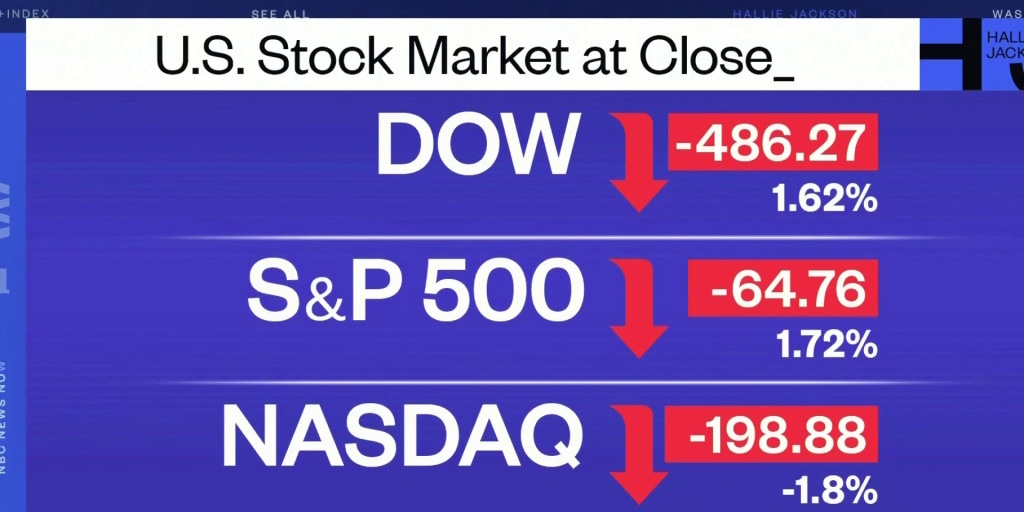
Every evening, financial news outlets and countless apps flash a singular, crucial piece of information: the closing value of the Dow Jones Industrial Average (DJIA). For millions, it’s more than just a number; it’s a barometer for the market’s health, a snapshot of economic sentiment, and often, a trigger for both optimism and concern. Understanding “where the Dow ended today” goes far beyond a simple quote; it requires delving into the intricate web of economic forces, corporate actions, and investor psychology that dictate its daily dance. This article aims to unpack the significance of the Dow’s daily close, explore the myriad factors that drive its movements, and provide an insightful framework for interpreting its implications for investors and the broader economy.
The Pulse of the Market: Understanding the Dow Jones Industrial Average
To truly grasp the meaning behind the Dow’s daily performance, one must first appreciate what it represents. Far from being a mere collection of stock prices, the DJIA is a carefully constructed index designed to reflect the health and direction of the U.S. industrial sector and, by extension, the broader American economy.
What is the DJIA and Why Does it Matter?
The Dow Jones Industrial Average, established in 1896, is one of the oldest and most frequently cited stock market indexes in the world. It comprises 30 of the largest and most influential publicly traded companies in the United States, often referred to as “blue-chip” stocks. These companies span various sectors, from technology and manufacturing to finance and consumer goods, making the index a diverse, albeit selective, representation of American corporate power. Unlike market-capitalization-weighted indexes like the S&P 500, the DJIA is a price-weighted index, meaning companies with higher share prices have a greater impact on the index’s value, regardless of their total market capitalization.
Its significance stems from its historical role as a bellwether for economic conditions. When the Dow moves up, it often signals investor confidence in corporate earnings and future economic growth. Conversely, a downward trend can suggest concerns about recessions, inflation, or geopolitical instability. While critics sometimes point to its limited number of components or its price-weighting methodology as drawbacks, the Dow remains an indispensable tool for gauging market sentiment and understanding the daily narrative of the U.S. stock market. For many individual investors, it’s the first number they check, providing a quick, albeit often superficial, read on their portfolio’s potential trajectory.
Beyond the Numbers: Interpreting Daily Fluctuations
Simply knowing “where the Dow ended today” — whether it was up 150 points or down 300 points — tells only part of the story. The true insight lies in interpreting these daily fluctuations within a broader context. A gain of 100 points might be seen as modest on a day of widespread positive economic news, while the same gain on a day of otherwise negative headlines could be interpreted as a sign of resilience. Similarly, a decline might be easily explainable by specific corporate news, or it could signal a deeper underlying concern about systemic risks.
Effective interpretation requires looking beyond the raw change in points or percentage. It demands an understanding of the day’s market internals: were most stocks up or down? Which sectors led the gains or losses? What was the trading volume like? High volume accompanying a significant move often suggests strong conviction behind that move, whereas low volume might indicate a lack of broad participation and less meaningful direction. Furthermore, comparing the Dow’s performance to other major indexes, such as the S&P 500 (which is broader and market-cap weighted) or the Nasdaq Composite (tech-heavy), provides a more holistic view of which segments of the market are driving the overall trend. A strong Dow on a weak Nasdaq, for instance, might indicate a rotation from growth stocks to value stocks, signaling a shift in investor preference.
Dissecting the Day’s Drivers: What Moved the Dow?
The daily movement of the Dow is not random; it’s the result of countless inputs being processed by millions of market participants. Understanding these drivers is key to discerning the narrative behind each day’s close.
Economic Indicators and Federal Reserve Influence
Macroeconomic data plays a colossal role in shaping market sentiment. Reports on inflation (Consumer Price Index, Producer Price Index), employment (jobs reports, unemployment rates), GDP growth, manufacturing activity, and consumer confidence are closely watched. Strong economic data often fuels optimism, leading to upward movements, as it suggests healthy corporate earnings and consumer spending. Conversely, weak data can trigger fears of recession or slowing growth, prompting sell-offs.
Perhaps the single most influential factor is the Federal Reserve’s monetary policy. The Fed’s decisions regarding interest rates (the federal funds rate), quantitative easing or tightening, and its forward guidance on economic outlook can send powerful ripples through the market. Higher interest rates, for instance, can increase borrowing costs for companies and consumers, potentially slowing economic growth and making future earnings less attractive, often leading to market declines. Traders scrutinize every word from Fed officials, and expectations around upcoming Federal Open Market Committee (FOMC) meetings frequently dictate pre-market and intra-day trading patterns, directly impacting where the Dow ultimately settles.
Corporate Earnings and Sectoral Performance
While the Dow is an aggregate index, its components are individual companies, and their fortunes directly impact the index. Quarterly earnings reports are major catalysts. When a Dow component announces stronger-than-expected earnings or provides an optimistic outlook, its stock price typically rises, contributing positively to the index. Conversely, a miss on earnings or a downgraded outlook can drag the index down. The cumulative effect of these 30 companies’ performances can significantly shift the Dow’s daily close.
Beyond individual company performance, broader sectoral trends also play a role. If a particular sector, such as technology or financials, is experiencing tailwinds (e.g., increased demand for software, rising interest rates benefiting banks), the Dow components within that sector will likely see gains, pulling the overall index higher. Conversely, headwinds for a dominant sector can exert downward pressure. This “sector rotation” is a constant feature of market dynamics, where investor capital shifts from one industry to another based on economic outlook and perceived growth opportunities. Understanding which sectors are leading or lagging on any given day provides critical context for the Dow’s movement.
Geopolitical Events and Global Market Dynamics
In an increasingly interconnected world, events beyond domestic economic reports can profoundly impact the Dow. Geopolitical developments, such as international conflicts, trade disputes, or significant political shifts in major global economies, can introduce uncertainty and volatility. For example, a new tariff imposed by the U.S. on goods from a major trading partner could disrupt supply chains and hurt the profitability of multinational Dow components, causing the index to fall. Similarly, fluctuations in global commodity prices, like oil, can have widespread effects, impacting everything from manufacturing costs to consumer spending habits.
Global market dynamics also play a role. A significant downturn in European or Asian markets can spill over into U.S. trading, as investors react to global economic anxieties or seek to de-risk their portfolios across different regions. Currency fluctuations, particularly the strength or weakness of the U.S. dollar, can also influence the earnings of multinational corporations, thereby affecting the Dow. The interconnectedness means that no market operates in isolation; the Dow’s close today can be a reflection of news that broke thousands of miles away hours earlier.
Investor Sentiment and Technical Factors
Finally, human psychology and technical trading strategies exert significant influence. Investor sentiment—the prevailing mood of optimism or pessimism—can create self-fulfilling prophecies. If investors collectively believe the market is headed higher, they buy, pushing prices up. If fear grips the market, a stampede to sell can rapidly drive prices down. Indicators like the CBOE Volatility Index (VIX), often called the “fear index,” provide a measure of expected market volatility driven by options trading, giving insight into prevailing sentiment.
Technical analysis, which studies past market data, primarily price and volume, to forecast future price movements, also contributes to daily Dow movements. Chart patterns, support and resistance levels, moving averages, and other technical indicators are used by traders to identify entry and exit points. Large institutional traders and algorithmic trading systems, programmed to execute trades based on these technical signals, can collectively exert substantial influence, amplifying trends or triggering reversals as certain price thresholds are met. This interplay of human emotion and automated trading creates a complex, often unpredictable, dynamic that contributes to where the Dow finally lands each day.
The Short-Term View vs. The Long-Term Vision for Investors
For individual investors, the Dow’s daily close can be an emotional trigger. A positive day can instill confidence, while a negative one might spark worry. However, a crucial distinction must be made between short-term market noise and long-term investment strategy.
Navigating Daily Volatility: When to React (and When Not To)
Reacting impulsively to every daily swing in the Dow is a common pitfall for many investors. “Where did the Dow end today?” becomes a question of immediate portfolio impact, often leading to emotional decisions like panic selling during downturns or chasing gains during rallies. This short-term, reactive approach rarely yields favorable long-term results. Markets are inherently volatile, and daily movements are often driven by transient news cycles or minor adjustments.
Successful long-term investing requires discipline and a strong psychological constitution. Rather than fixating on daily closes, investors should focus on the underlying fundamentals of their investments and their personal financial goals. Unless there is a fundamental change in an investment’s thesis or one’s personal financial situation, short-term market noise should generally be filtered out. Overreacting to a single day’s Dow performance can lead to costly mistakes, such as locking in losses or missing out on subsequent recoveries. It’s often said that “time in the market beats timing the market” – a principle that underscores the importance of a patient, long-term perspective.
Strategic Allocation and Diversification
While the Dow provides a snapshot of the blue-chip sector, a robust investment strategy extends far beyond it. Strategic asset allocation involves spreading investments across different asset classes, such as stocks, bonds, real estate, and commodities, based on an individual’s risk tolerance, time horizon, and financial objectives. This diversification helps to mitigate risk, ensuring that a downturn in one asset class doesn’t devastate the entire portfolio. For instance, while the Dow might be down, bonds or gold might be performing well, providing a buffer.
Within the equity portion of a portfolio, diversification extends to investing in a wide range of companies, sectors, market capitalizations (small-cap, mid-cap, large-cap), and geographical regions, not just the 30 companies in the Dow. This broad exposure ensures that an investor is not overly reliant on the performance of a few specific companies or segments of the market. A well-diversified portfolio is designed to weather the inevitable storms of market volatility, allowing investors to stay committed to their long-term growth objectives despite daily market headlines.
The Importance of a Financial Plan
Ultimately, the best defense against the emotional rollercoaster of daily market movements is a well-defined financial plan. This plan should articulate clear financial goals (e.g., retirement, home purchase, education), establish a realistic timeline, and define an appropriate risk profile. A comprehensive plan, often developed with the help of a qualified financial advisor, provides a roadmap that helps investors stay focused on their objectives, rather than being swayed by the Dow’s daily closing number.
A financial plan also incorporates strategies for dealing with market fluctuations, such as dollar-cost averaging (investing a fixed amount regularly, regardless of market highs or lows) and periodic rebalancing (adjusting the portfolio back to its target asset allocation). With a clear plan in place, “where did the Dow end today?” becomes less of a source of anxiety and more of an interesting data point that informs, but does not dictate, investment decisions. It reinforces the wisdom of long-term perspective and disciplined execution over reactive trading.
Broader Economic Implications and What Lies Ahead
Beyond individual investors, the Dow’s daily performance carries broader implications for the economy and offers hints about future trends.
The Dow as an Economic Barometer
While not a perfect predictor, the Dow is widely considered an important economic barometer. Its movements can signal changes in consumer confidence and business investment plans. A consistently strong Dow can indicate a healthy economy, encouraging businesses to invest more, expand operations, and hire, while also making consumers feel wealthier and more inclined to spend. Conversely, a sustained downturn can foreshadow slower economic growth, reduced business activity, and tighter consumer wallets. Policymakers and economists frequently refer to market performance, including the Dow, as one of several indicators they monitor to assess the state of the economy. It’s a reflection, often in real-time, of how market participants perceive the current and future economic landscape.
Key Events to Watch in the Coming Days/Weeks
To anticipate where the Dow might head next, investors and analysts closely monitor upcoming events. This includes scheduled economic data releases (e.g., next month’s inflation report, jobless claims, retail sales figures), corporate earnings season (when all the Dow components and other companies report their quarterly results), and central bank announcements (like the next FOMC meeting). Geopolitical developments, such as ongoing negotiations, elections, or international summits, also remain firmly on the radar. Staying informed about this economic calendar and significant global news flow is essential for understanding potential catalysts for market movements and forming a more informed view of where the Dow might end tomorrow.

Cultivating Financial Literacy in a Dynamic Market
In a world where information is abundant but wisdom is scarce, cultivating financial literacy is paramount. Understanding how markets function, what drives their movements, and how to interpret complex financial data empowers individuals to make more informed decisions. It involves continuous learning, seeking out reputable sources of financial news and analysis, and critically evaluating information. Relying on superficial headlines or social media chatter can be misleading.
Developing financial literacy means not just knowing “where the Dow ended today,” but understanding why it ended there, what the implications are, and how that information fits into one’s own financial strategy. It’s about recognizing that market dynamics are constantly evolving and that staying educated and disciplined is the most reliable path to achieving long-term financial success. The Dow’s daily close is a fascinating data point, a culmination of the day’s financial narrative, and a reminder of the dynamic interplay between economics, politics, and human behavior that shapes our financial world.
aViewFromTheCave is a participant in the Amazon Services LLC Associates Program, an affiliate advertising program designed to provide a means for sites to earn advertising fees by advertising and linking to Amazon.com. Amazon, the Amazon logo, AmazonSupply, and the AmazonSupply logo are trademarks of Amazon.com, Inc. or its affiliates. As an Amazon Associate we earn affiliate commissions from qualifying purchases.