
In the realm of personal finance and investment, numbers are the primary language. However, the most critical dialect of that language isn’t addition or subtraction—it is the percentage. Whether you are calculating the annual return on a brokerage account, determining the impact of inflation on your purchasing power, or trying to understand the interest rate on a high-yield savings account, knowing how to find the percent of a number is a foundational skill.
Financial literacy is often gatekept by complex jargon, yet at its core, most wealth-building strategies rely on basic proportional relationships. Mastering these calculations allows an individual to move from a passive consumer to an active strategist of their own capital. This guide explores the mathematical mechanics of percentages specifically through the lens of money management, providing you with the tools to optimize your fiscal health.

The Foundation of Financial Literacy: Why Percentages Matter
In finance, absolute numbers can often be misleading. A $500 profit might sound substantial, but its significance changes entirely depending on whether you invested $1,000 or $100,000 to get it. This is why percentages are the “great equalizer” in the financial world. They provide context, allowing you to compare different financial instruments on an apples-to-apples basis.
Decoding the Mathematics of Capital
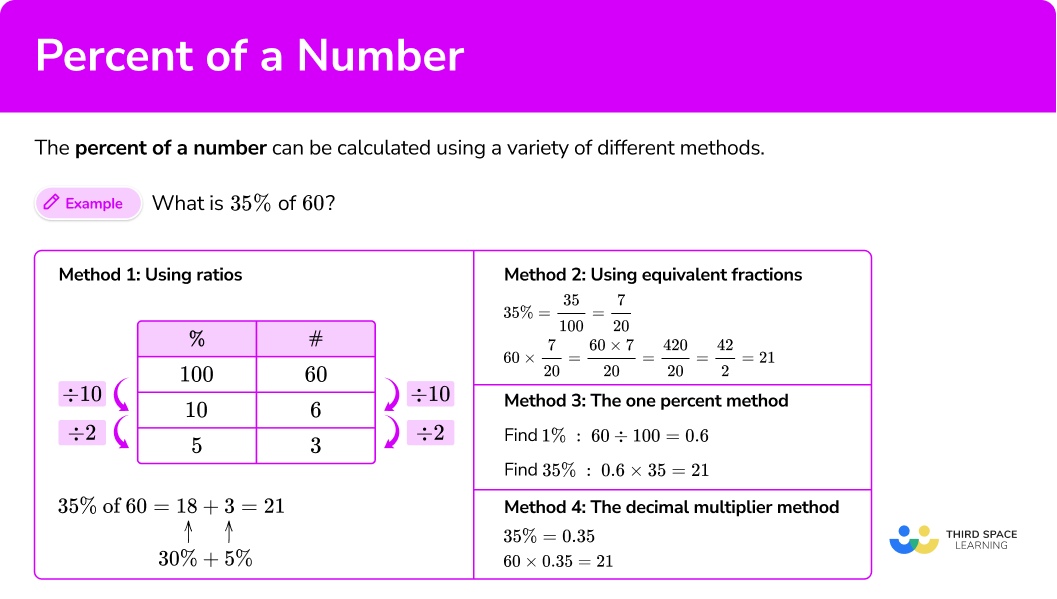
To find the percent of a number in a financial context, you are essentially determining a portion of a whole based on a scale of 100. The formula is straightforward:
Result = (Percentage / 100) × Total Amount
For example, if you want to find 5% of a $2,000 investment (perhaps a common management fee or a dividend yield), you convert 5% into a decimal (0.05) and multiply it by $2,000. The result, $100, represents your cost or gain. Understanding this basic movement—from percentage to decimal to final value—is the first step in auditing your bank statements and investment portfolios.
Why Mental Math Saves You Money
While we carry sophisticated calculators in our pockets, the ability to perform mental percentage calculations is a hallmark of a financially savvy individual. When you are at a car dealership or sitting across from a financial advisor, being able to quickly calculate that a 1.5% “hidden fee” on a $50,000 asset equals $750 annually can change the trajectory of the conversation.
A quick trick for mental math is the “10% Rule.” To find 10% of any number, simply move the decimal point one place to the left. To find 5%, find 10% and cut it in half. To find 1%, move the decimal two places to the left. Using these building blocks, you can dismantle complex financial offers in real-time.
Essential Formulas for Savvy Investors and Budgeters
Once you move past simple calculations, percentages become the primary tool for measuring growth and loss. In the world of “Money,” two specific applications of percentages reign supreme: Return on Investment (ROI) and Percent Change.
Calculating ROI (Return on Investment)
The most common question in investing is: “How well is my money working for me?” To answer this, we use the ROI formula, which is essentially a percentage calculation of profit relative to cost.
ROI = [(Current Value – Original Cost) / Original Cost] × 100
If you bought a stock for $150 and it is now worth $180, your absolute gain is $30. To find the percentage, you divide $30 by the original $150, resulting in 0.20, or a 20% return. This percentage allows you to compare that stock’s performance against other assets, such as real estate or bonds, which may have entirely different price points.
Managing Debt with Interest Rate Calculations
Conversely, percentages can work against you in the form of interest. When you carry a balance on a credit card with an Annual Percentage Rate (APR) of 24%, you aren’t just paying back what you borrowed; you are paying a “rent” on that money.

To find the monthly interest charge on a balance, you take the annual percentage (24%), divide it by 12 months to get the monthly rate (2%), and then find 2% of your average daily balance. If you owe $3,000, 2% of that is $60. Understanding this math is often the catalyst people need to prioritize debt “avalanche” or “snowball” methods, as they see the literal cost of the percentage.
The Rule of 72 and Percentage Growth
For those looking at long-term wealth, the “Rule of 72” is a shortcut that uses percentages to estimate how long it will take for an investment to double. You simply divide 72 by your annual fixed percentage rate of return. If your index fund returns 8% annually, 72 divided by 8 equals 9. It will take approximately nine years to double your money. This illustrates the power of compound interest, which is essentially “a percentage of a percentage” growing over time.
Strategic Budgeting: Using Percentages to Allocate Income
A common mistake in personal finance is budgeting with fixed dollar amounts rather than percentages. A fixed budget is rigid; it breaks when your income fluctuates. A percentage-based budget is dynamic and scales with your career growth.
The 50/30/20 Rule
The most famous percentage-based budgeting framework is the 50/30/20 rule. It suggests that:
- 50% of your income should go to “Needs” (housing, utilities, groceries).
- 30% of your income should go to “Wants” (dining out, hobbies, travel).
- 20% of your income should go to “Financial Goals” (debt repayment, emergency fund, investments).
By learning how to find these percentages of your take-home pay, you ensure that as your salary increases, your savings increase proportionally. If your monthly pay is $4,500, finding 20% ($900) ensures your “future self” is being paid before you spend on “wants.”
Analyzing Expense Ratios in Mutual Funds
In the world of professional investing, “the percent of a number” is most insidious when applied to fees. Expense ratios in mutual funds or ETFs are expressed as percentages. A 1% fee might seem negligible compared to a 0.05% fee. However, when applied to a $500,000 retirement account over 30 years, that 0.95% difference can result in hundreds of thousands of dollars in lost gains due to the “lost” percentage that could have been compounding. Investors must calculate the “percent of the total” that goes to the brokerage versus the percent that stays in their pocket.
Percentages in Taxation and Savings Strategy
As you move into higher income brackets, the “percent of a number” becomes a matter of legal and fiscal strategy. Taxes are almost exclusively calculated via percentages, and understanding how they apply to your specific situation can prevent overpayment.
Understanding Marginal Tax Rates
A common misconception is that if you “move into a higher tax bracket,” all your money is taxed at that higher percentage. In a progressive tax system, taxes are calculated as a percentage of specific “buckets” of money.
For instance, you might pay 10% on your first $11,000 and 12% on the amount between $11,001 and $44,725. Knowing how to calculate the percentage of each segment of your income allows you to determine your “Effective Tax Rate”—the true percentage of your total income that goes to the government. This is crucial for determining how much to set aside for quarterly estimated taxes if you are self-employed.
Calculating Safe Withdrawal Rates (SWR) for Retirement
In the final stage of the financial lifecycle—retirement—percentages determine your lifestyle’s longevity. The “4% Rule” is a classic financial guideline. It suggests that if you withdraw 4% of your total retirement nest egg in the first year of retirement (and adjust for inflation thereafter), your money has a high probability of lasting 30 years.
To apply this, you must be able to find 4% of your total portfolio. If you have $1.2 million, 4% is $48,000. If your annual expenses are higher than that, the percentage tells you that you either need to save more (increase the “number”) or lower your withdrawal rate (change the “percentage”).
Conclusion: Empowerment Through Numbers
The ability to find the percent of a number is more than a middle-school math requirement; it is a vital tool for financial sovereignty. In every corner of the money world—from the interest rates on a mortgage to the dividend yields of a Blue Chip stock—percentages are used to communicate value, risk, and growth.
By mastering these calculations, you gain the ability to look past marketing fluff and see the raw reality of a financial deal. You can calculate your own ROI, set a sustainable budget, and understand the true cost of debt. In the pursuit of wealth, the “how” of the calculation is simple, but the “why” is transformative. When you control the percentages, you control your financial future.
aViewFromTheCave is a participant in the Amazon Services LLC Associates Program, an affiliate advertising program designed to provide a means for sites to earn advertising fees by advertising and linking to Amazon.com. Amazon, the Amazon logo, AmazonSupply, and the AmazonSupply logo are trademarks of Amazon.com, Inc. or its affiliates. As an Amazon Associate we earn affiliate commissions from qualifying purchases.