
The concept of making your money work for you is a cornerstone of financial independence and wealth creation. Far beyond simply earning a paycheck, strategic financial management allows your capital to generate additional income, grow in value, and ultimately contribute to a more secure and prosperous future. This isn’t about getting rich quick, but rather about understanding the principles of smart money management, diligent investing, and leveraging financial tools to build sustainable wealth over time.
The Foundation: Building a Strong Financial Base
Before you can effectively make money with your money, a robust financial foundation is essential. This involves understanding your current financial standing, setting realistic goals, and fortifying your position against unexpected challenges. Without this groundwork, any investment strategy can be precarious.

Understanding Your Current Financial Picture
The first step is a thorough audit of your finances. This means meticulously tracking your income, expenses, assets, and liabilities. Create a detailed budget that categorizes every dollar earned and spent. Tools like spreadsheets, budgeting apps, or even a simple notebook can provide clarity. Knowing exactly where your money goes is crucial for identifying areas to optimize and free up capital for investing. Understand your net worth by subtracting liabilities (debts) from assets (savings, investments, property). This snapshot provides a baseline for measuring future progress.
Setting Clear Financial Goals
Vague aspirations lead to vague results. Define specific, measurable, achievable, relevant, and time-bound (SMART) financial goals. Do you want to save for a down payment on a house, fund a child’s education, retire early, or achieve a certain net worth by a specific age? Each goal will dictate different strategies, timelines, and risk tolerances. Breaking large goals into smaller, manageable milestones makes them less daunting and easier to track.
The Power of an Emergency Fund
An emergency fund is your financial safety net, typically covering three to six months of essential living expenses. This dedicated fund, held in an easily accessible, liquid account (like a high-yield savings account), prevents you from derailing your investment plans or incurring high-interest debt when unforeseen events occur, such as job loss, medical emergencies, or major home repairs. Prioritizing this fund provides peace of mind and protects your other assets.
Eliminating High-Interest Debt
High-interest debt, such as credit card balances or personal loans, acts as a significant drag on your financial progress. The interest payments on these debts can easily outpace any returns you might earn from investments, effectively negating your efforts to make money with your money. Prioritize paying off these debts aggressively using strategies like the debt snowball or debt avalanche method. Once freed from high-interest obligations, the money previously allocated to debt payments can be redirected towards wealth-building investments.
Strategic Investing: Growing Your Wealth Passively
Investing is the primary mechanism through which your money can generate more money. It involves allocating capital to assets with the expectation of generating an income or an increase in value over time. Understanding different investment vehicles and strategies is key to building a diversified and resilient portfolio.
Diversification: Spreading Your Risk
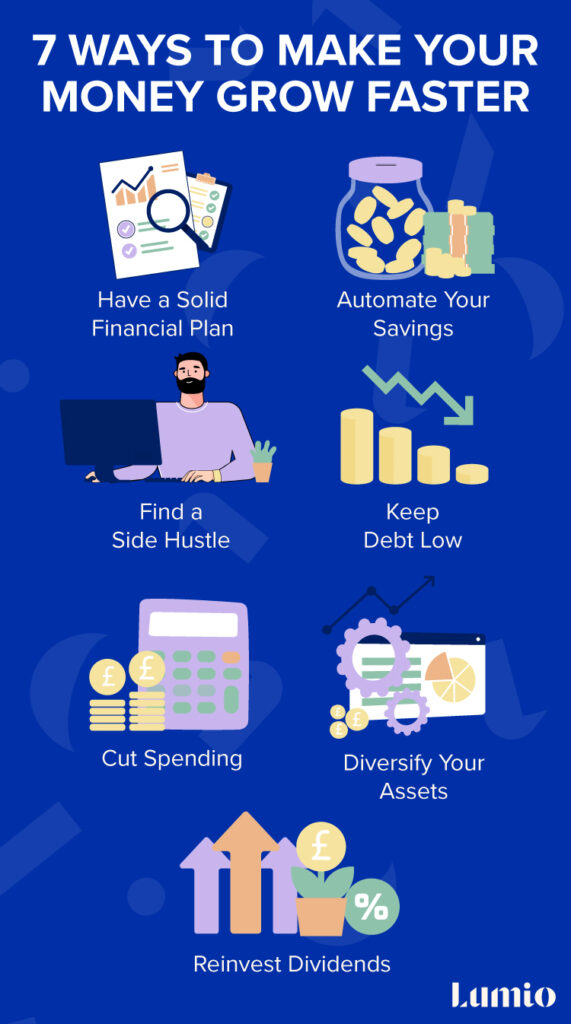
“Don’t put all your eggs in one basket” is a timeless investing adage. Diversification involves spreading your investments across various asset classes, industries, and geographies to minimize risk. If one investment performs poorly, others may perform well, balancing out your overall returns. A diversified portfolio might include a mix of stocks, bonds, real estate, and potentially alternative assets, tailored to your risk tolerance and time horizon.
Long-Term vs. Short-Term Investments
Investment strategies generally fall into two categories:
- Long-Term Investments: These are held for several years, often decades, aiming to benefit from compound interest and market growth. Examples include retirement accounts (401k, IRA), index funds, and quality growth stocks. They typically involve higher risk but also higher potential returns over time.
- Short-Term Investments: These are held for less than a year, often focused on quick gains or preserving capital. Examples include high-yield savings accounts, certificates of deposit (CDs), and money market accounts. They typically offer lower returns but also lower risk and higher liquidity.
Your goals will dictate the appropriate mix of short- and long-term allocations.
Understanding Investment Vehicles
- Stocks: Represent ownership shares in a company. Investors profit through capital appreciation (when the stock price increases) or dividends (a share of company profits).
- Bonds: Essentially loans made to governments or corporations. Investors receive regular interest payments and the return of their principal at maturity. Bonds are generally considered less volatile than stocks.
- Real Estate: Can generate income through rental payments or capital appreciation from property value increases. This can be direct ownership or indirect via Real Estate Investment Trusts (REITs).
- ETFs (Exchange-Traded Funds): Baskets of securities (like stocks or bonds) that trade on exchanges like individual stocks. They offer diversification and often lower fees than actively managed mutual funds.
- Mutual Funds: Professionally managed portfolios of stocks, bonds, or other investments. Investors buy shares in the fund, and fund managers make investment decisions.
- Certificates of Deposit (CDs): Savings accounts that hold a fixed amount of money for a fixed period, and in exchange, the issuing bank pays interest. They offer guaranteed returns but lock up funds.
The Magic of Compound Interest
Compound interest is often referred to as the eighth wonder of the world. It’s the interest earned on both the initial principal and the accumulated interest from previous periods. Over long periods, even small, consistent investments can grow exponentially due to compounding. The earlier you start investing, the more powerfully compound interest works in your favor.
Leveraging Your Assets: Active Income Generation

Beyond the passive growth of strategic investing, certain assets can be leveraged to generate more active or semi-active income streams. These methods often require more direct involvement but can provide more immediate and substantial cash flow.
Real Estate Investments: Rental Properties & REITs
Directly owning rental properties can be a lucrative way to make money with your money. Rent payments provide a steady income stream, and the property itself can appreciate over time. However, it requires capital, management effort, and understanding of local markets. Alternatively, Real Estate Investment Trusts (REITs) allow investors to pool money to buy, manage, or finance income-producing real estate without the complexities of direct ownership. REITs often pay high dividends.
Dividend Stocks and Income Funds
Investing in companies that regularly pay dividends is a strategy focused on generating recurring income. Dividends are portions of a company’s profits distributed to shareholders. Reinvesting these dividends can significantly accelerate wealth accumulation through compounding. Income funds, such as bond funds or certain types of ETFs, also focus on generating regular income for investors.
Peer-to-Peer Lending
Peer-to-peer (P2P) lending platforms connect individual investors directly with borrowers. As an investor, you can lend small amounts to various individuals or businesses, earning interest on these loans. While potentially offering higher returns than traditional savings accounts, P2P lending carries higher risk due to the possibility of borrower defaults. Diversifying across many loans is crucial.
High-Yield Savings Accounts and CDs
While not generating “active” income in the traditional sense, placing your money in high-yield savings accounts or Certificates of Deposit (CDs) is a low-risk way to earn more interest than conventional bank accounts. These options are ideal for emergency funds or money you need to access relatively soon but still want to grow slightly. The “yield” is the money your money makes for you, albeit modest compared to other investments.
Beyond Traditional: Exploring Alternative Income Streams
The financial landscape is constantly evolving, presenting new opportunities to make money with your money that go beyond conventional investments. These avenues often involve a blend of capital deployment and strategic engagement.
Investing in Yourself: Skills and Education
While not a direct financial instrument, investing in your own knowledge and skills is arguably the most impactful way to increase your earning potential. Taking courses, acquiring certifications, or pursuing higher education can lead to career advancement, higher salaries, or the ability to start a more profitable business or side hustle. This form of investment offers returns that compound over your entire career.
Fractional Ownership Opportunities
The rise of fintech has popularized fractional ownership, allowing individuals to invest in high-value assets that were once inaccessible. This includes art, collectibles, real estate, and even private equity funds. By owning a “fraction” of an asset, investors can participate in its appreciation or income generation without requiring the full capital outlay. Platforms facilitate these investments, opening doors to diverse portfolios.
Utilizing Digital Assets
The world of digital assets, including cryptocurrencies and NFTs (Non-Fungible Tokens), presents a highly speculative yet potentially lucrative avenue. Investing in established cryptocurrencies like Bitcoin or Ethereum, or participating in decentralized finance (DeFi) protocols, can offer significant returns but also comes with extreme volatility and risk. Understanding the underlying technology and market dynamics is paramount, and only capital you are prepared to lose should be allocated here.
Key Principles for Sustainable Financial Growth
Regardless of the specific strategies you employ, sustained financial growth hinges on adhering to fundamental principles that govern long-term wealth building.
Consistency and Patience
Building wealth is a marathon, not a sprint. Consistency in saving, investing, and adhering to your financial plan, coupled with the patience to let your investments mature and compound, is far more effective than chasing short-term gains or reacting impulsively to market fluctuations. Regular contributions, even small ones, over decades significantly outperform sporadic, larger investments.
Continuous Learning and Adaptation
The financial world is dynamic. Market conditions change, new investment vehicles emerge, and economic landscapes shift. Commit to continuous learning about personal finance, investing, and economic trends. Read reputable financial news, books, and engage with educational resources. Be prepared to adapt your strategies and portfolio as your life circumstances change and as new opportunities or risks present themselves.
Seeking Professional Guidance
While self-education is crucial, there are times when professional guidance is invaluable. A qualified financial advisor can help you clarify your goals, create a personalized investment plan, optimize your tax strategies, and navigate complex financial decisions. They can provide an objective perspective and ensure your plan is aligned with your long-term aspirations, especially as your financial situation becomes more complex. The fee for such advice is often an investment in itself, yielding returns through better decision-making and optimized wealth management.
Making money with your money is an empowering journey that combines discipline, knowledge, and strategic action. By building a solid financial foundation, embracing smart investing, and exploring diverse income streams, you can cultivate a financial future where your capital works tirelessly to support your goals and secure your prosperity.
aViewFromTheCave is a participant in the Amazon Services LLC Associates Program, an affiliate advertising program designed to provide a means for sites to earn advertising fees by advertising and linking to Amazon.com. Amazon, the Amazon logo, AmazonSupply, and the AmazonSupply logo are trademarks of Amazon.com, Inc. or its affiliates. As an Amazon Associate we earn affiliate commissions from qualifying purchases.