
Tesla, Inc. (TSLA) has been a phenomenon in the stock market, transcending its origins as an electric vehicle manufacturer to become a symbol of innovation, disruption, and at times, extreme market speculation. Its journey on public exchanges has been marked by staggering growth, dramatic volatility, and unparalleled investor interest. For many investors, both seasoned and novice, understanding the trajectory of TSLA’s stock, particularly its highest valuation, offers crucial insights into the dynamics of growth investing and the forces that drive market capitalization.
The Unprecedented Rise of Tesla Stock
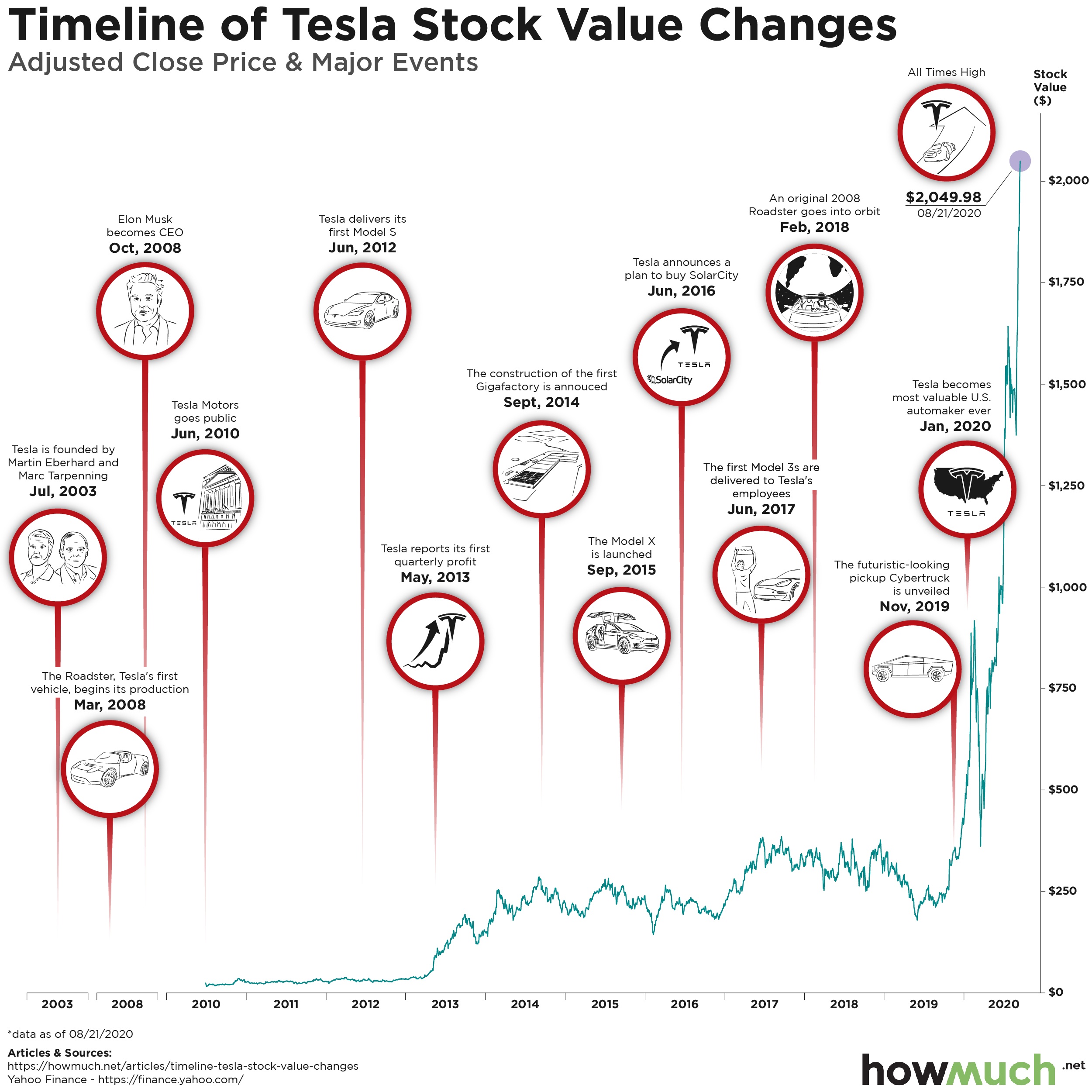
Tesla’s ascent to becoming one of the world’s most valuable companies is a story deeply intertwined with technological innovation, an charismatic leader, and a shifting global paradigm towards sustainable energy. When it went public in June 2010 at an IPO price of $17.00 per share (or $3.40 adjusted for subsequent stock splits), few could have predicted the dizzying heights it would achieve.

From Niche EV Maker to Market Darling
Initially dismissed by many traditional automotive analysts, Tesla systematically defied expectations. Its early models, the Roadster and later the Model S, demonstrated that electric vehicles could be not just practical, but desirable and high-performance. This foundational success laid the groundwork for mainstream adoption, challenging the conventional wisdom that legacy automakers would dominate the electric transition. Investor sentiment began to shift from skepticism to cautious optimism, then to fervent belief as the company scaled production, expanded its Gigafactories, and launched increasingly popular models like the Model 3 and Model Y.
Key Growth Catalysts in the Early Years
Several factors fueled Tesla’s initial and sustained growth. Technological superiority in battery technology, range, and software (including its advanced driver-assistance system, Autopilot) set it apart. The company’s direct-to-consumer sales model, eschewing traditional dealerships, resonated with a new generation of buyers. Crucially, CEO Elon Musk’s visionary leadership and willingness to challenge norms created an unparalleled brand mystique, attracting a passionate retail investor base that saw TSLA not just as a stock, but as an investment in a future vision. Regulatory tailwinds, such as government incentives for EV purchases and stricter emissions standards, also played a significant role, providing a favorable operating environment.
Deconstructing TSLA’s All-Time High
Pinpointing Tesla’s “highest stock price” requires careful consideration, primarily due to the company’s two significant stock splits. These events adjust the share price and the number of shares outstanding, fundamentally altering how historical prices are interpreted for current comparative purposes.
Identifying the Peak (Pre and Post-Split Analysis)
Tesla’s stock underwent a 5-for-1 stock split in August 2020 and a 3-for-1 stock split in August 2022. These splits meant that for every share an investor held, they received additional shares, while the price per share was proportionally reduced. The total value of their investment remained the same, but the share count and individual share price changed.
On an unadjusted basis, meaning the raw trading price before accounting for any splits, Tesla’s highest stock price was approximately $1,243.49 per share. This peak was reached during intraday trading on November 4, 2021. At this point, the company’s market capitalization briefly soared to over $1.2 trillion, solidifying its position among the world’s most valuable public entities.
However, for investors analyzing performance today, or comparing past prices to current ones on a consistent basis, it is often more useful to look at split-adjusted prices. If one were to adjust this peak price for both the 2020 and 2022 splits, the equivalent price for a single share of the current outstanding stock would be significantly lower, roughly in the range of $80-$90, depending on the exact calculation and closing prices of the split dates. It’s vital for investors to understand this distinction: the raw peak reflects the highest nominal value a single share ever traded at, while the split-adjusted peak contextualizes that value against the current share structure.
The Market Conditions at its Zenith
The period leading up to and including Tesla’s November 2021 peak was characterized by a confluence of unique market conditions. The global economy was emerging from the initial shock of the COVID-19 pandemic, leading to unprecedented fiscal and monetary stimulus. Interest rates were at historic lows, making growth stocks, which promise future earnings over immediate profits, particularly attractive.
There was also a significant surge in retail investor participation, often fueled by easy access to trading platforms and social media discussions. Tesla, with its high-profile leader and disruptive narrative, became a favorite among these investors. Furthermore, institutional investors, initially hesitant, began to allocate significant capital to TSLA as its production capabilities matured and its profitability became more consistent. The global push for decarbonization and the acceleration of EV adoption provided a strong narrative tailwind, suggesting a massive addressable market for Tesla’s products.
The Multi-Faceted Drivers Behind Tesla’s Valuation
Tesla’s valuation at its peak was not just a speculative bubble; it was the culmination of fundamental business strength, strategic vision, and powerful market dynamics.
Innovation, Production, and Deliveries
At its core, Tesla’s valuation was driven by its ability to innovate and execute. The company consistently pushed the boundaries of battery technology, electric powertrain efficiency, and software integration. More importantly, it demonstrated an ability to scale production rapidly, a challenge that had plagued many startups. Record-breaking delivery numbers, quarter after quarter, provided tangible evidence of its growing market share and operational efficiency. The expansion of Gigafactories across continents signaled a long-term commitment to global dominance in EV manufacturing.
The Elon Musk Effect and Brand Appeal
Elon Musk’s personality and vision have been inextricably linked to Tesla’s brand and stock performance. His audacious goals, frequent pronouncements, and direct communication with the public via social media created a unique connection with investors and consumers alike. This “Musk premium” contributed significantly to the stock’s elevated valuation, as investors often factored in his ability to inspire innovation and overcome seemingly insurmountable challenges. The brand itself transcended automobiles, becoming a symbol of cutting-edge technology and environmental responsibility, attracting a loyal customer base and a fervent investor following.
Global EV Adoption and Regulatory Support
The mid-2020s marked a critical inflection point for electric vehicles. Governments worldwide began to implement aggressive policies to phase out internal combustion engines, offering incentives for EV purchases and investing in charging infrastructure. This created a powerful macroeconomic tailwind for Tesla, positioning it as the undisputed leader in a rapidly expanding market. Investors projected massive future revenues and profits based on the accelerating global shift towards electrification, seeing Tesla as the prime beneficiary of this generational transition.
Retail Investor Enthusiasm and Institutional Conviction
Tesla’s stock became a darling of retail investors, often characterized by strong conviction and a willingness to hold through volatility. This enthusiasm, amplified by online forums and social media, created a self-reinforcing buying pressure. Simultaneously, as Tesla demonstrated consistent profitability and increasing free cash flow, institutional investors, including large mutual funds and hedge funds, increased their positions. Their growing conviction signaled broader market acceptance and provided substantial capital inflows, further pushing the stock price to new highs.
Navigating Volatility: Lessons from Tesla’s Journey
While Tesla’s peak stock price represents a moment of triumph, its journey has been anything but smooth, characterized by significant drawdowns and recoveries. This volatility offers important lessons for investors.
The Nature of Growth Stock Investments
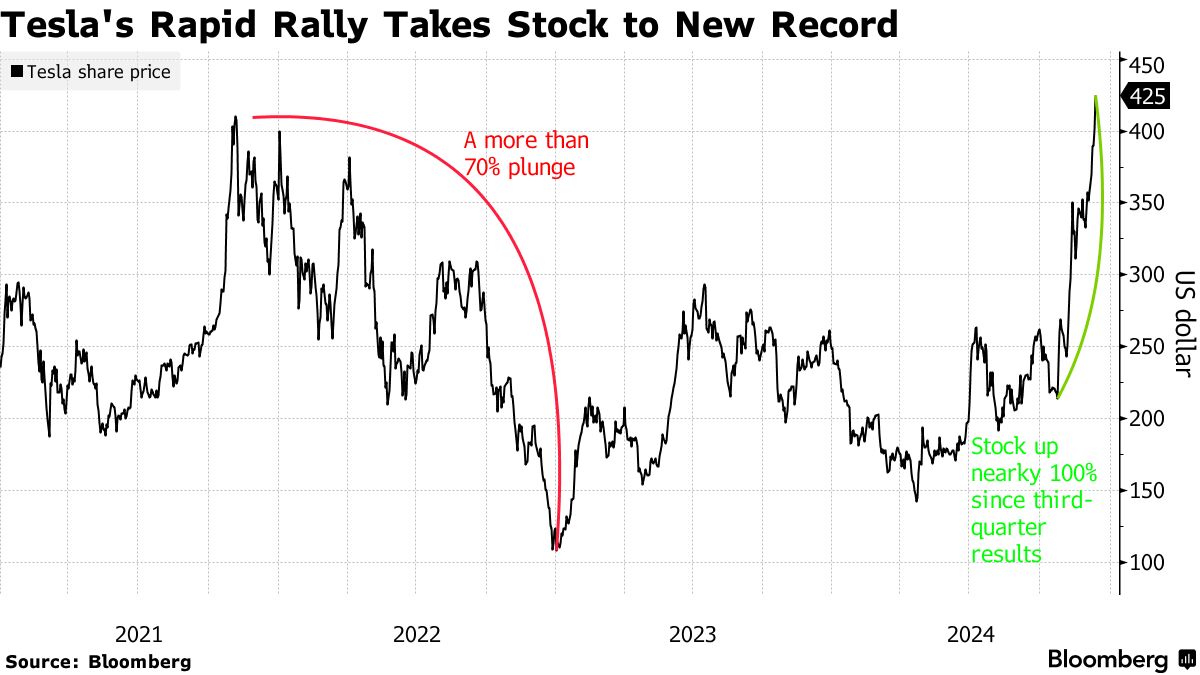
Tesla exemplifies the double-edged sword of investing in high-growth companies. Such stocks often trade at high valuations relative to current earnings, with their prices largely dependent on future growth expectations. When these expectations are met or exceeded, the rewards can be exponential. However, any perceived stumble, competitive threat, or shift in broader market sentiment can lead to sharp corrections. Tesla has experienced multiple significant pullbacks from its highs, demonstrating that even industry leaders are not immune to market forces.
Understanding Risk and Reward in High-Flying Assets
The story of Tesla’s stock is a powerful reminder that higher potential returns often come with higher risk. Investors who bought TSLA at its peak, or during previous highs, have experienced substantial paper losses during corrections. Conversely, long-term holders who bought at much lower prices have seen extraordinary returns. This underscores the importance of a robust investment thesis, understanding one’s risk tolerance, and avoiding emotional decision-making when dealing with volatile assets. Diversification remains a critical strategy to mitigate the impact of any single stock’s performance on an overall portfolio.
Long-Term Perspective vs. Short-Term Speculation
Tesla’s journey underscores the difference between long-term investing and short-term speculation. While day traders and short-term speculators may have tried to profit from its daily swings, the truly life-changing returns have historically been realized by those with a long-term vision, who believed in the company’s fundamental mission and were willing to weather the inevitable market storms. The peak price serves as a historical marker, but for most investors, the more significant takeaway is the company’s sustained ability to create value over years, rather than just a single point in time. The Tesla narrative reminds us that truly disruptive companies often follow a volatile path, where patience and conviction are as important as market timing.
aViewFromTheCave is a participant in the Amazon Services LLC Associates Program, an affiliate advertising program designed to provide a means for sites to earn advertising fees by advertising and linking to Amazon.com. Amazon, the Amazon logo, AmazonSupply, and the AmazonSupply logo are trademarks of Amazon.com, Inc. or its affiliates. As an Amazon Associate we earn affiliate commissions from qualifying purchases.