
Nvidia, once the darling of the semiconductor world and an undisputed leader in AI computing, has experienced a rollercoaster ride in market sentiment. From its astronomical rise driven by insatiable demand for its GPUs in AI, gaming, and data centers, the question “how low will Nvidia go?” has become a pertinent one for investors, financial analysts, and market watchers alike. This inquiry is not merely about a stock price dip; it reflects a broader introspection into the sustainability of hyper-growth valuations, the impact of macroeconomic shifts, and the intensifying competitive landscape in the tech sector. Understanding Nvidia’s potential downside requires a deep dive into its unique market position, its financial underpinnings, and the array of external factors influencing its trajectory. For anyone invested in or considering Nvidia, a meticulous financial lens is essential to parse through the hype and assess the real risks and opportunities.

Nvidia’s Meteoric Rise and the Undercurrents of Skepticism
Nvidia’s journey from a niche graphics card manufacturer to a trillion-dollar market cap company is a testament to its innovation and strategic foresight. However, such unprecedented growth naturally invites scrutiny, especially when market conditions become less favorable.
The AI Revolution and Nvidia’s Indispensable Role
The advent of the generative AI era, spearheaded by large language models like ChatGPT, catapulted Nvidia into an almost indispensable position. Its CUDA platform and specialized GPUs (Graphics Processing Units) became the de facto standard for training and deploying complex AI models. This unique ecosystem, built over decades, created a significant competitive moat, making it incredibly difficult for rivals to catch up. Data centers globally clamored for Nvidia’s H100 and A100 chips, leading to revenue surges that defied expectations and sent its stock soaring to record highs. Investors flocked to Nvidia, viewing it not just as a chipmaker, but as the foundational infrastructure provider for the future of artificial intelligence – a truly transformative technology. The narrative was powerful: investing in Nvidia was investing in the very fabric of the coming AI-driven world. This belief justified, for many, a premium valuation that few other companies could command.
Shifting Market Dynamics and Valuation Debates
However, the rapid ascent also fueled concerns about market frothiness and the sustainability of its growth rate. As interest rates climbed and global economic uncertainties loomed, investors began to scrutinize high-multiple growth stocks more critically. The sheer scale of Nvidia’s valuation meant that even minor shifts in sentiment or slight decelerations in growth could have a magnified impact on its stock price. Analysts began to question if the current demand, while robust, was pulling forward future sales, potentially leading to a “digestion” period. Furthermore, the concentration of demand within a relatively small number of hyperscale cloud providers and AI companies presented its own set of risks. If these key customers were to slow down their spending or diversify their hardware suppliers, Nvidia’s revenue projections could face significant pressure. This shift in market dynamics prompted a re-evaluation, moving from pure exuberance to a more cautious and analytical stance, laying the groundwork for the “how low will it go?” question.
Unpacking Valuation: Is Nvidia Truly Overvalued?
One of the central debates surrounding Nvidia revolves around its valuation. Is its current market capitalization justified by its earnings potential and growth trajectory, or has it entered the realm of speculative excess?
Traditional Metrics vs. Growth Premiums
When examining Nvidia through the lens of traditional valuation metrics, such as Price-to-Earnings (P/E) ratios or Enterprise Value-to-EBITDA, the stock often appears exceptionally expensive relative to the broader market or even its semiconductor peers. Historically, Nvidia has commanded a premium, but its P/E ratios have often stretched into triple digits during periods of peak enthusiasm. For value investors, such metrics trigger alarm bells, suggesting an unsustainable valuation.
However, growth investors argue that traditional metrics fail to capture the exponential growth potential and disruptive impact of Nvidia’s technology in a rapidly expanding market like AI. They contend that a “growth premium” is warranted, given the company’s dominant market share, technological leadership, and the vast addressable market for AI infrastructure. The focus shifts from current earnings to future earnings, with discounted cash flow (DCF) models attempting to project profits far into the future, often making optimistic assumptions about market expansion and sustained dominance. The question then becomes how much growth is already priced in, and what magnitude of future growth is required to justify the current stock price.
The Challenge of Forecasting Future Earnings
Accurately forecasting Nvidia’s future earnings is an inherently complex task. The AI industry, while promising, is still nascent and evolving at a breakneck pace. Demand for AI accelerators could continue to surge, or it could moderate as the market matures, or as competition intensifies. Supply chain dynamics, geopolitical events, and regulatory changes can all introduce significant variability into revenue and profit projections. Moreover, the capital expenditure cycles of hyperscale cloud providers, Nvidia’s largest customers, are notoriously lumpy. A strong quarter could be followed by a period of inventory adjustment or reduced spending, making quarter-over-quarter growth difficult to predict and sustain at extreme levels. Any deviation from aggressive growth forecasts can lead to sharp downward revisions in analyst estimates and subsequent stock price corrections, as the market re-calibrates its expectations for future earnings.
Lessons from Past Tech Bubbles
The high-flying valuations of companies like Nvidia inevitably draw comparisons to past tech bubbles, particularly the dot-com era. While Nvidia is a profitable company with tangible products and significant revenue, unlike many speculative internet companies of the late 90s, the speed and magnitude of its ascent raise cautionary flags. During bubble periods, investor psychology often prioritizes “story stocks” and future potential over current fundamentals, leading to valuations that are divorced from realistic earnings potential. The crucial lesson from history is that even fundamentally strong companies can experience significant drawdowns if their valuations get stretched too far, and market sentiment shifts. While Nvidia’s underlying technology and market position are robust, the stock’s performance is also a reflection of investor perception and the broader market’s appetite for risk. A contraction in market multiples, even if earnings continue to grow, could lead to a substantial decrease in share price, illustrating that even a strong company can be a poor investment if bought at too high a price.
Navigating the Downside Risks and Headwinds
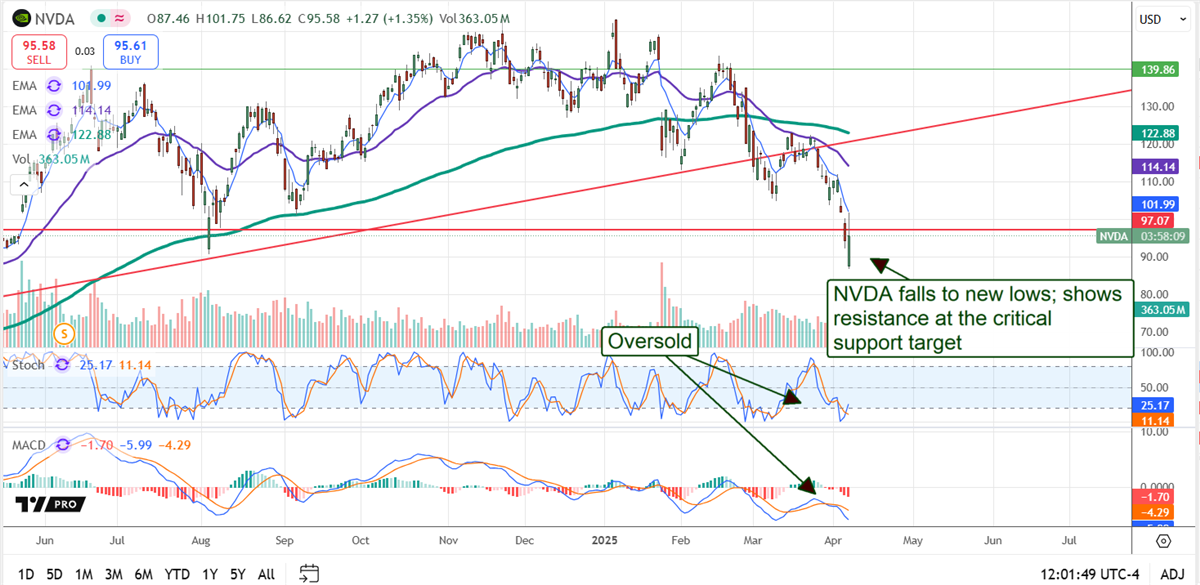
Even with its formidable strengths, Nvidia faces a multitude of risks that could contribute to its stock experiencing further declines. Understanding these headwinds is crucial for assessing how low the stock might ultimately go.
Intensifying Competition in AI Hardware
While Nvidia currently holds a commanding lead in AI accelerators, the competitive landscape is rapidly evolving. Traditional rivals like AMD and Intel are aggressively developing their own GPU and specialized AI chip architectures. AMD, with its MI300 series, is positioning itself as a credible alternative, offering compelling performance-per-dollar. Intel is also investing heavily in its Gaudi accelerators and custom AI chips. Furthermore, major hyperscale cloud providers (e.g., Google with TPUs, Amazon with Trainium/Inferentia, Microsoft with Maia 100) are increasingly designing their own custom AI silicon. This “in-housing” trend poses a long-term threat to Nvidia’s market share, as these large customers seek to reduce reliance on a single vendor, optimize for their specific workloads, and control costs. Should these competitors gain significant traction, it could erode Nvidia’s pricing power and market dominance, directly impacting its revenue growth and profit margins.
Macroeconomic Pressures and Interest Rate Impacts
The broader macroeconomic environment plays a significant role in determining investor appetite for high-growth tech stocks. Elevated inflation, rising interest rates, and the specter of a global economic slowdown can dampen corporate spending on IT infrastructure, including AI hardware. Higher interest rates also increase the cost of capital for businesses, making it more expensive to finance large-scale AI projects or data center expansions. Furthermore, higher discount rates, used in valuation models, naturally lead to lower present values for future earnings, disproportionately affecting stocks with long-duration growth narratives like Nvidia. In an environment where capital is more expensive and economic outlook is uncertain, investors typically rotate out of speculative growth assets and into more stable, dividend-paying, or value-oriented stocks, putting downward pressure on Nvidia’s valuation multiple.
Geopolitical Risks and Supply Chain Fragility
Nvidia’s intricate global supply chain, heavily reliant on advanced manufacturing capabilities in Asia (particularly TSMC in Taiwan), exposes it to significant geopolitical risks. Tensions between major global powers, trade disputes, or regional conflicts could disrupt chip production, lead to export restrictions, or impact access to critical markets. The U.S. government’s restrictions on advanced chip exports to China, for instance, have already forced Nvidia to create modified, less powerful versions of its AI chips for the Chinese market, impacting its revenue potential in a key growth region. Any escalation of these tensions could severely impede Nvidia’s ability to produce or sell its most advanced chips, resulting in significant financial setbacks and uncertainty.
Regulatory Scrutiny and Market Saturation
As Nvidia’s influence grows, so does the likelihood of increased regulatory scrutiny, particularly concerning anti-trust and market dominance. Governments worldwide are becoming more vigilant about monopolistic practices in critical technology sectors. Any regulatory action, such as forced divestitures or restrictions on market practices, could hinder Nvidia’s strategic flexibility and growth prospects. Additionally, while the AI market is vast, there are legitimate questions about potential saturation in certain segments. If the initial surge in AI infrastructure build-out normalizes or if the pace of AI adoption slows in specific industries, Nvidia could face challenges in maintaining its blistering growth rates, leading to a re-calibration of future earnings expectations.
Identifying Potential Support Levels and Future Trajectories for Investors
For investors seeking to understand “how low will Nvidia go,” identifying potential support levels and considering various future trajectories is key to informed decision-making.
Technical Indicators and Price Floors
From a technical analysis perspective, traders and quantitative analysts look for historical price levels where buying interest has previously emerged, creating “support floors.” Key moving averages (e.g., 50-day, 200-day) often act as dynamic support or resistance. Fibonacci retracement levels from previous highs can also indicate potential areas where a stock might find temporary stability during a downturn. Volume analysis can reveal conviction behind price movements; high volume on a downside could signal strong selling pressure, while declining volume on a dip might suggest a weakening bearish trend. However, technical analysis provides probabilities, not certainties, and extreme market conditions can see prices break through established support levels. The psychological impact of round numbers (e.g., $400, $300 per share) can also sometimes act as temporary support. Investors should combine technical insights with fundamental analysis for a holistic view.
Fundamental Revaluation: Growth Deceleration vs. Profitability
Ultimately, Nvidia’s long-term trajectory will be dictated by its fundamental performance. Even if growth decelerates from its hyper-scale rates, the company’s ability to maintain high profitability margins and generate significant free cash flow will be paramount. A shift in investor focus from pure top-line growth to sustainable profitability and efficient capital allocation could lead to a revaluation, where the market assigns a lower P/E multiple but values the stability of its earnings. Investors would be keen to see how Nvidia manages its operating expenses, its research and development investments to maintain its technological edge, and its ability to return capital to shareholders. If the company can demonstrate resilience in its profit margins even amidst increased competition or slower revenue growth, it might establish a new, more sustainable valuation floor based on its underlying financial health rather than purely speculative growth prospects.

Strategic Investor Playbook: Long-Term vs. Short-Term Approaches
For long-term investors, the “how low will it go” question might be less about pinpointing an exact bottom and more about identifying attractive entry points over time. Strategies like dollar-cost averaging, where one invests a fixed amount regularly regardless of price fluctuations, can mitigate the risk of buying at a peak. Long-term holders typically focus on Nvidia’s enduring competitive advantages, its leadership in AI, and its long-term growth runways, viewing short-term volatility as opportunities to accumulate shares at a discount.
In contrast, short-term traders or those with a higher risk tolerance might attempt to time market lows, utilizing technical indicators and market sentiment. However, this approach carries significantly higher risk. For all investors, establishing a clear risk management strategy, including position sizing and setting stop-loss orders if appropriate, is essential. Diversification across different asset classes and industries can also help cushion the impact of a significant downturn in a single stock like Nvidia.
In conclusion, the question of “how low will Nvidia go?” is multifaceted, intertwined with its innovative dominance, its stretching valuation, and a complex web of market and geopolitical risks. While no one can predict an exact bottom, a thorough understanding of these financial dynamics empowers investors to navigate the volatility with greater insight and strategic foresight. Nvidia remains a pivotal company in the technology landscape, but its financial journey will continue to demand a discerning and informed approach from the investment community.
aViewFromTheCave is a participant in the Amazon Services LLC Associates Program, an affiliate advertising program designed to provide a means for sites to earn advertising fees by advertising and linking to Amazon.com. Amazon, the Amazon logo, AmazonSupply, and the AmazonSupply logo are trademarks of Amazon.com, Inc. or its affiliates. As an Amazon Associate we earn affiliate commissions from qualifying purchases.