
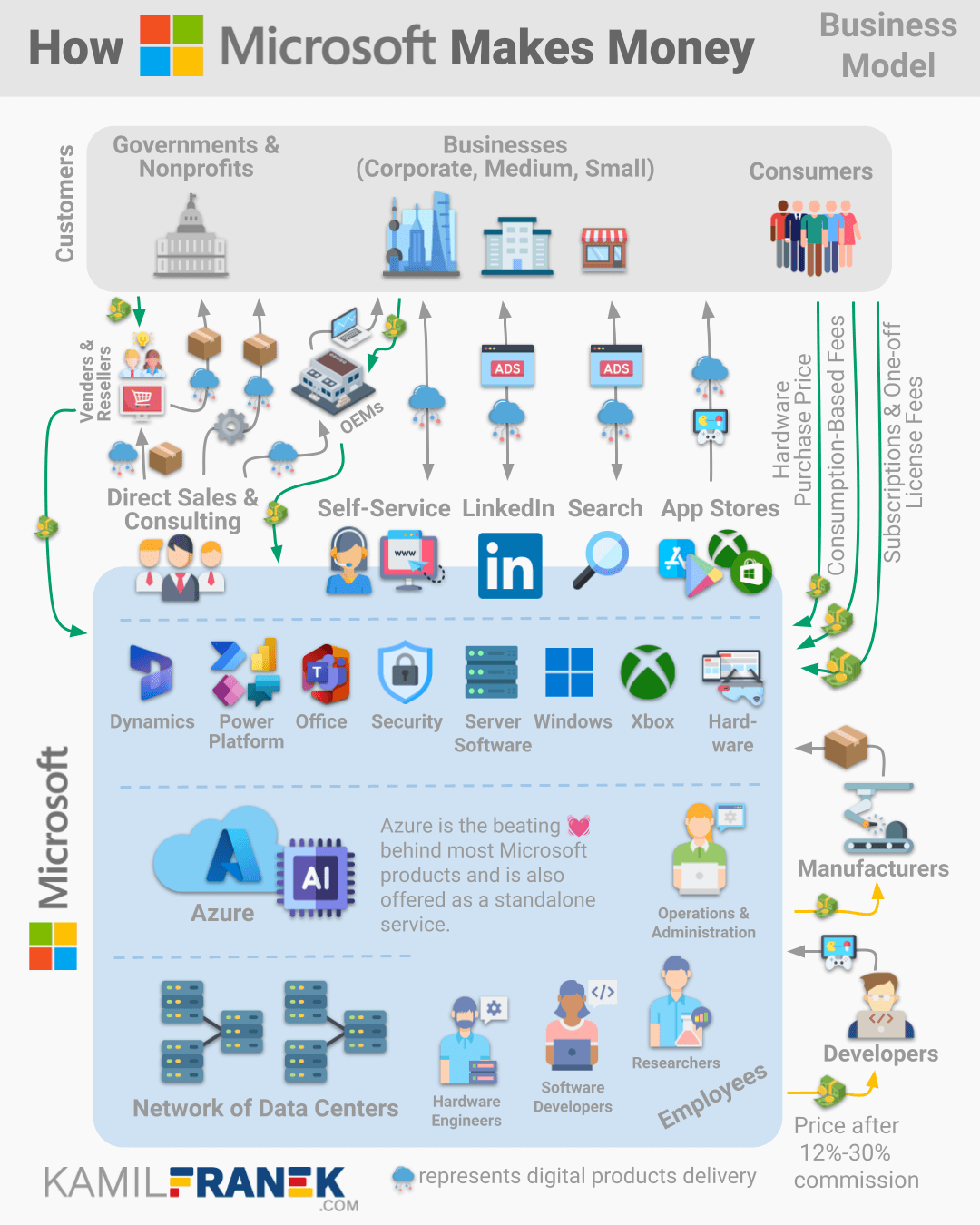
Microsoft Corporation stands as a colossus in the global technology landscape, a name synonymous with innovation, productivity, and the very fabric of the digital world. Far from being a company defined by a single product, Microsoft has evolved into a multifaceted tech giant whose influence permeates nearly every aspect of modern computing, from personal productivity and enterprise solutions to cloud infrastructure, artificial intelligence, and cutting-edge hardware. At its core, Microsoft designs, develops, manufactures, licenses, supports, and sells computer software, consumer electronics, personal computers, and related services, continuously pushing the boundaries of what technology can achieve for individuals, businesses, and entire industries worldwide.
Pioneering the Software Landscape
Microsoft’s foundational legacy is deeply rooted in software, a domain it has dominated and continuously reshaped since its inception. From operating systems that powered the PC revolution to productivity suites that became indispensable tools, Microsoft’s software offerings form the bedrock of countless digital experiences.
The Enduring Power of Windows
The cornerstone of Microsoft’s software empire is undoubtedly Windows, the operating system that brought graphical user interfaces to the masses and fundamentally transformed personal computing. Launched in the mid-1980s, Windows has undergone numerous iterations, each building upon the last to offer greater stability, security, and user-friendliness. From Windows 95’s cultural impact to Windows XP’s widespread adoption and the modern, feature-rich Windows 10 and 11, it remains the most widely used desktop operating system globally. Its prevalence means that millions of developers create applications specifically for the Windows ecosystem, ensuring a vibrant and continuously evolving software environment. Beyond consumer PCs, Windows Server continues to power critical enterprise infrastructure, providing robust and scalable solutions for businesses of all sizes, from small local networks to sprawling data centers.
Revolutionizing Productivity with Microsoft Office
Before the cloud, there was Microsoft Office – a suite of productivity applications that became the industry standard for document creation, data analysis, and presentations. Programs like Word, Excel, PowerPoint, and Outlook are ingrained in professional and academic life, enabling unprecedented levels of efficiency and organization. With the advent of cloud computing, Office evolved into Microsoft 365 (formerly Office 365), transforming from a perpetual license model to a subscription service. This shift brought not only continuous updates and new features but also robust cloud integration, real-time collaboration capabilities, and access across multiple devices and platforms. Tools like Teams have become central to modern workplace communication and collaboration, facilitating remote work and connecting teams across geographical boundaries. Microsoft 365 represents a comprehensive ecosystem designed to enhance individual and organizational productivity through intelligent tools and seamless connectivity.
Enterprise Software and Business Solutions
Beyond consumer and general productivity software, Microsoft provides an extensive portfolio of enterprise-grade software solutions tailored to meet the complex demands of businesses. Dynamics 365, for instance, integrates ERP (Enterprise Resource Planning) and CRM (Customer Relationship Management) functionalities, offering a suite of intelligent business applications that help organizations manage sales, customer service, field service, finance, and operations. Furthermore, Microsoft’s developer tools, most notably Visual Studio, provide a powerful integrated development environment (IDE) for building applications across various platforms, including Windows, web, and mobile. These tools empower millions of developers worldwide to create innovative software, reinforcing Microsoft’s position as a critical enabler of technological advancement across industries.
Shaping the Future of Cloud Computing
The 21st century has seen a seismic shift in computing paradigms, with the cloud emerging as the new frontier. Microsoft recognized this trend early and has invested massively in building Azure, one of the world’s leading cloud computing platforms, profoundly altering how businesses operate and innovate.
Azure: A Comprehensive Cloud Platform
Azure is Microsoft’s public cloud computing platform, offering an expansive array of services that encompass everything from basic compute and storage to highly advanced artificial intelligence and machine learning capabilities. It provides Infrastructure-as-a-Service (IaaS), Platform-as-a-Service (PaaS), and Software-as-a-Service (SaaS) options, allowing businesses and developers to host, build, deploy, and manage applications and services through a global network of Microsoft-managed data centers. Customers can leverage Azure for virtual machines, databases, networking, analytics, IoT (Internet of Things) solutions, and much more, all designed for scalability, reliability, and security. Azure’s versatility makes it a critical platform for enterprises looking to migrate existing infrastructure, develop cloud-native applications, or harness advanced technologies without the need for significant upfront hardware investment.
Empowering Hybrid and Edge Computing
Understanding that not all workloads can or should reside solely in the public cloud, Microsoft has championed hybrid cloud solutions. Azure Stack, for example, extends Azure services and capabilities to on-premises environments, allowing organizations to maintain consistency between their local data centers and the public cloud. This approach provides flexibility, enables compliance with specific data residency requirements, and optimizes performance for latency-sensitive applications. Furthermore, Microsoft is heavily invested in edge computing, bringing computational power closer to the data source. This is crucial for IoT devices, real-time analytics, and applications where immediate processing is essential, such as in autonomous vehicles or smart factories. By integrating cloud services with on-premises and edge capabilities, Microsoft offers a comprehensive and adaptable cloud strategy for the modern enterprise.
Innovating Across Hardware and Entertainment
While primarily known for software, Microsoft has also made significant strides in hardware, both in personal computing and the entertainment sector, demonstrating its commitment to delivering end-to-end user experiences.
The Surface Line: Blending Innovation and Design
The Surface line of devices represents Microsoft’s vision for premium computing hardware. Beginning with the Surface RT in 2012, the family has expanded to include a diverse range of innovative devices, such as the Surface Pro (a versatile tablet-laptop hybrid), Surface Laptop (traditional clamshell laptops), Surface Studio (an all-in-one desktop for creators), and Surface Go (a more affordable, portable option). These devices are designed to showcase the full potential of Windows, often featuring high-resolution touchscreens, pen input, and high-quality build materials. The Surface line’s success lies in its ability to combine sleek design with powerful performance, often blurring the lines between different device categories and setting trends in the PC industry.
Xbox: A Global Gaming Phenomenon
In the realm of entertainment, Microsoft’s Xbox division has carved out a dominant position in the video game industry. Launched in 2001, Xbox consoles have competed fiercely with rivals, evolving through multiple generations, including the Xbox 360, Xbox One, and the current Xbox Series X and S. Beyond the hardware, Xbox has built a robust ecosystem comprising the Xbox Live online service for multiplayer gaming and digital content, and the hugely popular Xbox Game Pass, a subscription service offering access to a vast library of games. Microsoft’s strategic acquisitions, notably Bethesda Softworks and the ongoing acquisition of Activision Blizzard, signal a massive commitment to expanding its first-party game content and further cementing its position as a major player in gaming, including a strong push into cloud gaming with Xbox Cloud Gaming.
Mixed Reality with HoloLens
Microsoft is also at the forefront of mixed reality (MR) technology with its HoloLens devices. HoloLens are untethered, holographic computers that blend digital content with the physical world, creating immersive and interactive experiences. While not a consumer product in the vein of Xbox, HoloLens has found significant application in enterprise and industrial settings, assisting with remote assistance, training, design, and complex operations. From surgeons practicing procedures to engineers designing new products, HoloLens offers a transformative way to interact with information and reality, pointing towards a future where digital and physical worlds seamlessly converge.
Driving Intelligence with AI and Advanced Technologies
Artificial Intelligence (AI) is no longer a futuristic concept but an integral component of Microsoft’s strategy, permeating almost every product and service the company offers, alongside other cutting-edge research and development.
AI Everywhere: From Office to Azure
Microsoft’s commitment to AI is evident across its entire portfolio. AI-powered features enhance productivity in Microsoft 365, with intelligent suggestions in Word, predictive analytics in Excel, and smart scheduling in Outlook. Microsoft Copilot, an AI-powered assistant, integrates across various Microsoft products, offering intelligent assistance for tasks ranging from drafting emails to summarizing meetings. On the Azure platform, developers have access to a rich suite of AI and Machine Learning (ML) services, including cognitive services for vision, speech, language, and decision-making, allowing them to easily embed intelligent capabilities into their own applications. Microsoft is also a leading proponent of responsible AI development, focusing on fairness, accountability, and transparency in its AI research and deployment.
Advancing Research and Development
Microsoft Research (MSR) is one of the world’s premier computer science research organizations, employing thousands of scientists and engineers globally. MSR conducts fundamental and applied research across a vast spectrum of fields, including AI, quantum computing, human-computer interaction, privacy, and security. Breakthroughs from MSR often find their way into Microsoft products, driving long-term innovation. For instance, Microsoft is heavily invested in quantum computing, exploring its potential to solve problems currently intractable for classical computers, from drug discovery to materials science. This long-term, high-risk research is crucial for shaping the next generation of computing paradigms.
Digital Security and Trust
In an increasingly interconnected world, digital security is paramount, and Microsoft dedicates significant resources to protecting its users and data. The company provides a comprehensive suite of security solutions, including identity and access management (Azure Active Directory), threat protection across endpoints, cloud, and email (Microsoft Defender suite), and information protection. Microsoft invests billions annually in cybersecurity research and development, operating a vast global network of security experts and intelligence. This focus ensures that its platforms and services are resilient against evolving cyber threats, building trust and safeguarding critical data for individuals and enterprises alike.
Microsoft’s Vision for an Inclusive Digital World
Beyond technological prowess, Microsoft is increasingly focused on how its technology can foster a more inclusive, accessible, and sustainable future, reflecting a broader corporate responsibility.
Accessibility and Inclusivity in Design
A core tenet of Microsoft’s product development philosophy is accessibility. The company strives to ensure its products and services are usable by everyone, regardless of ability. This includes building accessibility features directly into Windows and Microsoft 365, such as Narrator for screen reading, speech-to-text functionality, and tools for users with visual, auditory, or mobility impairments. Microsoft’s Inclusive Design principles guide its product teams to consider a wide range of human diversity from the outset, aiming to remove barriers and empower all users to achieve more.
Sustainable Technology Practices
Microsoft is committed to environmental sustainability, setting ambitious goals to become carbon negative by 2030 and to remove all historical carbon emissions by 2050. This involves optimizing data center energy efficiency, investing in renewable energy sources, designing more sustainable hardware, and developing solutions that help customers reduce their own environmental impact. The company also focuses on water positive and zero-waste initiatives, actively working towards a circular economy for its products and operations.

Philanthropy and Community Engagement
Through Microsoft Philanthropies, the company contributes significantly to communities worldwide, focusing on digital skills training, affordable access to technology, and supporting non-profit organizations. Initiatives include providing grants, software donations, and employee volunteering programs. Microsoft believes that technology should be a force for good, and its philanthropic efforts aim to bridge the digital divide, empower underserved communities, and foster positive social impact globally.
In essence, Microsoft is a dynamic technology company constantly adapting and expanding its reach. From the operating systems that power billions of devices to the cloud infrastructure that drives modern businesses, and from innovative hardware to the cutting edge of AI and mixed reality, Microsoft’s mission “to empower every person and every organization on the planet to achieve more” continues to define its vast and multifaceted endeavors in the digital age.
aViewFromTheCave is a participant in the Amazon Services LLC Associates Program, an affiliate advertising program designed to provide a means for sites to earn advertising fees by advertising and linking to Amazon.com. Amazon, the Amazon logo, AmazonSupply, and the AmazonSupply logo are trademarks of Amazon.com, Inc. or its affiliates. As an Amazon Associate we earn affiliate commissions from qualifying purchases.